


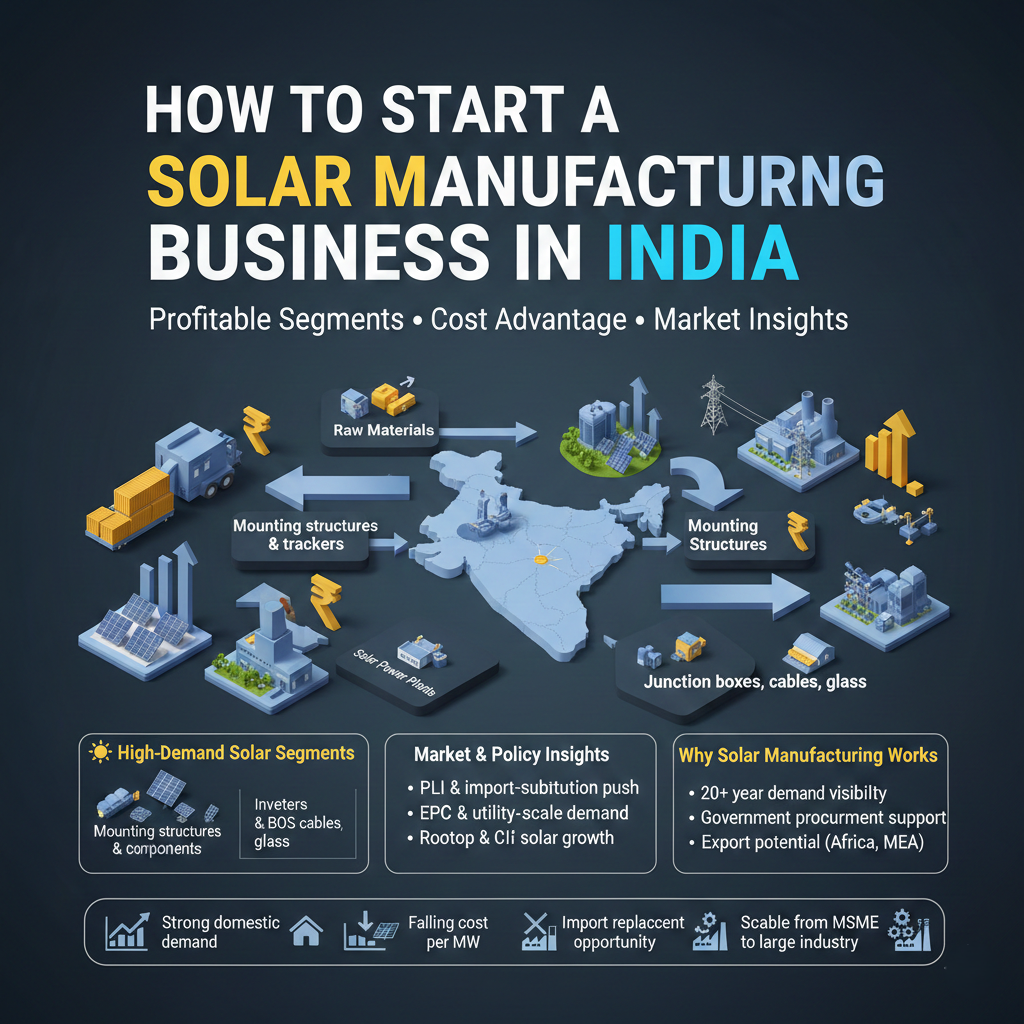
Solar panel manufacturing India is rapidly evolving from ambitious policy plans to full-scale industrial opportunities. What began as a demand for clean energy has now become a structured market with long-term growth, offering huge potential for entrepreneurs and industrial players. Today, solar manufacturing is not just about producing modules and panels — it’s about building sustainable businesses, capturing upstream supply chain opportunities, and tapping into export markets.
In this blog, we gain a deep understanding of the logic, potential for profits, and strategic insights for anyone considering venturing into India’s solar manufacturing sector.
Read More: Solar PV Power and Solar Products Handbook
The Shifting from Risk to Structured Opportunity
The Indian solar industry has undergone its most important development through its ability to forecast energy production. Current business operations can achieve their targets because utility-scale tenders and commercial rooftop adoption provide better visibility than previous subsidy-based investments which depended on uncertain market demand.
The three key engines of solar demand in India are:
1.Utility-Scale Projects – The manufacturing process requires solar module producers to create standardized solar modules which generates regular demand for their products.
2.Commercial & Industrial Rooftops – The segments focus on three main objectives which include achieving operational efficiency and maintaining product excellence and protecting customers through warranty services.
3.Export Markets – International markets now demand multiple supplier options who can provide products from sources other than existing manufacturing centers in China and South East Asia which creates new business possibilities for Indian manufacturers who want to enter premium markets.
The structured demand system enables businesses to create their capacity plans while they develop production procedures which they will use to expand their operations throughout the entire business operation.
Where India’s Solar Manufacturing Gaps Lie
Despite growth, India continues to import substantial volumes of solar cells, wafer, glass, EVA film, backsheet and inverter components. This gap constitutes a very obvious opportunity for entrepreneurs who are interested in upstream segments over the crowded full-module market.
Some high potential segments are:
- Solar Cells: High-margin, performance-based products have a good backward integration opportunity.
- Solar Glass: Although capital intensive, domestic glass manufacturing has the advantage of logistics and quality.
- EVA Films & Backsheets: The segments provide support to micro small and medium enterprises through their continuous demand which needs basic technological equipment to operate.
- Power Electronics & Inverter Sub-Assemblies: The engineering-focused startups will use their accurate solutions and compliance capabilities and their outstanding service delivery to win institutional clients.
Focusing on these upstream components, entrepreneurs can capture greater margins, reduce price competition and obtain long-term security.
Read More: Renewable Energy Sector, Green Power, Solar Energy, Biofuel, Hydroelectric, Wind, Geothermal, Biomass, Non-conventional Energy, New and Renewable Energy Projects
High Potential Manufacturing Opportunities
1. Solar Cell Manufacturing
Solar cells are the determining factor to the efficiency and pricing power of modules. While the investment is capital-intensive, successful manufactures benefit from:
- Industry knew what to say to the trade: “It’s protection from module price wars”.
- Strong export relevance
- Sustainable profit margins
Success relies on process control, yield optimization and strategic technology partnerships.
2. Solar Glass
Good glass is essential for each solar module. Domestic production is attractive because of:
- Reduced dependency on imports
- Logistical advantages
- Technically defensible barriers to entry
Though heavy industry, solar glass can deliver a long-lasting competitive advantage to manufacturers prepared to invest in quality and scale.
3. EVA Films & Backsheets
The modules depend on these consumables which serve as essential components for their operational reliability. The primary advantages that this product offers include:
- Recurring demand and predictable sales
- Lower capital requirements than full-module manufacturing
- Opportunities for formulation improvements to enhance margins
For MSME or first-generation entrepreneurs it is the best risk-reward ratio.
Read More: Investing in Solar PV Module Manufacturing: A Sustainable Opportunity for Startups
4. Power Electronics & Inverter Sub-Assemblies
Precision, compliance and quality of service characterize profitability here. Target repeat institutional buyers – rather than a competitive retail market. The establishment of small production facilities which maintain high standards of output will achieve excellent financial results through their commitment to product quality and reliable delivery.(Solar panel manufacturing India)

Lessons of Industrial Leaders
Successful Indian solar manufacturers implement three strategic approaches which lead to their business success. The three strategies include:
- Control of Critical Inputs Backward integration is ensuring quality and price stability.
- Disciplined Capacity Expansion: The process of scaling in phases prevents overcapacity and reduces financial strain.
- Organizations follow their motto which states “Execution over Opportunism.
- August 20, 2008 Capital: Timing Investment with Cycles of Technology and the Global Economy (1) Productive investments and capital allocations are most profitable when they are timed with the cycles of demand.
For first generation entrepreneurs, patience, operating discipline and strategic integration is more important than short term gain.
Read More: How to Start a Solar Panel Manufacturing Business
Patterns of Profitability and Risk Awareness
Margins in solar manufacturing are made through structure and not speculation. Major drivers of profitability are:
- Utility or industrial contracts (captive demand)
- Upstream integration (Cells, glass, films)
- Export-oriented sales
Common risks to manage:
- Technology Obsolescence: Continuous improvement is mandatory to stay competitive.
- Volatility of Prices: The prices of modules and raw materials which are subject to the global fluctuation.
- Working Capital Pressure: During expansion phases it is necessary to have a strong financial planning.
Feasibility studies, realistic capacity planning and detailed financial modelling are key to minimising these risks and ensuring sustainable operations.(Solar panel manufacturing India)
Read More: Solar Panel Manufacturing: 10 reasons why it is a game-changer for startups
The Function of Feasibility Thinking
A complete feasibility study is essential to long term success. Key elements include:
- Evaluating market demand before buying land and machinery
- Understanding the manufacturing processes, equipment choice and raw material sources
- Modeling finances in its entirety, including working capital stress tests
Disciplined feasibility thinking makes the difference between a long-term asset and a financial liability for a project.

Conclusion
India’s solar manufacturing tale has moved from ambition to industrial execution. Entrepreneurs who focus on upstream components, plan capacity intelligently and prioritize operation discipline are best positioned to succeed.(Solar panel manufacturing India)
The solar boom presents a once in a lifetime opportunity to set up asset-backed, export-ready and high margin businesses in one of the fastest growing industrial sectors in India. With structured demand, obvious supply chain gaps, and strategic execution, solar manufacturing in India is not just a green cause – it’s a lucrative industrial revolution waiting to be seized.
Frequently Asked Questions
Q1: Is solar manufacturing possible for first generation entrepreneurs?
Yes. Starting with component manufacture such as EVA films, backsheets or inverter assemblies reduce the risk and capital required.
Q2. Which segment breakeven the quickest?
EVA films, backsheets and select power electronics usually achieve breakeven at an earlier period due to lower CAPEX and recurring demand.
Q3: How important is export orientation?
Critical. Export sales stabilises the pricing and better utilisation of capacity and reduces the dependency on domestic tender cycles.
Q4: What is the biggest mistake new solar manufacturers make?
The financial model predicts scale-up growth through two incorrect assumptions which lead to incorrect projections about profit margins and essential operational funds.
Q5: When should you conduct feasibility studies?
Before finalizing land and machinery to be financially efficient and flexible.