


In India, SAP manufacturing is emerging as a lucrative opportunity for chemical entrepreneurs. However, in chemical manufacturing, demand alone does not guarantee success. Many first-generation founders assume that a strong market will automatically bring profits, but the reality is different. Success in SAP manufacturing India depends on feasibility mechanics—raw material economics, process stability, utilities, pollution control, working capital cycles, and the ability to deliver consistent quality into industrial value chains.
Super Absorbent Polymer (SAP) manufacturing is different in the sense that it is not speculative in terms of demand. It is anchored in everyday consumption, healthcare growth, aging demography, and rising water stress. More importantly, SAP is not dependent on the one industry. It is a platform material with so many end uses that makes it strategically attractive for disciplined entrepreneurs.
Read More: SUPER ABSORBENT POLYMERS – Manufacturing Plant, Detailed Project Report, Profile, Business Plan, Industry Trends, Market Research, Survey, Manufacturing Process, Machinery, Raw Materials, Feasibility Study, Investment Opportunities, Cost and Revenue
What Is Super Absorbent Polymer (SAP)?
Super Absorbent Polymer, which is based most commonly on Sodium Polyacrylate chemistry is a polymer that can absorb and retain water many times its own weight. Once absorbed, water is transformed into a stable gel and released slowly at the pressure of.
This single useful property has led to several industrial applications including:
- Baby diapers, feminine hygiene and adult incontinence products
- Medical dressings, wound care and absorbent pads
- Industrial Spill Control and Safety Products
- Agriculture and horticulture as soil water retention material
For entrepreneurs, this implies that SAP is not a one market chemical. A manufacturer can enter through one segment and gradually expand into others as quality approvals and credibility increases.
Market Outlook: Why SAP Demand Is Structural
The global SAP market is moving at expansion because of steady, long-term consumption and demographic trends and not short-term cycles. Hygiene awareness, healthcare expenditure, longevity and water scarcity caused by climate change are structural forces.
Industry estimates have it that the global SAP market is moving from a current value of approximately USD 9.7 billion to a value of USD 16.4 billion, with global demand for this projected at almost eight million metric tons over the next ten years.
This growth is strongly reflected in India. The domestic SAP market is growing at more than 8 percent CAGR, driven by hygiene penetration, high-end absorbent products and organised healthcare. At the same time, India continues to import a major portion of the SAP requirement. This gap between demand and domestic capacity makes SAP a good import substitution manufacturing opportunity.
Read More: A Business Plan For Super Absorbent Polymer (SAP)
Why SAP Manufacturing is Attractive – And Not Casual
SAP manufacturing is no joke, polymer business. It needs process discipline, quality control and scale. The attractiveness of SAP is based on three basic economic drivers:
- Scale economics, where unit costs fall greatly at higher capacities as utilities and fixed costs are spread over larger volumes
- Qualification driven demand, where once approved, customers do not frequently change SAP suppliers due to performance sensitivity
- Import substitution advantage, i.e., domestic producers providing shorter lead time, technical support and supply reliability
At the same time, risks are real. Off-spec production can easily tie up working capital, while inconsistent operations can cause buyer distrust. SAP rewards founders who respect operational discipline from day one.
Indicative Project Economics of Manufactory of SAP
A feasibility-based snapshot is useful for grounding expectations. For a SAP manufacturing plant with a capacity of approximately 40,000 metric tons per annum, typical project indicators are:
- Plant and machinery investment of about ₹94 crore
- Total project cost nearly close to Rs 137 crore
- Expected internal rate of return close to 26 percent
- Break-even point is around 42 percent capacity utilization
These figures make it obvious that SAP manufacturing is not a micro-enterprise. It is a capital intensive chemical project, in which returns become attractive if the plant is engineered properly and markets are developed in a systematic manner.
Read More: A Business Plan for Super Absorbent Polymer
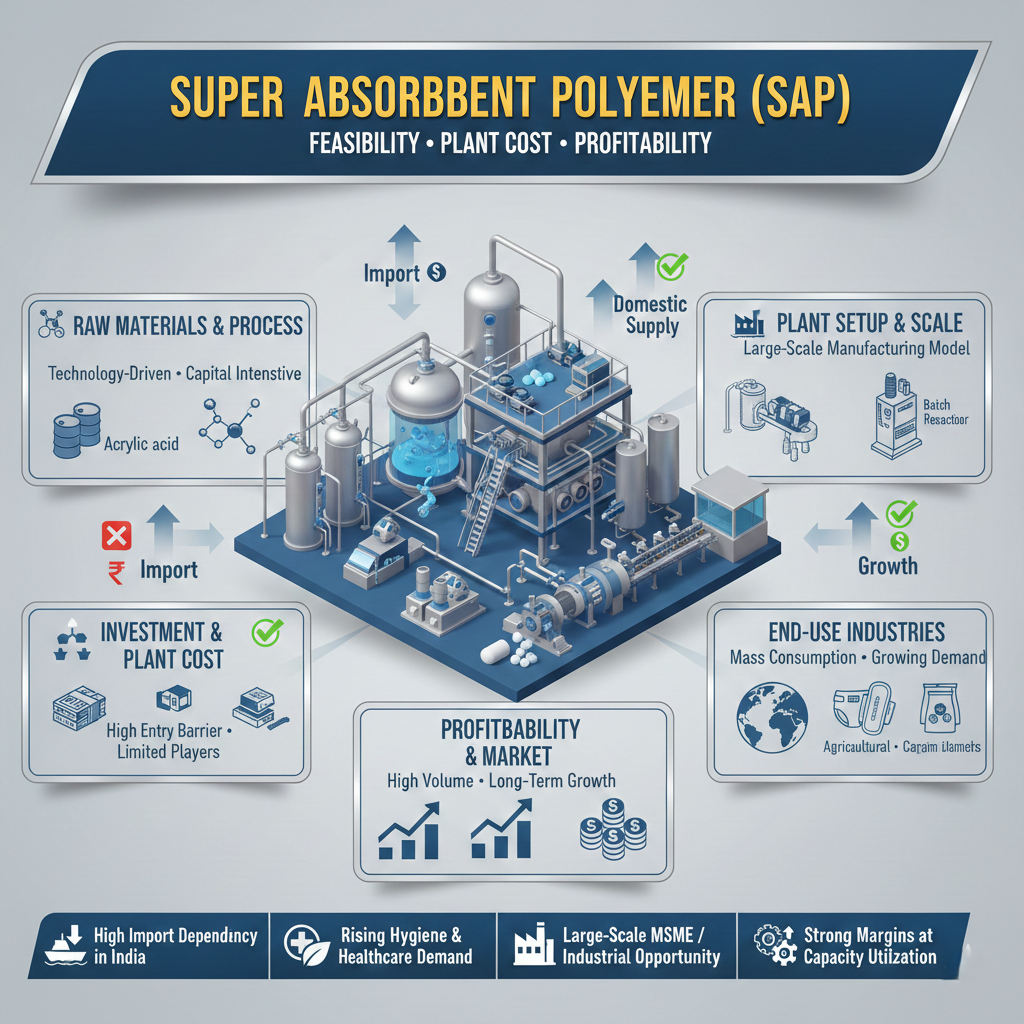

Export Potential and India’s Competitive Edge
Export success in SAP is based on reliability and not opportunistic pricing. International buyers, especially hygiene and medical manufacturers, appreciate consistency, moisture regulation, discipline in document management and reliable logistics.
Regions such as Southeast Asia, the Middle East and Africa provide a growing demand where local capacity for SAP is limited. India’s competitive position is derived from:
- Cost-competitive manufacture given utility and sourcing optimised
- Improving quality standards throughout the specialty chemical industry
- Geographical proximity to high growth emerging markets
However, export readiness needs to be planned at the feasibility stage. Packaging design, shelf stability, certification requirements and compliance documentation cannot be done as an afterthought. Government institutions like the Department of Chemicals and Petrochemicals and other regulatory bodies also have a role in impacting long-term viability, including compliance frameworks, as well as industrial policy signals.(SAP manufacturing India)
What Feasibility Teams Consider Prior to Approving SAP Projects
From a feasibility perspective, SAP projects are measured using functional, execution-oriented lenses. The key points of focus are usually:
- When taken to the extreme: “SAP performance is validated by lab data, not claims.”
- Utilities and pollution control integration, such as power, steam, water, effluent treatment and air handling
- Raw material sourcing strategy – assuring continuity, multiple vendors, and stringent quality specifications
- Customer qualification roadmap, including pilots supply, validation, commercial approval and phased scale-up
Projects that presume an immediate sale of the bulk without qualification tend to struggle. Bankable SAP ventures plan for market entry as carefully as plant construction.
Read More: Potato Powder, DI Double Flanged Pipes, Rice Husk Tableware and SAP Gel Opportunities in Manufacturing
Lessons to Learn from Successful Indian Industrial Companies
Indian chemical and manufacturing leaders have something to offer, as these are transferable lessons. Pidilite Industries developed the leadership based on formulation performance and customer trust. Vinati Organics achieved the scale by targeting the selection of molecules, process excellence, and export credibility. Asian Paints proved the value of operational discipline, reliability and service responsiveness in achieving dominant market positions.
For SAP founders, the takeaway is simple – Quality consistency isn’t a cost, it’s the business model.
Read More: Top 3 Profitable Manufacturing Opportunities in 2026: Ferrosilicon, Vedic Paint & Bamboo Wood Pellets
Alternative Entry Paths into the SAP Value Chain
Not all entrepreneurs must start full-scale manufacturing of SAP polymer. There are adjacent routes of entry that have a different risk profile:
- Downstream hygiene product manufacturing, where value is derived from branding, OEM supply & distribution
- Agriculture-grade water retention formulations that are based on regional crops and climate condition
- Medical and Industrial absorbent products, which are niche compliance-driven B2B segments
These paths enable participation in SAP demand with the accumulation of operational and market experience.

Final Thoughts
The Super Absorbent Polymer manufacturing process creates an exceptional business opportunity because it combines international market demand with the ability of domestic production facilities to meet growing industrial needs. The founders who succeed in this space need to establish feasible SAP solutions which create market capacity limits and design plant operations to meet compliance requirements and bring on board technical personnel at the start of the process while building customer trust through consistent performance.(SAP manufacturing India)
The production of SAP products requires strict management because handling SAP manufacturing operations with discipline enables chemical businesses to achieve their export goals while maintaining long-term viability.
Frequently Asked Questions (FAQs)
Is SAP manufacturing suitable for first-generation entrepreneurs?
Yes, if it is treated as an engineered chemical business with professional teams, process discipline, and phased execution.
What makes SAP financially attractive?
Diversified demand, strong scale economics, and sticky customer relationships once qualification is achieved.
What are the biggest risks in SAP projects?
Off-spec production, weak utilities planning, underestimated compliance costs, and unrealistic sales assumptions.
How does import substitution work in SAP?
Buyers shift when domestic suppliers offer consistent quality, reliable lead times, and technical support—not just lower prices.
Can founders enter the SAP ecosystem without producing SAP itself?
Yes. Downstream conversion, agri-grade formulations, and niche absorbent products are practical entry points.