


Pyroxasulfone Market in India
India’s agriculture industry is grappling with a new challenge, which is silently changing the cropping protection industry: herbicide resistance. Many weeds which were once easily controlled with traditional herbicides, are now becoming resistant to those herbicides making them less effective and more costly for farmers to control. This problem has paved the way for next generation herbicides that provide better control and longer results.
Among these new solutions, it is Pyroxasulfone which has become one of the most promising molecules in the agrochemical industry worldwide. With strong demand from farmers, increasing market in India and limited domestic manufacturing capacity, Pyroxasulfone is rapidly emerging as a good opportunity for entrepreneurs, agrochemical companies and investors.
The market for this herbicide will achieve substantial growth during the next ten years because farmers will start using advanced weed management methods and the government will support domestic chemical manufacturing under the Make In India program.
Read More: The Complete Technology Book on Pesticides, Insecticides, Fungicides and Herbicides (Agrochemicals) with Formulae, Manufacturing Process, Machinery & Equipment Details 4th Revised Edition
What is Pyroxasulfone?
Pyroxasulfone functions as a pre-emergence herbicide that controls weeds before they emerge above the ground. The isoxazoline chemical class contains a compound that prevents germinating weed seedlings from producing very long-chain fatty acids. Without these fatty acids weeds cannot form properly and don’t come out of the soil.
Unlike many traditional herbicides that are applied after the weeds have grown, Pyroxasulfone is applied to the soil in the early stage of crop cultivation. Once applied it forms a barrier within the soil that prevents weed seeds from germinating successfully.
Some of the major advantages of Pyroxasulfone are:
- Effective control of herbicide resistant weeds
- Long residual activity in the soil
- Reduced application rate as compared to older herbicides
- Broad-spectrum weed control
- Safe use of antiquated in major crops, e.g. wheat, maize, soybean
One of the most significant targets of Pyroxasulfone in India is Phalaris minor commonly known as Gulli Danda. This weed has developed resistance against several of the generally used herbicides and causes major yield losses in wheat growing areas like Punjab, Haryana and Uttar Pradesh.
Pyroxasulfone Global Market Growth
The global agrochemical industry is seeing good growth in advanced herbicide molecules and Pyroxasulfone is one of the fastest growing segments.
The global market of Pyroxasulfone is valued at approx USD 305 million in 2024. Industry projections have this figure growing to more than USD 500 million by 2031, indicating a high compound annual growth rate.
A number of factors are contributing to this expansion:
- Growing resistance to weeds around the world
- Increased Demand for Efficient Crop Protection Solutions
- Growth in large-scale commercial farming
- Adoption of modern technologies of agriculture
Asia-Pacific is expected to dominate the growth of this market, India and China play a major role in this due to their large agricultural sector.
Read More: Dairy Farm for Milk Production – Manufacturing Plant, Detailed Project Report, Profile, Business Plan, Industry Trends, Market Research, Survey, Manufacturing Process, Machinery, Raw Materials, Feasibility Study, Investment Opportunities, Cost and Revenue
Pyroxasulfone Market size in India
India is one of the most important markets for Pyroxasulfone because of its large cultivating area for a number of crops requiring aggressive weed control.
The Indian Pyroxasulfone market is worth over 450 crores right now and will steadily increase for the next 5 years.
The dominant crops that are creating demand include:
- Wheat
- Maize
- Soybean
Together these crops constitute over 52 million hectares of cultivated land, a massive market to be exploited by herbicide manufacturers.
However, the current adoption of Pyroxasulfone to these crops is still relatively low. As the awareness of farmers is increasing and spread of resistant weeds will continue, the market penetration of this herbicide is expected to rise significantly.
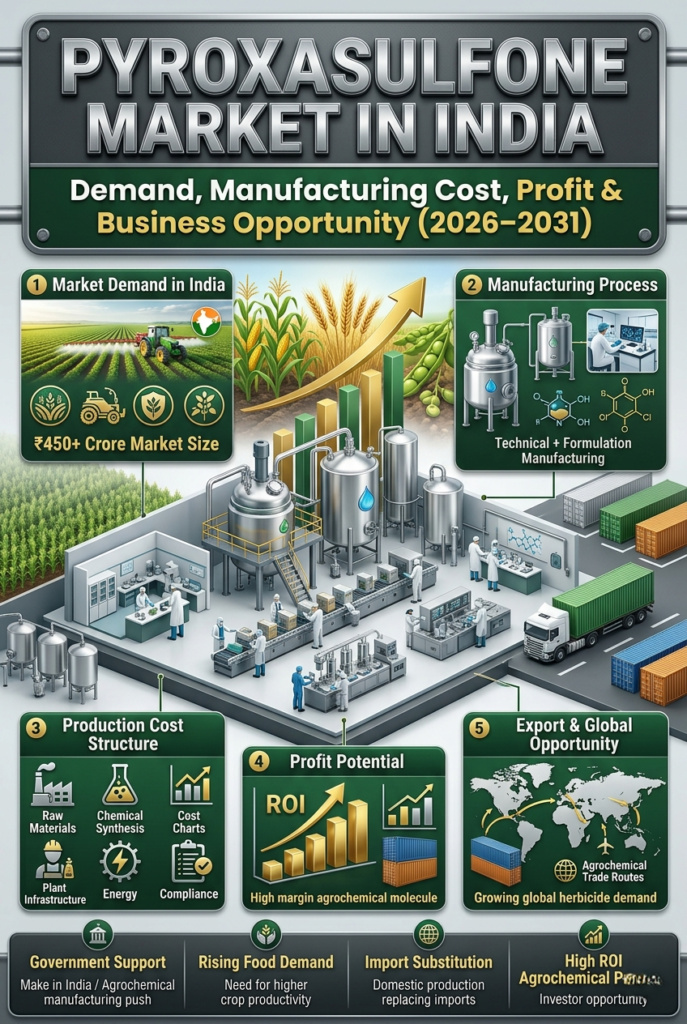

Demand–Supply Gap in India
One of the most important features of the Pyroxasulfone industry in India is that there is a huge mismatch between demand and domestic production.
Till recently, India was totally dependent on imports for this molecule. Even today, domestic manufacturing capacity is limited.
Current estimates in the industry indicate that:
- Around 60-70% Pyroxasulfone India is still being supplied to India by imports
- Imports are largely from China, Japan and Germany
- Only a few Indian companies are presently in the business of manufacturing the technical product
This supply gap therefore presents a significant opportunity for new manufacturers to enter the market, and to take advantage of this import substitution.
If the domestic production boosts, India could eventually emerge as a global manufacturing hub for the Pyroxasulfone formulations and the technical materials.
Read More: Project Reports & Profiles
Major Companies Operating in the Market
Although the market potential is large, the number of companies working in the Pyroxasulfone segment in India is still small.
Some of the key players are:
- Best Agrolife Ltd. Pyroxasulfone Technical and formulations domestic manufacture – Manufactured by the first Indian company.
- Markets Pyroxasulfone formulations under the Awkira brand.
- UPL Ltd. -One of the largest agrochemical companies of India looking for expansion in Pyroxasulfone.
Globally, there are still major technology players involved in the development of this molecule including BASF and Kumiai Chemical.
Compared to old herbicides such as glyphosate or 2,4-D where dozens of companies compete each other, the Pyroxasulfone market still has very little domestic competition.
Read More: Startup Selector
Why Demand for Pyroxasulfone Will Continue to Grow
Several trends in the structural development are supporting the long-term growth of the Pyroxasulfone market in India.
First, weed resistance is a serious agricultural problem. As a result, Many traditional herbicides are losing their efficacy and consequently, farmers are forced to use newest molecules with different modes of action.
Second, increasing capital costs for labour are further favouring farmers to increase their reliance on chemical weed control options. Manual weeding is turning costly and challenging with peak agriculture seasons.
Third, the Indian herbicide market itself is growing rapidly. The total market size of Herbicides available in India is estimated to be around Rs. 8200 crore, making it one of the fastest growing segments of the crop protection industry.
Finally, modern farming practices lend themselves more to pre-emergence herbicides which offer long lasting weed control with minimal applications.
Read More: Agrochemical Intermediates Market in India: Demand, Growth and Startup Opportunities
Business Opportunities for Enterprising people and MSMEs
The Pyroxasulfone industry has several opportunities for entrepreneurs and small businesses.
One of the most practical ones, for instance, is formulation manufacturing, in which companies form finished herbicide products from Pyroxasulfone technical material. This business model requires a moderate investment and can suit MSMEs with manufacturing experience of agrochemicals.
On the other hand, Another opportunity is in the technical grade manufacturing, which includes the production of high purity Pyroxasulfone active ingredient. Although this part of the business is more technical in nature and requires a higher capital investment, it does provide greater opportunity for profit and export.
Furthermore, Entrepreneurs and manufacturers can look into the development of combination herbicide products containing Pyroxasulfone together with other active ingredients in order to bring about a significant impact towards the control of weeds.
Read More: Top 8 Food Processing Business Opportunities in India (2026–2031 Guide)
Investment and Profitability Outlook
The financial outlook for the Pyroxasulfone Manufacturing Projects in India is bright.
Overall, Typical investment and profitability estimates are:
- Formulation manufacturing unit investment: Rs 5 – 15 crores
- Technical manufacturing facility investment: Rs 30-80 Crore
- Estimated payback period: 3 – 5 years
- Gross margins: 25–50% depending on business model
Furthermore, With the domestic market set to grow to almost near to $600-800 Crore in the next few years, therefore the early entrants could benefit with strong market growth.

Future Prospects of the Pyroxasulfone Industry
Looking at the future, Pyroxasulfone is poised to become one of the most important herbicide molecules of Indian agriculture. Moreover, The pervasiveness of resistant weeds and the general rise in modern farming practices will push for long-term and higher demand for advanced solutions for weed control.
In addition, Government initiatives to support domestic chemical manufacturing are also likely to encourage new investments in the agrochemicals sector.
Furthermore, If India continues to expand its production capabilities, the country could emerge as an important exporter of Pyroxasulfone based products to regions like Latin America, Southeast Asia and Africa.
Therefore, For entrepreneurs and industrial investors, this sector is a rare opportunity to gain entry into a high growth market with relatively little competition.
Frequently Asked Questions (FAQ)
What is Pyroxasulfone used for?
Pyroxasulfone is a pre-emergence herbicide used to control weeds in crops like wheat, maize and soybean.
What is the size of the Pyroxasulfone market in India?
The Indian Pyroxasulfone market is estimated to be worth over Rs. 450 crores, and is estimated to grow at a rapid rate.
Why is Pyroxasulfone an important chemical for wheat farming?
It provides good control of Phalaris minor, a weed that has become resistant to many herbicides commonly in use.
How much investment is needed to establish the manufacture of Pyroxasulfone?
A formulation unit may need cost of Rs 5 – 15 crore and technical manufacturing facility may need Rs 30 – 80 crores.
Is Pyroxasulfone market profitable?
Yes. The sector has good margins as demand is increasing and local competition is limited.