


Business Opportunities for Entrepreneurs: Manufacturing ideas with steady demand, broad applicability, and long-term growth are critical to success. As a result, a variety of new firms are entering the intersection of packaging, minerals, and natural oils. These businesses sustain agriculture, construction, food processing and consumer goods, and are still very important to global supply chains.
Despite the different functions of the items, there are very strong, consistent markets for all of them. Many companies are attracted to the products, providing them opportunities in the markets. These products are PP woven bags, HDPE FIBC jumbo bags, quartz powder, and avocado oil. This guide gives the entrepreneurs the necessary information on the products’ processes and market trends to help them select the ideal opportunities for each of their businesses.
PP Woven Bags: Durable Packaging for a Growing World-Business Opportunities for Entrepreneurs
What Are PP Woven Bags?
PP woven bags are long-lasting sacks of polypropylene. Industries use bags of woven polypropylene for items like grain, sugar, and sand. Moisture and branding are concerns these companies guard against with their laminated, coated, and printed bags. These businesses choose woven polypropylene bags for their lightweight, reusable, and recyclable attributes.
Read More: Scope In Production of Woven PP (Polypropylene) Cement Sacks/Bags
Manufacturing Process
Production of PP woven bags occurs in a logical order. Factories first melt polypropylene resin before extruding it into tapes. They then stretch the tapes to improve strength while reducing cost with filler masterbatch. The tapes are woven into fabric with circular or flat looms.
The woven fabric is then cut and sewn into bags of varying sizes, with the optional addition of handles, liners or coatings. Logos or product information are printed before the bags undergo quality control with drop and burst testing. Since the entire process can be handled either manually or with full automation, it is easy for entrepreneurs to scale operations from small units to large units.
Read Our Project Report: Click Here
Types and Features
Although most PP woven bags are of the same categories, they different in forms. Some bags are unlaminated to allow for breathability, and others have a polyethylene coating for improved moisture protection. BOPP-laminated bags are used for branding to display high-quality graphics, while PE-liner bags are used for chemicals or food ingredients to enhance safety.
Moreover, block-bottom bags make for easier stacking, and ventilated bags are designed to allow airflow to vegetables like potatoes and onions. Since each type fulfills a specific demand, it is easy for manufacturers to aim for different industries.
Market Prognosis, Demand, and Growth Factors-Business Opportunities for Entrepreneurs
The PP woven bag market continues expansion driven by agriculture, construction and retail on a global scale. Research indicates this market to continue a strong increase from slightly over US$10 billion in 2023 to over US$16 billion by 2033. There is also another research report suggesting growth of more than US$5 billion by 2032.
Such growth figures indicate the demand in the Asia-Pacific region, North America, and Europe. Consequently, the demand consumption increase is driven by the growth of agricultural production, construction activities, e-commerce, and sustainability policies. Businesses use PP bags as they are cost-effective, reusable, and customizable which makes them preferable for bulk packing.
Read Our Book: Click Here
Entrepreneurial Factors
The sector can be penetrated by most beginners on a small budget as the machinery required to rope in is relatively simple construction. Startups in this sector will need to exercise a lot of quality control to avoid product failure and complaints from customers.
Consistent demand should also be established by forming partnerships with farms, fertilizer suppliers and grain merchants. Providing custom dimensions, coatings, and printing can help them differentiate in the market. As they are also likely to be food or chemical packaging, the regulations governing such activities may require these manufacturers to obtain some certifications.
HDPE Jumbo Bags (FIBC): Bulk Handling Made Easy-Business Opportunities for Entrepreneurs
What are FIBC Bags?
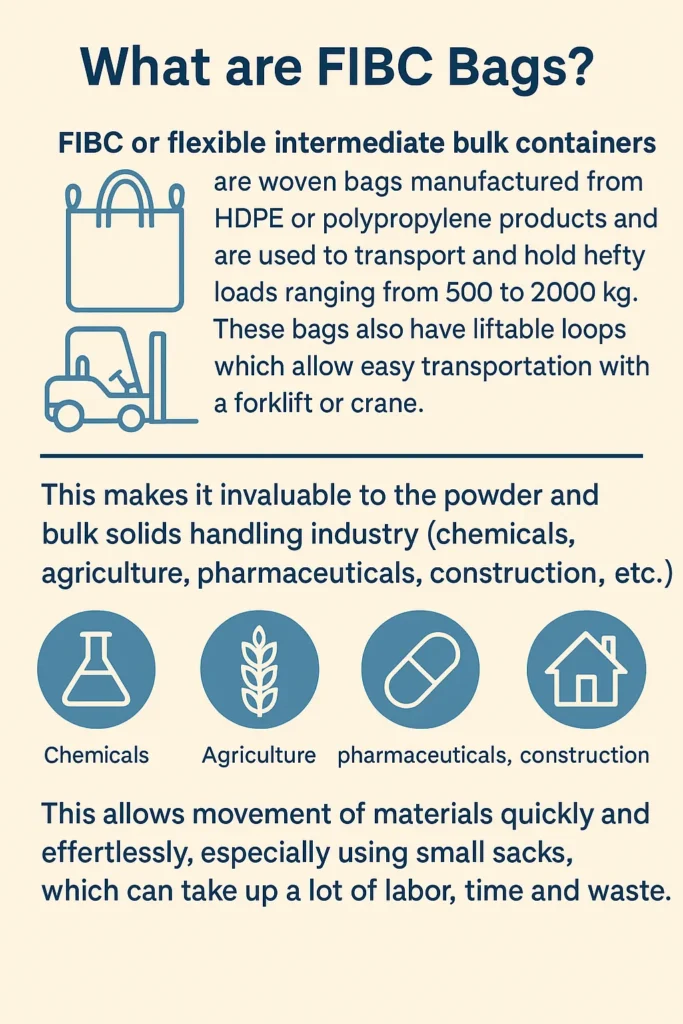
FIBC or flexible intermediate bulk containers are woven bags manufactured from HDPE or polypropylene products and are used to transport and hold hefty loads ranging from 500 to 2000 kg. These bags also have liftable loops which allows easy transportation with a forklift or crane.
This makes it invaluable to the powder and bulk solid making industry (chemicals, agriculture, pharmaceuticals, construction, etc). This allows movement of materials quickly and effortlessly, especially, using a small sack, which can take up a lot of labor, time and waste.

Manufacturing Process
The production process includes extrusion and slitting of HDPE or polypropylene to make the tapes followed by weaving the tapes into a highly durable fabric which is moisture resistant.
This fabric can then be cut, with the addition of loops and spouts, into finished goods such as U and FIBC bags. Due to the highly safety sensitive materials and bags involved, the bags are rigorously load stacked and burst tested before being sent on to their final customer.
Types and Features
In terms of safety, FIBC bags can be classified into four categories. Type A is for non-flammable. And B is for non-flammable but helps reduce spark risks. Type C bags are conductive and require grounding. Type D bags are conductive and can dissipate static without being grounded.
Also, bags may be designed with dust covers, liners, or baffles to keep shape and stability. These options allow industries to choose the safest and most effective design for their products.
Market Forecast and Demand-Business Opportunities for Entrepreneurs
The FIBC industry is driven by growth in all industries. Analysts expect it to grow in value from around 5.3 billion dollars in 2024, to 10 billion dollars in 2034. As construction, chemical processing, and agriculture expand, the demand for bulk packaging increases.
Because reusable jumbo bags lower costs, speed up handling, and reduce waste, many companies are replacing smaller sacks with FIBCs. Because of this, companies entering the industry for the first time can expect to meet strong demand for a long time-Business Opportunities for Entrepreneurs.
Potential Areas for New Businesses
New entrepreneurs can provide specialized food grade, pharmaceutical, or dangerous materials FIBCs. They can provide cleaning and reconditioning multi-use bags. As many industries seek adjustable traceability, start-ups can assist customers with scanning inventory with RFID tags.
While machinery for FIBC production is more expensive than PP sack production, there is a good return on investment due to higher prices FIBCs selling at, and consistent demand.
Producing Industrial Minerals: Quartz Powder
What is Quartz Powder?
Quart powder is produced by crushing and grinding natural quartz and is made with adding quartz due to its high purity, hardness and stability.
It is also widely used in many industries such as construction, glass manufacturing, ceramics, paints, plastics, and adhesives, and especially in high used quartz for many modern technologies such as electronics, fiber optics, and solar panels. It is also widely used in quartz powder construction.
Production Process
Cultured milled quartz starts with the procurement of clean and high-quality quartz stones. Employees wash the stones to remove clay, iron, and other impurities, and inspection to ensure this is done is performed. Subsequently, stones go through several stages of size reduction, as primary and secondary crushers are used to produce smaller fragments.
The quartz is then milled to different grain sizes, and air classifiers produce the finished product by separating the fine powders from the coarse. Dust collectors capture the fine particulate matter, and coarse grits get sent back to the mill. Some quartz grades use performance-enhancing coatings for polymer applications.
Read More: Start your own Quartz Slabs Manufacturing Business and Make Money in Best Mineral Based Industry
Modern quartz milling operations are fully computerized, so they can achieve and maintain specified thresholds of purity and size range to the tolerance of the most rigorous specifications-Business Opportunities for Entrepreneurs.
Applications and Benefits
Powdered quartz is an important additive to concrete. It improves the concrete’s resistance to abrasion, enhances wear characteristics, and increases overall durability. It is formulated with other ingredients to produce ceramic tiles, sanitary ceramics, and tableware. Additionally, high-purity quartz is essential to solar cells, semiconductor devices, and optical fibers.
It is also used in several applications for the customers’ convenience: toothpaste, cosmetics, filtration systems, and sports surfaces. Quartz is widely available, and because of it’s non-reactive and stable characteristics, it is an important industrial raw material.
Projected Expansion-Business Opportunities for Entrepreneurs
Further growth of quartz powder market is due to ongoing development in construction and electronics. Reports from credible sources project ductile quartz market will grow from US 1.3 billion in 2025 to more than US 3.0 billion by 2035.
Infrastructure developments are increasing. Consequently, the demand for advanced concrete becomes greater. To add, the interest in renewable energy and the development of semiconductor technologies drives the demand for high purity. In quartz powder, entrepreneurs will find a greenfield opportunity.
Opportunities for Entrepreneurs
New entrants to the market must establish long term partnerships for high purity quartz or collaboarate with established players in the mining field. Since various sectors are targetted, focus of new manufacturers can be customized grades of quartz within construction, electronics and cosmetics.
They can establish in house systems to validate and industry compliance. Adoption of energy efficient systems can also increase circularity and profitability through use of quartz waste.
Avocado Oil: Naturally Healthy and Valuable
What It Is-Business Opportunities for Entrepreneurs
Avocado oil is made from the fleshy pulp of a ripe avocado. It is rich in monounsaturated fats, vitamin E, and antioxidants, which are beneficial what it is used to cook and in skin care. It is most suitable for frying, grilling, and baking as it has a high smoke point.
Moreover, it is rich in nutrients that are good for the skin, hair, and even for some medicines. The demand for this oil is increasing as the awareness of health is elevating worldwide.
Production Flow
This process starts by washing ripe avocados and removing their skin and seeds. then, the manufacturers mash the pulp and press it to obtain the oil. After that, they use centrifugation to separate oil from the water and solids.
From then, they filters the oil and seal it in dark bottles to slow down oxidation. If the oil is cold-pressed, most of the nutrients and flavor are retained. Otherwise, the oil is refined and lightened. Refined oil is used in cosmetics.
Read More: How to Start a Manufacturing Business of Avocado Oil
Health Benefits and Uses
70% of avocado oil is monounsaturated fat, which helps lower bad cholesterol and is beneficial to heart health. Furthermore, it contains Vitamin E and antioxidants, which protect the skin and eyes. People also use avocado oil for purposes outside of cooking, like lotion, serum, conditioner, wood polish, and leather polish.
In some locations, it is an ingredient added to baby formula. This has contributed to the expanding market.
Market Outlook and Segmentation
Around the world, about $627 million worth of avocado oil is bought and sold each year. By the year 2030, this is expected to increase to about $800 million. In the market today, ‘virgin’ and ‘cold pressed’ is the most popular and in most demand for these products since there is a trend towards wanting unprocessed and ‘less natural’ products(Business Opportunities for Entrepreneurs).
North America is the #1 Continent for this products sales. This is due to a rise in health concerns and a turn towards cooking. This product is sold mostly in supermarkets and hypermarkets, leadig to a need for producers to use top quality, eye-catching packaging.
Startup Prospects
By collaborating with avocado farms, an entrepreneur can easily create a successful business while having an assured steady supply. Organic and premium cold-pressed oils can be sold at high prices.
The beauty industry is growing and diversifying into skincare and haircare products would be a great business move. Producers situated in high avocado growing areas have the opportunity to export their oil to countries with high and fast growing demand.
Find the Best Idea for Yourself With our Startup Selector Tool
How NPCS Can Assist You
NPCS helps new businesses during the initial phase by preparing detailed project reports, with each industry having its own set of reports. These reports also show the processes, machinery and plant layout, as well as, the calculations of the required raw materials.
These reports aid entrepreneurs with cost estimations, profitability and market risks as the reports contain financial projections and market studies. NPCS also assists enterprises with the required regulatory frameworks, certifications and quality standards. Therefore, these reports can be used by startups to accurately plan their projects and establish operational manufacturing units.

Frequently Asked Questions
1. What should I check before starting a PP woven bag unit?
A.Local demand from farms, construction firms and wholesalers should be assessed. You also need to determine the cost for resin, the required power and labour. You should also decide whether you want to do the printing and coating in-house, as these processes add value.
2. Should I produce FIBCs or small PP sacks?
A.Your choice is based on available funds and your end market. FIBCs have a longer profit margin trey and require more expensive machines and thorough quality checks. Small PP sacks require a lower starting capital and work well in the agricultural and local market.
3. Can small companies produce high-purity quartz?
A.Producing high-purity quartz is impossible on a small scale due to the required high level of purification. However, a quartz separation and grinding process is routine. A small startup can produce less pure grade quartz and scale in the future.
4. How environmentally friendly is the production of avocado oil?
A.Avocado oil is environmentally friendly when producers work with eco-conscious farms and reuse skins and pits as compost or animal feed. The high-value cold-pressed oil is produced, but the avocado fruit supply can vary.
5. What restrictions apply to these industries?
A.The rules are different in every country. The manufacturers of PP and FIBCs have to follow a set of guidelines around safety in packaging. The producers of quartz have to have permits around mining and the environment.