


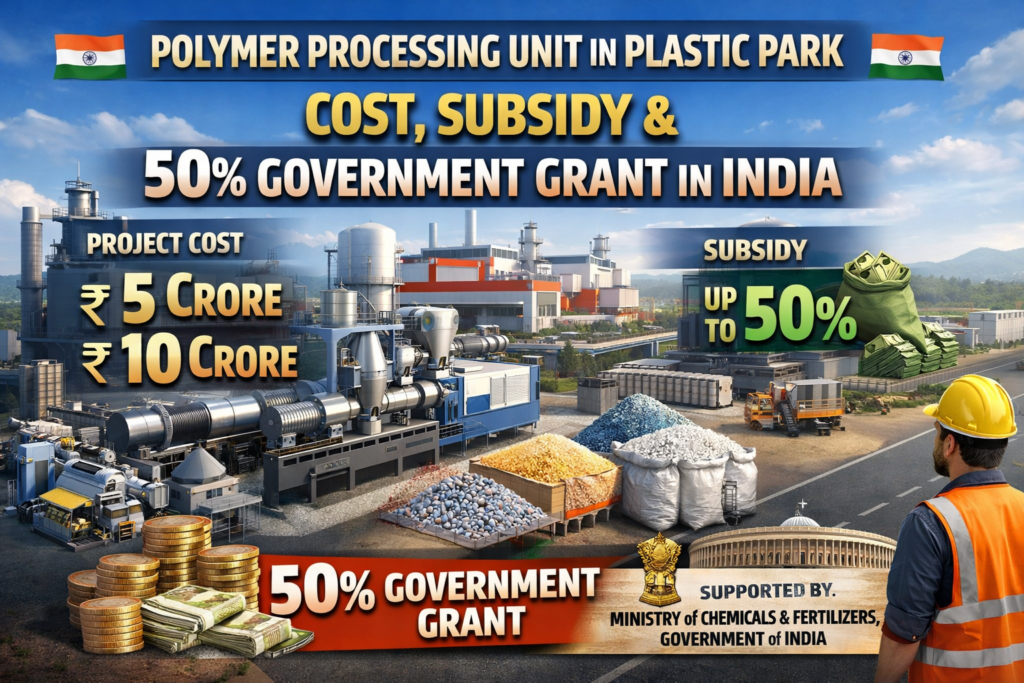
Polymer Processing Unit India industry is entering a phase of structurally strong and long term growth. Demand for polymer-based products is growing in the packaging, agriculture, infrastructure, logistics, automotive components, consumer appliance, and healthcare sections. For most of the aspiring manufacturing entrepreneurs, market demand is not the constraint – the real challenges lie in infrastructure cost, environmental compliance, utilities, and project execution risks.
This is precisely why Government-supported Plastic Parks have become one of the most efficient avenues for polymer processing units to enter.
Under the Plastic Park Scheme by the Ministry of Chemicals & Fertilizers through the Department of Chemicals & Petrochemicals, entrepreneurs can avail of readymade industrial infrastructure with support of up to 50% from the government, thereby making the feasibility of such projects more feasible and yielding high ROI for the project.
This guide covers how to establish a polymer processing unit within a Plastic Park, the rationale behind the chosen model and which segments of the product are most appropriate for new entrepreneurs.
Read More: Modern Technology of Plastic & Polymer Processing Industries
Understanding Plastic Park Scheme in India
Plastic Parks are not conventional and traditional industrial estates. They are cluster based manufacturing ecosystem structured in such a way as per downstream plastic and polymer processing industries. Instead of each unit individually investing in roads, power systems, effluent treatment and waste management, these facilities are developed centrally and shared in several units.
Key Infrastructure Presented in Plastic Parks
- Developed – industrial plots with internal roads
- Reliable distribution of power and water supply
- Common Effluent Treatment Plant (CETP)
- Plastic and solid waste management systems
- Tool rooms, testing laboratories and logistics support
The Government grants aid to the tune of up to 50% of the total project cost subject to a maximum of 40 crores for one Plastic Park. While the grant is disbursed at the park level, individual entrepreneurs benefit by significantly reduced infrastructure costs and quicker commissioning.
From a financial point of view, this cut in non-productive capital expenditure can reduce the payback period by many years.
Why Polymer Processing Units Do Better in Plastic Parks
Polymer processing is a conversion process of manufacture. Raw polymers including polyethylene (PE), polypropylene (PP), PVC, PET, ABS, nylon and polycarbonate are transformed into finished or semi-finished products in technologies such as injection moulding, extrusion, blow moulding, thermoforming and compounding.
Profitability in this sector is extremely sensitive to:
- Power and utility costs
- Machine uptime and maintenance
- Logistics efficiency
- Costs of environmental compliance
Plastic Parks are specially designed to maximize these variables.
Read More: The Complete Technology Book on Polymers with Processing & Applications
Operational Advantages
- Lower infrastructure-related capital expenditure
- Stable utilities and power availability
- Simplified environmental compliance with CETP
- Reduced logistics, transportation delays
- Access to a common vendor and maintenance ecosystem
In practical terms, the capacity utilisation of polymer units operating within Plastic Parks is often higher in the first year of operations than standalone factories leading to the direct positive impact on cash flows and financial stability.
Policy Scale & Investment Commitment
Among approved Plastic Parks in India:
- Of the 1,800 acres of industrial land, more than 1,100 acres have been developed
- More than 900 industrial plots have been allotted
- Total investment in the project is more than 900 crores
- Government grant support is about the same at approx. $349 Crore
These figures represent serious long-term policy commitment towards strengthening the downstream plastics manufacturing ecosystem in India and enabling participation of MSME in value-added polymer processing.
For lenders and financial institutions, however, this policy backing mitigates regulatory uncertainty and enhances project bankability.
Read More: Project Reports & Profiles


Polymer Processing Segments Suitable for New Entrepreneurs
The choice of the right product segment often is more important than choosing machinery. Within Plastic Parks, there are several downstream polymer segments which provide favorable demand and manageable technical complexity for first generation entrepreneurs.
1. Rigid Industrial Packaging
The chemical and lubricant and agrochemical and logistics industries utilize products which include jerry cans and drums and crates and pallets and bulk containers. The demand for this segment operates through established contracts which create recurring business thus generating consistent revenue streams.(Polymer Processing Unit India)
2. Injection moulded Household & Utility Products
Buckets, storage containers, bins, electrical fittings, and appliance parts continue to have consistent volume demand as well. While margins may be moderate up front, scale is achieved by the growth of SKUs and mould diversification.
3. Agricultural Films and Irrigation Elements
Mulching films, greenhouse covers and irrigation systems made of LDPE, take advantage of the new farming techniques and export demand, especially in Africa and Southeast Asia.
Read More: High-Demand Manufacturing Segments for MSMEs and Investors in EVs, Specialty Chemicals, and Polymers
4. Plastic Components in Engineering
These products are for automotive, electrical and appliance OEMs. They have the advantage of higher margin but they require tighter quality controls and process discipline. Many entrepreneurs join this segment after gaining some experience in operations.
5. Compounding of Polymers and Masterbatch Production
This segment is particularly interesting inside Plastic Parks due to the proximity of moulding and extrusion units, building a captive customer base and minimizing the cost of logistics.
What is Learned from India’s Leading Polymer Companies by New Entrepreneurs
The growth paths of our large polymer processors in India provide good lessons. Unflex Ltd. grew from simple films into integrated flexible packaging based on constant innovation. Time Techno last Ltd. concentrated on B2B industrial applications which had predictable demand cycles. Astral Ltd. was a company that showed the world how quality assurance and distribution networks can turn polymer processing into a branded business.
The common pattern is clear:
- They did not start with excessive capacity
- Growth was based on operational reliability
- Regulatory compliance was taken as non-negotiable
- Long-term customer relationships were prioritized.
These principles are still very relevant for the entrepreneurs of today’s MSMEs.(Polymer Processing Unit India)
Import Substitution & Export Opportunities
India still imports some of the specialized polymer components and precision moulded parts in view of inconsistent quality of domestic supply. Polymer units that have the ability to retain dimensional accuracy and material consistency can replace these imports for OEM buyers.
At the same time, the demand for packaging materials, agricultural films and household plastic products for export is growing in Africa, Southeast Asia and Latin America. Plastic Parks make exports easier by sharing systems, improved access to logistics and improved documentation support.
Read More: 10 New Manufacturing Business Opportunities in India for Startups and MSMEs
Why Feasibility Planning Decides the Success of Projects
A polymer processing project should never start with machinery acquisition. Without a structured feasibility analysis, financially even technically sound projects can fail.
A good feasibility study test evaluates:
- Market demand and sensitivity to price
- Volatility of raw material prices
- Effects on power and utility costs
- Working capital cycle
- Capacity utilisation and break even levels
Professional preparing of project plays a decisive role at this stage.
Niir Project Consultancy Services (NPCS) prepares Market Survey-cum-Detailed Techno-Economic Feasibility Reports (DPRs) that include manufacturing processes, machinery selection, capacity planning and complete financial projections. These reports help entrepreneurs to determine feasibility, risk and scalability before committing capital.
Final Insight
Plastic Parks are changing the mode of launching polymer processing business in India. By combining the support of government grants, sharing the infrastructure and addressing efficiency on a cluster level, they enable entrepreneurs to focus on quality production, cost control and sustainable growth and not on operational bottlenecks.
A polymer processing unit inside a Plastic Park is not only easier to set up – it is structurally located for long term profitability, scalability, and global competitiveness.(Polymer Processing Unit India)
Frequently Asked Questions (FAQs)
Is polymer processing suitable for first time entrepreneurs?
Yes. Plastic Parks lower the infrastructure and compliance risks considerably, thus easing it for MSMEs.
What is the main advantage of setting up inside a Plastic Park?
Shared utilities and CETP minimise capital expenditure and regulation.
Can MSME polymer units export their products?
Yes. Packaging and agricultural polymer products have good demand for export.
How does government grant support improve the ROI?
Reduced initial investment reduces the payback period and enhances internal rate of return (IRR).
Which segment provides stability in the demand for startups?
Rigid industrial packaging and B2B injection moulded parts tend to offer regular order cycles.