


Plastic Recycling Business in India
India produces more than 3.5 million tonnes of plastic waste annually, but only 30% of that is recycled. This seemingly painful gap is an opportunity, however, for those entrepreneurs who want to take a shot at a business idea that has tremendous potential in the green economy. The plastic recycling industry is a combination of environmental need and smart business, and one of the most profitable industrial businesses in today’s world. The plastic recycling industry provides clear avenues for participation, rising demand from the market, and government support for both first-generation founder entrepreneurs and MSMEs, as well as for feasibility studies by consultants.
Why the Plastic Recycling Sector Is a Smart Business Bet
All of these are sectors that have a high demand for plastic consumption in India including packaging, FMCG, agriculture, construction, and e-commerce. But post-consumer plastic waste management is less developed than compared with the amount of plastic waste produced. This allows a continuous supply of raw materials to the recyclers, while providing a significant demand for recycled plastic pellets, granules and products.
The recycled PET, HDPE and LDPE have consistent market prices in domestic production and export. Moreover, with the growing awareness of global brands towards packaging sustainability goals, recycled plastic is now directly competing with virgin resin in various product categories. The economy is getting better. However, the development of sorting technologies has reduced recycling costs, and agreements with companies have increased confidence in offtake. For new entrepreneurs, this translates into profitable, scalable and long-term policy-directioned business.
This market is expanding because of a number of structural factors:
- Growing demand by FMCG and packaging manufacturers for recycled content
- Imported products from Southeast Asia, Middle East, and Europe to be exported
- Declining availability and rising price of virgin plastic resin
- Corporate ESG mandates driving recycled plastic procurement
- To increase waste collection and sorting facilities in the country.
Furthermore, global companies such as Unilever, Nestlé and Hindustan Lever have announced that they will use a minimum percentage of recycled plastic in their packaging. This establishes forward contracts and long-term offtake deals, which decreases market risk for the domestic recyclers.
Government Policies and Incentives Supporting the Plastic Recycling Business
India’s policy setting is one of the most conducive in Asia for plastic waste management. The government has created a number of regulatory and monetary schemes directly in favor of new recycling units.
The Plastic Waste Management Rules, 2016 (amended in 2021 and 2022), make Extended Producer Responsibility (EPR) mandatory for producers, importers, and brand owners. In EPR, the businesses are required to purchase recycled plastic credits from certified recyclers. This provides a secure income for registered recycling businesses. You may be a certified recycler with the ability to receive EPR credits directly from brand owners.(Plastic Recycling Business in India)
Get Detailed Insights from This Book: Handbook on Biodegradable Plastics (Eco Friendly Plastics)
The Ministry of MSME provides loans of up to ₹2 crore in the Credit Guarantee Fund Trust for Micro and Small Enterprises (CGTMSE) without requiring collateral. Under this scheme, plastic recycling units are eligible and will allow 1st generation entrepreneurs to avail the capital without the pledging of personal assets.
Recycling startups will be able to benefit from income tax exemption for three years and will get priority access to the government procurement portals under the DPIIT Startup India framework, as well as quicker patent approvals. There is also a corpus fund under the scheme for sustainability-related businesses.
Also, the Government of India has launched Make in India initiative which encourages the manufacture of plastic products in India with recycled materials as input. These further fuels the Indian market for recycled plastic pellets & granules in their own manufacturing system.
Similarly, state-level incentives are also important:
- Provide subsidy for capital expenditure for plant and machinery in most states by 15-25%
- MSME manufacturing units will benefit from power tariff concessions.
- Allotment of land at subsidized rate in MIDC and GIDC industrial areas
- Priority lending in MSME promotion schemes (State specific)
Importantly, the Central Pollution Control Board (CPCB) has made stricter regulations on the ban of single use plastics. This regulatory move spurs additional post-consumer plastic into formal recycling streams, thus providing a direct boost in raw material to new recycling units.

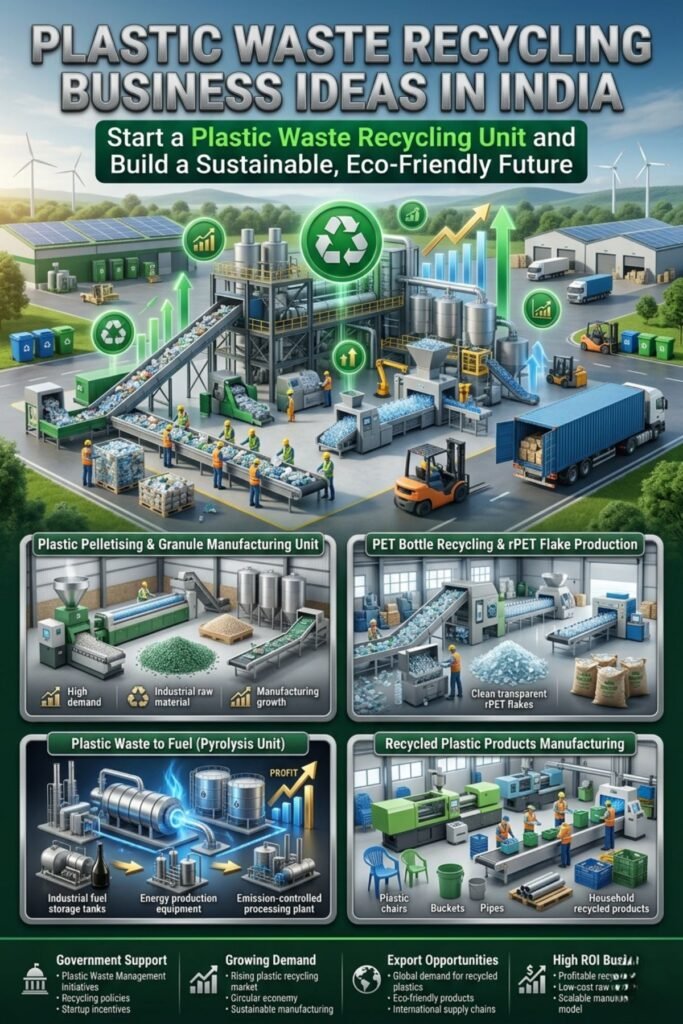
Multiple Business Ideas for Startups in Plastic Recycling
1. Plastic Pelletising and Granule Manufacturing Unit
It is the basic model in the plastic recycling value chain. Entrepreneurs gather post-consumer or post-industrial plastic waste such as PET bottles, HDPE containers, LDPE bags, PP woven sacks and process the waste on washing lines, shredding lines, drying lines, and extrusion lines to obtain recycled plastic pellets or granules.
Furniture manufacturers, pipe manufacturers, packaging manufacturers, and injection moulders use the granulates as a raw material. You can install it in an area of about 2,000–4,000 sq ft, and its cost ranges from ₹20 lakh to ₹60 lakh depending on its capacity and level of automation.
Margins remain healthy because the company buys raw materials directly from waste aggregators at low prices and sells its output at a 15–25% discount compared to virgin plastic. A well-managed 500kg/day pelletisation plant can contribute with an annual turnover of ₹30–50 lakh. Feedstock consistency and downstream buyer relationships are the two key success drivers.(Plastic Recycling Business in India)
2. PET Bottle Recycling and rPET Flake Production
One of the most commercially developed sectors in plastic recycling in India is PET bottle recycling. Workers separate the collected PET bottles by colour, wash them, crush them, and convert them into rPET flakes. Fibre manufacturers buy the flakes and convert them into products for packaging and clothing manufacturers. The market for recycled polyester (rPET) flakes and granules originated from India, especially with the global fashion brands with pressure to use recycled polyester. A dedicated rPET unit will require more precise washing and decontamination process to achieve food-grade or textile-grade standards and have premium pricing. The investment is from ₹50 lakh to ₹1.5 crore based on the technology level and processing capacity. The CIPET (Central Institute of Petrochemicals Engineering & Technology) offer technical training, testing support and consultancy to entrepreneurs establishing PET recycling units which helps minimize the learning curve.
Get Detailed Project Report (DPR): Biodegradable Products and Eco-Friendly Plastics
3. Plastic Waste to Fuel (Pyrolysis Unit)
Pyrolysis technology separates (deconstructs) mixed and contaminated plastic waste, such as multi-layered packaging, rejected plastics, and non-recyclable plastics, into fuel oil, carbon black, and combustible gas. This model is an answer to a particular market issue, where there exists a lot of plastic waste that is not conductive to mechanical recycling, but contains calorific value.
Pyrolysis units process this waste to produce a fuel similar to diesel, which industries can use in generators, kilns, boilers, and other equipment. The carbon black produced is also used in industry. This capital-intensive model requires an investment of ₹1–3 crore and demands careful adherence to pollution norms and CPCB guidelines.
However, the margins are good, and waste generators may even pay to dispose of their waste, allowing businesses to acquire raw materials at little to no cost—or even at a negative cost. Those starting companies in this field have to closely collaborate with pollution control boards and environmental consultants from the beginning.(Plastic Recycling Business in India)
4. Recycled Plastic Products Manufacturing
Some entrepreneurs do not sell recycled pellets as intermediate products. Instead, they use recycled plastics to manufacture final products. Products commonly produced include plastic lumber and boards, parking bollards, chairs and outdoor furniture, flower pots, bins and containers, cable ducting and road construction materials. This model maximises value from the recycled material and creates a brand in the sustainable material space. This requires a slightly higher capital investment due to the additional moulding or extrusion equipment. However, the profit margin on finished products is 40–60% higher than that of selling pellets. There is also a B2G sales channel with several state governments actively buying recycled plastic products for use in public infrastructure. This model works well for entrepreneurs who are close to the waste generation areas of large cities and have access to municipal solid waste.
Build a profitable business with the right idea
Import–Export Opportunity Analysis for the Plastic Recycling Business
The recycled plastic material market in India is gaining momentum as the country is emerging as a major exporter of recycled plastics due to competitive cost of labour, volume of waste, and quality of recycling processes. The e-waste recyclers in India find markets for their rPET flakes, HDPE regrinds, and mixed plastics in Vietnam, Malaysia, Turkey, Bangladesh, and now in more European markets due to EPR requirements.
India also imports a small quantity of post-industrial plastic scrap from developed countries, but the government now strictly regulates these imports under the Hazardous Waste Management Rules and the Basel Convention. It is very important for the entrepreneurs to keep themselves updated on the category of imports allowed as per DGFT (Directorate General of Foreign Trade) notifications.(Plastic Recycling Business in India)
Export opportunities are easier to navigate and less risk of compliance issues. Exporters can register on DGFT (Directorate General of Foreign Trade) and get link with international waste/trash trade portal. Duty drawback and the Remission of Duties and Taxes on Exported Products (RoDTEP) are two schemes that benefit the Indian exporters and enhance the margins of exports. The Confederation of Indian Industry (CII) also operates industry clusters focussed on sustainability, which will enable the MSMEs to connect with the global buyer networks in the recycled materials segment.
Indian MSME Success Stories in Plastic Recycling
Several Indian entrepreneurs have successfully created highly profitable businesses in plastic recycling by successfully combining both scale and sustainability.
Suchit Sancheti, CEO of Aakar Innovations, Pune, and its associated plastic recycling initiatives, founded his project on the premise of EPR credit monetisation and municipal waste partnerships. The simple reason that drove his decision is that he did not want to compete with big FMCG firms to buy feedstock, instead he decided to join the municipalities as an authorised recycler. This enabled him to secure regular subsidised waste flows. His experience shows that, in this industry, the government linkage is a strong competitive edge, not only private sourcing.
Envision Plastic which is now a Unifi company in the US, after Kabir Barday, would inspire a new generation of Indian rPET entrepreneurs. GEM (envigored – a unit of the Jain family) based in Chennai expanded its plastic recycling business on a more local basis, targeting its attention to rPET flakes certified for textile exports. What they learnt: quality certification (food-grade or textile-grade) gives 20-30% premium pricing, which opens up export markets for the competitors who are not able to get it with lower grade output.(Plastic Recycling Business in India)
MSME operators in Surat and Rajkot have established clusters in Gujarat for recycling polypropylene and HDPE, supplying regranulated material to the local textile and automotive component industries. The cluster models minimise logistics costs, share processing resources, and produce collective bargaining power with big raw material buyers. These are models for new entrepreneurs: Come in as a niche processor, establish quality, grow through aggregation or forward integration.
How NPCS Helps Entrepreneurs Evaluate Plastic Recycling Projects
Niir Project Consultancy Services (NPCS) offer Professional Consulting services for preparation of Market Survey cum Detailed Techno-Economic Feasibility Report (DPRs) for new Industry/Business setups. We present the detailed manufacturing processes, market research and demand analysis, process flow diagrams, product mix and capacity planning, machinery details, raw material details and complete project financials with profitability analysis in our reports. Our aim is that we help the entrepreneur determine before investing if it is feasible, profitable and has a good future in the long run. For the plastic recycling sector, our DPRs provide a detailed analysis of capital cost estimation, feedstock sourcing models, compliance requirements, EPR registration guidance, and ROI analysis to provide a detailed framework to help founders decide on investing in capital before they do.
Related Article: Biodegradable Packaging Manufacturing: India’s ₹10,000 Crore Sunrise Opportunity Post-Plastic Ban
Plastic Recycling Business: Key Market and Project Data
| Parameter | Pelletising Unit (Small) | rPET Recycling Unit (Medium) |
| Project Investment | ₹20–40 Lakh | ₹80 Lakh – ₹1.5 Crore |
| Land & Space Required | 1,500–3,000 sq ft | 4,000–8,000 sq ft |
| Installed Capacity | 300–500 kg/day | 1,000–3,000 kg/day |
| Key Raw Material | HDPE/LDPE/PP waste | PET bottles (post-consumer) |
| Primary Output | Recycled plastic pellets | rPET flakes / granules |
| Estimated Annual Revenue | ₹25–50 Lakh | ₹80 Lakh – ₹2 Crore |
| Gross Margin (Approx.) | 20–30% | 25–35% |
| Payback Period | 2–3 years | 3–4 years |
| Government Incentive Applicable | CGTMSE, MSME subsidy | EPR credits, Startup India |
| Export Potential | Moderate (HDPE/PP regranules) | High (rPET textile/food grade) |

Conclusion: A Business Built for the Future
Today, recycling plastics is no longer a niche business. It is a mainstream industrial segment that has regulatory tailwinds, rising corporate demand, solid government support and positive unit economics. It can be both lucrative and a valuable solution to India’s environmental objectives for entrepreneurs who are willing to do their part and act with discipline. You can enter the rPET value chain at one level, either with a small pelletising machine, or as a producer of rPET flakes. The route to profitability starts at any point within the rPET value chain, from operating a small pelletising machine to producing flakes, and remains well defined throughout the process. How quickly you get there will depend on the feasibility analysis, compliance preparation, and market linkage strategy that you use.(Plastic Recycling Business in India)
Frequently Asked Questions (FAQs)
Q1. What is the investment required to set up a plastic recycling business in India?
The investment needed depends on the type of recycling technology chosen and the scale of operation. A small-scale plastic pelletising unit can be established for as low as 20-40 lakh while taking into account expenses like machinery costs, working capital and space requirement. The investment to set up a medium-scale rPET or HDPE recycling unit may range anywhere from 80 lakh to 1.5 crore. Collateral-free bank loans up to 2 crores are available through various schemes like CGTMSE.
Q2. Do I need to obtain a pollution control licence to start a plastic recycling unit?
Yes, you need to get both the Consent to Establish and Consent to Operate from the state Pollution Control Board. You also need to register with the CPCB to get an EPR registration, and issue plastic credits to brand owners. Mechanical recycling unit setups do not normally pose problems while setting up. However, the environment clearance and pollution control board requirements for pyrolysis units may be stringent. The NPCS reports contain compliance guidelines.
Q3. What is EPR and how can it earn me additional revenue from my recycling unit?
EPR stands for Extended Producer Responsibility and is governed by the Plastic Waste Management Rules. EPR is a framework in which brand owners, manufacturers, importers will be held responsible for the recycling of a specified quantity of plastics that they place into the market by buying recycling credits issued by registered recyclers, which you could be! Depending on the type of plastic and its quantity, the EPR credit price ranges between 2 and 20. Setting up a unit to recycle 500 Kg of plastic a day could potentially earn significant revenue only from the EPR credits issued.
Q4. What types of plastic are the most sought after in terms of usage after recycling?
PET and HDPE have the most demand currently followed by polypropylene (PP). Recycled PET is used for textiles and food-grade packaging while rPET for packaging food items and beverages as well as for textiles. RPET is in constant demand from the garment industry and food packaging producers while HDPE granules find use among the pipe manufacturing and moulding industry. Polypropylene is used by automotive and consumer goods industries. Multi-layered packaging and PVC recycling are very challenging and would better be utilized for Pyrolysis or energy recovery.
Q5. Can a plastic recycling unit be set up in a rural or semi-urban area?
It not only can but is usually a preferred option. Cheaper land and labor along with proximity to agricultural plastic waste (mulch films, greenhouse sheets, etc) can help in cost efficiency as well as supply of raw materials for rural and semi-urban units. Additional incentives for MSME manufacturing units to be set up outside metropolitan cities are often given by the various State governments. However, it would be wise to check for a stable power supply and the connectivity between the city and village.
Q6. How long does it take to set up and commission a plastic recycling unit?
From idea to operationalization, setting up a small to medium scale plastic recycling or pelletising unit can take any duration between 6-12 months. This estimate includes everything from the project plan to buying equipment (which may take 3-4 months for equipment made in India) to land allocation and other permits along with operational testing of the plant. With a properly drawn up DPR a business can reduce the amount of time wasted considerably in selecting machinery, and layout design and planning.