


The India export narrative is being rewritten. The Hindu has published details of how petroleum products have become one of the most powerful drivers of India’s merchandise export growth in a detailed data analysis. Now, refined petroleum products account for a lion’s share of total outbound trade, which has redefined opportunity maps for manufacturers, MSMEs, startup founders and investors all over the country.
It’s not a fleeting moment. India has the 4th position in the world in terms of refining. In 2025, gasoline exports reached near-record levels as extra processing capacity for crude oil and increased ethanol blending allowed for extra fuel availability to be exported. India often exports its refined products to the Netherlands, UAE, Singapore and the US.
The actual story isn’t in the fuel tankers that are departing from Indian ports, for the entrepreneurs and MSMEs. It is part of the thicket of manufacturing and chemicals, specialty products and industrial services that India’s petroleum export boom makes profitable today.
The Hindu’s data journalism team has highlighted that petroleum exports can sustain India’s dream of becoming ₹100-lakh-crore exporter. This report turns that macro signal into actionable manufacturing business opportunities for founders who want to get things done.
Get Detailed Insights from This Book: The Complete Book on Distillation and Refining of Petroleum Products (Lubricants, Waxes and Petrochemicals)
What The Hindu’s Reporting Means for Business
The figures released by The Hindu are arresting – petroleum products have always helped in boosting India’s overall merchandise export statistics, sometimes even offsetting the sluggish performance of other industries such as gems and jewellery or readymade garments. This trend has structural depth.
What Happened
During the decade following the outbreak of the pandemic, India’s share of refined petroleum exports rose significantly. Peak rates of petroleum products accounted for more than 21 per cent of all merchandise exports. The strategic advantage for India was to import subsidised crude at a lower price, and process and refine the crude into higher value products to export to other countries, which very few developing nations could achieve at such a significant level.
Why It Matters
The change is significant as it represents a major increase in capacity in the Indian refining and petrochemicals industry. Indian Oil Corporation aims to increase its group refining capacity to almost 98.4 million MT per year by 2028. Bharat Petroleum has announced that it will spend ₹5,044 crore on building a new polypropylene plant at Kochi. The Ministry of Petroleum and Natural Gas has published live project updates and investment pipelines that entrepreneurs can access directly, to track the progress of refinery expansion and opportunities in the downstream sector.
There’s a massive demand for specialty chemicals, industrial lubricants, catalyst feedstocks, packaging, industrial gases, maintenance and safety equipment, etc. that each new refining unit must meet upstream and downstream. That’s what the opportunity zone for MSMEs looks like.
Entrepreneurs can’t afford to sit around and wait any longer.
The decision to enter the market with the downstream supply of petroleum products has left the entrepreneurs and MSME founders with a market with decade-long demand visibility. The Indian chemicals and petrochemicals market is expected to cross the $300 billion mark, according to the petroleum minister. The first step for every founder is to register as a MSME (Udyam Registration), which is the basic registration required by the MSME from day one so that the government can differentiate it from others and provide credit, subsidy, and preference in government tenders.
Why India’s Petroleum Downstream Industry Is Growing
India’s petroleum products market is one of the most investable markets in India due to several structural factors:
- Capacity expansion refinement: India’s total refining capacity is expected to touch 300 million MT towards the end of this decade, resulting in an abundance of feedstock for downstream manufacturers.
- Ethanol blending mandate: India became ethanol fuel blending mandated at 20% level of blending in gasoline in 2025, thus allowing for millions of barrels of petroleum products to be exported.
- Indian refiners to continue to source crude oil at meaningful discounts, enhancing refinery margins and output economics, as a result of the Russian crude oil discount advantage.
- The global diversification of supply—Now, the export basket extends to over 100 countries across European, African and Asian markets and the European and Asian buyers are engaged in import of Indian refined products.
- Petrochemical integration push: Large refiners are integrating petrochemical units and are creating a demand for specialty intermediate chemicals which is expected to be met by the MSMEs.
- India’s per capita consumption of petrochemicals is also significantly lower than developed countries, indicating several decades of growth in domestic demand.
Government Policies & Incentives Supporting Petroleum Downstream MSMEs
Government policy has a positive thrust for business activity in specialty chemicals, petroleum products and petrochemical derivatives. These incentives are now in place — and if the founders take advantage of them early, they create a structural cost advantage.
The National Small Industries Corporation (NSIC) helps new MSME manufacturers overcome a daunting task, that is, procurement of raw materials. NSIC’s raw material assistance scheme enables MSMEs to obtain petroleum by-products, base oils and chemical feed stocks on credit terms which helps in achieving smooth working capital cycle of the small manufacturers in their initial two years.
If you are a first-generation entrepreneur who doesn’t have collateral, then you need to know about the Credit Guarantee Fund Trust for MSMEs (CGTMSE) scheme the most. It offers collateral-free credit guarantees of up to ₹2 crore for manufacturing units in the chemicals, petroleum products, and industrial goods segments—whereby your business plan becomes the collateral at the bank.
The chemicals sector push of Make in India has a strong mention of petroleum downstream products like lubricants, specialty chemicals, polymer compounds and bitumen derivatives. The single-window investment clearance process by the DPIIT has significantly reduced the regulatory process for manufacturing units having investment of above ₹10 crore as compared to the traditional multi-department clearance process.
Access Complete Business Plan: Petroleum & Petroleum Products
The Directorate General of Foreign Trade (DGFT) provides several incentives to export companies in the field of export promotion. The combination of Advance Authorisation, Export Promotion Capital Goods (EPCG) licences, and the Duty Drawback scheme reduces the effective cost of establishing an export-oriented petroleum manufacturing unit by approximately 15-25 per cent.
One of the most economical of the incentives for the scale-up manufacturers is the Production-Linked Incentive (PLI) Scheme for Specialty Chemicals. Under this scheme, 10-20 per cent incentives are provided on incremental sale of eligible petroleum derivative products. On the other hand, MSMEs that sustain their export growth can receive cash incentives which can be directly used for capacity building.
In case the manufacturing companies are apprehensive of payment default risk in the export markets, the Export Credit Guarantee Corporation of India (ECGC) offer export credit insurance facility for up to 90 per cent payment default risk. This has become economically attractive to venture into markets in Africa and Southeast Asia, where Indian petroleum products are increasingly sought after.
Technology-driven petroleum downstream startups — those building novel formulations, specialty compounds, or process innovations — should explore DPIIT recognition through the Startup India portal. Recognition unlocks tax holidays for three years, access to the Fund of Funds, and fast-track IP filing — advantages that meaningfully accelerate a petroleum downstream startup’s trajectory from pilot plant to commercial scale.

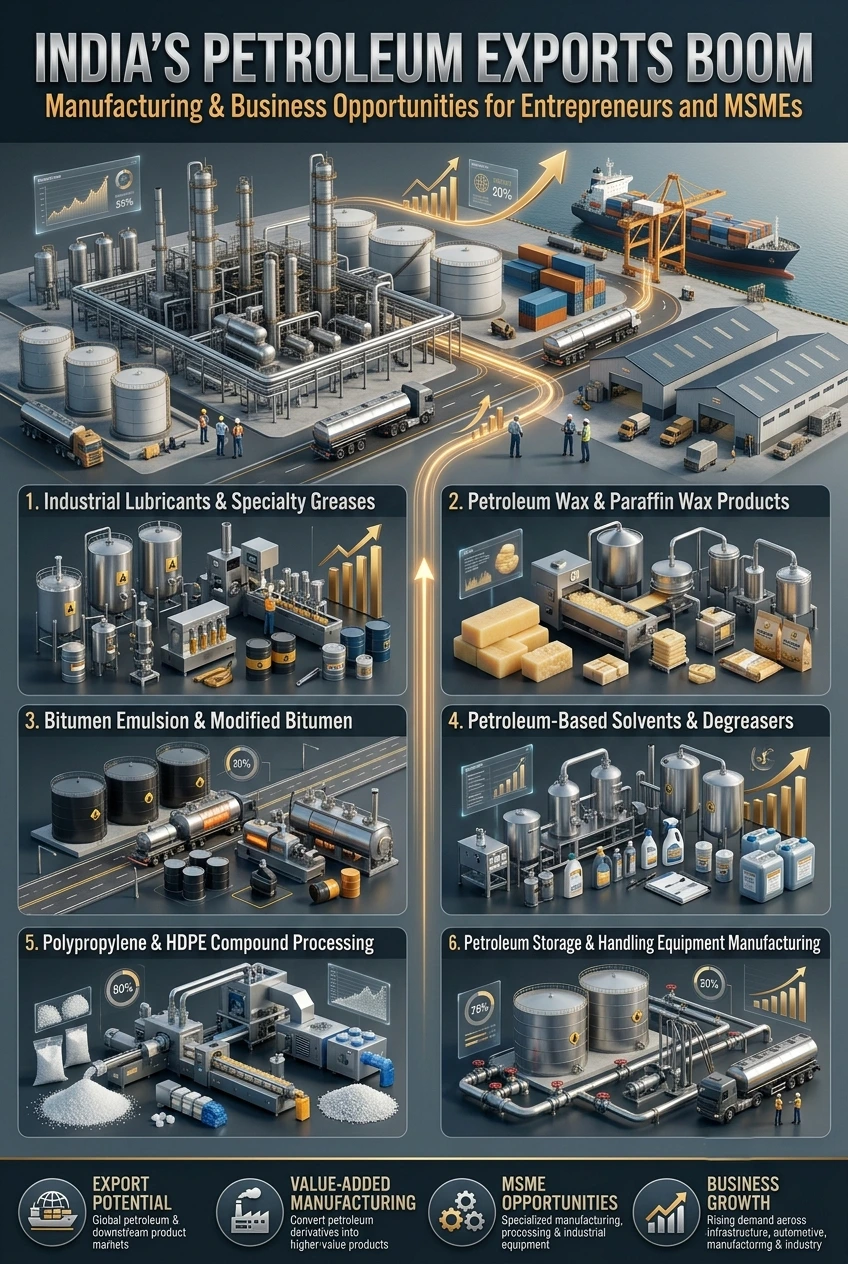
Manufacturing Business Ideas Directly Linked to India’s Petroleum Export Growth
The Hindu’s analysis of petroleum-driven export growth directly opens the following high-potential MSME manufacturing verticals. Each benefit from India’s expanding refinery infrastructure and its downstream demand chain:
1. Industrial Lubricants and Specialty Greases
India’s automotive and industrial sectors consume over 2.5 million kilolitres of lubricants annually. Yet the market for specialty industrial lubricants — used in refineries, compressors, turbines, and heavy machinery — remains heavily import-dependent. With refining capacity expanding, captive demand for industrial lubricants at new refinery complexes is enormous.
MSME manufacturers can produce engine oils, gear oils, hydraulic fluids, cutting fluids, and specialty greases using base oil — a direct refinery by-product. Margins are strong, export potential is high, and the raw material supply chain is domestically anchored.
- Investment Range: ₹50 lakh – ₹3 crore (blending and packaging plant)
- Key Markets: Refinery contractors, auto OEMs, engineering firms, agricultural equipment sector
- Export Opportunity: Middle East, Southeast Asia, Africa
2. Petroleum Wax and Paraffin Wax Products
Candles, makeup, food, cable coatings, pharma products are some of the sectors that utilize paraffin wax which is an output product of petroleum refining. India currently imports significant volumes of specialty wax despite being a major refiner. This is an import substitution gap that MSMEs can fill immediately.
- Investment Range: ₹30 lakh – ₹2 crore
- Products: Fully refined paraffin, semi-refined paraffin, micro-crystalline wax, scale wax
- Export Opportunity: Europe and Southeast Asia, where Indian wax is highly cost-competitive
3. Bitumen Emulsion and Modified Bitumen
The infrastructure, i.e. Highways, airports, roads both urban and non-urban, construction is running very high across the entire India, and consumption of bitumen at such high rates is not known before. Polymer and/or Crumb Rubber Modified Bitumen, commands premium prices across world over. Manufacturers who build small-scale bitumen emulsion plants near state highway departments can secure steady government contract revenue.
- Investment Range: ₹40 lakh – ₹2.5 crore
- Key Buyers: NHAI contractors, state PWD departments, airport developers
- Export Opportunity: Nepal, Bangladesh, Sri Lanka — all import bitumen
4. Petroleum-Based Solvents and Degreasers
Petroleum derived solvents – namely Naphtha, Hexane, Mineral Spirits, paint thinners- are consumed by Indian Chemical Industry. The paints, adhesives, leather, rubber etc industries are the main consumers. Out of this, MSMEs operating in these sectors are more prone to purchasing solvents from dealers rather than the refineries. Assembling a solvent blending and purifying and packing plant is high turnover, repeat order manufacturing plant.
- Investment Range: ₹25 lakh – ₹1.5 crore
- Core Products: Mineral turpentine oil, stoddard solvent, industrial hexane, isopropyl alcohol blends
- Margins: 18–28% depending on specialisation
5. Polypropylene and HDPE Compound Processing
Large quantities of polymer pellets will enter the domestic market from Bharat Petroleum’s new 400,000 TPA polypropylene plant at Kochi and the enhanced petrochemical capacities of IOC. The MSMEs can, however, set up compounding units. They can blend PP or HDPE with additives, colourants and fillers, and create specialty compounds used for auto-parts, appliances, pipelines and packaging.
- Investment Range: ₹75 lakh – ₹5 crore (twin-screw extruder-based plant)
- Product Applications: Automotive interior compounds, cable insulation, industrial pipes, furniture
- Export Markets: Germany, Italy — European plastics processors actively source Indian compounds
6. Petroleum Storage and Handling Equipment Manufacturing
India’s refinery expansion and petroleum product logistics require thousands of storage tanks, valve fittings, flow meters, pipeline components, and safety instruments. The domestic manufacturing ecosystem for these products is underdeveloped, creating a clear import-substitution opportunity. MSMEs with engineering capabilities can manufacture flanges, pipe fittings, pressure gauges, and stainless-steel storage vessels for petroleum applications.
- Investment Range: ₹1 crore – ₹8 crore
- Target Buyers: IOC, HPCL, BPCL, private refinery contractors
- Export Markets: Refinery infrastructure suppliers globally
Related Article: Petroleum and Petroleum Products Industry Consultants in India: A Complete Guide for Entrepreneurs and Investors
Import–Export Opportunity Analysis
Export Markets
India’s petroleum export geography is rapidly diversifying. The Netherlands, UAE, and Singapore are top destinations. Newer markets are emerging: Israel, Brazil, South Africa, and several African nations are importing Indian refined petroleum products in growing quantities. For MSME manufacturers of petroleum derivatives, the following export paths are commercially viable:
- Industrial lubricants and specialty oils: Southeast Asia, Africa, Middle East
- Paraffin wax and petroleum wax derivatives: Europe, North America
- Bitumen and bituminous products: South Asia (Nepal, Bangladesh, Sri Lanka), Africa
- Specialty solvents and degreasers: ASEAN, Africa
- Polymer compounds and masterbatches: Europe, Japan
Import Substitution Opportunity
India currently imports thousands of crores of worth speciality lubricants, higher grade paraffin wax, speciality solvents and polymer additives. They are all available and doable by MSMEs using locally available raw materials that India’s rising network of refineries churns out. The government’s Make in India push specifically targets chemical import substitution.
International Demand Outlook
Global demand for Indian petroleum products is structurally strong. European buyers are diversifying away from Russian and Middle Eastern suppliers. African nations are seeking reliable Indian supply. Asian refiners are increasingly integrating, creating demand for specialty feedstocks from India. ECGC credit insurance and DGFT export promotion schemes reduce international payment risk for MSME exporters significantly.
Indian MSME Success Stories in the Petroleum Downstream Sector
1. Gulf Oil Lubricants India Ltd – Mumbai
It started out as a mid-sized Indian industrial lubricant manufacturer and became large over time through a blend of refinery-produced base oil, specialty blending, and forceful export pushing and in due course, expanded to over 100+ countries becoming a “best in class” example of how to shift from Indian MSME to exporter across world in one generation.
2. Hindustan Wax Products – Haryana
As a medium-sized manufacturer of petroleum wax, fully refined paraffin and micro-crystalline wax products, Hindustan Wax Products shows the potential to become an MSME vertical in petroleum wax. Hindustan sources its feedstock from Indian refineries and is a supplier to the international market comprising of candlemakers, cosmeticians and industrial consumers.
3. Savita Oil Technologies Ltd – Maharashtra
Starting as a transformer oil manufacturer, Savita Oil Technologies diversified into specialty lubricants, industrial oils, and process fluids. It now supplies to power sector utilities, heavy engineering firms, and exports to over 50 countries. Founders can study Savita’s product diversification strategy as a realistic growth blueprint.
Choose the right startup backed by real market demand
About NPCS – Niir Project Consultancy Services
For entrepreneurs and MSME founders seeking to enter petroleum downstream manufacturing, Niir Project Consultancy Services (NPCS) provides the technical and financial scaffolding needed to move from idea to operational plant.
- Detailed Project Reports (DPR): Sector-specific reports covering plant layout, machinery selection, raw material sourcing, and financial projections for lubricants, wax, bitumen, solvents, and polymer compounds.
- Feasibility Studies: Market-calibrated feasibility analysis for new manufacturing units aligned with India’s refinery expansion trajectory.
- Market Research: Demand analysis for petroleum derivatives, import-export mapping, and customer profiling for domestic and export markets.
- Technology Consultancy: Process engineering guidance for lubricant blending, bitumen emulsion, solvent purification, and polymer compounding plants.
- Bank Loan Documentation: Bankable project reports accepted by PSU banks, SIDBI, and NBFC lenders for MSME manufacturing finance.
Industry Overview Data Table
| Industry | Petroleum Products Manufacturing & Downstream Chemicals |
| Market Driver | India’s refinery expansion + petroleum products exceeding 20% of total merchandise exports |
| Investment Range | ₹25 lakh – ₹8 crore (varies by product: lubricants, wax, bitumen, solvents, polymers) |
| MSME Opportunity | Import substitution in specialty lubricants, wax, solvents, polymer compounds, storage equipment |
| Export Potential | High – Netherlands, UAE, Singapore, Southeast Asia, Africa, North America |
| Government Support | PCPIR zones, PLI for specialty chemicals, DGFT export schemes, CGTMSE credit guarantee |
| Risk Level | Medium – subject to crude price volatility; mitigated by domestic refinery feedstock access |
| Growth Outlook | Strong – India targeting $300B chemicals market; refining capacity to cross 300 MT this decade |

Conclusion: Act on India’s Petroleum Export Momentum
The reporting by The Hindu makes one thing clear: India’s petroleum products sector is not a legacy industry riding out a decline. It is an expanding, innovation-hungry, export-oriented sector creating real manufacturing opportunity at every point along its value chain.
India’s refining capacity is growing toward 300 million MT. Its petroleum export share has exceeded 20% of total merchandise exports at peak. The government has designated PCPIR zones, launched PLI schemes, and is actively supporting domestic petrochemical manufacturing. The petroleum minister has publicly stated that India’s chemicals and petrochemicals market will reach $300 billion.
For MSME founders, the opportunity window is now. The refinery expansion cycle of the next five years will generate demand for thousands of small manufacturers supplying lubricants, waxes, bitumen emulsions, solvents, polymer compounds, and industrial equipment. Founders who position themselves in this supply chain today will benefit from decade-long demand visibility.