


The PET bottle industry in India is transforming on two fronts. On one hand, rising demand for beverages, pharmaceuticals, and packaged foods continues to drive strong volume growth. On the other hand, new government regulations require manufacturers to increase the use of recycled content, creating a significant and measurable capacity gap across the industry.
From April 2025, PET manufacturers in India must increase recycled content in their products from 30% toward 60% by FY30. Industry estimates also suggest that India currently has more than 20% fewer recycling facilities than the country needs to meet the mandated targets, creating an urgent opportunity for investment in PET recycling and recycled PET (rPET) production capacity. In manufacturing, this is a unique situation in that there is a need for a demand-supply imbalance and a hard regulatory deadline.
Access Complete Business Plan: PET Bottles Manufacturing Project Report
What Are PET Bottles?
PET bottles are bottles manufactured from polyethylene terephthalate (PET), a thermoplastic polyester resin which is formed from the reaction of purified terephthalic acid (PTA) and monoethylene glycol (MEG). PET is a key packaging material for beverage and liquid packaging due to its lightweight, transparency, shatterproof, economical moulding characteristics and — most importantly — it is one of the most widely and successfully recycled plastics in the world.
The PET bottle value chain consists of three major value chain segments – each with different manufacturing opportunities:
- PET bottle recycling – gathers PET bottles for recycling (capital-intensive, dominated by large integrated petrochemical players)
- PET preform and bottle manufacturing – injection-moulding PET resin to make PET preforms, and blow-moulding preforms to produce finished bottles (segment which is most open to MSME and regional players)
- PET recycling (rPET) – collection, separation, washing, and reprocessing of post-consumer PET bottles into recycled flakes, granules or food-grade recycled PET (rPET resin) for use in new PET bottles, a fastest growing and most policy driven segment in India.
Global and India PET Bottle Market Size and Growth
The global PET bottles market is estimated to grow from USD 46.2 billion in 2025 to USD 48.0 billion in 2026 and reach USD 69.6 billion by 2036. In India, the PET bottle market is expected to reach USD 1.6 billion by 2025, growing at an approximate CAGR of 3.57% in volume. This moderate growth reflects the market’s increasing maturity compared with the faster overall growth of the PET resin market.
India remains a net importer of PET resin, while PET resin consumption has grown by 10–14% annually over the past few years. Total PET resin consumption reached approximately 1.9 million tonnes in FY2024–25, with the bottle segment accounting for around 92% of total consumption. Sheets, straps, and monofilaments together accounted for the remaining 8%.
Note on figures: These figures reflect estimates for the PET market, which are based on different definitions of market including finished bottles versus resin, as well as the entire PET packaging value chain (caps and labels). NPCS can develop an investor-grade number-specific techno-economic feasibility study for your location in the value chain (e.g., preforms/bottles vs. rPET recycling).
The rPET Opportunity: A Quantified, Deadline-Driven Gap
This is the section of the PET story that relates to a new entrant. The Extended Producer Responsibility (EPR) Guidelines under the Plastic Waste Management Rules, 2018, put in place by the Government of India, aim to transition PET packaging to 30% recycled content by FY2025-26 and to 60% recycled content by FY2028-29. This is estimated to generate rPET demand of more than one million tonnes by 2031 and industry analysis views it as an INR 15,000 crore (around USD 1.8 billion) market opportunity directly created by the government.
The supply side cannot keep pace with demand. India’s B2B operational capacity is projected to remain more than 20% below the requirement for compliance by March 2025 because new recycling plants need significant time to stabilize their operations and obtain approvals from brand owners.
Policy Tailwinds
- A single biggest demand driver in this category is EPR mandatory recycled content requirement as per the rules of Ministry of Environment, Forest and Climate Change, 2024 (MoEF&C) that mandates 30% recycled PET content from FY2025-26 and 60% by 2028-29.
- FSSAI approval for food-grade rPET: The Food Safety and Standards Authority of India has approved rPET for direct food-contact end-uses, removing what was previously a significant regulatory barrier to bottle-to-bottle recycling.
- RINA (IS 14534:1998, IS 14535:1998): These have given the quality framework which allowed a 10-15% uptake of rPET in non-food industrial applications.
- Brand-owner sustainability commitments: Major beverage companies including Coca-Cola and PepsiCo have committed to significantly higher recycled content in their packaging by 2030, creating direct offtake demand beyond the regulatory minimum.
- MSME support for plastic recycling scheme: The PET recycling units are also eligible for the project funding as they contribute to the objective of circular economy and waste management. Also the model of small-scale rPET flake/granule production supported by MSME is eligible for government funding.
Explore This Book: Handbook on PET Film, Foams & Specialty Plastics

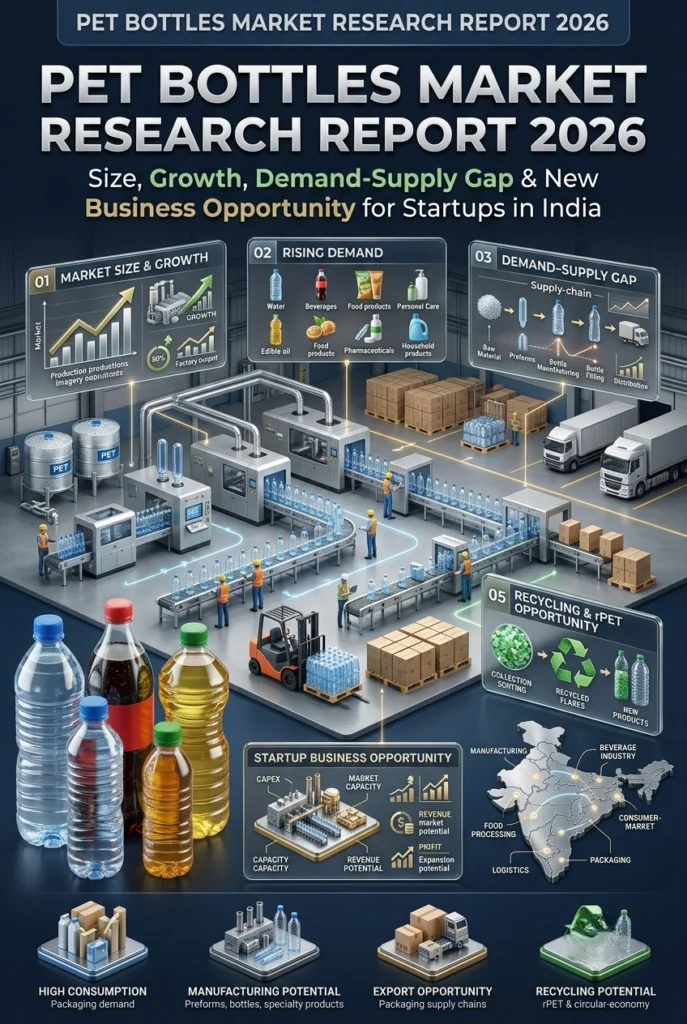
India Demand-Supply Gap: PET Bottles and rPET
| Parameter | Current Position |
| India PET resin consumption (FY2024-25) | ~1.9 million tonnes annually, growing 10–14% per year historically |
| PET bottle usage vs. rPET usage | Bottle usage ~1.9 MMT (FY24-25); recycled PET usage already at ~1.75 MMT (92% recycling rate for collected PET) — but this reflects existing informal + formal recycling, not the new EPR-compliant B2B supply chain |
| B2B rPET operational capacity | ~300,000 tonnes as of March 2025 |
| Regulatory requirement (FY25-26) | 30% recycled content mandatory in all PET packaging, implying a ~4 lakh MTPA (400,000 tonne) formal B2B rPET market in FY26 |
| Projected shortfall | Industry estimates a 20%+ capacity shortfall relative to compliance requirements by March 2025, even accounting for planned capacity additions |
| Regulatory trajectory | Recycled content requirement scales to 60% by FY2028-29, implying the formal B2B rPET market could reach 10-12 lakh MTPA (1.0-1.2 million tonnes) by then |
| Nature of the gap | A capacity-build gap with a fixed regulatory deadline — this is not a slow-moving structural trend but an accelerating, government-mandated demand curve that current recycling infrastructure has not caught up to |
Reading the Gap: This is one of the more time-sensitive opportunities profiled in this series. India already recycles a large share of its collected PET bottles through the informal sector, with roughly a 92% collection-and-recycling rate for collected PET. However, the growing demand for formal, food-grade, traceable rPET within B2B supply chains creates a very different and much smaller market. Brand owners increasingly need this high-quality rPET to meet EPR compliance requirements, and the market is expanding rapidly. Formal recycling capacity, however, still remains well below the level required to meet the growing regulatory demand. For an entrepreneur, that combination (hard mandate + rising percentage requirement + documented capacity shortfall) is about as clear a demand signal as manufacturing gets.
Major Indian PET Bottle, Resin, and rPET Manufacturers
| Company | Segment | Notes |
| Reliance Industries Limited | PET resin manufacturing | India’s largest integrated PET resin producer, with significant investment in recycling infrastructure to support EPR compliance |
| JBF Industries | PET resin manufacturing | Established Indian PET resin producer |
| Ganesha Ecosphere Ltd. | rPET recycling | Leading player in India’s B2B rPET capacity expansion, among the largest recycled PET resin producers in the country |
| Srichakra Polyplast | rPET recycling | Recognised leading player expanding rPET recycling capacity to meet EPR demand |
| Manjushree Technopack Limited | PET bottle/preform and rigid packaging manufacturing | Major Indian rigid plastic packaging company (Bangalore-based) with converting capacity of 175,000+ MT of PET, HDPE, and PP across nine plants; serves FMCG, dairy, liquor, food, pharma sectors |
| TPL Plastech | PET bottle, jar, and container manufacturing | India’s largest PET bottle, jar, and container company by market capitalisation as of 2024 |
| Hitech Corporation | PET bottle/container manufacturing | Second-largest Indian PET packaging company by market capitalisation |
| AG Poly Packs Private Limited | PET bottle manufacturing | Recognised Indian PET packaging manufacturer |
| JSK Plastic Industries | PET bottle manufacturing | Recognised Indian PET packaging manufacturer |
| A large base of regional preform/bottle converters | Maharashtra, Gujarat, Tamil Nadu (largest consuming/manufacturing states) | The MSME-scale entry tier — regional converters serving local FMCG, water, and pharma bottling demand |
Major International PET Resin and Recycling Players
| Company | Country | Notes |
| Indorama Ventures | Thailand | World’s largest integrated PET resin producer by volume; the company states that roughly one in five PET bottles worldwide is made using Indorama resin; active in India through its own operations and partnerships |
| Alpla Group | Austria | Major global rigid plastic packaging manufacturer, active in the India PET bottle market |
| Berry Global, Inc. | United States | Major global plastic packaging manufacturer with a significant presence in the India market |
| Loop Industries (technology partner) | Canada/United States | Developer of “Infinite Loop” proprietary chemical PET recycling technology, licensed for facilities including India-linked joint ventures |
| Veolia | France | Major global recycling and environmental services company, recently investing significantly in closed-loop PET recycling infrastructure |
| Amcor | Switzerland/Australia | Major global packaging company with significant PET packaging and recycling operations |
| Plastipak Packaging | United States | Global PET packaging and recycling technology company |
Market Segmentation
Value Chain Stage
- Virgin PET resin manufacturing
- PET preform manufacturing
- PET bottle/container blow-moulding
- rPET (recycled PET) processing — flakes, granules, and food-grade B2B resin
Application
- Beverages (bottled water, carbonated soft drinks, juices) — largest application segment
- Pharmaceuticals (oral rehydration solutions, blister packaging)
- Food packaging (edible oils, sauces, condiments)
- Personal care and household products
- Textiles and non-woven applications (recycled polyester fibre)
Capacity/Size
- Up to 500ml
- 500ml to 1 litre
- 1 to 2 litres
- Above 2 litres
Recycling Process
- Mechanical recycling — currently the dominant process in India
- Chemical recycling/depolymerization — emerging technology, increasingly relevant as recycled content requirements tighten toward 60%
Related Article: Plastics, Polymers and Resins Industry Consultants in India
Key Growth Drivers
- EPR required recycled content requirements. The one most important demand driver in this segment is a fixed regulatory schedule (30% now, 60% by FY29), which provides for a guaranteed escalating B2B rPET demand, irrespective of consumer sentiment or brand marketing decisions.
- Expanding beverage and packaged water industry. India’s growing bottled water and beverage consumption continues to drive underlying PET bottle volume growth, particularly in Tier-2/3 cities.
- Pharmaceutical packaging demand. PET’s quality, safety and cost profile is making it more and more attractive alternative to glass and aluminium in the oral rehydration solutions and other pharmaceutical liquid packaging market.
- Brand-owner sustainability commitments. Beyond the regulatory floor, there is demand pull from global and Indian beverage giants’ public pledges to increase the recycled content in their products, which will help drive up the market. Demand pull is also occurring as global and Indian beverage majors make commitments to increase recycled content in their products by 2030.
- Regulation clarity by 5FSSAI and BIS. Removal of critical barriers like approval for direct food contact and standardisation of the quality of recycled resin has paved the way for bottle-to-bottle recycling in India.
- Promotion of e-commerce and organised retail. There remains good underlying demand for PET packaging across categories, supported by growth in packaged goods distribution via e-commerce and modern retail.
Challenges and Restraints
- Capacity build lead times. New rPET recycling plants require significant time to stabilise operations and secure brand-owner quality approvals, meaning capacity additions consistently lag behind regulatory deadlines.
- Feedstock collection and traceability. While India has 200+ collection-cum-baling centres, ensuring consistent, traceable, food-grade-quality post-consumer PET feedstock remains an operational challenge, particularly as digital/blockchain-based supply chain traceability becomes increasingly important to brand owners.
- Informal sector transition. A meaningful share of India’s PET collection still runs through the informal sector; formalising this into the traceable, quality-verified supply chain required for B2B food-grade rPET requires deliberate investment.
- Raw material and feedstock price volatility. Both virgin PET resin (linked to crude oil-derived PTA/MEG feedstock) and post-consumer bottle feedstock prices are subject to volatility that affects margin predictability.
- Technology investment for chemical recycling. As recycled content requirements rise toward 60%, mechanical recycling alone may not sustainably meet quality and volume requirements, pushing the industry toward more capital-intensive chemical recycling/depolymerization technology.
Competitive Landscape
India’s preform and packaging converter market is highly fragmented. It includes large integrated players such as Manjushree Technopack, along with many regional MSME converters.
The rPET recycling segment, however, is still at a relatively early stage. It is dominated by a few scaling players, including Ganesha Ecosphere and Srichakra Polyplast. Virgin PET resin manufacturers, including Reliance Industries and Indorama-affiliated entities, are also investing directly in recycling infrastructure.
These investments help companies meet their own EPR mandates. They also support growing demand from other brand owners.
The segment has a documented capacity shortfall compared with regulatory requirements. As a result, it offers greater opportunities for well-capitalised new entrants. This opportunity is stronger than in the more mature bottle-manufacturing segment.
PET Bottle and rPET Manufacturing: Business Opportunity for Startups and MSMEs
- B2B food-grade rPET-manufacture. This is the singly most visible opportunity in the category, as capacity for rPET processing is already 20%+ short of EPR compliance requirements, and is expected to increase to 30%-60% recycled content.
- Collection and baling facilities for PET. There are currently 200+ collection-cum-baling centres in place and formal collection and pre-processing businesses are being established at the regional level, which can provide feedstock for larger rPET processors.
- Regional PET preform/bottle production. Packaging for local FMCG, water bottling and pharmaceutical products demand can be a good entry point given the low technology requirement and it is mostly in the untapped regional markets outside the popular manufacturing belt of Maharashtra, Gujarat and Tamil Nadu.
- Small scale PET recycling (flake/granule) plants. The model of discarded PET bottle recycling provided by PMEGP may provide a reduced capital start-up opportunity to PET bottle recycling compared to B2B food grade rPET production.
- Adoption of 5 chemical recycling/depolymerization technology. Entrepreneurs who invest early in more advanced recycling technology (compared to mechanical recycling) could be in a better position to meet the highest quality part of the future demand as recycled content requirements approach 60%.
Assumption Flag: Investment and margin figures for PET bottle and rPET manufacturing can vary significantly based on the business’s position in the value chain, such as preform manufacturing, mechanical recycling, or B2B food-grade rPET production, as well as the targeted production capacity. NPCS offers detailed project reports that include technology-specific machinery lists, FSSAI and BIS compliance guidance, and financial forecasts for businesses targeting opportunities in the EPR market. These reports can be tailored to your specific target segment and production capacity.
Instantly discover profitable startup opportunities tailored for you
How NPCS Supports Entrepreneurs Entering This Space
Creating a Detailed Project Report (DPR) is the first step for any entrepreneur considering a PET bottle manufacturing or rPET recycling business in which they plan to invest; a DPR should cover plant capacity, technology selection (preform/blow-moulding vs. mechanical/chemical recycling), sourcing of raw materials and feeds, manpower planning, project cost and financial viability of the activity, based on the type of value-chain position and the target market.
About NPCS (Niir Project Consultancy Services)
Since its inception in 1994, NPCS is a New Delhi based industrial consultancy, a ISO 9001:2015 certified organisation with more than 30 years of experience in the field of techno-economic and project consultancy. For 30 years, NPCS has provided over 150,000 project reports and profiles in 85 countries and across essentially all manufacturing and process industries, including plastic packaging, polymer processing and circular economy/recycling businesses.
NPCS has three integrated platforms:
- niir.org — the primary repository of industry-specific Detailed Project Reports, business plans, and techno-economic feasibility studies
- entrepreneurindia.co — market research, project profiles, and manufacturing business opportunity content aimed at entrepreneurs and MSMEs
- npcsblog.com — industry insight, trend analysis, and manufacturing sector commentary
The following are some of NPCS’ main deliverables related to an NPCS PET bottle/rPET business venture:
- Detailed Project Reports (DPRs) with plant capacity, machinery specifications and layout
- Techno-economic feasibility studies, which include the guidance for compliance with FSSAI and BIS for the processing of rPET
- Financial modelling – project cost, profit analysis, ROI, and break-even analysis.
- This entails a raw material and market assessment tailored to Indian EPR compliance demand and regions’ bottle markets. This includes raw material and market assessment specific to Indian EPR compliance demand and regions’ bottle markets.
- Support documents for MSME application, subsidy schemes, bank funding needs etc.
A custom feasibility study is available for this sector for different value-chain businesses and capacities – you can request these or view relevant PET bottle and recycling manufacturing profiles directly on the niir.org website or entrepreneurindia.co website.
Government and Institutional Reference Links
- Ministry of Environment, Forest and Climate Change (MoEFCC) — Plastic Waste Management Rules/EPR
- Central Pollution Control Board (CPCB) — EPR Portal
- Food Safety and Standards Authority of India (FSSAI)
- Bureau of Indian Standards (BIS)
- Ministry of Micro, Small and Medium Enterprises (MSME)
- Development Commissioner, MSME (DCMSME)
- Press Information Bureau (PIB), Government of India
- Startup India
- Invest India (National Investment Promotion and Facilitation Agency)
Entrepreneurs are advised to verify the latest EPR recycled-content thresholds, FSSAI food-grade rPET approval procedures, and MSME subsidy guidelines directly on these portals, as regulatory provisions and compliance deadlines are periodically revised.
Conclusion
PET bottles and recycling represent one of the most time-critical opportunities highlighted in this series. The sector combines two important business segments. The first is the well-established and growing bottle and preform manufacturing industry. The second is the newer, regulation-driven market for food-grade rPET used in B2B applications.
The rPET recycling opportunity is particularly attractive for entrepreneurs who can move quickly. Food-grade rPET is currently under-supplied, and the industry faces a documented capacity shortfall. At the same time, compliance deadlines are creating fixed and predictable demand.
This opportunity is especially strong because clearly defined regulatory requirements, strong brand-owner offtake interest, and an existing supply gap create a favorable market environment. Current recycling capacity cannot fully meet the expected demand. Entrepreneurs who establish capacity quickly may therefore benefit from a significant market opportunity.
PET bottle production and rPET recycling present some solid volume growth for entrepreneurs and MSMEs as well as an actual policy-driven need to build capacity.