


Odisha’s Paradip Critical Mineral Park
India’s industrial landscape is undergoing a transformation and the ink hasn’t even dried. On 22 July 2026, the Economic Times Manufacturing reported that Odisha is intending to build a dedicated Critical Mineral Processing Park in the city of Paradip, which is one of the most strategically located industrial hubs on the country’s eastern coast that is linked to the ports. It’s not a far-off statement of intent. The land has already been reserved. Road maps for implementation are being developed. And the Centre has allocated ₹500 crore in the National Critical Mineral Mission (NCMM) for just these facilities.
This is a sign of something more than a government infrastructure project. It provides Indian start-ups, MSMEs, and industrial entrepreneurs with a visible, near-term manufacturing opportunity in sectors, which are in high demand in global supply chains, such as lithium refining, cobalt processing, graphite purification, separation of rare earth elements (REEs), advanced manufacturing of components using minerals etc.
For entrepreneurs who have been eyeing the development of the critical minerals sector, the Economic Times report today could hardly be a better indicator than that: they’re building the infrastructure. The anchor investment is secured. A question that comes next is: Will you be ready to provide, transform, or contribute to the ecosystem that follows?
Get Detailed Project Report (DPR): Odisha Business Opportunities & Startup Guide
What Recent Economic Times Reporting Means
The Economic Times today reported that the government has identified Odisha, along with Gujarat, Telangana, and Maharashtra, as one of four Indian states to set up critical mineral value-processing plants under the NCM. The Paradip facility is of special importance for three reasons.
First, Paradip is already a deep-draft, high throughput port to serve mineral-rich hinterlands of Odisha, Jharkhand, and Chhattisgarh, with its direct connectivity. It’s a convenient place to export processed minerals to Asian markets, including China, Japan, and Korea.
Secondly, Odisha already has IOCL’s 15 MMTPA Paradip Refinery, a Plastics Park and is in the process of developing a PCPIR (Petroleum, Chemicals, Petrochemicals Investment Region) similar to the Jurong Complex in Singapore. The critical mineral park fits into this ecosystem, establishing a real industrial cluster.
Thirdly, currently India is heavily reliant on imports and overseas processing for strategic minerals.
This park meets the need for dependable mineral processing, and every processing unit built inside it gives manufacturers, startups, and MSMEs an opportunity to enter a market with guaranteed demand.
Economic Times reporting today is not just news for businessmen, it’s business intelligence alert for manufacturing entrepreneurs. For the complete story, check out ET Manufacturing – Odisha Critical Mineral Processing Park, Paradip
Why This Industry Is Growing — And Growing Fast
The raw materials required for the modern economy are known as critical minerals. Lithium is used in EV batteries. Cobalt helps prolong battery life. Graphite is one of the important anode materials. Nickel is used as an alloying agent in the aerospace industry. Rare earth elements are used in magnets for wind turbines, electric motors and defence electronics. These minerals are essential for any green energy system, every next generation semiconductor and each next generation defence asset.
India is a vulnerable nation as is well known. The country is also highly dependent on China for its processed critical minerals imports, with China having approximately 60-80% of the world’s processing facilities for a number of critical minerals. The NCMM’s mission plan for seven years and ₹34,300 crore directly challenges this dependency. One of the earlier physical manifestations of that mission is the Paradip park.
Economic Times has been closely monitoring this market for the past year (2025–26), covering block auctions, KABIL’s acquisition of lithium in Argentina, and India’s efforts to eliminate customs duties on essential mineral imports. Paradip’s announcement of a park today is the next step — from exploration to processing infrastructure.
Government Policies and Incentives You Must Know
The policy framework for this sector is exceptionally good. New entrepreneurs in the critical mineral processing sector have strong regulatory and financial support for their ventures.
National Critical Mineral Mission (NCMM): Outlay of ₹34,300 crore over 7 years. Spans end-to-end value chain, from exploration to recycling. Direct allocation of funds for processing parks of ₹500 crore/particular.
Union Budget 2024-25: Customs Duty Elimination: Customs duties were removed on many critical minerals. This significantly reduces raw material input costs to processors.
MOM started this initiative under the S&T PRISM Program me to provide funding to start-ups and MSMEs and bridge the R&D-to-commercialization gap in critical mineral processing.
Credit Guarantee and Technology Upgradation Funds for MSMEs, and incubation support from the MSME Ministry, can be availed by the entrepreneurs, and the Startup India scheme allows the entrepreneurs to register their start-ups for tax exemptions and to match them with investors.
Make in India’s shift towards advanced manufacturing dovetails with this area. The Centre and state’s investment policy, coupled with the location on the port, makes for a unique policy-infrastructure synergy. This is a phase that startups in capital intensive businesses look forward to.
Manufacturing Business Ideas for Startups — Born from the ET News Signal
Each below manufacturing idea is directly linked to the paradigm park development. These are not “generic” start-up ideas, these are gaps that the park ecosystem will need.
1. Lithium Carbonate Purification Unit
The requirement for India is for battery-grade lithium carbonate (99.5% +). The placement of a purification unit in the park at Paradip or around the park puts one of the founders at the front of the first gap in the supply. Import of raw lithium brine and spodumene are now duty-free. Investment: ₹3 to 10 crore for a pilot scale unit. Target customers: Gujarat and Tamil Nadu battery manufacturers.(Odisha’s Paradip Critical Mineral Park)
Get Detailed Insights from This Book: Handbook on Production, Recycling of Lithium-Ion and Lead-Acid Batteries
2. Spherical Graphite Manufacturing Plant
India has deposits of natural graphite in Odisha. India virtually imports the valuable processing step that transforms raw graphite into spherical graphite for lithium-ion battery anodes from China. Spherical graphite production plant near Paradip: Near the raw material sources and connected to the port for shipment. Market Opportunity: Global demand for spherical graphite could exceed 1 million tons by 2030.
3. Cobalt Sulphate Manufacturing for Battery Precursors
Cobalt sulphate is a key input for NMC (Nickel Manganese Cobalt) battery cathode precursors. India’s battery manufacturing ambitions — driven by PLI schemes — depend on domestic cobalt processing. A cobalt sulphate refinery unit, even at MSME scale, can supply battery cell manufacturers and earn premium pricing for battery-grade output. Regulatory pathway: accessible through DPIIT’s industrial licensing framework.(Odisha’s Paradip Critical Mineral Park)

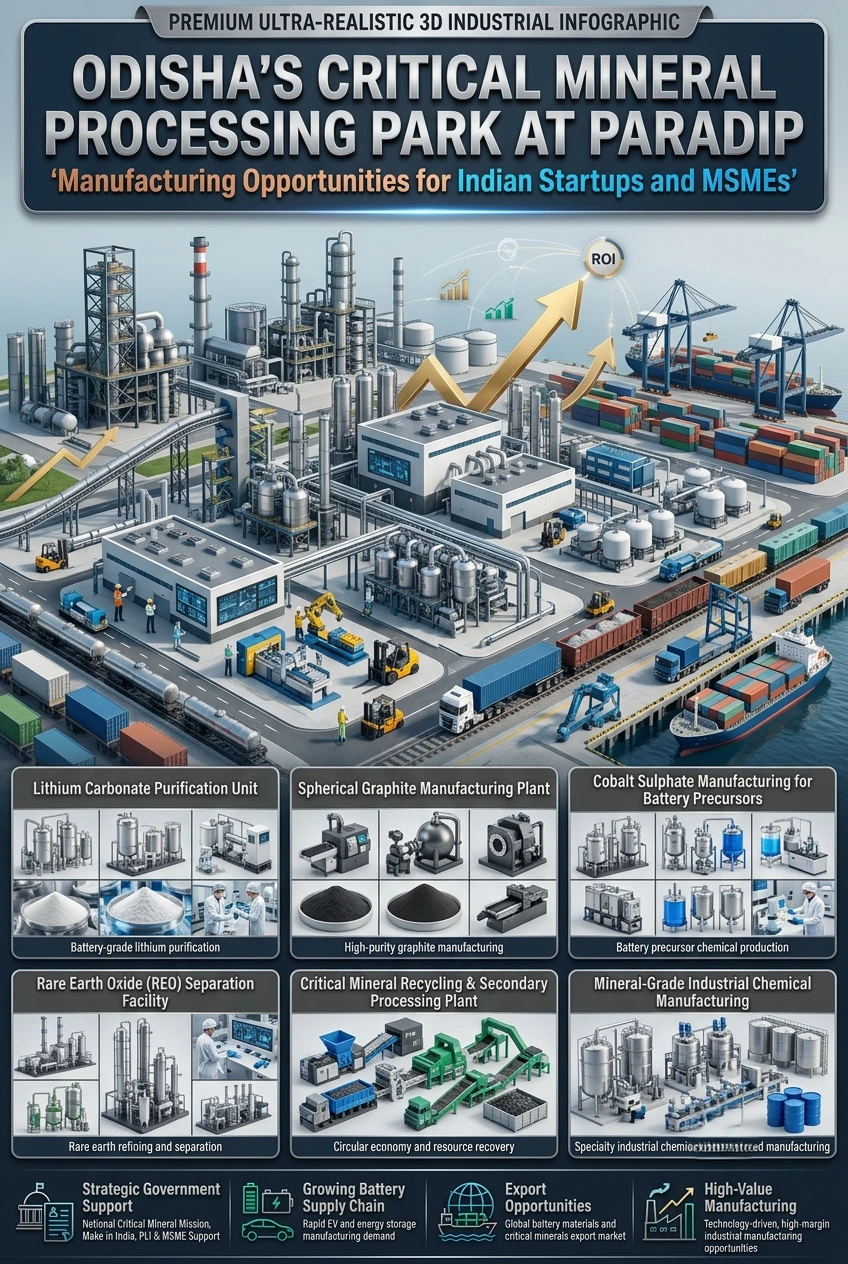
4. Rare Earth Oxide (REO) Separation Facility
India is one of the world’s top five holders of rare earth reserves, yet exports ore and imports refined REOs. A separation and refining facility for neodymium, praseodymium, and dysprosium — elements critical for permanent magnets in EVs and wind turbines — represents a manufacturing opportunity of generational scale. The Paradip park’s strategic designation could provide preferential land and utility access for such a facility.
Related Article: India’s Rare Earth Revolution: 6 Business Opportunities MSMEs Cannot Afford to Miss
5. Critical Mineral Recycling and Secondary Processing Plant
The NCMM explicitly includes recovery from end-of-life products. Building a facility that recovers lithium, cobalt, and nickel from used EV batteries, industrial scrap, and electronic waste is both environmentally sound and commercially lucrative. India’s rapidly growing EV fleet will generate significant battery waste within 5–7 years. Founders who build recycling infrastructure now will be well-positioned when that wave arrives.
6. Mineral-Grade Industrial Chemical Manufacturing
Critical mineral processing requires high-purity industrial chemicals — hydrochloric acid, sulphuric acid, ammonium solutions, and specialty reagents. A chemical manufacturing unit supplying these inputs to the Paradip park’s processors is a B2B manufacturing play with predictable, industrial-scale offtake. Given the Paradip PCPIR’s existing petrochemical infrastructure, feedstock for such a unit is physically proximate.
Import–Export Opportunity Analysis
The Paradip location is not incidental. It is a deliberate strategic choice. Paradip Port, with its deep-draft berths and dedicated railway connectivity to mineral belts, allows processors to:
- Import unprocessed mineral concentrates from KABIL’s overseas acquisitions (Argentina, Australia, Africa) with minimum logistical cost.
- Export refined, value-added minerals to Japan, South Korea, and Southeast Asian battery and electronics manufacturers at premium prices.
- Serve domestic battery, semiconductor, and defence manufacturing clusters in a domestic market growing at double-digit rates.
For export-oriented manufacturers, the Directorate General of Foreign Trade (DGFT) under www.dgft.gov.in provides export licensing frameworks and advance authorisation schemes specifically relevant to processed minerals. Manufacturers should also explore export incentives under the Remission of Duties and Taxes on Export Products (RoDTEP) scheme.(Odisha’s Paradip Critical Mineral Park)
Indian MSME Success Stories: Learning from the Ground Up
India already has MSMEs building capability in adjacent sectors that illustrate the commercial viability of entering mineral processing:
Indian Metals & Ferro Alloys Ltd (IMFA), Odisha: A decades-old example of how mineral processing in Odisha can achieve global competitiveness. IMFA’s ferrochrome operations supply global stainless-steel manufacturers — a template for what critical mineral processors can replicate.
Vedanta’s MSME Ecosystem, Jharsuguda: Vedanta is establishing Aluminium Parks near its Odisha plants, explicitly designed to attract downstream MSMEs for high-end alloy manufacturing. This shows the anchor-MSME model works in Odisha’s industrial ecosystem.
Battery Recycling Startups, Pan-India: Success stories of companies like Attero & Lohum reveal that recovery of secondary minerals from e-waste, in fact, is an attractive business proposition in India. A success case – proof of concept of a much larger e-waste recycling opportunity at Paradip.
Choose the right startup backed by real market demand
How NPCS (Niir Project Consultancy Services) Supports Entrepreneurs in This Sector
Entering capital-intensive industrial sectors like critical mineral processing requires detailed feasibility intelligence. NPCS Niir Project Consultancy Services is a top industrial consulting and project report India with 3 decades of industry experience of Techno-economic feasibility, Market survey and Manufacturing processes for Mining & mineral sector, Chemicals industry, Metals & Metalliferous Products, and Specialty and Value-Added Materials.(Odisha’s Paradip Critical Mineral Park)
If an entrepreneur wants to venture into Paradip Critical Mineral Processing Park, NPCS offers sector specific project reports such as plant layout and machinery list, cost of raw materials, regulatory compliances and feasibility study reports with detailed financial details. These reports support bank financing, investor presentations, and government scheme applications, making them a practical entry point for any founder serious about this sector.
Critical Mineral Manufacturing Opportunity at a Glance
| Mineral Segment | Key End-Use Sectors | MSME Investment Range | Paradip Advantage |
| Lithium Carbonate Purification | EV Batteries, Energy Storage | ₹3–10 Crore | Port import of raw material, export of battery-grade product |
| Spherical Graphite | Battery Anodes (Li-ion) | ₹5–15 Crore | Local graphite deposits, direct Asian export route |
| Cobalt Sulphate | NMC Battery Cathodes | ₹8–20 Crore | Duty-free imports, proximity to battery PLI clusters |
| REO Separation | Wind Turbines, EV Motors, Defence | ₹15–50 Crore | India’s large domestic REE reserves; export premium |
| Critical Mineral Recycling | EV Battery Recovery, E-Waste | ₹2–8 Crore | NCMM policy backing; growing domestic waste stream |
| Mineral-Grade Chemicals | Processing Support Industry | ₹1–5 Crore | Paradip PCPIR feedstock proximity; guaranteed B2B offtake |

Frequently Asked Questions (FAQs) — Founder Edition
Q1. What is the National Critical Mineral Mission (NCMM) and how does it help manufacturers?
The NCMM is a ₹34,300 crore, seven-year government mission covering the full critical mineral value chain — from exploration through processing to recycling. For manufacturers, it provides financial support for processing parks (₹500 crore already earmarked), fast-track regulatory approvals for critical mineral projects, and the S&T PRISM fund specifically for startups and MSMEs developing processing technology.
Q2. Do I need prior mining experience to enter the Paradip critical mineral processing sector?
No. Processing is a distinct industrial activity from mining. You can import mineral concentrates (now with zero or low customs duty) and build a purification or refining business without owning any mining blocks. The highest-value steps — purification, separation, and component manufacturing — are open to industrial entrepreneurs with chemical or metallurgical manufacturing backgrounds.
Q3. How do I identify the right business idea within critical minerals for my budget?
Start by mapping your existing manufacturing capabilities to mineral processing steps. Chemical industry players suit lithium purification or cobalt sulphate production. Engineering fabricators can enter equipment supply for the park. MSMEs in waste management can pivot to battery recycling. Your entry point should leverage existing assets — location, equipment, team skills — rather than building from zero.
Q4. What government schemes support MSMEs entering critical mineral manufacturing?
Key schemes include Credit Guarantee Fund Trust for MSMEs (CGTMSE) for collateral-free loans, Technology Upgradation Fund Scheme (TUFS) for plant modernisation, PLI schemes for battery manufacturing, and Startup India tax exemptions for registered startups. Mineral-specific support flows through the NCMM’s S&T PRISM programme. Visit www.msme.gov.in and www.startupindia.gov.in for current eligibility criteria.
Q5. Is the critical mineral sector open to private sector manufacturers or only PSUs?
It is explicitly open to the private sector. The NCMM’s framework encourages Indian PSUs and private companies equally to acquire overseas assets and build domestic processing capabilities. The Paradip park will need private manufacturers — processors, recyclers, chemical suppliers, equipment fabricators, and logistics providers — to function as a complete industrial ecosystem.
Q6. How does Paradip’s location benefit a critical mineral processor specifically?
Paradip provides direct port access for raw material imports from KABIL’s overseas mining acquisitions in South America and Africa. It sits closest to Odisha, Jharkhand, and Chhattisgarh — India’s richest mineral belts. Railway connectivity directly links mining regions to the port. And the PCPIR’s existing petrochemical infrastructure provides nearby feedstock for chemical processing operations. Few industrial locations in India offer this convergence.
Conclusion: The Window is Open — Act Before the Ecosystem Fills
Economic Times’ reporting today on Odisha’s Critical Mineral Processing Park at Paradip marks a genuine inflection point for Indian industrial manufacturing. The Centre has committed funds. The state has allotted land. The port infrastructure is in place. The policy framework — NCMM, duty eliminations, S&T PRISM, Startup India, make in India — is fully operational.
What remains is for manufacturing entrepreneurs, MSME founders, and startup builders to move. The critical minerals sector does not reward late movers. Anchor tenants attract secondary suppliers. Early processors lock in long-term offtake agreements. Equipment manufacturers establish vendor relationships before alternative suppliers arrive. The ecosystem fills up quickly once anchor investment is confirmed—and in Paradip, it has now been confirmed.(Odisha’s Paradip Critical Mineral Park)
India’s dependence on Chinese mineral processing is not a permanent condition. It is a market gap waiting for Indian manufacturers to close. If the Economic Times signal from today tells you anything, it is this: the government has done its part. Now it is your turn.
Explore government support for your manufacturing venture: Make in India | Invest India | DPIIT