


Published on Entrepreneur India | Category: Agribusiness & Food Processing
The Quiet Revolution in Indian Mushroom Farming
There was a time when mushrooms were considered a luxury item in India, something you ordered at a five-star hotel or spotted occasionally at a metropolitan supermarket. That perception has changed dramatically over the past decade. Today, mushroom farming is one of the fastest-growing agribusiness segments in the country, supported by government policy, rising consumer health awareness, and a booming processed food market.
The Government of India has formally declared mushroom cultivation a major thrust area under its agricultural development priorities. Urban consumers increasingly seek high-protein, low-calorie food options, and mushrooms tick every box — rich in vitamins, minerals, and plant-based protein while being naturally low in fat and carbohydrates. For entrepreneurs, farmers, and food processing businesses, few sectors offer the combination of low capital requirement, quick returns, and rising demand that mushroom cultivation does.
Market Demand & Growth: Why Mushrooms Are Booming
India’s mushroom production has grown several times over in recent years. According to the Ministry of Agriculture & Farmers Welfare, the country’s mushroom output has been rising consistently, driven by demand from urban households, hotels, restaurants, and the export market.
Globally, the edible mushroom market is valued at over USD 50 billion and is projected to grow at a compound annual growth rate (CAGR) of around 7–8% through the end of the decade, according to FAO data on Indian food production. India is uniquely positioned to capture a meaningful share of this growth, given its large agricultural base, abundant lignocellulosic agricultural waste (ideal for mushroom substrate), and a growing network of MSME food processing units.(Mushroom cultivation business in India)
Three commercial mushroom species dominate Indian cultivation: Agaricus bisporus (white button), Volvariella volvacea (paddy straw mushroom), and Pleurotus sajor-caju (oyster mushroom). Each has its own market segment — button mushrooms command premium pricing in urban markets, oyster mushrooms are increasingly popular in East and South India, and paddy straw mushrooms are integral to rural food culture in several states.
Key Market Drivers
- Rising health consciousness among urban consumers seeking plant-based protein
- Rapid growth of the organised food service sector (QSR, hotels, packaged food)
- Government support through schemes like PMEGP, MUDRA, and National Horticulture Mission
- Export demand for dried and canned mushrooms from Gulf countries, Europe, and Southeast Asia
- Low gestation period — most mushroom crops mature in 30–45 days
Business Opportunities in the Mushroom Value Chain
What makes mushroom cultivation particularly attractive for MSMEs and rural entrepreneurs is the breadth of business opportunities along the value chain. It is not just about growing mushrooms — processing, preservation, and value-added products open up entirely new revenue streams.(Mushroom cultivation business in India)
According to Invest India’s Food Processing Sector profile, food processing is one of the highest priority sectors under the Make in India initiative, with significant incentives available for entrepreneurs entering mushroom-based processed food production.
Fresh mushrooms have an extremely limited shelf life — they must be consumed or processed within hours of harvesting. This biological reality creates a strong and constant demand for processing infrastructure. Entrepreneurs who can dehydrate, preserve, or can mushrooms effectively are not just solving a logistical problem — they are unlocking access to pan-India and export markets where fresh mushrooms simply cannot reach.
Processing-Based Business Opportunities
- Dehydrated mushroom production for retail and food service supply chains
- Canned mushrooms for export and institutional catering
- Mushroom powder and extract for nutraceuticals and pharma
- Mushroom-based ready-to-eat (RTE) products
- Spawn production units supplying raw material to cultivators
- Composting and substrate manufacturing for mushroom farms
The Challenges New Entrants Face — and Why Knowledge Matters
Despite its promise, mushroom cultivation is not without its complexities. Many new entrepreneurs stumble at the same hurdles: incorrect substrate preparation, contamination from competing fungi, inadequate understanding of spawn requirements, poor post-harvest handling, and failure to integrate processing into the business plan.
Unlike conventional vegetable farming, mushroom cultivation requires precise environmental controls — temperature, humidity, light cycles, and substrate sterilisation must all be managed carefully. The difference between a successful mushroom farm and a failed one often comes down to the quality of technical knowledge the entrepreneur starts with.(Mushroom cultivation business in India
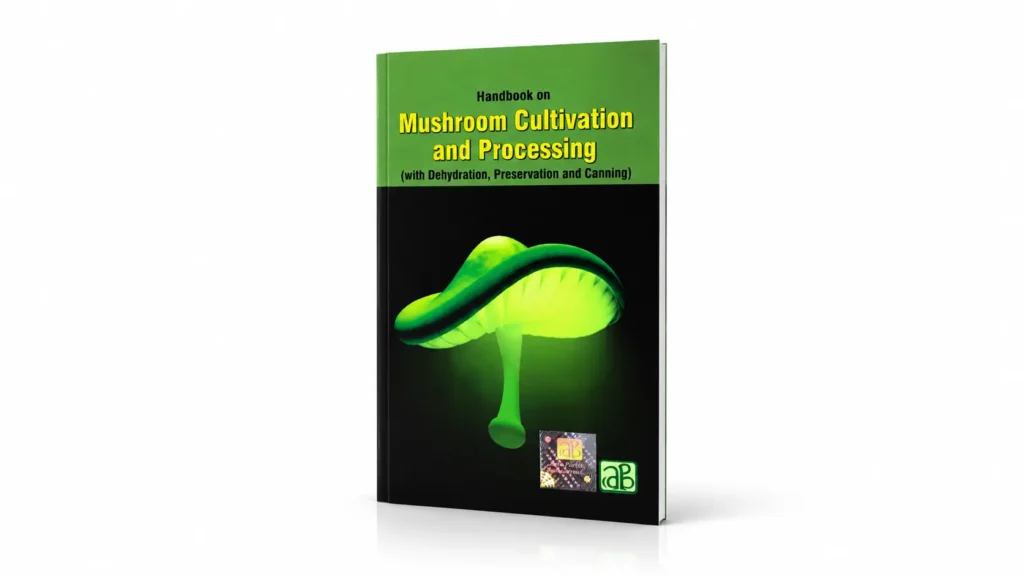
This is exactly where a comprehensive, technically sound reference guide becomes invaluable. And few resources are as thorough — or as practically oriented — as the Handbook on Mushroom Cultivation and Processing published by NPCS.
About the Book: Handbook on Mushroom Cultivation and Processing (with Dehydration, Preservation and Canning)
Author: NIIR Board of Consultants and Engineers | Publisher: Asia Pacific Business Press Inc. Pages: 544 ISBN: 978-81-7833-034-1 | Price: ₹1,275 / USD 33.95
This 544-page handbook is one of the most comprehensive technical and commercial references available for anyone entering the mushroom industry — from a first-time farmer setting up a small unit to a food processing entrepreneur looking to scale mushroom-based value-added products.
The book begins where every cultivator needs to begin: understanding the biology of mushrooms. It covers the nutritive value of edible mushrooms in detail — fresh mushrooms contain around 85% water and 3.2% protein, while dried mushrooms carry protein levels of 34–44% with fat content below 0.3%. This nutritional density is precisely what is driving modern consumer demand, and the book gives readers a firm scientific foundation to appreciate why.
What the Book Covers
- Nutritive and medicinal value of edible mushrooms — from protein content to their documented health benefits
- Morphology and classification of fungi — understanding species differences before cultivating them
- Chemical composition, anti-nutritional factors, and shelf-life characteristics
- Osmotic dehydration characteristics of button mushrooms — a scientifically detailed treatment of moisture reduction techniques
- Full cultivation methodology — substrate preparation, spawning, casing, pinning, and harvesting
- White button mushroom (Agaricus bisporus) cultivation in complete technical detail
- Factors determining spawn quantity requirements — helping entrepreneurs avoid costly over- or under-inoculation
- Fungicide applications for disease management and insecticide use for pest control
- Processing and canning of multiple mushroom species
- Dehydration and preservation techniques for shelf life extension
What sets this book apart is that it does not separate cultivation from processing. Most agricultural guides focus on growing; this handbook treats the entire value chain as a connected enterprise. Understanding how to grow mushrooms without knowing how to preserve, dry, or can them leaves an entrepreneur only halfway prepared. This book closes that gap entirely.(Mushroom cultivation business in India)
Why This Book Is Genuinely Useful for Entrepreneurs and Farmers
The NPCS handbook has been compiled by a board of consultants and engineers with decades of experience in food and agro-industrial project preparation. This means the content is not theoretical — it reflects the practical realities of setting up and running mushroom operations at different scales.
A beginner who has never cultivated mushrooms will find the step-by-step cultivation guidance accessible and thorough. An experienced farmer who wants to add processing capabilities will find the dehydration and canning sections technically precise and commercially relevant. A consultant preparing a project report for a bank loan will find the technical parameters they need to build a credible feasibility study.
In a sector where misinformation is common and access to reliable technical guidance is limited, a 544-page handbook prepared by domain experts is genuinely valuable. The book’s treatment of mushroom diseases, pest management, and environmental controls reflects hard-earned institutional knowledge that would otherwise take years to accumulate through trial and error.
For entrepreneurs interested in export potential, APEDA’s agricultural export data confirms that processed mushroom products, including dried and canned varieties, are among India’s growing agro-processed export categories. The processing knowledge in this book directly enables entrepreneurs to meet the quality and shelf-life standards required for export markets.
Who Should Buy This Book
This handbook has been designed as a resource for the agricultural and food processing community broadly, but it will be most valuable for:
- Aspiring mushroom farmers and agri-entrepreneurs looking to set up cultivation units
- Existing vegetable farmers exploring diversification into high-value crops
- Food processing MSMEs interested in adding mushroom-based products to their portfolio
- Students and researchers in agriculture, food technology, and plant sciences
- Consultants and project report preparers working on agri-processing proposals
- Agri-universities and extension workers training rural farmers
- Investors evaluating entry into the food processing sector
- Hotel and food service buyers who want to understand supply chain and quality parameters
The Ministry of MSME actively promotes food processing as one of the most viable segments for new enterprise creation under various credit-linked subsidy schemes. If you are exploring mushroom cultivation as a business under PMEGP or MUDRA, this book provides the technical backbone your project report will need.(Mushroom cultivation business in India)
Why This Book Is Worth Buying
At 1,275, this book costs less than a single consultation with a technical expert — yet it contains knowledge that would ordinarily require extensive field experience or expensive training to accumulate. The 544 pages cover the complete mushroom enterprise lifecycle, from spore to shelf.
Consider what a new entrepreneur typically spends chasing fragmented knowledge: browsing agricultural websites, attending workshops, consulting local extension officers. Much of that guidance is either generalised or incomplete. This handbook brings together everything into a single, referenced, structured resource.
The treatment of dehydration technology is particularly worth highlighting. Osmotic dehydration is one of the most commercially important methods for extending mushroom shelf life — it determines whether a grower can sell to local markets only or reach distant cities and export buyers. The book’s detailed treatment of this subject alone could justify the purchase for any entrepreneur planning a processing unit.
Recommend This Book To
- Agricultural colleges and university libraries — as a curriculum-support reference
- Rural entrepreneurship trainers under NABARD and state agriculture departments
- MSME development institutes and District Industries Centres
- Food technology institutes teaching applied food science
- Individual farmers in Himachal Pradesh, Uttarakhand, Punjab, Maharashtra, and Telangana — states with established or emerging mushroom cultivation traditions
Get Your Copy Today
If you are serious about mushroom cultivation or processing as a business, this handbook belongs on your desk. Whether you are a first-time farmer, an MSME operator expanding into food processing, or a consultant building a project report, the Handbook on Mushroom Cultivation and Processing delivers the technical depth and commercial relevance you need.
Purchase from:
NPCS Website: niir.org — Buy from NPCS
Amazon India: amazon.in — Buy on Amazon
Flipkart: flipkart.com — Buy on Flipkart
Price: ₹1,275 (India) | USD 33.95 (International) | 544 Pages | ISBN: 978-81-7833-034-1

Frequently Asked Questions (FAQ)
Q1. Is mushroom cultivation profitable as a small business in India?
Yes, mushroom cultivation is among the most capital-efficient agribusinesses available to small entrepreneurs. The initial investment is relatively low, the crop cycle is short (30–45 days for most species), and demand is consistent throughout the year. Adding processing capabilities — dehydration or canning — significantly increases profitability by extending shelf life and enabling access to distant markets.
Q2. Which mushroom species are best suited for commercial cultivation in India?
India commercially cultivates three main species: Agaricus bisporus (white button mushroom), Volvariella volvacea (paddy straw mushroom), and Pleurotus sajor-caju (oyster mushroom). Button mushrooms are the most widely cultivated and command strong urban market prices. Oyster mushrooms are gaining ground due to their adaptability to warmer climates and agricultural waste substrates.
Q3. What is osmotic dehydration and why is it important for mushroom businesses?
Osmotic dehydration is a food preservation method. It removes moisture from mushrooms by soaking them in a concentrated solution. Water moves out through osmosis, and then the mushrooms are further dried. It is commercially important because it extends shelf life from a few hours (for fresh mushrooms) to several months. This enables wider distribution and export. The handbook covers this topic in considerable technical depth.
Q4. Can this book help me prepare a project report for a bank loan or PMEGP application?
The book provides the technical foundation for a mushroom cultivation or processing project report. It covers production parameters, species selection, substrate requirements, equipment needs, and processing methods. For a complete PMEGP or bank loan DPR, you can combine it with a formal techno-economic feasibility study. This study can be obtained from a consultancy such as NPCS.
Q5. Is mushroom cultivation suitable for landless or small farmers?
Mushroom cultivation is well suited for landless or resource-constrained farmers. It does not require agricultural land. It can be done in a controlled indoor environment. Agricultural waste as a substrate. The Government of India recognizes mushroom cultivation as a thrust area. This reflects its potential to generate rural income and create employment.
References & Authentic Data Sources
- Food and Agriculture Organization (FAO) — India Agricultural Data
- Invest India — Food Processing Sector
- APEDA — Agricultural and Processed Food Products Export
- Ministry of MSME — Schemes and Support for Micro Enterprises