


One Approval. 2,427 Jobs. A Ripple That Reaches Every Tier-2 Supplier in Tamil Nadu.
The Unit Approval Committee (UAC) of MEPZ Special Economic Zone cleared 11 investment proposals of ₹443.11 crore on one sitting in August. These 2,427 projects are projected to create direct employment in Tamil Nadu, Andaman, and Puducherry. On average, every direct job created in a Special Economic Zone supports 3–5 provider or indirect jobs that support the anchor business. This one MEPZ approval could indirectly help 7,000 to 12,000 livelihoods in the MSME manufacturing corridor of the state.
The three anchor projects are a good story. German industrial conglomerate ZF Group’s ₹3.5-lakh-crore subsidiary ZF Industrial Technology Coimbatore Pvt Ltd is investing ₹336.13 crore in a new plant at Aspen Park Infra, Coimbatore. Global electronics manufacturing services (EMS) provider Sanmina-SCI India Pvt Ltd has passed the stage of getting approval for a plant in SIPCOT Hi-Tech SEZ, Oragadam, Sriperumbudur with a capacity to create 1,350 jobs. And Visionet Systems is infusing ₹11.31 crore into ELCOT SEZ, Vilankurichi, Coimbatore. Three projects. Three districts. The Tamil Nadu SEZ manufacturing cluster is in the middle of a serious buildout; and that buildout requires local MSME suppliers, fabricators, service providers and component makers to operate.
Access Complete Business Plan: Tamil Nadu Business & Investment Opportunities
The Supply Gap That Large Units Cannot Fill Themselves
As with most startups, Sanmina-SCI’s first-generation founders had a lot to learn, and one of the most important lessons is that a company such as the manufacturer of circuit boards and electronics assemblies for OEMs worldwide simply won’t have its own structural packaging materials, precision-machined fasteners, cable harnesses, printed labels, or industrial cleaning chemicals, etc. These are directly related to vendor sourced inputs and are almost always sourced locally to ensure quick delivery and low transport cost. This Oragadam-Sriperumbudur-Irungattukottai belt alone has more than 200 Tier-1 and Tier-2 manufacturers but according to the Guidance Tamil Nadu data, there are 57 lakh MSMEs in the state which contributes to 8.4% of national GDP in the economy which is the second largest in India. Even at that density, the procurement managers at large SEZ units constantly say that they are experiencing difficulties finding precision components, specialty packaging, and industrial consumables locally.
This is aggravated by the import dependency issue. Currently, India imports a large portion of industrial fasteners, specialty adhesives, and precision sheet-metal subassemblies from China, Taiwan and South Korea. Areas of domestic substitution identified by the Ministry of Commerce are ancillary manufacturing. Coimbatore, Kancheepuram, Thiruvallur, and Ranipet have the lowest Tier-2 vendor capacity at the district level compared with the demand being tapped through SEZs. An initial founder who launches an ancillary manufacturing business in these four districts now is not going to have to compete with existing businesses, but rather they are filling a void that the anchor businesses actively seek.
TABLE 1: State-wise Demand Concentration and Key Industrial Clusters
| District / Region | Anchor SEZ / Park | Primary Manufacturing Focus | MSME Vendor Gap | Key Buyers in Zone |
| Coimbatore | Aspen Park Infra SEZ | Industrial technology, wind energy, precision engineering | Sheet metal, industrial seals, cable assemblies | ZF Industrial Technology, Pricol, Roots Group |
| Sriperumbudur / Oragadam | SIPCOT Hi-Tech SEZ | Electronics assembly, EMS, auto components | PCB cleaning chemicals, precision fasteners, packaging | Sanmina-SCI, Nokia, Daimler India |
| Hosur | ELCOT SEZ Hosur | Electric vehicles, electronics, battery components | EV battery trays, wire harnesses, powder coatings | TVS Motor, Ola Electric, Foxconn |
| Tiruchirappalli | ELCOT SEZ Trichy | Non-leather footwear, engineering services | Adhesive soles, synthetic uppers, injection moulded soles | TKG Taekwang India |
| Ranipet | SIPCOT SEZ Panapakkam | General manufacturing, logistics, engineering | Industrial consumables, MRO supplies, packaging | Grand Atlantia Panapakkam SEZ units |
| Chennai / Tambaram | MEPZ SEZ Tambaram | Garments, electronics, semiconductor-adjacent | Precision cables, connector housings, cleanroom supplies | Kinesis Semiconductor, export garment units |
Why the Window Is Open Right Now — and Not for Long
Tamil Nadu’s SEZ investment momentum has been building across multiple rounds. In June alone, MEPZ cleared ₹710 crore in investments projecting 15,424 jobs — including a ₹514.72 crore footwear manufacturing facility for TKG Taekwang India in Tiruchirappalli and a ₹115.20 crore semiconductor-adjacent unit in Tambaram. Cumulatively, the MEPZ SEZ exports stood at ₹2.22 lakh crore in FY26, making MEPZ one of the highest-value SEZ jurisdictions in the country. That export base generates enormous backward linkage demand — and most of it remains unmet by local MSMEs.
There are three tailwinds aiding this move. First, the Production Linked Incentive (PLI) scheme of the Central government for electronics has already attracted a committed investment of ₹20,600 crore, and cumulatively, produced electronics worth ₹11.62 lakh crore. Tamil Nadu has 38 approved manufacturing units under PLI alone, and each of these will require a value chain to be established around them, PLI-Auto data reveals. Second, Tamil Nadu CM MK Stalin introduced the Tamil Nadu Electronics Components Manufacturing Scheme under which investments of over ₹30,000 crore and employment of 60,000 are planned, the first of its kind in the country. Third, diversification in the global supply chain is further driving multinationals to look at India as an alternative to single sourcing.
MSME founder can request for the subsidy of up to ₹35 lakh as margin money in manufacturing units with project cost of up to ₹50 lakh for rural and special category borrowers through the PMEGP (PM Employment Generation Programme). When combined with CGTMSE’s collateral-free loan guarantee of up to ₹2 crore and the Tamil Nadu NEEDS scheme for first-generation educated entrepreneurs, the money crunch that hampers most entrepreneurs is no real obstacle.

Setting Up a Vendor Unit Near the MEPZ SEZ Corridor: Step-by-Step
The usual anchor for an MSME that enters this field will be a precision sheet metal fabrication or industrial component manufacturing firm – a sector that has a direct demand from SEZ cluster electronics assemblers, auto component manufacturers and industrial technology firms. Here are the requirements for the setup.
The price of a functional micro-unit (Single CNC Press Brake plus Welding Station) begins at ₹12–18 lakh. The price for a mid-scale unit with multi-axis CNC, quality inspection equipment and a shed with an area of 3,000 sq ft is ₹45-85 lakh in Coimbatore/Sriperumbudur.
Space requirement:
The space requirement of a micro unit is 800-1200 sq ft of sheltered industrial space. For a mid-scale unit, the required plant size is 2,500-4,000 sq ft which should have separate raw material storage, production and quality inspection areas. The plots in SIPCOT industrial area in Sriperumbudur taluk range from ₹800 per sqft for ownership to ₹18-28 per sqft per month for shed rentals in ancillary zone.
Key machinery (sheet metal / precision components)
CNC press brake (₹6-12 lakh), TIG/MIG welding stations (₹1.5-2.5 lakh each), drill-tap centre (₹3-5 lakh), surface grinder (₹2-4 lakh), powder coating booth (₹4-7 lakh), coordinate measuring machine for QC (₹5-8 lakh). The Indian suppliers consist of Jyoti CNC (Rajkot), Bhavya Machine Tools (Ahmedabad) and ACE Designers (Bengaluru).
Raw material sourcing
Cold-rolled steel, aluminium sheets, and stainless grades from SAIL (Steel Authority of India) distribution networks in Chennai’s Ambattur industrial area; copper and brass from traders in Coimbatore’s Ganapathy market; specialty alloys from Mukand Steel’s Chennai office. Most SEZ buyers will qualify you as a vendor and provide 30-day advance purchase orders to help you plan procurement.
Licenses and approvals
Udyam Registration (free, at udyamregistration.gov.in, 1 day), GST registration (3–5 days), Factory License from the Inspector of Factories under Tamil Nadu Factories Act (15–30 days), Pollution NOC from Tamil Nadu Pollution Control Board if using surface treatment or powder coating (30–60 days), Trade License from local municipality (7–15 days). No BIS or FSSAI requirement for general precision metal components.
Timeline
Registration to first production runs 90–150 days for a micro-unit (dominated by shed lease finalization and machinery delivery lead times), 5–8 months for a mid-scale setup with fitouts.
Team to start
A micro-unit needs 4–6 people: one CNC operator, one welder, one quality checker, one helper, and the founder handling business development and procurement. A mid-scale unit requires 12–18 people with dedicated shift supervisors.
TABLE 2: Full Investment Breakdown — Mid-Scale Precision Component Unit (Coimbatore / Sriperumbudur)
| Cost Head | INR (₹) | Notes |
| Shed / Factory Space (Rent Deposit + 6 months advance) | ₹3,50,000 | 2,500 sq ft @ ₹22/sq ft/month; 3-month deposit + advance |
| CNC Press Brake (80-Ton, Indian make) | ₹9,00,000 | Jyoti CNC / ACE Designers; includes installation |
| TIG Welding Stations (3 units) | ₹5,50,000 | Miller or Fronius India; 3 stations for parallel production |
| Surface Grinder + Drill-Tap Centre | ₹7,00,000 | Bhavya Machine Tools, Ahmedabad; standard spec |
| Powder Coating Booth + Oven | ₹5,50,000 | Includes electrostatic gun; Indian-made system |
| Quality Inspection Equipment (CMM, calipers, gauges) | ₹3,00,000 | Manual CMM from Mahr India; basic set |
| Electrical Fitout, Compressor, Material Handling | ₹4,50,000 | 3-phase power connection, 10HP compressor, trolleys |
| Raw Material Opening Stock (steel, aluminium) | ₹6,00,000 | 45-day buffer stock; can reduce with advance PO from buyer |
| Working Capital (3-month operating expenses) | ₹5,00,000 | Salaries, utilities, consumables, packaging |
| Licensing, Registration, Consultancy Fees | ₹80,000 | Udyam, GST, Factory License, Pollution NOC |
| Contingency (8%) | ₹4,00,000 | Equipment freight, unexpected delays, miscellaneous |
| TOTAL CAPEX + WORKING CAPITAL | ₹53,80,000 | Eligible for PMEGP + CGTMSE combination financing |
Financial Snapshot: What a ₹54 Lakh Unit Can Actually Earn
Capital expenditure: ₹50–60 lakh for a medium scale unit upwards as mentioned above; and ₹12–20 lakh for a micro unit where the initial investment would be made in a single press brake and manual welding equipment.
Monthly operating cost at steady state: ₹2.8–3.5 lakh per month, which includes electricity costs, raw material consumed (incurred as COGS, which is part of the sale price), overheads, and salary (₹1.2–1.5 lakh for 12–15 people). The major variable cost is the raw material cost; 55-62% of revenue.
Revenue (capacity 60%): ₹5.5 to 7 lakh per month. At 100% capacity: ₹9–12 lakh/month (blended realisation of ₹280–340 per kg of fabricated components sold to SEZ buyers on 30-day credit terms).
Gross margin: 28% to 34% at steady state volume. Net margin: 18-24% excluding depreciation, interest on working capital loan and administrative costs. These figures can be achieved at 70%+ capacity utilisation as long as there are two confirmed anchor buyers in the SEZ.
The payback period is realistic, 70% capacity utilization at end of Year 2, in the Coimbatore or Sriperumbudur cluster, 28–38 months. This is greatly reduced by the repeated purchase orders from the anchor buyer.
Five Manufacturing Business Ideas Anchored in the MEPZ SEZ Opportunity
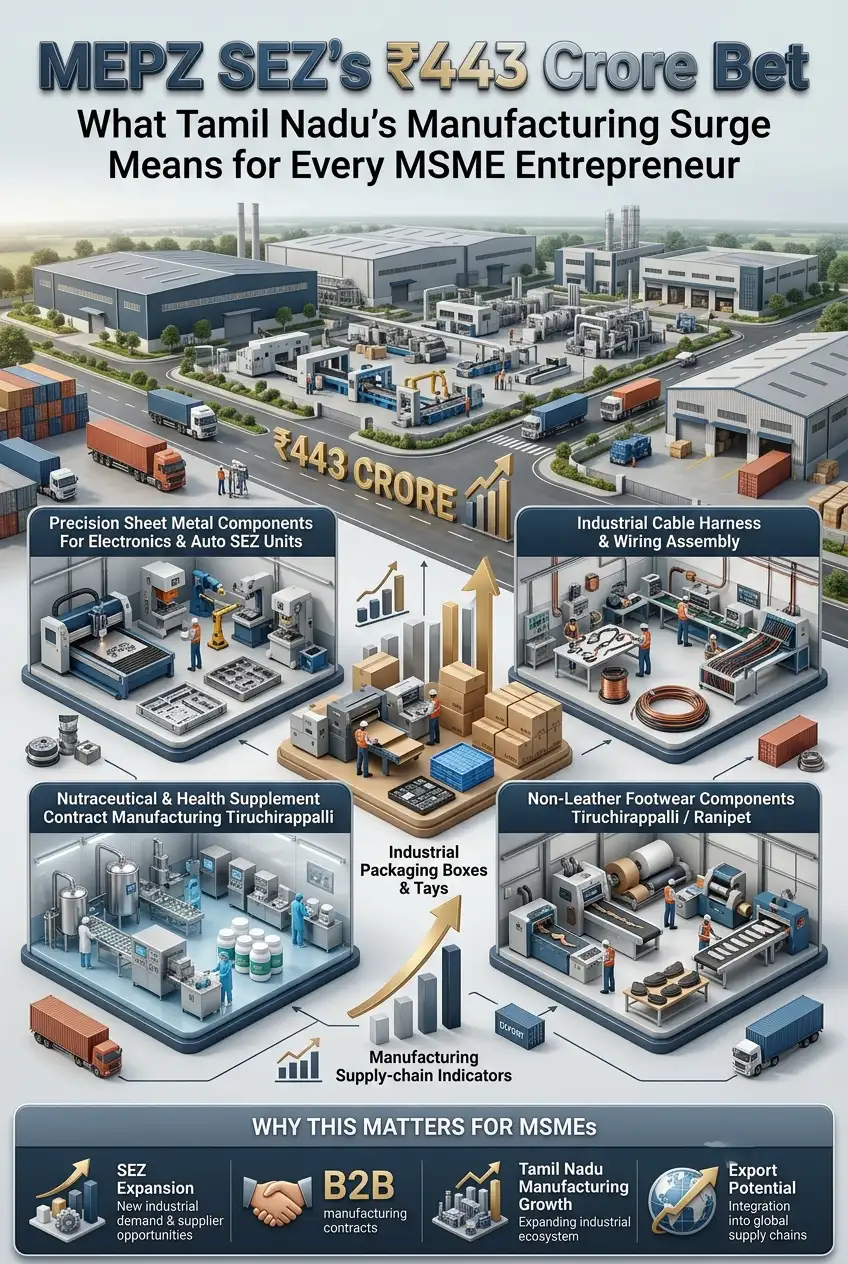
Precision Sheet Metal Components for Electronics and Auto SEZ Units
The Sanmina-SCI plant at SIPCOT Hi-Tech SEZ Oragadam will produce electronic assemblies that need to be custom-made using sheet metal enclosures, mounting brackets and chassis which the anchor unit will not be able to produce in-house. A precision sheet metal fabrication shop that has a CNC Press Brake, MIG welding station and powder coating booth can provide these directly. Demand is almost guaranteed, as the founder registers as a vendor with the procurement team at the SEZ unit prior to operations (around 6-12 months after approval). Investment range: from ₹15 to 25 lakh for a micro-unit to ₹45 to 80 lakh for mid-scale investment. Target customers for the products include the EMS companies, auto component manufacturers and industrial switchgear manufacturers in the 40 km radius of any SIPCOT or ELCOT SEZ. Coimbatore/ Sriperumbudur address is a material advantage, freight to zone buyers is virtually negligible.
Explore This Book: Handbook on Steel Bars, Wires, Tubes, Pipes, S.S. Sheets Production with Ferrous Metal Casting & Processing
Industrial Cable Harness and Wiring Assembly
Cable harnesses connect power and signals across vehicles, machines, and assemblies in every auto and electronics plant in the MEPZ cluster. Currently significant portion of harness sub-components are imported from China to India. Cable harness assembly is a labour intensive business with low capex, the major investment is in crimping machines (₹1.5–3 lakh per machine) and wire-cut machines and testing boards. The 15 workers of a unit can manufacture 2,000–4,000 sets of harnesses a month. The investment required for start-ups is ₹8-15 lakh (inclusive of tooling). Customer groups are Daimler India Commercial Vehicles (SIPCOT Oragadam), auto component assemblers and white-goods producers. The Tamil Nadu government’s scheme “NEEDS” for first generation entrepreneurs, who are holding only degrees, offers margin money support for this category of assembly manufacturing. Procurement teams at the Oragadam cluster should be targeted by the founder from Kancheepuram/Tiruvallur district.
Get Detailed Insights from This Book: Manufacture of Electrical Cables, Wire and Wire Products Handbook
Industrial Packaging — Corrugated Boxes and ESD-Safe Trays
Electronics manufacturing is one of the high-volume users of specialised packaging such as ESD (electrostatic discharge) safe trays and corrugated cartons which every SEZ electronics unit in the cluster needs. As of now, large corrugated box manufacturers based in Pune and Hyderabad handle procurement, charging ₹40–80 in freight per delivery, while local jobbers handle the rest with fewer quality controls. The price of a small corrugated sheet plant (with 3 ply or 5 ply corrugation machine) is ₹12-18 lakh with the machine alone and for the entire setup including die-cutting and stitching, it is ₹22-35 lakh. The cost of a thermoforming machine is ₹8–14 lakh, which is required for the production of foam trays in ESD-safe. Both of them are eligible for micro-unit under PMEGP.
The Oragadam-Sriperumbudur corridor has 50,000 to 80,000 units of demand per month in its operational plants, with local suppliers meeting 60% of this demand. Within 18 months, a plant that costs half a dozen suppliers, in Sriperumbudur taluk, with a good quality control system can replace them.
Nutraceutical and Health Supplement Contract Manufacturing — Tiruchirappalli
ELCOT SEZ Tiruchirappalli is not a mere electronics zone. MEPZ approvals in June saw Tamilnadu Nutraceutical Innovation Hub Pvt Ltd, which has been a statement of its own significance that the nutraceuticals and functional food supplements industry is getting industrial infrastructure in Tamil Nadu. An extremely high margin opportunity for a first generation Founder with a background in Food Technology or Pharmacy. A contract manufacturing unit that combines mixing, encapsulating, and packing for branded nutraceutical players can cost ₹20–35 lakh, including a mixer, encapsulator, blister packing line, and FSSAI-licensed facility. The unit can achieve a net margin of 22–28% by Year 2.
Direct to consumer health brands (Setu, Wellbeing Nutrition, OZiva) who outsource their manufacturing. Trichy sources raw materials like tamarind extract, curry leaf extract, and moringa powder from within a 150 km radius. FSSAI and the State Food Department must approve the business registration. GMP certification brings credibility and opens up pharma branded clientele.
Related Article: Top Pharmaceutical Industry Consultants in India: A Practical Guide for Entrepreneurs
Non-Leather Footwear Component Manufacturing — Tiruchirappalli / Ranipet
The largest single approval in the June MEPZ round covers the ₹514.72 crore facility at ELCOT SEZ, Tiruchirappalli, by TKG Taekwang India Pvt Ltd, which expects to employ 13,364 people. The plant will require thousands of tonnes of injection moulded soles, synthetic textile uppers, adhesive compounds, and shoe last tools locally due to its scale. A micro-unit equipped with injection moulded EVA/TPU soles needs one injection moulding machine which costs ₹6-10 lakh, moulds (at ₹1.5-3 lakh per mould design from Chennai-based petrochemical traders) and 6-8 workers with EVA granules (at ₹90-120/kg) from the petrochemical traders in Chennai.
Total startup: ₹14–22 lakh. For mid-scale unit, it takes ₹60–90 lakh of machines for daily production of 8–12,000 sole pairs. The anchor buyer and the unit will have a nearly guaranteed relationship if the unit operates in Tiruchirappalli before TKG Taekwang reaches full production. Similar footwear component supply opportunities are the alternate cluster for Ranipur’s SIPCOT Panapakkam SEZ. Register for Udyam Registration and avail the Tamil Nadu Rubber and Plastics Industry Cluster scheme for shared infrastructure.
TABLE 3: Government Schemes for MSME Manufacturers Near SEZ Clusters
| Scheme Name | Nodal Ministry / Agency | Key Eligibility | Maximum Benefit | How to Apply |
| PMEGP (PM Employment Generation Programme) | MSME Ministry / KVIC | New entrepreneurs; 18+ years; no prior govt subsidy in 5 years | 35% subsidy on project cost up to ₹50 lakh (manufacturing) | kviconline.gov.in/pmegpeportal |
| CGTMSE (Credit Guarantee Fund) | MSME Ministry + SIDBI | Micro and small enterprises with valid Udyam registration | 75–85% guarantee cover on collateral-free loans up to ₹2 crore | Through lending bank / NBFC at cgtmse.in |
| MUDRA – Tarun / Kishore | MSME Ministry / MFI banks | Non-farm micro enterprises; no minimum collateral for Shishu/Kishore | Up to ₹10 lakh (Tarun); ₹20 lakh (Tarun Plus for repeat borrowers) | udyamimitra.in or bank branch |
| Mutual Credit Guarantee Scheme (MCGS-MSME) | Ministry of Finance / NCGTC | MSME manufacturers and exporters; machinery purchase | 60% guarantee on term loans up to ₹100 crore for machinery | Through scheduled commercial banks |
| Tamil Nadu NEEDS Scheme | TN MSME Department / TIDCO | First-gen degree/diploma holders; new manufacturing enterprise in TN | 30% subsidy on project cost (up to ₹30 lakh subsidy cap) | tnswp.com MSME portal |
| PLI for Electronics (Large Scale Electronics Mfg) | MeitY | Manufacturers of targeted electronics products; minimum production threshold | 4–6% incentive on incremental sales over base year for 5 years | meity.gov.in PLI portal |
| ZED Certification Scheme | MSME Ministry | Manufacturing MSMEs; any scale | 100% cost reimbursement for women-led; partial for others; GeM preference | zed.msme.gov.in |
ENTREPRENEUR SPOTLIGHTR. Suresh Kumar — Coimbatore, Tamil Nadu Suresh Kumar started a precision sheet-metal fabrication unit near the Coimbatore SEZ corridor in 2015 with ₹18 lakh and a single CNC press brake. Today his unit — Suresh Precision Components — clocks annual revenue of ₹3.2 crore supplying brackets, enclosures, and housings to Tier-1 auto and industrial electronics buyers within the SIPCOT cluster. His lesson: “Get your Udyam certificate on day one, apply for CGTMSE guarantee before you exhaust personal funds, and always visit the buyer’s factory floor before quoting.” Source: MSME Ministry Success Stories |
Identify high-growth industries before others do
Expert Guidance for First-Time Founders Entering SEZ Supply Chains
Entrepreneurs looking to enter the Tamil Nadu SEZ supply chain — whether for precision fabrication, cable assembly, packaging, footwear components, or nutraceutical contract manufacturing — can access detailed project reports, techno-economic feasibility studies, plant layout designs, and end-to-end manufacturing consultancy through Niir Project Consultancy Services (NPCS), one of India’s most established techno-commercial advisory firms for MSME manufacturing projects. The same calibre of project reports also appear in actionable formats on entrepreneurindia.co, which covers sector-specific investment analysis for first-generation founders. If you are mapping a unit’s financial viability, choosing between districts, or preparing a bankable DPR for a CGTMSE-backed loan, NPCS project reports reduce the research-to-decision cycle from months to days.

Your Next Move Is Not Research — It Is Registration
The MEPZ SEZ’s ₹443 crore August approval round is not an isolated event. In June, the number was ₹710 crore. In May, ₹450 crore. Every round of SEZ approvals narrows the vendor gap window — because every new anchor unit that comes online will eventually develop its local supplier base. The founders who show up before the anchor unit’s production lines run are the ones who get multi-year purchase orders and become indispensable partners. The ones who arrive after the lines are running compete on price against an entrenched field.
The one specific action to take this week: visit udyamregistration.gov.in, complete your Udyam Registration in under 30 minutes (it is free and requires only your Aadhaar and PAN), and then contact the vendor development cell of the nearest SIPCOT or ELCOT cluster to register as an interested supplier. That conversation — not a business plan, not a loan application — is where the opportunity actually begins.