


No other industry in India is expanding as quickly as the healthcare industry. Hospitals are moving to smaller cities, chains of diagnostics are springing up more than ever before, and the volumes being purchased for government health schemes are reaching new highs. A key but often overlooked enabler that makes this expansion possible is medical plastics. From the disposable syringe a nurse reaches for in a primary health centre to the sterile IV bag hanging in a metro ICU, medical-grade polymers are the material backbone of modern medicine. Entrepreneurs who’ve got a feel for this trend are already preparing themselves to meet this need.
However, the journey of converting a manufacturing dream into a functional, CDSCO compliant medical plastics plant is not a simple one, and more than just capital and enthusiasm is required. It requires the knowledge and skills of the best medical plastics industry consultants in India, who are adept in polymer processing, regulatory clearances, and hospital-grade quality systems all in one.
This article is a practical approach for the founders, investors, and MSME promoters interested in entering or scaling in the medical plastics and surgical disposables industry. It tells you what these consultants do, why India has become a hot destination for medical plastic investments, and how to find and assess the best consultant for your project.
Explore This Book: The Complete Book on Medical Plastics
Why Medical Plastics Industry Consultants Matter in India Today
Indian medical plastics industry is at a crossroads of healthcare infrastructure growth and capability of polymer manufacturing. The numbers do not lie – the medical disposables market in India is worth more than USD 21 bn and is expected to grow by close to 100% over the next 10 years, and the medical plastics materials market itself is growing at a compounding rate of more than 16% per year. The figures are the actual numbers of hospitals, diagnostic centres and government procurement under health mission programmes.
But complexity is part of the package when it comes to this opportunity. The medical plastics manufacturing sector is highly complex as a new player has to deal with multiple layers of challenges – polymer grade selection for each product, addressing Medical Devices Rules 2017 and compliance with CDSCO, setting up plant layout for cleanroom environment, validating sterilisation processes, and establishing a supply chain for medical grade raw materials. All of these areas have specialisations. There’s no universal manufacturing consultant who will understand the difference between a ISO 11135 compliant EO Sterilisation and gamma irradiation requirements. No generic project report will guide you through the process of CDSCO Class A versus CDSCO Class D device registration. Medical plastics consultants for the sector fill just these gaps.
In addition, the Production Linked Incentive (PLI) Scheme of the Department of Pharmaceuticals has been designed specifically to promote opportunities for import substitution in the field of medical devices such as disposables and surgical supplies. PLI advisors are able to help entrepreneurs avoid costly pitfalls at the outset of planning, by knowing the eligibility guidelines and how to apply for PLI, as well as the associated investment requirements.
What Medical Plastics Plant Consultants Actually Do
As a business owner, learning what a reliable medical plastics consultant provides will help you pose the right questions when shortlisting. The consulting engagement is much, much more expansive than a written report.
Feasibility Studies and Market Research
One of the first things a founder needs to receive is a tough techno-commercial feasibility study. This evaluates the demand for the particular product, such as disposable syringes, IV sets, blood bags, catheters, surgical gloves and diagnostic tubes, in the hospital procurement processes, government tenders, and export markets. Competition, pricing comparisons, raw material availability and a realistic capacity utilisation ramp are all factors that a good feasibility study will consider. It provides a fact-based response to the most critical question: can this project be done?
Detailed Project Reports (DPRs)
The Detailed Project Report (DPR) is the document which supports each and every downstream decision right from bank financing to plant construction. A DPR for a medical plastics project will include: Manufacturing process description, Process flow diagrams, Plant layout and cleanroom design, Machinery selection (Injection moulding, Blow moulding, Extrusion, Assembly lines), Raw material specification, installed capacity and throughput calculations, project cost estimation (Civil, Machinery, working capital), Complete financial projections including profitability, payback period and IRR. Every bank, NBFC lender and government scheme administrator needs a well-drafted DPR prior to disbursements.
CDSCO Regulatory and Compliance Advisory
Medical devices in India are regulated by the Central Drugs Standard Control Organisation (CDSCO) of the Ministry of Health and Family Welfare. Medical plastics products range from disposable syringes (Class A) to catheters (Class B/C) and there are different manufacturing licence requirements for each class. In addition, manufacturers should adhere to the medical device quality management system standards set by ISO 13485, the norms issued by BIS and the Pollution Control Board of the state with regard to biomedical waste produced during manufacturing. Leading medical plastics consultants take clients through the complete CDSCO registration process including the selection of applicable forms, facility audit preparation, the compilation of technical files and post-licence compliance.
View Full Project Details: Surgical & Medical Plastics and Disposables
Process Engineering and Plant Layout
Medical plastics plants are not just like any other polymer processing plant. Requirements for clean room grades (ISO Class 7 or ISO Class 8 most disposables), HVAC design for particulate control, design of the sterilisation area and personnel flow management are engineering requirements that extend beyond a general plastic injection moulding facility. Process engineering consultants convert product requirements into a detailed engineering package; equipment list, utility requirements (chilled water, compressed air, clean steam), plant layout drawings and installation supervision. This is the difference between a compliant medical device manufacturer and a non-compliant one.
EPC Support and Project Management
Some medical plastics consultants are willing to provide support to entrepreneurs without manufacturing background, in the form of Engineering, Procurement and Construction (EPC) support or owner’s engineering. They serve as the client’s technical representative throughout the construction process, manage the procurement of machinery, ensure the selection of vendors, supervise civil and MEP contractors as well as ensure the machine and equipment are installed as per the validated design for commissioning of the plant. This end-to-end role minimises cost overspend and technical shortfalls in the start-up process.

India as a Hotspot for Medical Plastics Consulting and Manufacturing
India is one of the most active countries for investment in medical plastics projects due to several converging factors. For entrepreneurs to grasp these drivers, they can gain an understanding of the consulting ecosystem’s acceleration around this industry.
First, the government’s Atmanirbhar Bharat push has explicitly targeted medical devices as an import-substitution priority. India currently imports a substantial share of its medical device requirement, creating a large addressable market for domestic manufacturers. The PLI scheme for medical devices allocates ₹3,420 crore to incentivise production in priority segments, and a separate Medical Device Parks scheme has established common infrastructure facilities in states like Himachal Pradesh and Andhra Pradesh.
Second, the expansion of Ayushman Bharat and state health insurance schemes has dramatically increased government hospital procurement of medical disposables — syringes, IV sets, gloves, blood bags — at scale. This procurement creates demand predictability that investors find attractive. Third, India’s cost-competitive polymer processing industry, combined with the availability of medical-grade polymer grades from domestic petrochemical producers, gives Indian manufacturers a meaningful landed-cost advantage in global export markets.
Fourth, India’s export footprint in medical devices is expanding rapidly. According to IBEF, medical device exports surged 88% to reach ₹31,120 crore in FY25 — underscoring India’s growing credibility as a quality supplier to global healthcare supply chains, including markets in the US, Germany, UAE, and Australia. All of this is creating sustained demand for credible process plant consultants who can help entrepreneurs navigate the opportunity.
How to Evaluate and Shortlist the Best Medical Plastics Industry Consultants in India
Whether it’s a boutique management consulting company in India specializing in healthcare strategy or a specialist in process engineering that has decades of experience within medical device plants, the market for industrial consultancy is large and varied in India. There is a need for a structured evaluation framework because there are the right partners for every single project.
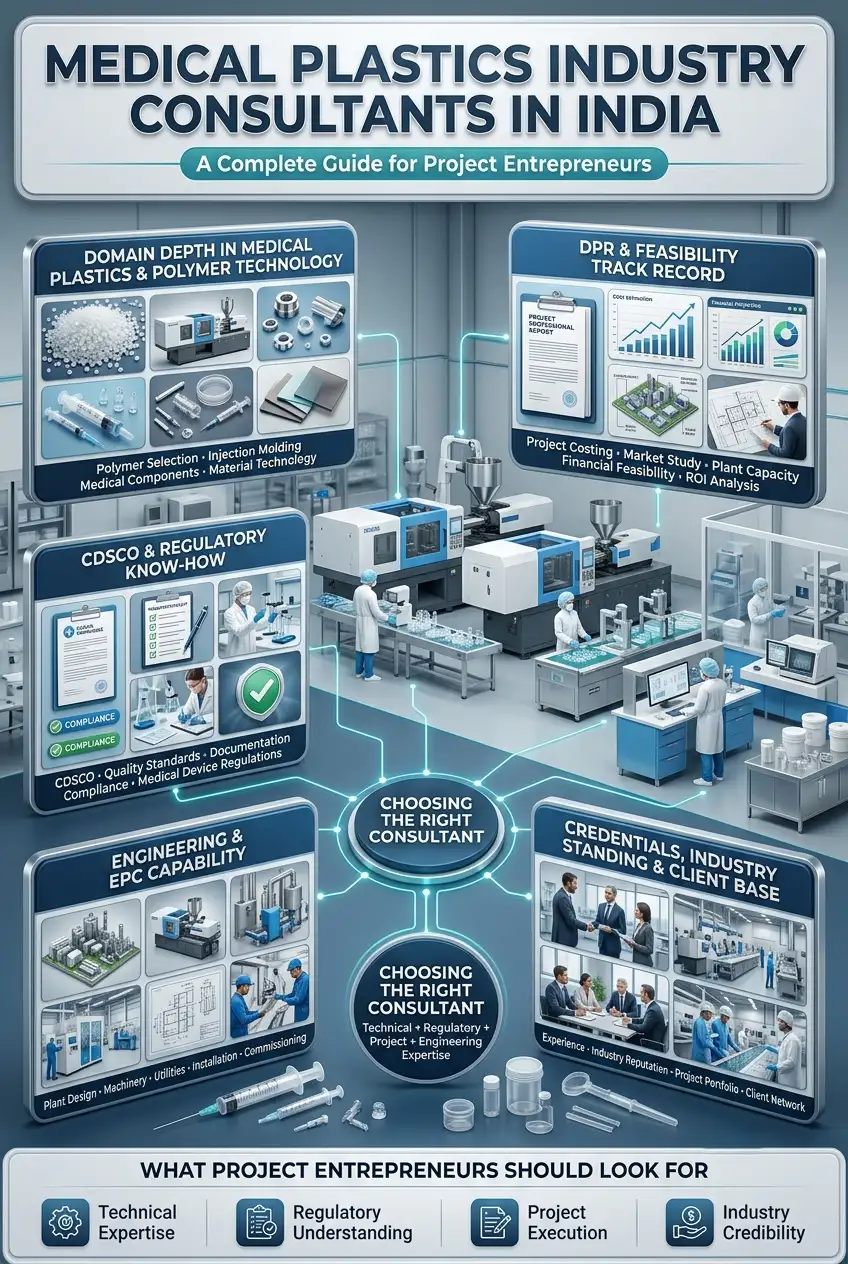
1. Domain Depth in Medical Plastics and Polymer Technology
The consulting team should come with proven experience in Biomedical Plastics Technology — a particular niche of polymer science and medical device manufacturing. Request samples of previous work that used medical grade PVC, polypropylene (PP), polyethylene (PE), polycarbonate (PC), or ABS for products bearing your target. A consultant who has just worked in general plastics packaging or polymer parts for the automotive industry won’t have the product knowledge required for a medical device manufacturer, such as sterilisability or biocompatibility requirements, extractables and leachables testing, etc.
Related Article: Medical Disposables Manufacturing in India: MSME Guide to Profitable Products & Export Opportunities
2. DPR and Feasibility Track Record
Request a sample collection of detailed project reports and feasibility studies that have been performed in the medical plastics or surgical disposables industry. A reputable company will be able to offer you a range of products from different categories – for example, the disposable syringes, IV administration sets, blood collection tubes, surgical gloves, catheters, dialysis disposables. From a portfolio overview, it’s clear whether their methodology of market research, their cost estimation process, and their financial modelling are of quality.
3. CDSCO and Regulatory Know-How
It is a must in this industry to be compliant with the regulations. A minimum of 1 year experience in leading CDSCO Manufacturing Licence process for pharmaceutical industry clients, ISO 13485 Quality system implementation and Process validation for Sterilisation process. Also inquire about their knowledge of the requirements of the State Pollution Control Board in relation to the production of biomedical waste, and those of the Factories Act in relation to clean room and utility areas.
4. Engineering and EPC Capability
When projects become larger, the engineer’s ability to provide engineering drawings, cleanroom specifications, and equipment procurement assistance becomes very important. The best engineering consultancy companies in India for medical plastics can help to take you from a feasibility study to a complete engineering and construction-ready project package. The value of process engineering consultants who can draft with in-house equipment and who can have relationships with equipment vendors is especially great at this stage.
5. Credentials, Industry Standing, and Client Base
Look for consultants who actively engage with sector bodies such as AiMeD (Association of Indian Medical Device Industry), FICCI’s health division, or CIPET (Central Institute of Plastics Engineering and Technology). Membership or active participation in these bodies signals genuine immersion in the sector rather than occasional project familiarity. Also verify whether the firm has served clients who have subsequently received bank financing, CDSCO licences, or PLI scheme approval — these are external validations of consulting quality.
Role of NPCS in Medical Plastics Project Consultancy
In the field of medical plastics and surgical disposables, Niir Project Consultancy Services (NPCS) has a unique position in the established industrial project consultancy companies in India, based in Delhi. Now in its 32nd year of operations, NPCS has assisted manufacturing entrepreneurs in 85 countries and completed over 15,000 manufacturing feasibility studies, Detailed Project Reports and techno-economic analysis in almost every manufacturing industry including medical plastics.
The project profiles in NPCS are especially important to entrepreneurs who are entering the medical plastics field because they are very detailed and specific. DRPs are prepared by the NPCS team that encompass all the aspects of what a founder would require prior to investing capital – manufacturing process documentation, raw material specifications including medical grade polymer grades, list of machinery with technical parameters etc., market research and demand analysis, plant layout concepts, and comprehensive financial projections such as capacity utilisation assumptions, profitability analysis and break-even assessment.
If you are still working on deciding which of the medical plastics product you’ll develop, NPCS has a full catalog of project profiles in the surgical and medical disposables sector on this project profiles page. Enabling a first-generation entrepreneur to compare project options prior to a final product selection, the catalog covers disposable syringes, IV sets, blood bags, catheters, surgical gloves, face masks and other polymer-based medical consumables.
This method – project identification, feasibility validation and preparation of DPR – is the way by which experienced Indian consulting firms drive pre-investment for medical plastics entrepreneurs. NPCS is an example of this and has over 30 years of experience in the medical plastics industry, providing a solid reference for the founders to learn from and secure investment documents.
Your investment deserves the right opportunity
Regional Focus: Medical Plastics Industry Consultants in Delhi and the Broader India Landscape
There is no doubt that Delhi and NCR are still the main places in India for industrial consultancy services in the medical plastics industry. Moreover, Delhi is natural hub for consultants who require frequent interaction with the regulators (CDSCO) as well as national level associations (AiMeD, FICCI, CII) being located in various government ministries and departments. In addition, The majority of the best engineering consultants in India having health care manufacturing experience are based out of Delhi or Gurugram.
Meanwhile, Medical plastics & surgical disposables manufacturers are more concentrated in Ahmedabad & Vadodara (Gujarat) apart from Delhi, which provides Gujarat based consultants with good ground level exposure of factories & supply chain. Furthermore, The State of Himachal Pradesh has become a serious medical device manufacturing hub including the establishment of government incentivised parks which are bringing in investments for polymer processing. Similarly, Growing medical device manufacturing clusters in Chennai and Pune also have local engineering networks and process plant consultants.
Therefore, The benefit for an entrepreneur looking for the best medical plastics industry consultants in Delhi is that they are close to the regulatory bodies and policy intelligence. However, Consultants on the ground may be better suited for on-ground implementation in Gujarat or Tamil Nadu. Finally, Ideal solution is to involve a firm in Delhi for DPR and regulatory documentation and a local engineering firm for construction supervision of plant.
Medical Plastics Consulting Services: Types, Deliverables, and Best-Fit Clients
| Service Type | Core Focus | Key Deliverables | Best-Fit Client |
| Techno-Commercial Feasibility Study | Market demand, competition, financial viability | Market analysis, revenue projections, go/no-go recommendation | Pre-investment stage founders and investors evaluating project entry |
| Detailed Project Report (DPR) | Full project documentation for financing and execution | Manufacturing process, plant layout, machinery list, financial model, capacity plan | Entrepreneurs seeking bank loans, PLI scheme application, or MSME scheme funding |
| CDSCO Regulatory Consulting | Licence application, classification, compliance | Device classification memo, Form MD-3/MD-5 filing, facility audit readiness plan | New manufacturers entering regulated medical device categories |
| Process Engineering Consulting | Cleanroom design, process validation, equipment selection | Engineering drawings, cleanroom specs, equipment RFQs, sterilisation process validation | Mid-scale manufacturers scaling capacity or upgrading to new product lines |
| EPC / Owner’s Engineering | End-to-end project execution support | Vendor evaluation, construction supervision, commissioning, startup support | First-generation entrepreneurs with no prior manufacturing experience |
| Export Market DPR | Export-oriented unit setup, international certification support | CE Mark / ISO 13485 roadmap, export market sizing, pricing benchmarks | Manufacturers targeting US, EU, or Middle East hospital supply chains |
Government Schemes and Reference Resources for Medical Plastics Entrepreneurs
Entrepreneurs entering the medical plastics manufacturing space should familiarise themselves with the key government portals and sector bodies that shape the regulatory and incentive landscape. The Department of Pharmaceuticals (pharma-dept.gov.in) is the nodal ministry for medical device policy, PLI scheme administration, and medical device parks. The Central Drugs Standard Control Organisation (cdsco.gov.in) manages all device licensing and registration.
For sector intelligence and export promotion, IBEF’s Medical Devices page provides regularly updated market data on production, exports, and investment trends. Invest India’s medical devices portal is the authoritative source for PLI scheme guidelines and applicant information. CIPET offers polymer testing, certification, and skilling support that medical plastics manufacturers can access for product development and quality validation.
Industry representation is anchored by AiMeD (Association of Indian Medical Device Industry), which covers manufacturers of consumables, disposables, diagnostics, and implants. FICCI’s health division and the MSME Ministry’s PMEGP and CGTMSE schemes provide further financial support pathways for first-generation medical plastics entrepreneurs.

Conclusion: Next Steps for Medical Plastics Project Entrepreneurs
India’s medical plastics and surgical disposables sector offers a compelling combination of structural demand growth, government policy support, and export market opportunity. However, the regulatory complexity, cleanroom engineering requirements, and CDSCO compliance framework make this a sector where professional consulting support is not optional — it is foundational to project success.
First, Start by clearly defining your target product category — disposable syringes, IV sets, blood bags, gloves, catheters, or diagnostic tubes — and your target market (domestic hospital procurement, government tenders, or export). Then engage a consultant with specific experience in that product type, confirmed DPR and regulatory track record, and the process engineering capability to design a CDSCO-compliant plant.
Additionally, If you are still in the project identification stage, exploring the range of options before committing to a specific product, NPCS’s surgical and medical plastics project profiles catalog is a useful starting point. It covers a wide range of medical disposables projects with initial feasibility data, product descriptions, and market context — helping you shortlist the right project before investing in a full DPR.
Furthermore, The medical plastics industry in India is at an inflection point. Domestic demand is rising, import substitution policy is creating market space, and export markets are actively seeking reliable Indian suppliers. Entrepreneurs who move decisively — with the right technical guidance and a bankable project plan — are well positioned to build durable, scalable businesses in this sector.
Finally, Assumption note: Regulator confirmed as CDSCO (Central Drugs Standard Control Organisation) under Ministry of Health and Family Welfare, per Medical Devices Rules 2017. Technical keyword used: Biomedical Plastics Technology. Reference links verified live at time of writing. Niir project profile URL confirmed consistent with Medical Plastics industry.