


Manufacturing Business Ideas Under ₹5 Lakh
500,000 Rupaiyas. The amount isn’t a lot of money. However, in a successful manufacturing company, it is more than enough to establish a viable business that can produce 2x to 3x the amount in the first year and much more in subsequent years. It’s not a matter of how much capital one might have. First, which business you want to pursue, how efficiently you use the capital and which market you want to target. These business ideas have been chosen precisely for those businessmen who have not much initial capital, and are looking to maximise their returns without incurring unnecessary expenses on infrastructure and equipment.
Competent Indian entrepreneurs started businesses with just a handful of lakhs, while today, a ₹5 lakh investor can choose from businesses that benefit from better government policies, improved infrastructure, and a larger distribution network than ever before in India’s industrial history.
Why ₹5 Lakh Is a Viable Manufacturing Starting Capital in India
The traditional belief that it takes crores of rupees to set up a manufacturing unit, to buy machines and to keep a healthy working capital is no longer correct. Today’s business models in manufacturing have undergone a complete transformation. Contract manufacturing helps brand owners to begin without an investment in the factory. Since the production facilities are shared, the costs of the mechanised plant is lowered. Subsidies from the Government (PMEGP’s capital subsidy of 25-35% and PM FME’s 35% subsidy) make the real capital deployment required much smaller. Digital distribution saves on costly distribution infrastructure.
Lean manufacturing thinking and methodologies help entrepreneurs test, validate, and scale their ideas without putting everything at stake in a single large production run. They can start with one SKU, one small batch, and one target market segment. The right business can start earning with ₹5 lakhs only after 30-60 days of setting up the business. Actually, a maximum of ₹5 lakh entrepreneur may be able to have his working capital doubled through Mudra alone because the category of Mudra Yojana Shishu offers additional collateral free loans of ₹50,000, and Kishore offers it up to ₹5 lakh.
Government Schemes That Multiply ₹5 Lakh into Larger Enterprise
The Indian government has organized several plans which allow for small capital investment and large viable business. The PMEGP scheme by KVIC offers subsidy of 25% (35% in rural areas) for fresh manufacturing units, where a loan from the bank is coupled with the subsidy to get a project cost of ₹15-20 lakh for an own contribution of ₹5 lakh. The PM FME scheme for food processing offers credit-linked subsidy of 35%, which helps food manufacturing companies, some of the best investments in this category. The credit guarantee scheme by CGTMSE provides banks with collateral-free working capital loans to MSME manufacturers, such as a manufacturer with a ₹5 lakh worth of raw material requirements who is unable to put any security to establish credit.
NSIC’s raw material assistance programme is a way for the small manufacturers to avail raw material inputs at better terms, using the NSIC’s bulk purchasing capability — a great working capital management tool for tight-budget entrepreneurs. The MSME sector is dominated by the micro enterprise segment (investment of less than ₹1 crore) and is supported with credit and scheme-specific support as well since they play a significant role in creating job opportunities and contribute to economic resilience, as confirmed by the growth data by IBEF.
8 Manufacturing Businesses That Can Start With ₹5 Lakh
1. Handmade Soap and Detergent Manufacturing
One of the easiest businesses to start with a investment of ₹5 lakh is soap manufacturing especially cold process handmade soap and liquid dishwash and laundry detergent. Raw materials such as caustic soda, coconut oil, palm oil, caustic potash and surfactants are readily available and reasonably priced. The manufacturing method is very easy and can be learnt from ITI (ITI 10th pass) course or online tutorials by government. The equipment needed for a basic soap unit is very limited; a small setup requires only mixing tanks, moulds, cutting equipment, and packaging equipment.
Products sell well in local retail stores and institutions through wholesale channels. With the rise of online marketplaces, handmade soap brands now sell directly to customers by using attractive photos and clean packaging to command premium prices. The personal care market continues to grow and consumers are demanding natural and chemical-free products – and well positioned small soap makers are there to reap the benefits.
Read the Complete Book Here: Modern Technology of Soaps, Detergents & Toiletries (with Formulae & Project Profiles)
2. Agarbatti and Dhoop Manufacturing
The small-scale manufacturing business in India is perhaps Agarbatti (incense stick) manufacturing. The raw materials are bamboo sticks, binding powder, coal dust and aromatic compounds, which are very inexpensive. The cost of a hand-rolling machine is a few thousand rupees. Semi-automatic machines are more expensive, but produce a lot more. Cellophane wraps, printed boxes are relatively cheap, and can be sourced by specialist suppliers. The demand for the product is religious based in India with a population of 1.4 billion, and 365 days of demand. There is good distribution coverage of local kirana, religious supply stores and wholesale distributors.
A ₹5 lakh investor in the agarbatti manufacturing industry can invest in the equipment, initial raw material stock, packaging and working capital for the first 2-3 months of production. Generating revenue starts virtually as soon as you hit the market. Additional subsidy and market linkage support to the agarbatti manufacturers at the village level are provided through the KVIC’s agarbatti promotion programmes.
View Full Project Details: Agarbatti (Incense Sticks) Manufacturing
3. Spice Powder and Masala Manufacturing
Spice manufacturing involves grinding and packaging red chilli, turmeric, coriander, and garam masala. This business has low entry barriers, high demand, and requires relatively little capital to start. Key assets include spice grinder, pulveriser, sealing machine, packaging materials, FSSAI registration, and spice stock inventory. Branded spice trading offers significantly better margins than commodity trading. The cost of the chilli powder is 3–4 times the raw chilli. All this is value added by cleaning, grinding, packaging and branding the chilli.
The natural starting market is local retail distribution, defined as supplying the kiranas, supermarkets and ration shops in a radius of 20-30 km. Once the brand pays attention to quality and consistency, it can expand its reach to online sales, institutional catering and restaurant supplies to generate more sales. The FSSAI compliance, uniform quality and professional packaging are the main competitive factors in this food business.
Explore This Book: Handbook on Spices, Seasonings and Condiments
4. Candle Manufacturing (Decorative and Standard)
Candle manufacturing has two distinct markets: the mass commodity market (plain paraffin candles for household and religious use) and the fast-growing premium market (soy wax, beeswax, scented, and decorative candles for gifting, home décor, and aromatherapy). A ₹5 lakh entrepreneur can profitably enter both, or focus on the premium segment for better margins. Equipment required is basic: a melting pot, pouring equipment, moulds, wick setter, and packaging materials. Paraffin wax is inexpensive and widely available. Soy wax costs more but enables 2–3x higher selling prices. The gifting and home décor candle segment sells heavily through Instagram and e-commerce, where a brand with strong visual identity can build significant following without expensive distribution infrastructure. Seasonal demand peaks — Diwali, Christmas, Valentine’s Day, weddings — create high-volume selling opportunities throughout the year.
Check Out This Recommended Book: The Complete Technology Book on Candle Making & Designs

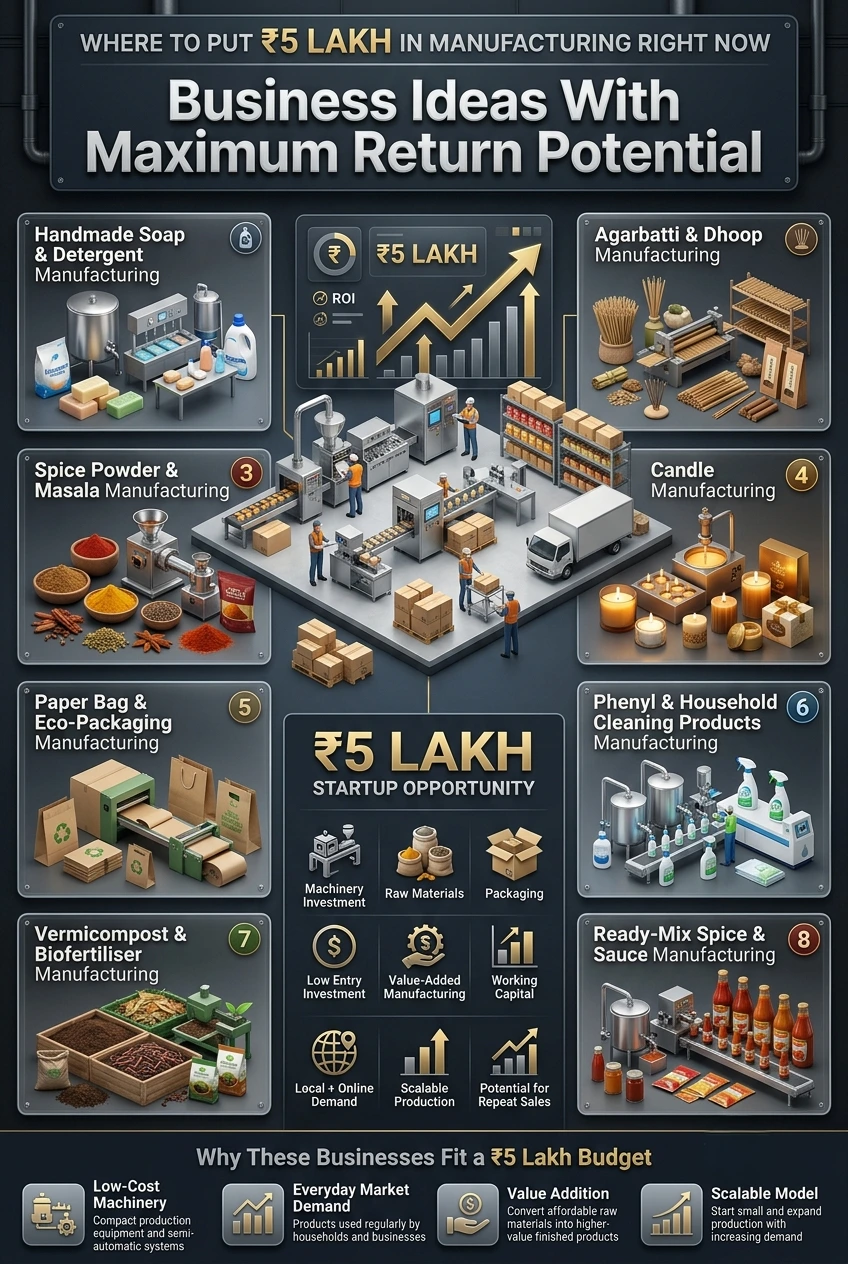
5. Paper Bag and Eco-Packaging Manufacturing
India’s plastic ban has created a genuine supply-demand gap in eco-friendly packaging. Paper bags, fabric bags, and biodegradable packaging materials are in shortage relative to the retail industry’s demand — particularly in food service, retail, and e-commerce packaging. A paper bag making machine — available at accessible price points for small capacity models — plus paper roll inventory and basic printing capability represents a viable ₹5 lakh investment. Target customers: restaurants, bakeries, apparel retailers, grocery stores, and supermarkets. All of these businesses need steady paper bag supply and prefer local manufacturers who can deliver quickly and provide custom printing. This is a B2B business where the first 10–15 regular clients generate the majority of revenue. Selling through personal visits to local businesses is the primary customer acquisition method — no expensive marketing needed.
Access Complete Business Plan: Paper Bags, Cups & Packaging Products
6. Phenyl and Household Cleaning Products Manufacturing
Manufacturers produce floor cleaning liquids (phenyl), toilet cleaners, glass cleaners, and surface disinfectants through simple chemical blending processes that require no specialist knowledge. The formulations are widely available. Raw materials — pine oil, carbolic acid, emulsifiers, and surfactants — are inexpensive and locally sourced. The manufacturing process involves mixing, quality testing, and packaging in branded bottles. Margins are excellent: the raw material cost of a phenyl bottle is a fraction of the retail selling price. Distribution channels include local wholesale, institutions (hotels, hospitals, schools, offices), and retail stores. With ₹5 lakh, an entrepreneur can set up a blending unit, procure initial raw material inventory, register the brand, and begin local distribution within 30–45 days. The institutional market — particularly post-COVID sanitisation consciousness — provides large-volume, repeat-order opportunities that sustain a small cleaning products manufacturer for years.
7. Vermicompost and Biofertiliser Manufacturing
Vermicompost manufacturing requires land (which many rural entrepreneurs already own), earthworm culture (purchased cheaply from agricultural centres), and organic waste (which is free on farms). The entire manufacturing process is biological — no machinery, no fuel, no electricity required. The output — vermicompost — sells at prices per kilogram that are significantly higher than bulk compost, particularly when certified and branded for organic farming use. For a ₹5 lakh investor in a rural or semi-urban area, vermicompost manufacturing is one of the highest-ROI manufacturing businesses available. Capital goes into earthworm procurement, composting beds, shed construction, certification, packaging, and marketing — rather than machinery. Revenue begins within 60–90 days of the first batch. Repeat customers—including organic farmers, horticulture nurseries, and urban gardening enthusiasts—can provide predictable recurring revenue once you establish strong relationships with them.
Get Detailed Project Report (DPR): Biofertilizer Manufacturing Business
8. Ready-Mix Spice and Sauce Manufacturing
Ready-mix spice blends — biryani masala, chaat masala, curry paste, instant sambar mix, rasam powder — and bottled sauces like green chutney, tamarind sauce, and schezwan sauce are high-demand, high-margin products with growing consumer adoption. Home cooks increasingly prefer ready-to-use spice mixes and cooking sauces over grinding from scratch. A ₹5 lakh entrepreneur can start with 2–3 flagship products, produce in small batches, and sell through local retail and online platforms. The FSSAI registration process is straightforward. Packaging in professional, branded pouches and bottles immediately elevates perceived value. This business benefits enormously from digital marketing — food content on Instagram and YouTube, recipe videos featuring your product, and food blogger collaborations are low-cost, high-impact marketing tools that home-scale manufacturers can deploy effectively.
Related Article: Spice Processing Business Ideas in India: How the SPICED Scheme Helps You Start
Import–Export Opportunities for ₹5 Lakh Manufacturers
Several of the businesses above have natural export potential once basic scale is established. Indian spice blends, agarbatti, handmade soaps, and organic inputs have established international buyer communities — particularly in countries with large Indian diaspora populations. APEDA’s export registration and support for small food manufacturers is accessible even to micro enterprises with very modest production volumes. The key is to achieve FSSAI certification, consistent quality, and adequate packaging standards before approaching export markets. Many small manufacturers start domestic, build their product, and export within 2–3 years of establishment.
Indian MSME Success Stories That Started With Minimal Capital
Lijjat Papad began with ₹80 in seed capital. Haldiram’s started as a small namkeen shop in Bikaner. MDH Masala, founded by Mahashay Dharampal Gulati, began as a cart-based spice business after Partition — with virtually zero capital. These are not ancient history. They are proof of a principle that remains true in India’s manufacturing sector: the right product, the right quality, and the right market relationship compound over time into enterprises of enormous scale. The ₹5 lakh entrepreneur of today has advantages these founders lacked: government subsidies, digital distribution, e-commerce reach, and online marketing tools that cost almost nothing.
Your investment deserves the right opportunity
₹5 Lakh Manufacturing Business — Return Potential Comparison
| Business | Est. Monthly Revenue Potential | Primary Channel | Break-Even Period |
| Soap & Detergent | Moderate | Local retail, online | 3–5 months |
| Agarbatti | Moderate | Local wholesale | 2–4 months |
| Spice Powder | Moderate-High | Local retail, online | 3–6 months |
| Candles | Moderate | Online, gifting | 4–6 months |
| Paper Bags | High | B2B supply | 2–4 months |
| Phenyl & Cleaning | Moderate | Local + institutional | 3–5 months |
| Vermicompost | Moderate | Farmers, nurseries | 4–6 months |
| Spice Blends & Sauce | High | Online, local retail | 3–5 months |

Conclusion — ₹5 Lakh Is Enough. Clarity Is the Real Capital.
The most important capital a ₹5 lakh manufacturing entrepreneur needs is not money. It is clarity — about the product, the buyer, the quality standard, and the distribution plan. Money runs out if clarity is absent. But when a ₹5 lakh entrepreneur knows exactly what they are making, who is buying it, and how it will reach the buyer, the initial capital goes much further than most people expect. The eight manufacturing businesses in this article represent proven, demand-driven opportunities where ₹5 lakh is a genuine starting point — not a compromise. With government subsidy available to effectively multiply that capital, and digital distribution to eliminate expensive middlemen, the barriers to entry have never been lower. The barriers to success — quality, consistency, and customer trust — remain the same as always. Build those, and the business will follow.