


NITI Aayog has just given India’s entrepreneurs a unique present – a database-driven list of places for the next generation of manufacturing business ideas. The government think tank in its report this week identified four sectors – chemicals, textiles, telecom and networking equipment, and solar PV manufacturing – as the area’s most suitable for transforming India into a true global manufacturing power. This is no pious rhetoric for entrepreneurs looking out the window for a promising venture. It provides an exact indication of where demand, government support and export potential are colliding today.
In this article, I have explained the importance of these four sectors, the incentives that the government already offers, the specific businesses entrepreneurs can explore in these four sectors, and the businesses that Indian entrepreneurs have already started in this space. When looking for the next manufacturing business idea this report is a good starting point.
Why Manufacturing Is India’s Best Bet Right Now
India accounts for nearly 17.5% of India’s GDP but output of manufacturing in India accounts for only around 3% of the world’s manufacturing output. That’s the opportunity. NITI Aayog has assessed 62 sectors and shortlisted 12 sectors for detailed review, of which chemicals, textiles, telecom equipment, and solar PV have been selected for detailed analysis first followed by eight more sectors (NITI Aayog Report — PIB Press Release).
In each of these four areas, the threshold for success is comparable: there is robust demand at home, with potential export markets; and policy incentives that encourage economies of scale. But in each opportunity, the opportunity is different.
The Chemicals Opportunity
The Indian chemical industry comprises three major sectors: petrochemicals and organic chemicals, specialty chemicals, and inorganic chemicals. The largest percentage of Petrochemicals comprises polymers, Synthetic fibres and Performance plastics. However, many businesses in this value chain still rely on imported feedstock. Enhancing the value chain of the downstream production and better utilisation of the feedstocks can help realise a strong domestic value addition (IBEF — Chemicals Industry Exports).
Why Textiles Still Matters
Textiles do not have to be a legacy business; it has to be jobs engine. It accounts for nearly 2% of GDP, over 11% of manufacturing GVA and provides livelihood to over 45 million people, the largest employment after agriculture. In the previous fiscal year, India exported USD 37.7 billion, and is the sixth biggest exporter of textiles in the world (IBEF — Textiles Industry).
Telecom’s Underrated Scale
The second largest telecom market in the world is the Indian telecom market where there are more than 1.2 billion subscribers and penetration is approximately 85%. This scale should have resulted in a much more substantial domestic equipment industry. It hasn’t… and that’s the key distinction that a manufacturing entrepreneur should be looking at.
Solar PV’s Import Problem
India had added 106 GW of solar power and requires 174 GW of additional capacity to achieve its target of 280 GW. The domestic Solar PV market is estimated to reach around Rs 32,400 crore by 2020 with growth rate of around 17–20% for the coming years. But the majority of the value chain remains in the ocean.
Government Policies and Incentives Backing These Sectors
Direct government support here is specific, funded and explicitly linked to these sectors, rather than generic policy terms.
The Production Linked Incentive (PLI) Scheme started in 2020 and covers 14 sectors, including telecom and networking products, textile products (MMF and technical textiles), and high-efficiency solar PV modules. In the solar PV tranche alone, committed investment is in the range of Rs 48,120 crore, which are likely to create around 38,500 direct jobs (PIB — PLI Scheme Progress).
Within three years of its launch, the Telecom PLI Scheme already has attracted investment of Rs 3,400 crore, driven equipment production to over Rs 50,000 crore and created over 17,800 direct jobs (PIB — Telecom PLI Scheme).
The government is rolling out a new scheme for chemicals, called Petroleum, Chemicals and Petrochemicals Investment Regions (PCPIRs), to provide integrated infrastructure and availability of feedstocks (Make in India — Chemicals Sector).
MSMEs entering into any of these sectors also avail loans under the Credit Guarantee Scheme, which are available with the Ministry of MSME through CGTMSE, without requiring any collateral. The ceiling of the guarantee was recently increased, thereby unlocking loans without collateral meaningfully larger sized which is a true unlock for first generation entrepreneurs (Ministry of MSME — CGTMSE Scheme).
Add liberalised FDI norms (100% automatic route for most manufacturing), National Telecom Policy 2025 to double the contribution of the sector’s GDP and exports and continued Make in India and Aatmanirbhar Bharat momentum. These schemes make the cost of a new manufacturing company significantly more affordable.
Multiple Business Ideas for Startups Within These Sectors
Specialty Chemical Formulation Unit
Instead of making bulk commodities, a smaller manufacturer can establish a specialty chemical formulation business, whether it be additives, surfactants, or specialty chemicals used in paints, textiles, or agrochemicals. This segment has a greater growth rate than bulk chemicals and technical differentiation over scale is rewarded. The first steps an entrepreneur should take is to target one or two niche applications, develop a limited number of relationships with other “anchor” buyers in related sectors (e.g. textiles or construction) and invest early in quality certification. Specialty chemicals are used in many industries downstream, so demand remains more consistent and resilient than does the demand for bulk petrochemicals.
Explore This Book: The Complete Book on Distillation and Refining of Petroleum Products (Lubricants, Waxes and Petrochemicals)
Technical and Sustainable Textile Manufacturing
Technical textiles for automotive interiors, medical products, agriculture and geotextiles remain underdeveloped compared with India’s raw material base. A technical textile fabrication, or sustainable/ organic-fibre textile production, technology manufacturing business can access one of the growth levers that NITI Aayog identifies – skilling, technology adoption, and premium positioning. Entrepreneurs who can weave or knit and also produce goods that can meet technical standards will be able to cater to the demand of export buyers looking for ESG compliance as well as also industrial buyers in the home market, who are currently importing these materials.
Get Detailed Insights from This Book: The Complete Technology Book on Textile Spinning, Weaving, Finishing and Printing
Telecom Component and Testing Services
The ecosystem is not deep capital driven; full scale telecom equipment manufacturing is. Any company in the business of manufacturing components or connectors for telecom equipment manufacturers, or operating a certified testing and calibration facility for telecom hardware is right in the middle of the government’s “localisation” initiatives. That’s where the smaller player, who doesn’t have to face-off directly against large OEMs, comes in: As PLI-backed manufacturers grow, their component and testing demands grow, and the smaller player scales accordingly.

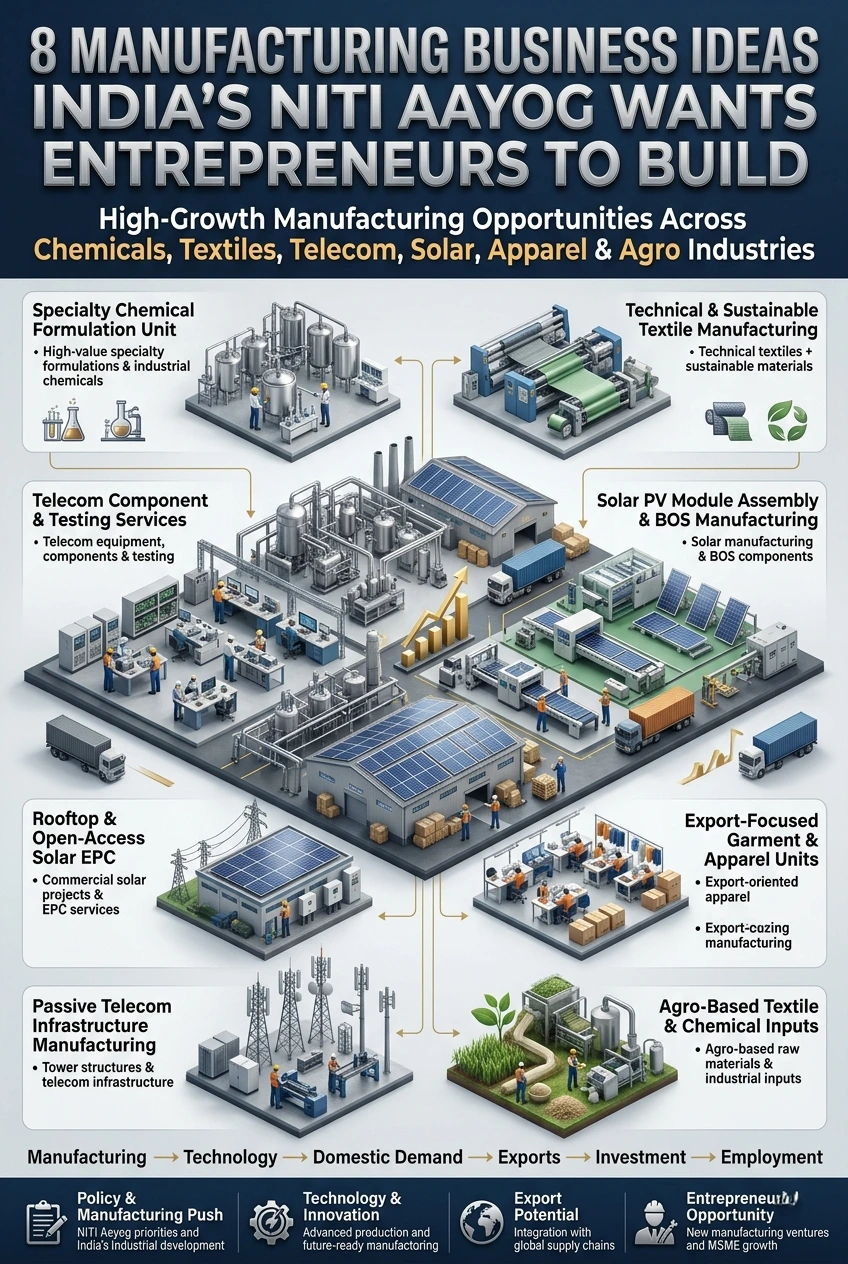
Solar PV Module Assembly and BOS Manufacturing
India has a requirement of 174 GW of new solar installations, and module assembly is a viable mid-scale project, especially in areas where there is good grid connectivity and proximity to industrial complexes. Even more accessible is the Balance of System (BOS) part of the system: mounting structures, junction boxes, cabling and inverters, which require less capital intensity than cell and wafer production and follow the same demand curve.
Related Article: Solar PV Manufacturing in India
Rooftop and Open-Access Solar EPC
There are other opportunities in the solar PV story – and it’s not just about manufacturing. This EPC (engineering, procurement, construction) company specializes in rooftop and OAC (open-access) solar projects, and expects to enjoy a similar upswing as the domestic PV market, without needing a factory by any means. Lower capital investment to gain exposure to the solar boom while gaining operational experience before entering manufacturing.
Export-Focused Garment and Apparel Units
The textile manufacturing industry deals with fabric, whereas the garment and apparel industry includes the manufacturing of garments and includes more jobs per rupee invested. India has been recognised as the sixth world biggest textile and apparel exporter in NITI Aayog report. Export-oriented, higher value garment units, such as technical, activewear, or premium cotton, will be able to achieve better margins than basic cut-and-sew units.
Access Complete Business Plan: Readymade Garments Manufacturing Project Report
Passive Telecom Infrastructure Manufacturing
In addition to the active telecom equipment, passive infrastructure like antenna mounts, tower parts, fibre management systems, enclosures is a less crowded manufacturing niche. When telecom operators roll out 5G networks and rural penetration increases in line with the Government’s National Telecom Policy 2025, demand for this passive equipment continues to rise, while manufacturers face fewer technology barriers than in active electronics production.
Agro-Based Textile and Chemical Inputs
Chemical and textile opportunities are connected with agro based inputs with genuine cost advantage such as natural dyes, bio-based finishing agents and fibre-processing chemicals, and India’s raw agricultural base provides this (APEDA — Product Catalogue). This is a more niche venture; it would allow an entrepreneur to merge two businesses flagged at the same time, thus lowering the risk of selecting only one business.
Import-Export Opportunity Analysis
The four sectors’ trade figures are telling of an unusual pattern in India: strong export capability coupled with an intransigent import dependency further upstream.
The opposite scenario is emerging in textiles: India already exports well, but it is bidding for business from China as China’s share of the world’s apparel orders drops. A study by the World Bank on apparel trade in South Asia estimated that in India, even a 10% increase in the price of apparel from China could create jobs for more than 1 million new units in the apparel industry, in India — an opportunity that will be available for new export players to come in in the coming days (World Bank — Stitches to Riches).
Telecom is a more localisation story than a pure trade story as domestic production was already diminishing import reliance in several products, while the government’s plan to double telecom exports under NTP-25 indicates continuing demand from the export side for domestic production (Invest India — Telecom Sector).
PV imports have the highest concentration risk. The NITI Aayog’s report highlights that majority of India’s exports of solar modules are currently going to just one overseas market, which is the very reason the report suggests taking the business up the value chain to polysilicon and wafers and diversifying markets.
Indian MSME Success Stories Worth Studying
All NITI Aayog has to say in its report is forward-looking and India already has entrepreneurs who have built a business from scratch: that’s how.
Deepak Nitrite — Specialty Chemicals from a Family Unit
Deepak Nitrite started out as a small chemical manufacturing unit and has since grown to become one of India’s top specialty chemical and performance chemical companies, led by Deepak C. Mehta, chairman. The company’s growth model is exactly what NITI Aayog has been advocating today: specializing in the higher value-creating specialty formulations business and not just the commodity volume business. A lesson for a new entrant is patience, value-chain movement, not overnight scale, built this business.
Arvind Limited — Textiles Built on Technical Diversification
Established in Ahmedabad, Arvind Limited was originally a textile mill that manufactured denim, but has now since diversified into manufacturing textile and technical fabrics for apparel brands around the world. The early investment in technical textiles and sustainable fibre processing by it matched what NITI Aayog’s report has now been calling for in the broader sector. This is a good lesson for newcomers – it’s not just a matter of capacity; it’s technical and sustainable positioning that is the key to winning export orders today.
Waaree Energies — Riding the Solar PV Wave Early
Waaree Energies initially began operations as a smaller solar module manufacturer and through the consistent reinvestment in the company and early PLI participation grew to become one of the largest solar PV manufacturers in India. The path of its evolution demonstrates the potential for significant expansion for a medium-sized manufacturer when government incentives and a growing domestic demand converge — which is exactly what NITI Aayog’s report is witnessing for the sector now.
Turning These Sector Signals Into a Fundable Project
Turning a sector opportunity into an actual factory takes more than enthusiasm; it needs a realistic feasibility study. We at Niir Project Consultancy Services (NPCS) provide professional consulting for the preparation of Market Survey cum Detailed Techno-Economic Feasibility Reports (DPRs) for setting up new industries or businesses. Our reports include detailed manufacturing processes, market research and demand analysis, process flow diagrams, product mix and capacity planning, machinery and raw material details, and complete project financials with profitability analysis. Whether you are exploring a specialty chemical unit, a technical textile facility, telecom component manufacturing, or a solar PV assembly line, a well-researched DPR is what separates a promising idea from a fundable project. Our objective is to help entrepreneurs evaluate feasibility, profitability, and long-term scalability before investing.
Discover business ideas that actually make money
Sector Snapshot: Chemicals, Textiles, Telecom and Solar PV
| Sector | Scale / Market Size | Export Performance | Growth Outlook |
| Chemicals | 6th-largest chemicals producer globally; ~7% of manufacturing GDP | Chemical exports of roughly USD 21 billion a year | Demand projected to nearly triple by 2040 |
| Textiles & Apparel | ~2% of GDP; ~11% of manufacturing GVA | USD 37.7 billion in exports; 6th-largest global exporter | 45+ million people employed; export share rising as China’s lead narrows |
| Telecom & Networking | World’s 2nd-largest telecom market; 1.2 billion+ subscribers | Equipment production over Rs 50,000 crore under PLI | NTP-25 targets doubling GDP contribution and exports |
| Solar PV | Domestic market worth roughly Rs 32,400 crore | Exports concentrated in one overseas market currently | 17–20% CAGR expected; 174 GW more capacity needed |

Conclusion: The Sector Selection Is Done — The Business Decision Is Yours
NITI Aayog’s report does something most policy papers do not: it names names. Chemicals, textiles, telecom equipment, and solar PV are not vague growth sectors — they are specific, data-backed business ideas with real government incentives behind them, real export gaps to fill, and real Indian companies already proving the model works.
For an entrepreneur deciding where to place the next rupee of investment, that specificity matters. The opportunity is not in copying what Deepak Nitrite, Arvind, or Waaree did years ago; it is in reading where each of these sectors still has gaps — feedstock, technical textiles, telecom components, solar BOS — and building toward those gaps deliberately.
Start with a feasibility study, understand your segment’s real demand and competition, and use the incentives already on the table. The report has done the sector-selection work. The business decision is yours.