


Maize Starch Industry Consultants
The maize starch industry in India has been developing unnoticed as one of the most important agro-processing industries in the country. For the first time entrepreneur or investors looking into this field, the first and most crucial step that you could take is to connect with the right stakeholders in the maize starch industry in India. Technical, capital-intensive and highly dependent on the agricultural supply chain and downstream industrial markets like food processing, pharmaceuticals, paper, textiles, and bioplastics. The economics, process design and regulatory compliance of the project should be right from the start. It is essential.
Currently, India is processing more than 2.6 million tonnes of maize per year into starch and its derivatives, and there are about 45 starch and derivatives manufacturing plants in Gujarat, Karnataka, Maharashtra, Andhra Pradesh and Madhya Pradesh. India has emerged as a true global starch player with export of almost 8 lakh tonnes of finished starch products to more than 125 countries on behalf of the starch industry represented by the All-India Starch Manufacturers’ Association (AISMA). However, a combination of wet milling technology know-how, market intelligence, financial modelling and compliance know-how is not something that most maize starch plant founders have in-house resources. That is where the maize starch plant consultants in India are very much valuable.
Explore This Book: Handbook on Maize (Corn) Processing and Manufacture of Maize Products
What Maize Starch Plant and Process Consultants Actually Do
When many consultants start consulting discussion, they are expecting a straightforward project report. The actual services provided by the best maize starch industry consultants in India are much more detailed. A real expert consultancy will include all phases of the project from validation to commercial production.
The Detailed Project Report (DPR) or techno-economic feasibility study is the base of the project. This document is not a formality! In a maize starch project, the DPR should include details of the process flow of the project, including preparation of steep water, separation of germ, washing of fibres, separation of starch and gluten, and final drying stages. It also needs to consider the logistics of the procurement of raw materials — the procurement, storage and moisture management of maize is critical to the success of a starch mill. A badly-written DPR doesn’t capture these subtleties.
In addition to the DPR, the plant layout design and equipment selection advice is given, which includes the capacity of the plant (usually in TPD of maize crushing), process engineering for maximum starch recovery rates, shortlisting of machinery vendors and preparing the technical specification for them, design of the utilities such as steam, water, effluent etc., and guidance for FSSAI registration and consent from the Pollution Control Board of the state. Some consultancies also provide services in EPC (Engineering, Procurement and Construction) project management for larger investments, assisting with coordinating the civil work, procurement of machinery and commissioning schedule.
Feasibility Studies vs. Detailed Project Reports: Understanding the Difference
These two deliverables are often mixed up by founders. A feasibility study is a preliminary analysis; a check on the market viability, rough capital costs, and general economic attractiveness. The DPR is much more detailed. It covers a detailed manufacturing process description, product mix and capacity planning, complete list of machinery Indian, imported, raw material sourcing and costing, project financial model with profit and loss statement, IRR calculation, payback period calculation, and working capital assessment. Under MSME credit schemes, it is necessary to have a well-configured DPR for bank financing. Hence, never take a leap and hire a consultant without their experience in preparing Indian public sector banks accepted DPR.
Why India Has Become a Hub for Maize Starch Consulting and Project Development
Maize starch project investment — and as a corollary, maize starch consulting — is on the verge of becoming one of the most bustling markets in the world, thanks to a number of structural developments in India. By knowing what each of these forces is, entrepreneurs can plan their projects accordingly and select consultants that they can benefit from and maximize on these trends.
The Ministry of Food Processing Industries (MoFPI) drives investment in agro-processing through the Production Linked Incentive (PLI) Scheme for Food Processing, which directly encourages value addition and investment in the sector. Maize starch is a product that falls in the scheme eligible product categories and project planning based on the PLI is an integral advisory service provided by the best maize starch industry consultant in Delhi and all over India.
Secondly, there are good opportunities for import substitution. Pharmaceutical grade and modified starches are still imported, and domestic production is not enough to meet the increasing demand in the pharmaceutical and textile finishing sector. Moreover, the prohibition on single-use plastic products in India has generated real demand for starch-based bioplastics, paving the way for new ventures based on derivative applications of maize starch. Entrepreneurs have yet another policy tailwind in the form of food processing, which has been pointed out by Invest India as an area of focus for FDI in India.
Third, India’s base of maize production is growing at a fast pace. The government plans to increase maize production to 86 million tonnes, further increasing the availability of raw materials, and limiting the volatility of input costs, an element explicitly considered by good consultants during project feasibility studies. The India Brand Equity Foundation (IBEF) closely monitors these developments, and relevant information is available for project reports.
View Full Project Details: Maize & Corn Processing Industry Guide
How to Evaluate and Shortlist the Best Maize Starch Industry Consultants in India
The decision as to the selection of consulting firms is not an easy one. These vary from Micro niche sector specialisation boutiques in India to large engineering type consultancies, whose agro-processing practice is just one amongst many. The importance of sector depth is greater than firm size in a maize starch project. This is the systematic approach to thinking about the evaluation.
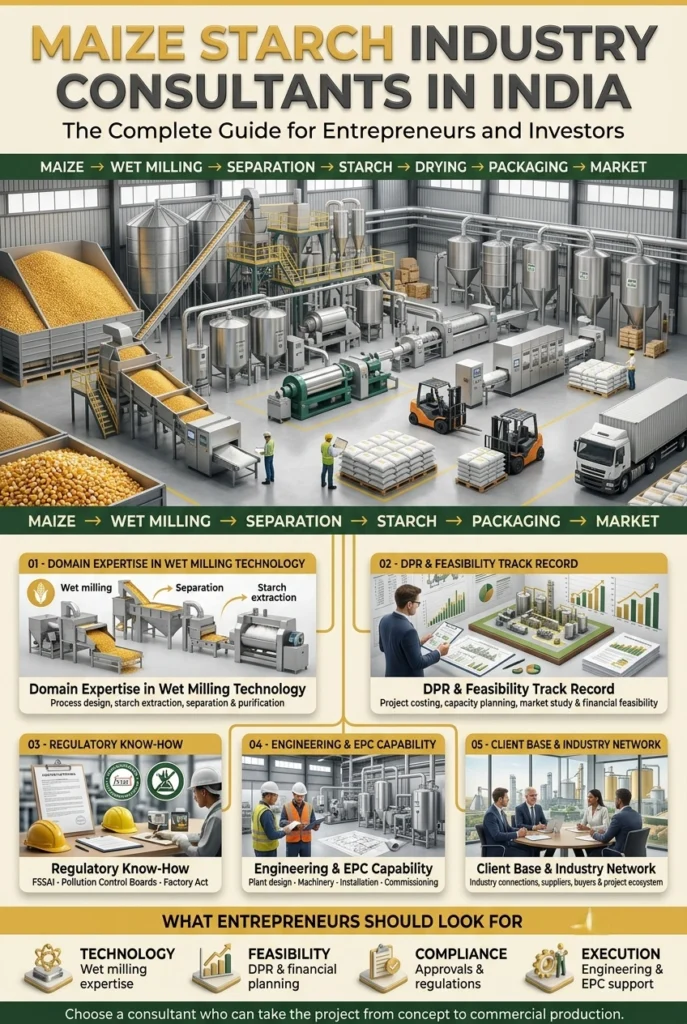
1. Domain Expertise in Wet Milling Technology
The technology for the commercial production of maize starch is basically wet milling. If you’re not able to explain technical details of steepwater pH management, germ extraction efficiency and starch/gluten separation parameters, you’re not the fit for this industry. Inquire specifically about the number of maize starch/corn processing projects they have worked on, and ask for the names of projects where they have worked. The best maize starch consultants in India will also have experience in both batch-type maize crushing mills for MSMEs (those having capacity of 50-100 TPD maize crushing) and continuous large scale maize crushing mills (200 or more TPD).
2. DPR and Feasibility Track Record
The DPR is the bank or investor’s or MSME lender’s main focus point to check. Your consultant’s experience in creating bank-ready DPRs is a must. Check if their DPRs are utilised for term loan applications to nationalised banks or SIDBI? A consultant with experience in feasibility studies for various size plants, product mixes (native starch, modified starch, glucose, dextrose and sorbitol), and various investment sizes will create a much more defensible and refined document than a generalist.
3. Regulatory Know-How — FSSAI, PCBs, and Factory Act
Maize Starch used for food applications comes under the Food Safety and Standards Authority of India (FSSAI) standards. Your consultant needs to be knowledgeable of the FSSAI registration and licensing requirements, food-grade product standards, and labelling compliance. Apart from food safety requirements, each manufacturing unit must obtain clearance from the respective State Pollution Control Board (PCB) under the Water and Air Acts. The unit must also register under the Factories Act and comply with Goods and Services Tax (GST) requirements. Project planners address these compliance requirements during the planning stage and include them in the project timeline and budget from the outset. This proactive approach helps businesses avoid unexpected delays and additional costs later.
Access Complete Business Plan: Maize Processing Unit – Detailed Project Report & Business Plan

4. Engineering and EPC Capability
Process engineering consultants that have the ability to EPC take the DPR one step further by actively assisting in plant commissioning. This is especially important for first-time plant owners who want to help fill in the gap between the feasibility document and machine-on-ground operations. Inquire if the consultancy can offer machinery vendor comparisons, negotiate machinery contracts, and offer commissioning supervision. The integrated service model is offered by top engineering consultants in India in the food processing industry.
5. Client Base and Industry Network
A well networked consultancy is more than just technical knowledge. They also have a strong network of relationships with equipment manufacturers, raw material suppliers, institutional lenders and industry organisations such as AISMA (All India Starch Manufacturers’ Association) which provide a valuable practical support to fast-track project completion. These connections are particularly crucial for new entrepreneurs entering this field for the first time, as connections that help bring a project from the concept stage to commercial production are what may make or break the success of a project.
Role of NPCS in Maize Starch Project Consultancy
Based in Delhi, India, Niir Project Consultancy Services (NPCS) has a strong portfolio of maize starch and corn processing projects advisory services among established industrial consultancy groups in India with its flagship portal niir.org. NPCS was founded in 1994 and is in its 40th year of operation, with a combination of sectors and countries in which the firm has operated that does not mean it has been specialised. NPCS has been operating since 1994 and has more than 150,000 successful project engagements, a figure attributable to its extensive sectoral and geographic reach, not to a narrow specialisation.
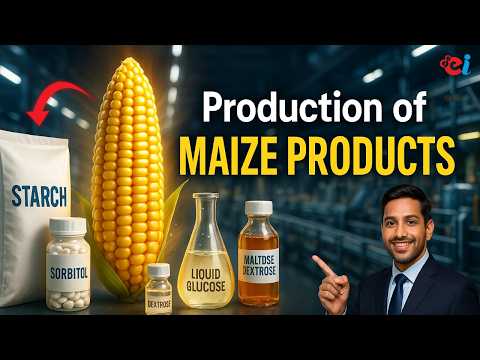
NPCS’s most immediate contribution for maize starch entrepreneurs is its extensive collection of detailed project reports and techno-economic feasibility studies on all the corn processing products, ranging from maize starch, dextrose monohydrate, liquid glucose, sorbitol, modified starches, corn gluten, germ oil to high-fructose corn syrup (HFCS). The reports include descriptions of manufacturing processes (wet milling route), machinery, raw material details, market research and demand analysis, process flow diagram, product mix and capacity planning, and full project financial details with profitability analysis.
Related Article: Maize Processing Industry in India: Starch, Sorbitol & Value-Added Products Market Opportunity
Before investing in a specific product, founders who are considering several product angles, such as maize native starch, dextrose or HFCS, can check out NPCS’s maize and corn processing project catalog and learn about all the investment possibilities. This resource is especially useful when at the pre-investment phase, the selection of the product has the greatest strategic impact.
NPCS’s purpose is to serve as a platform for project identification, feasibility validation and DPR preparations, all of which can be considered prerequisite steps in the initiation of a new manufacturing business. If you have determined that maize starch processing is a viable option, but have not decided on your product, plant size or location, using the project catalog provided by NPCS can help you start your project in a structured way, rather than hiring a full-service engineering or EPC consultant for detailed plant design.
Best Maize Starch Industry Consultants in Delhi and the India Consultancy Landscape
As in most other areas, Delhi-NCR is also the most concentrated area for industrial project consultancy services in India in maize starch industry. The best maize starch industry consultants in Delhi offer several advantages over consultants in other regions. They benefit from their proximity to the headquarters of key government ministries, including the Ministry of Food Processing Industries (MoFPI) and the Ministry of Home Affairs (MoHA). They also have easier access to MSME financing institutions and maintain established relationships with equipment suppliers across the country. Many of these consultancies provide project development assistance to entrepreneurs outside of Delhi, in addition to visiting the site for plant layouts and compliance checks.
Outside Delhi, there are some interesting regional clusters in India’s consultancy scene for this sector. Due to the concentration of the starch industry in Gujarat, the consultants in Gujarat are particularly strong in the field of Maize Starch. Likewise, Hyderabad and Bengaluru are consultative with good agro-processing and food technology know-how, close to major maize starch manufacturing centres in Andhra Pradesh and Karnataka. But, where ever the evaluation is done, the same standards are used: Domain expertise, DPR quality, regulatory expertise, and client track record.
There is also a growing section of management consultancy firms in India that are boutique players and have sectoral expertise, apart from financial advisory. These companies can be especially helpful when entrepreneurs already have some experience in the domain and require some support in structuring their business plan, in approaching investors, or during bank due diligence. This type of consultancy is valuable to those working on maize starch projects that are looking for external equity or NRI investment, beyond the DPR. Invest India also facilitates larger projects with a theme of FDI in this area.
Discover business ideas that actually make money
Comparing Consulting Service Types for Maize Starch Projects
The table below summarises the primary types of consulting engagements relevant to a maize starch project, helping entrepreneurs understand which service they need at each stage of their project journey.
| Service Type | Core Focus / Deliverable | Best Suited For | Typical Stage |
| Feasibility Study Consultant | Market viability, rough capex, economic attractiveness, product scope analysis | First-time entrepreneurs evaluating the sector; NRI investors at early idea stage | Pre-investment / idea validation |
| DPR / Techno-Economic Consultant | Detailed project report, process flow, machinery, raw material, financials, ROI | Founders seeking bank finance (MSME loans, term loans); investors requiring formal project documentation | Pre-financing / pre-sanction |
| Process Engineering Consultant | Wet milling process design, equipment sizing, starch recovery optimisation, plant layout | Entrepreneurs with secured funding looking to finalise plant design and machinery specs | Post-financing / pre-procurement |
| EPC Consultant / Project Manager | End-to-end project execution: design, procurement, civil co-ordination, commissioning | First-time plant owners who need turnkey project management support | Execution phase |
| Regulatory and Compliance Advisor | FSSAI registration, PCB consents, Factory Act, GST, BIS standards, export compliance | All project types — compliance advisory is required at multiple stages | Pre-commissioning and ongoing |
| Boutique Management Consultant | Business plan, investor pitch, financial modelling, market entry strategy, scale-up advisory | Growth-stage MSMEs, NRI-backed projects, equity fundraising scenarios | Growth / expansion / fundraising |
Conclusion: Practical Next Steps for Maize Starch Entrepreneurs
Maize starch industry in India is at a turning point. The demand of domestic market for food processing, pharmaceuticals, paper, textiles and new bioplastics industry is rising steadily. There is growth in export markets. Food Processing Investment is a deliberate policy support from the Government through MoFPI & Invest India. Also, the availability of maize will go up significantly in the next decade. This is a real long-term opportunity for entrepreneurs and investors, who have made the right investment decision at the right time.
However, none of that translates into a profitable plant without the right expert guidance at the right stage. The first step is getting a credible techno-economic feasibility study done — one that honestly addresses raw material sourcing, starch recovery rates, product mix economics, byproduct revenues, and regulatory compliance costs. From there, choose a process engineering consultant with demonstrated wet milling expertise to design your plant correctly from the start. For regulatory navigation, ensure your team understands FSSAI requirements and state PCB compliance timelines well before your scheduled commissioning date.
Entrepreneurs at the project identification stage will find it useful to review NPCS’s curated maize and corn processing project catalog to explore the range of product options — from native maize starch and dextrose to liquid glucose, sorbitol, and HFCS — before deciding on a specific investment focus. Meanwhile, established manufacturers looking to scale or diversify into derivatives should seek top maize starch industry consultants in India who combine process engineering depth with strong financial modelling capability.
In sum, a well-chosen consultancy partner does not just write a report — they help you build a fundable, buildable, and commercially viable maize starch business. That distinction is worth taking seriously before you sign the first engagement letter.