


Why LV Switchgear Business Ideas Are Worth Exploring Right Now
The transition of India’s power sector is one of the most ambitious ever witnessed in decades. A reliable, code compliant low voltage (LV) distribution network is crucial to every new township, industrial park, data centre, metro rail project and renewable energy farm. The LV switchgear system encompasses circuit breakers, contactors, motor protection relays, miniature circuit breakers (MCBs), moulded case circuit breakers (MCCBs), distribution boards and busbar systems, the core of the network. LV switchgear is a promising business opportunity for manufacturing entrepreneurs and MSME investors seeking venture ideas with significant domestic market demand, high profit margins, and expanding export potential. The sector is a key enabler for India’s infrastructure growth, energy transition and industrial indigenisation agenda – making it highly relevant for the next decade.
The Demand Logic Behind India’s LV Switchgear Market
India’s total power generation capacity has surpassed 950 GW and the target of 500 GW of renewable power capacity will see a significant growth in solar parks, wind farms, and hybrid projects. Each MW installed on the grid requires distribution boards, cable management and low voltage protection equipment. In the same way, the urban infrastructure push – smart cities, metro corridors, airport expansion, hospital complexes – results in regular procurement cycles for LV panels and switchgear assemblies.
Premium customers of high specification LV switchgear include factory automation, EV manufacturing plants and semiconductor fabrication plants on the industrial side. These buyers are looking for compact, IEC certified, digital metering and remote monitoring options. Besides, the Pradhan Mantri Awas Yojana (Urban) and Housing for All scheme has brought about new residential units in the tens of crores — where each unit needs MCB panels and distribution boards. The overall demand pull is uniform and anti-cyclical in nature, both for residential, commercial and industrial sectors.
The India Brand Equity Foundation (IBEF) has been monitoring the spending on infrastructure in these verticals and validates the multi-sector demand narrative. On the other hand, Invest India has listed electrical machinery, such as switchgear, as a top priority sector of Make in India.
Related Article: Switchgear and Control Panel Manufacturing Business Guide
Government Policies and Incentives Powering the Sector
Production Linked Incentive (PLI) for White Goods and Electrical Equipment
Domestic manufacturers can avail the incentive tranches of the Union government’s PLI scheme for White Goods, which includes components in the switchgear value chain. The Ministry of Heavy Industries also has a capital goods component, which includes switchgear assembly units and precision component makers. This scheme provides an incentive of a percentage of incremental sales from a base year to the eligible manufacturers that fulfil domestic value addition conditions.
MSME Credit Guarantee and PMEGP Support
The Credit Guarantee Fund Trust for Micro and Small Enterprises (CGTMSE) helps first generation entrepreneurs and small units to access credit without any collateral up to ₹5 crore. The PM Employment Generation Programme (PMEGP), run by KVIC, offers subsidized project loans for fresh manufacturing projects such as electrical components manufacturing units.
BIS Mandated Certification and Domestic Preference
IS/IEC certification is a mandatory requirement for MCBs, MCCBs and switchgear assemblies from the Bureau of Indian Standards (BIS) under the Electronics and IT Goods (Requirement for Compulsory Registration) Order. This ensures that domestic manufacturers do not face unfair competition from uncertified imports and creates a level playing field. Government agencies use the Government e-Marketplace (GeM) to purchase public goods. The platform gives MSMEs preference in public sector procurement, including electrical distribution equipment for Central and State Governments.
Multiple LV Switchgear Manufacturing Business Ideas for Startups
1. Miniature Circuit Breaker (MCB) and RCCB Assembly Unit
Domestic assembly facility of MCBs and Residual Current Circuit Breakers (RCCBs) is one of the most feasible LV switchgear business ideas for a start-up with moderate investment. It is a process of procuring stamped contacts, bimetals, bimetallic trip units and moulded housings from tier 2 suppliers which are many from Gujarat and Maharashtra and then assembling them together to make products which are BIS certified. The domestic demand for MCBs is vast, stemming from new housing construction, periodic refurbishment cycles and required upgrades to older buildings. A well setup unit that runs 500-1000 poles per day can be able to generate a consistent revenue stream from electrical wholesalers, builder procurement teams and e-commerce platforms. The strength of this advantage is the confidence of the local supply chain, the reduced delivery lead times for comparison with imported products and the ability to provide customised amp ratings for specific project needs.
Get Detailed Project Report (DPR): Miniature Circuit Breaker (MCB) Manufacturing Project Report
2. Moulded Case Circuit Breaker (MCCB) Manufacturing and Testing
MCCBs are installed on the industrial and commercial panel and provide protection for the distribution feeders up to 2,500A. This is a capital-intensive and higher margin venture than MCBs. The MCCB manufacturing startup company needs to invest in precision injection moulding of housing parts, arc chute assembly and electronic trip unit integration. The testing laboratory is a critical part of the initial capital investment and comprises 20-25% of the total. Once established MCCBs offer much better margins as the buyer market includes engineering procurement contractors (EPCs), panel builders and utility companies looking for quality, after-sales service and not solely price. Two emerging demand channels that are particularly fueling MCCB procurement for sub-distribution boards are the rollout of the EV charging infrastructure and the construction of data centres.
3. LV Distribution Panel and MCC Manufacturing
Motor Control Centres (MCCs) and power distribution boards are custom-engineered assemblies that integrate a variety of components including MCCB, contactors, overload relays, busbars and metering devices into one panel. It is a fabrication and integration company and not a pure component manufacturing company. The key equipment needed to run a well-operated panel-building shop includes skilled electricians, a good sheet metal fabrication system, and strong engineering design skills. The margins are appealing because they are custom-made and so there is a minimum of commoditisation. Reliable, tender-based customers include government infrastructure projects like pumping stations, substations and industrial estates. The Government also has an e-Marketplace (GeM) that provides procurement opportunities for entrepreneurs and switchgear panels have been included as a standardised category.

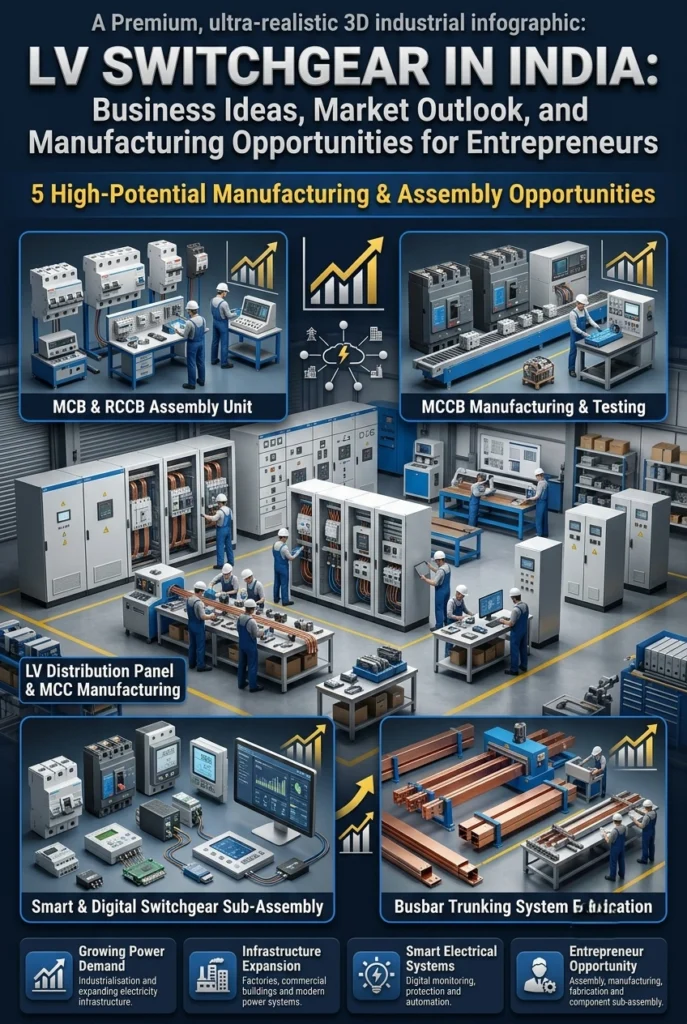
4. Smart and Digital Switchgear Component Sub-Assembly
Smart switchgear (current sensors, communication interface, remote trip/re-set) is increasing at a higher rate compared to conventional LV products as the use of automation and Industry 4.0 becomes more prevalent. A startup may position itself as a special sub-assembly producer for smart meters modules, motor protection relays with RS485/Modbus output and digital power monitoring relays. This business does not involve heavy production facilities; rather, it demands strict assembly and embedded test equipment and strong cooperation with the OEM customer. The deployment of smart metering is being actively pushed by the National Smart Grid Mission (NSGM) by the Ministry of Power, thereby ensuring that demand for digital switchgear components is continually rising in the distribution networks.
5. Busbar Trunking System Fabrication
Due to safety, ease of installation, and space saving, busbar trunking systems (BTS) are increasingly being adopted over the traditional cabling in large commercial buildings, data centres and industrial plants. An Indian MSME can establish a BTS Manufacturing Plant for manufacturing Copper or Aluminium Busbar Systems with a range of currents of 100A to 3,200A. Main raw materials, electrolytic copper bars and aluminium extruded profiles are locally available. Galvanised steel sheets are used to make enclosures. There is active support in this category for exporters by Electrical Equipment Industry Association (EEPC India). Also, BTS products are eligible for export incentives by the Foreign Trade Policy, which is regulated by the DGFT, thus, it’s an export business opportunity for growth-oriented startups.
Import–Export Opportunity Analysis for LV Switchgear Startups
The dynamics of LV switchgear trading in India are interesting. India is an importer of high quality contactors, electronic trip units and programmable protection relays, the bulk of which comes from Germany, Japan, South Korea and China. Meanwhile, Indian producers have started to make a solid mark in the export market, with a significant presence in the Middle East, Africa, and South and Southeast Asia, where buyers accept Indian-made products at competitive prices.
The import substitution aspect is particularly favourable for MCCB electronic trip units, smart relay modules and motor soft-starters. These sub-components have traditionally been imported from overseas OEMs. An entrepreneur that sets up domestic production of these sub-components can capture import value. It can also become a Tier-1 supplier to larger India switchgear assemblers. This substitution play is being encouraged by the government’s preference policy for public procurement under DPIIT. The policy forms part of the Atmanirbhar Bharat initiative.
South Asian markets like Bangladesh, Sri Lanka and Nepal and African markets like Kenya, Tanzania and Ethiopia are emerging markets for exports. Indian switchgear is available in accordance with IEC standards and the cost advantage of manufacturing it makes it competitive in these parts of the world. Electrical equipment exporters can avail of export advisory and market linkage facility from CHEMEXCIL and EEPC India.
Get Detailed Insights from This Book: Our Books
Indian MSME Leaders in the LV Switchgear Sector
Indo Asian Fusegear — Pioneering Domestic Switchgear Manufacturing
Initially established in Ludhiana, Indo Asian Fusegear Limited (now a part of a bigger group) adopted a straightforward approach. India’s growing power distribution network required BIS-certified, competitively priced MCBs and distribution boards. These products needed to be dependable for domestic panel builders. With a focus on BIS approval, the company invested in injection moulding equipment and manufacturing capacity. It also developed a nationwide distribution network. This helped the brand gain a head start in the residential and SME segment. What new business owners should take away from this is simple. Two of the longest-lasting competitive moats in this industry are manufacturing capability, certification, and distribution infrastructure. Technology is not the only factor.
L&T Electrical & Automation — The MSME-Originating Success Model
The depth of penetration of the Electrical & Automation division of Larsen & Toubro is in the segments where thousands of panel builders and distributors operate, which is where MSME switchgear manufacturers can play as a component supplier. Based on L&T’s experience, the panel builder market is a very large and highly fragmented channel. The addressable market for a startup providing MCCBs, busbars or digital relays to the panel builder is much greater than just the direct OEM market. The smart entrepreneur establishes his B2B interactions with the panel builder communities first, and then reaches out through trade associations and state electrical contractor groups.
C&S Electric — The Export Ambition Model
Established in New Delhi, C&S Electric has evolved from a medium-scale switchgear manufacturing business. It has become a globally accepted LV and MV switchgear brand, exporting to over 90 countries.
The philosophy of Sushil Gupta, the promoter, focuses on quality systems. It also includes international certification (CE, UL, CB scheme) and the appointment of international agents. This shows that Indian manufacturers can compete in the international market with strong quality systems.
Even if you are a new player in LV switchgear, you need to consider the certification roadmap. This should cover not only BIS but also IEC CB scheme certification. It can help open the European and Middle East markets.
Explore proven business ideas with high success potential
How NPCS Can Help You Evaluate LV Switchgear Business Feasibility
The Niir Project Consultancy Services (NPCS) are able to offer professional consulting for the preparation of Market Survey cum Detailed Techno-Economic Feasibility Reports (DPRs) for starting a new industry or business. We provide a detailed report for LV switchgear manufacturing industry, Electrical component manufacturing industry which contains manufacturing process, market research & demand analysis, process flow diagram, product mix & capacity planning, machine & raw material details, complete project financial, profit and loss statement of the project. Whether you are thinking of investing in a small MCB assembly unit or a full-scale manufacturing unit of MCCB, our goal is to assist you with feasibility, profitability and scalability assessments. To get project-specific advice, check out Entrepreneur India or contact us via our consulting portal.
LV Switchgear Segment Overview: Market and Business Snapshot
| Product / Segment | Primary End-Use | Key Buyers | Revenue Potential (Annual) | Typical Setup Investment | Growth Driver |
| MCB / RCCB Assembly | Residential & Commercial Buildings | Electrical Wholesalers, Builders | ₹40–80 Lakh | ₹30–60 Lakh | PMAY Housing Scheme |
| MCCB Manufacturing | Industrial Feeders, Panel Boards | EPC Contractors, Panel Builders | ₹1–3 Crore | ₹80 Lakh–1.5 Crore | Data Centres, EV Infrastructure |
| LV Distribution Panels / MCC | Industrial Process Plants | EPC Firms, Govt. Projects | ₹1.5–4 Crore | ₹50–80 Lakh | Infrastructure Push, GeM Tenders |
| Smart Switchgear Sub-Assembly | Smart Grids, Automation Plants | OEMs, Automation Integrators | ₹60 Lakh–1.5 Crore | ₹25–50 Lakh | Industry 4.0, NSGM Smart Metering |
| Busbar Trunking System (BTS) | Data Centres, Large Buildings | Infrastructure Developers | ₹1–2.5 Crore | ₹60 Lakh–1.2 Crore | Data Centre Boom, Export Markets |
| Digital Protection Relays | Utilities, Industrial Motors | Power Utilities, EPC | ₹80 Lakh–2 Crore | ₹40–70 Lakh | Grid Modernisation |
| Contactor & Overload Relay Mfg | Motor Starters, MCC Panels | Panel Builders, OEMs | ₹50 Lakh–1 Crore | ₹25–45 Lakh | Atmanirbhar Import Substitution |
| Metering Panels & AMR Systems | Utilities, Industrial Plants | DISCOMs, Project Developers | ₹1–2 Crore | ₹35–60 Lakh | Smart Metering Drive |
| Cable Management Accessories | All Electrical Installations | Contractors, Builders | ₹40–70 Lakh | ₹15–30 Lakh | Residential + Infra Construction |
| LV Switchboard Export Unit | GCC, Africa, South Asia | International Distributors | ₹1.5–4 Crore | ₹75 Lakh–1.5 Crore | Export Incentives, IEC Certification |

Conclusion: LV Switchgear Is a Long-Term Manufacturing Bet
The infrastructure journey in India, whether in energy, housing, industry, or digital systems, has made LV switchgear a structurally sound manufacturing category for MSME entrepreneurs. The demand is not cyclical or trend-driven. It is built into every electrical installation India will need over the next 20 years. As the economy grows, this demand will continue to expand. From MCB assembly and panel fabrication to smart relay sub-assemblies, there is a clear path to scale. The sector also offers tangible government support and opportunities for hundreds of new domestic suppliers.(LV Switchgear Business)
For entrepreneurs ready to take the first step, a professional Techno-Economic Feasibility Study from NPCS offers the analytical foundation to make informed investment decisions. Explore the full range of electrical and power sector business reports at Niir Project Consultancy Services.
Reference Links
- Ministry of Power — Government of India
- Ministry of MSME — Government of India
- DPIIT — Department for Promotion of Industry and Internal Trade
- Make in India — Official Portal
- Startup India — DPIIT
- EEPC India — Engineering Export Promotion Council
- BIS — Bureau of Indian Standards