


Kharkhoda Industrial Area
A Town That Is Rewriting India’s Auto-Industrial Map
A major development is taking place 45 minutes north of Delhi. Kharkhoda, a small town in Sonipat district of Haryana has been making its name in the industry without being noticed, and it is an address no serious manufacturer, MSME owner or industrial investor should ignore.
Avani Infratech, a rapidly expanding developer from Delhi-NCR and Haryana is now presenting a well fragmented Industrial plotting project in SGIT Kharkhoda which is spread across 10.34 acres on NH-334B located just 5 minutes from Kharkhoda City. The project is set in the lap of one of the biggest automobile manufacturing campus India ever built. That’s no coincidence. It is strategy.
Maruti Suzuki India Limited on 18 May 2026 announced that commercial production of the second plant of its Kharkhoda manufacturing plant has been started. The plant was then officially inaugurated on 3 July 2026 by Prime Minister Narendra Modi and Japanese Prime Minister Sanae Takaichi at the India-Japan Joint Economic Forum. The 800-acre plant is expected to attract a total investment of ₹35,000 crore and will be one of the world’s largest single-site automotive capacities with capacity to increase to 10 lakh units per year.
The message is clear for entrepreneurs, MSME founders, auto-component manufacturers, logistics operators and investors of industrial plots: Kharkhoda is open, funded and scaling up quickly.
What Recent Reporting Means for Entrepreneurs and Manufacturers
What Happened
As reported in the project page of SGIT Kharkhoda, the industrial plotting project in Village Jharothi, NH-334B is being done for manufacturing units, ancillary industries and suppliers in response to the rapidly increasing industrial site expansion by Maruti Suzuki around the area. The size of the plots varies from 597 sq. yds. to 1,773 sq. yds. and have zoning clearances for red, orange and green category industries.
Why It Matters
A Maruti scale plant cannot operate alone. We need a strong ecosystem of suppliers, component manufacturers, tool and die, logistics, quality testing labs and contract manufacturers within a 100-mile radius. History shows that scaling up Maruti’s Manesar plant created hundreds of ancillary units and 10,000 MSME-level jobs in the surrounding belt.
Today Kharkhoda is exactly at the same point, only on a grander scale, with a more robust policy ring and a built-in from-the-ground-up infrastructure.
What Opportunities Emerge
Combined with an 800-acre Tier-1 OEM campus, a government-sponsored Industrial Model Township, direct NH-334B connectivity and industrial plots from developers Avani Infratech, this translates into an 8-tiered opportunity landscape spanning manufacturing, logistics, real estate and support. Those entrepreneurs who make the move early will grab supply chain opportunities, before the third Maruti plant (under approval in 2029) secures vendor slots for good.
Identify high-growth industries before others do
Why Kharkhoda’s Industrial Belt Is Growing Faster Than Analysts Expected
There are three forces now coming together in Kharkhoda-Sonipat corridor:
The first: Maruti Suzuki’s multi-plant commitment. There are already 2 plants operational. A third project, approved by the board of directors at a cost of ₹7,410 crore, aims to begin operations by 2029. The capacity of the single facility will be able to reach 7.5 lakh vehicles annually. Auto-parts major Minda Industries has already set up units within the premises of IMT Kharkhoda and HSIIDC has leased nearly 1,000 smaller plots to MSME-scale manufacturers who are part of the supply chain.
Second: Policy pushes in Haryana. The Make in Haryana Industrial Policy 2025 is explicitly made for the industrialisation of corridors such as Kharkhoda. It has a 121.7-km Haryana Orbital Rail Corridor between Palwal and Sonipat, with a link through Manesar and Kharkhoda that offers Dedicated Freight Corridor (DFC) connectivity. The PADMA project also identifies the Kharkhoda area as a potential site for ESICs, incubation centres, and plug-and-play MSME sheds.
Third: Location fundamentals. The Kharkhoda belt is located within the NCR, and there are 14 districts in Haryana that lie in the NCR. NH-334B offers direct road links. Once the Haryana Orbital Rail Corridor becomes operational it will have rail connectivity to both the Western Dedicated Freight Corridor and the Eastern Dedicated Freight Corridor.
Government Policies and Incentives: What Manufacturers Can Claim
In the corridors such as Kharkhoda, the Haryana government (investharyana.in) has created several layers of incentives for manufacturers:
- Make in Haryana Industrial Policy 2025: Net SGST rebate for up to 07 years for priority units, capital subsidy, employment generation subsidy and 100% electricity duty exemption for 10 years.
- ₹500 Crore Saksham Fund: devoted for refurbishment and modernization of industrial townships in Sonipat, Hisar, Sirsa etc.
- PADMA Initiative: Plug and play MSME sheds in each and every one of the 143 blocks of the state, directly reducing the infrastructure capital required to start manufacturing.
- HSIIDC Plot Allotment: HSIIDC is continuing to allocate plots for industrial purposes for footwear, metal products, chemicals, machinery and automobile and auto-ancillary manufacturing in IMT Kharkhoda.
- For first time manufacturers in the Haryana industrial belt PMEGP, CGTMSE and Mudra loan facilities are still available.
- Startup Nodal Officers are appointed in all the districts by the Ministry of MSME schemes for on-ground support of startups namely Haryana Startup Advisory Council, and State Innovation & MSME Council.
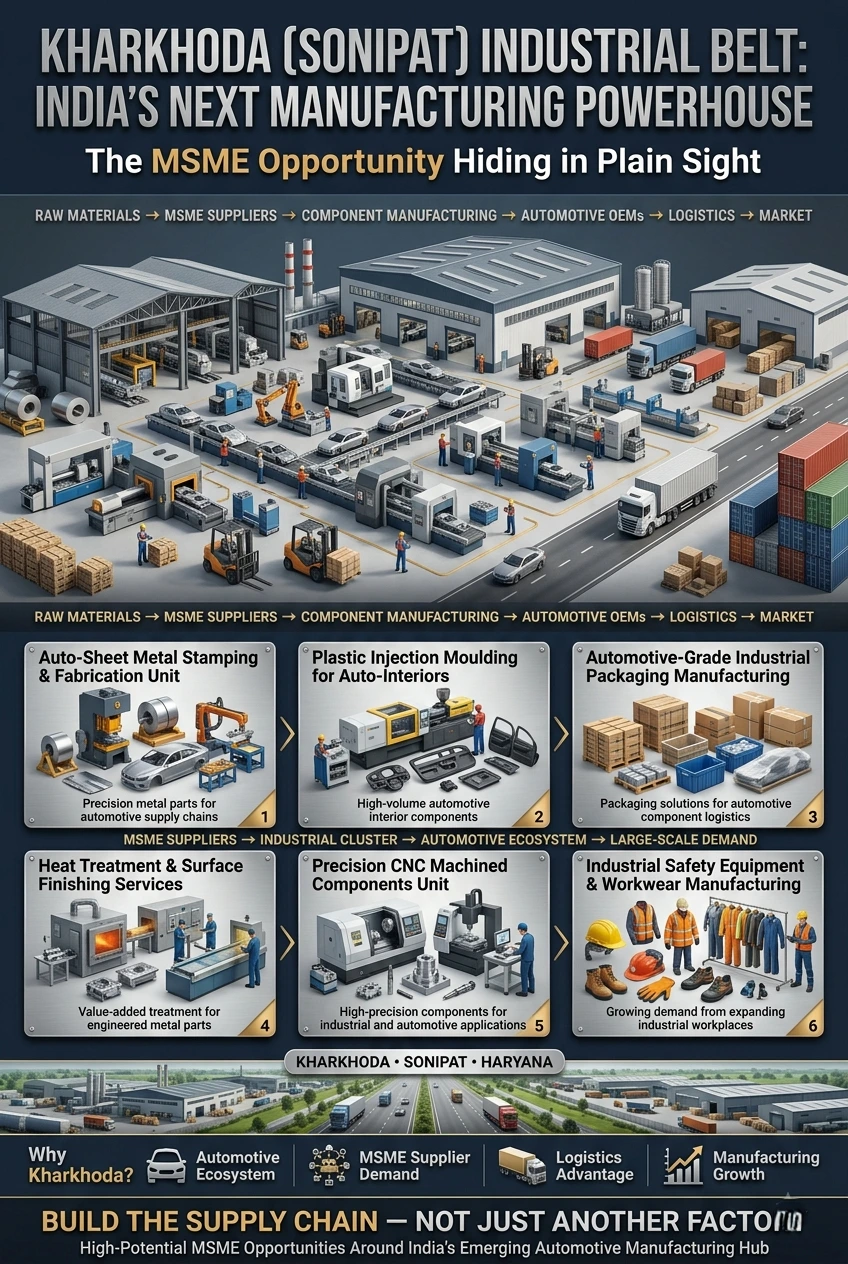
6 Manufacturing Business Ideas Directly Tied to the Kharkhoda Opportunity
All opportunities below are based on actual industrial activity at Kharkhoda (not estimated demand, but confirmed OEM pull).
1. Auto-Sheet Metal Stamping and Fabrication Unit
Brezza and Victoris compact SUVs made at Maruti’s Kharkhoda plant use thousands of components that manufacturers stamp from metal, including body panels, brackets, sub-frames, and reinforcements. One of the simplest supply chain opportunities available is a sheet metal stamping unit within 10-15 km. The plot sizes at SGIT Kharkhoda can accommodate a medium-size stamping shed, and the industrial zone already has red-category approval. Investment size: ₹80 Lakhs to ₹5 crores.
2. Plastic Injection Moulding for Auto-Interiors
All vehicles produced at Kharkhoda use plastic interior parts, such as dashboards, door trims, consoles, bezels, fasteners and clips, which local Tier-2 players generally supply. Plastic injection moulding is an orange industry with low compliance requirements. The minimum entry cost starts from ₹40 lakh for two machines to ₹2 crore for multi-cavity operations.
Get Detailed Insights from This Book: The Complete Book on Medical Plastics

3. Automotive-Grade Industrial Packaging Manufacturing
OEM assembly lines require suppliers to deliver components in custom corrugated boxes, foam-inserted trays, VCI anti-rust packaging, and returnable plastic dunnage boxes. A corrugated packaging or custom foam moulding operation which directly serves the Kharkhoda supply chain is a high volume, repetitive demand business. Compliance with green category zoning is easy. Investment: ₹25 lakh to ₹1.5 crore.
Related Article: Biodegradable Packaging Manufacturing Business in India: Cost, Profit & Project Report
4. Heat Treatment and Surface Finishing Services
Metal parts used in engine assembly, transmission and chassis undergo heat treatment—including hardening, tempering, annealing and case carburising—before OEMs accept them. The Kharkhoda belt has multiple Tier-2 suppliers, creating demand for technically specialised manufacturing service providers in this under-supplied, high-margin segment. The investment would be in between ₹1.5 crore and ₹6 crore.
5. Precision CNC Machined Components Unit
Precision machining is essential prior to final assembly of gearbox housings, brake callipers, suspension arms and structural castings. A 4–6 machine CNC shop can secure vendor pre-qualification with Tier-1 suppliers within 12–18 months by operating from a well-located industrial plot, such as those offered by SGIT Kharkhoda on NH-334B. Investment: ₹1 crore to ₹4 crore.
6. Industrial Safety Equipment and Workwear Manufacturing
For a large OEM campus, demand for safety helmets, high-visibility vests, gloves, safety shoes, and protective eyewear remains steady. Manufacturing workwear and PPE for the Kharkhoda industrial cluster is a Green Category, low-capex opportunity. It also offers good export potential in Southeast Asian markets. The investment required is between ₹20 lakh and ₹80 lakh.
Get Detailed Project Report (DPR): Workwear, Factory Uniforms, Work Clothing Suits Manufacturing Business
Import–Export Opportunity Analysis
Export Markets
India exports precision-machined components, forgings, and electrical harnesses to more than 40 countries. Key markets include Japan, Germany, the United Kingdom, and the United States. Auto-parts exports from India reached USD 21 billion in FY2024–25. The Haryana auto corridor plays a significant role in this growth. Products produced in Kharkhoda area units are eligible for export with the help of GSP to a number of markets.
Import Substitution
Precision manufacturing, jigs, fixtures, and specialty polymers for automotive applications are still largely imported. A tool and die-making and specialty polymer compounding facility in Kharkhoda can reduce India’s import bill. It may also qualify for the PLI (Production Linked Incentive) Scheme for automotive components.
International Trade Opportunity
Suzuki Motor Corporation revealed that it manufactures its all-electric e Vitara only in India and exports it to approximately 100 countries, making it the top car importer into Japan by value. This creates a strong opportunity as the supply chain can now serve both domestic and export demand.
Indian MSME Success Stories: What the Manesar Model Tells Us About Kharkhoda
Minda Industries
Starting with a small auto-parts factory, Minda Industries grew to become a listed Tier-1 auto-component supplier without straying far from Maruti’s manufacturing sites. It has already established its presence on the premises of IMT Kharkhoda, securing a first-mover positioning in the new belt. Nowadays, every MSME founder, in the Kharkhoda orbit, is in the same position that Minda was decades ago from Manesar.
MSME Sheet Metal Clusters Around Manesar
Over 20 years, Dharuhera, Rewari and Manesar fringe’s sheet metal vendors, who were originally 10 person businesses, grew into 200+ employee’s factories, all while consistently getting to meet the Maruti vendor criteria. The pattern repeats at Kharkhoda, which now has a stronger anchor, a better policy climate, and faster connectivity.
Haryana PPE Manufacturers Post-2020
With the push to manufacture PPE during the COVID-19 pandemic, a few MSMEs in Haryana, especially around Panipat, were able to switch their textile manufacturing to the production of industrial PPE. Some of them are now exporting to the Middle East and Southeast Asian markets. A similar demand catalyst exists in the Kharkhoda belt, which has industrial workwear related demands from big OEMs.
About NPCS — Niir Project Consultancy Services
NPCS (Niir Project Consultancy Services) is the largest industrial project consultancy firm in India that provides service to entrepreneurs, MSME and investors in all manufacturing fields. If you’re a business person considering the Kharkhoda opportunity, NPCS offers you:
- Detailed Project Reports (DPR): Techno-economic feasibility studies for auto-component, precision engineering, PPE and packaging manufacturing units.
- Market Research Reports: Demand Analysis, Competitive Landscape and Raw Material Sourcing Reports for the industrial belt of Haryana.
- Technology Consultancy: Plant layout, Machinery Selection, and Technology transfer advisory for the first time manufacturing companies.
- Financial Modelling, Investment Appraisal and Payback period for MSME scale manufacturing projects.
- Bank-ready Project Reports: Formatted for PMEGP & Mudra & Bank loan application.
Industry Opportunity Data Table
| Industry | Automotive Ancillary & Precision Manufacturing — Kharkhoda-Sonipat Belt, Haryana |
| Market Driver | Maruti Suzuki 800-acre facility (₹35,000 crore projected investment); 2nd plant commissioned May 2026; 3rd plant approved for 2029 |
| Investment Range (MSME) | ₹20 lakh (PPE/Packaging) to ₹6 crore (Heat Treatment / CNC Precision); larger units ₹10–₹50 crore |
| MSME Opportunity | Sheet metal stamping, plastic moulding, precision CNC, heat treatment, PPE, industrial packaging — all in direct supply-chain alignment |
| Export Potential | High — auto-components to Japan, Germany, UK, USA; PPE to Middle East and Southeast Asia; PLI Scheme support available |
| Government Support | Make in Haryana Policy 2025 (SGST rebate 7 yrs, 100% electricity duty exemption 10 yrs), PADMA MSME sheds, ₹500 cr Saksham Fund, HSIIDC plot allotment, PMEGP, CGTMSE |
| Risk Level | Moderate — demand visibility is strong given confirmed OEM anchor; standard MSME execution and quality-compliance risks apply |
| Growth Outlook | High — Kharkhoda capacity scaling to 10 lakh vehicles/yr by 2029; Haryana Orbital Rail Corridor under development; 10 new IMTs planned across Haryana |

Conclusion: The Kharkhoda Window Is Open — But Not Forever
SGIT Kharkhoda by Avani Infratech hits right the spot of a private infrastructure developer who sees the market signal – a confirmed large-scale, government-backed OEM investment in the direct sphere.
Maruti Suzuki Kharkhoda plant is not an imaginary venture. The company manufactures vehicles and has a second manufacturing plant. The board has also approved a third plant. This ₹35,000 crore investment will cover 800 acres. The project will create a cluster of hundreds of suppliers, logistics operators, tooling companies, and service providers in the Sonipat–Kharkhoda region.
Make in Haryana Industrial Policy 2025, HSIIDC’s infrastructure build-out, the Haryana Orbital Rail Corridor, and the Saksham Fund support a conducive policy environment. MSME manufacturers entering the belt within the next 24 months can gain a first-mover advantage. They can also benefit from favourable land and operating costs and growing OEM demand.
Entrepreneurs who made the early move penned the two stories of Manesar and Gurgaon. The Kharkhoda story is unfolding as we speak.