


Industrialists of Uttar Pradesh
However, the transformation of Uttar Pradesh is few in India’s recent history to drive business ideas. Despite its vast market and population, UP has been lagging behind in industrialisation, however, it has become one of the fastest growing investment destinations in India. The Yogi Adityanath government has garnered more than Rs. Ten successive investor summits with an investment intent of 40 lakh crores. In the past few years, more than 3,500 industrialists have grabbed industrial land and set up factories in UPSIDA areas in 51 districts, generating more than one lakh jobs.
Today, Uttar Pradesh ranks as the second largest economy among all the states in India with both manufacturing and industrial sectors growing at a fast pace, along with food processing, logistics and defence. The UP Defence Industrial Corridor, which covers the cities of Lucknow, Kanpur, Agra, Aligarh, Jhansi and Chitrakoot, is the most ambitious defence manufacturing initiative ever attempted in India. The IBEF Uttar Pradesh Report monitors the investment and growth details of the various sectors.
Why Uttar Pradesh Is India’s Fastest-Rising Industrial State
The industrialization of UP depends on three factors. Market size is the first one and UP is the largest domestic food, FMCG, construction materials and consumer electronics market in India with a population of 240 million. Secondly, infrastructure investment: during the last 10 years, the state has constructed more than 1,000 km of expressways, significantly decreasing logistics costs. Thirdly, the UP-Defence Corridor has become a hub for Hindustan Aeronautics, Tata Advanced Systems, Brahmos Aerospace and more than 100 defence MSMEs that have come to Lucknow and Kanpur. UP is an active industrial licenser and UP’s industry-wise activity is closely being monitored by DPIIT.
Besides, UP accounts for 60% of the production of perfume in India from the global hub of natural attar making named Kannauj. The exported products from leather and footwear sector in Agra market worldwide. Varanasi is a very important hub for silk and handloom. The cluster of brass and metalware of Moradabad is one of the biggest in the world. In Meerut sports goods are manufactured for export. This unique industrial mix makes UP one of the most complex yet opportunity rich manufacturing markets in India.
Get Detailed Project Report (DPR): Uttar Pradesh Business Opportunities Guide
Government Policies Supporting UP’s Industrial Growth
UP’s Industrial Investment and Employment Promotion Policy offer incentives for the various sectors such as capital subsidy, power tariff concession and exemption of stamp duty. There are active cluster development programmes by the Ministry of MSME in four industries in UP namely leather, handloom, brass, and agro-processing. The state’s single-window Nivesh Mitra portal is designed to allow digital regulatory approvals across 20+ departments, significantly cutting down the time taken for the new investors.(Industrialists of Uttar Pradesh)
The One District One Product (ODOP) scheme, which was introduced by Uttar Pradesh and is now a national scheme, connects 75 districts with their traditional industry strengths. Kannauj perfumes, Aligarh locks, Varanasi silk, Agra leather, Moradabad brassware are some of the 75 products under focused export promotion support under APEDA and Export Promotion Councils.
Top 10 Industrialists of Uttar Pradesh: Profiles and Future Vision
1. Kumar Mangalam Birla – Hindalco (Renukoot Operations)
The aluminium smelter at Hindalco, Renukoot, Uttar Pradesh is one of the biggest aluminium production plants in India. Aditya Birla Group’s Kumar Mangalam Birla has poured money into the industrial economy of UP via Hindalco’s integrated business, which has a captive bauxite processing, smelting and downstream aluminium product manufacturing model. Birla’s approach for his model in UP is similar to that of all his industrial enterprises, i.e. he had to situate the production closer to his own source of raw materials and energy. Future expansion plans include Hindalco’s downstream aluminium fabrications capacity in UP to cater the state’s booming automotive and EV industry.
2. Naveen Jindal – JSPL (UP Operations and Defence Corridor)
Naveen Jindal has strong industrial linkages in UP through his involvement in construction materials business with JSPL and Defence industry. UP defence corridor opens the door to Jindal’s steel manufacturing capabilities – defence applications of armour steel, structural steel for aircraft hangars, and specialised alloys are all areas where the JSPL product range meets the UP-defence corridor demand. He envisages that his future in UP is to strengthen the engagement of defence manufacturing and become a part of the infrastructure-led steel demand spree in the state.
3. Yusuf Hamied – Cipla (Pharma, Lucknow and Kanpur)
Major pharma companies like Cipla have set up and expanded businesses in the pharmaceutical manufacturing segment in UP, especially in Lucknow, Kanpur and Ghaziabad. UP’s high population base is creating an internal demand for pharmaceutical products, while improving infrastructure and government support for healthcare manufacturing, are the key factors that are enhancing the pharmaceuticals cluster in Lucknow. Cipla’s leadership model, which focuses on creating access oriented pharmaceutical manufacturing, making critical medicines affordable at scale, has provided UP’s pharma sector with a model – scale through volume, not premium pricing.
Read the Complete Book Here: Drugs & Pharmaceutical Technology Handbook
4. Leather Industry Leaders – Agra and Kanpur
The leather and footwear manufacturing belt in India is the biggest, Agra and Kanpur. Industrialists who established the shoe export industry in Agra and the tannery and finished leather industry in Kanpur established an export industry that was able to compete internationally with Italy, China and Brazil. The model of success is uniform: Quality certifications (ISO, OEKO-TEX), direct relations with global brands and continuous improvement of product design and finishing technology. The shoe cluster of Agra exports to more than 100 nations.(Industrialists of Uttar Pradesh)
5. Gaurav Burman – Dabur (Sahibabad Manufacturing)
India’s top FMCG company Dabur has one of its biggest manufacturing plants in Sahibabad, Uttar Pradesh. The Burman family’s approach to blending Ayurvedic formulation tradition with products in today’s consumer goods market has resulted in brands – Dabur Chyawanprash, Real fruit juice, Vatika hair care, etc – that have established a significant presence in their respective categories. The manufacturing plant in Sahibabad is an important distribution center for North India, highlighting UP’s geographic location in the FMCG value chain. Future investments are also planned to expand to nutraceuticals and health supplements manufacturing.

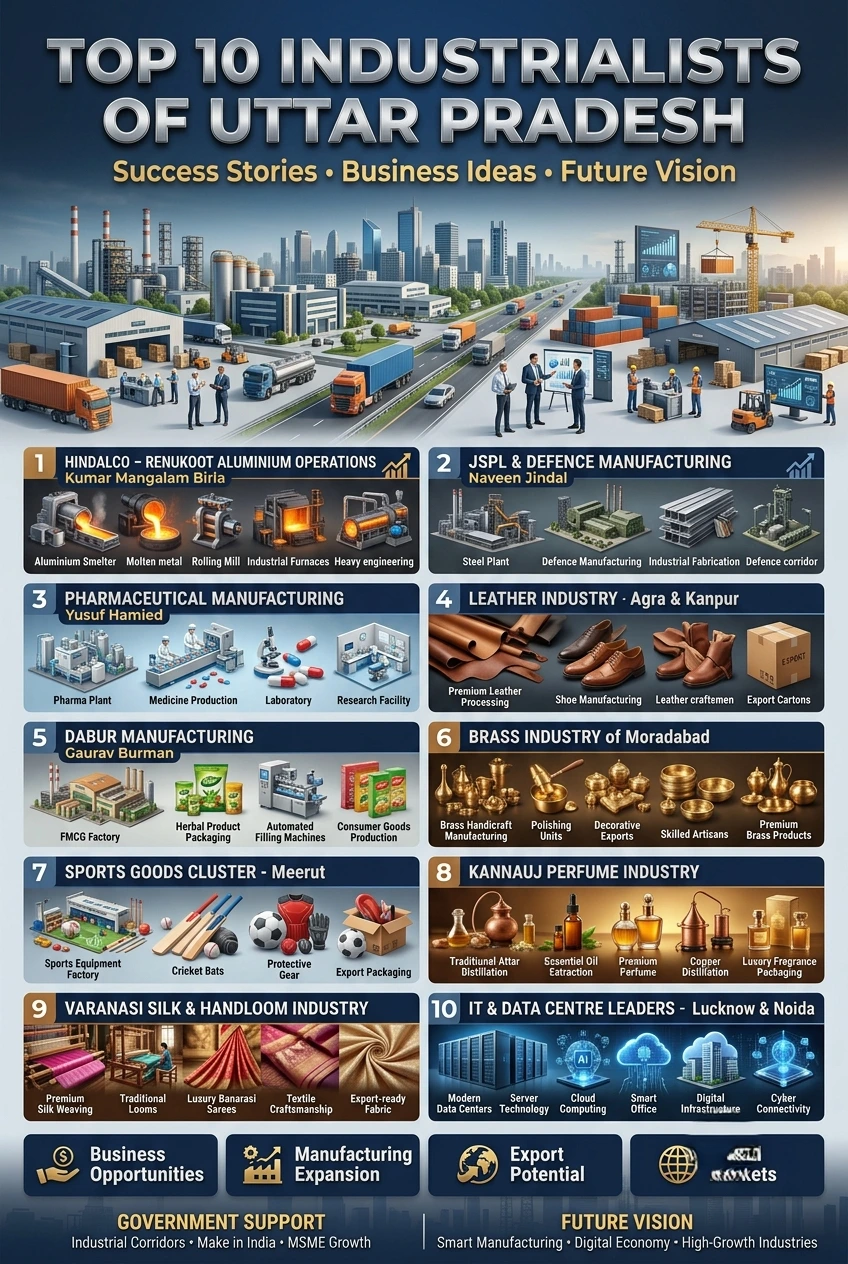
6. Brass Industry Leaders – Moradabad
Moradabad is popularly known as ‘Peetal Nagari’ (Brass City), a cluster of manufacturing units for brassware and metals homewares in the world. The industrialists in Moradabad created a competitive export industry based on bringing traditional knowledge of metal craftsmanship in the town, modern design processes and quality systems, and direct export connections. Moradabad has exports of decorative metal products, candle holders, picture frames and household items to retailers in US, Europe and Middle East to the extent of Rs. more than 10 crores per year. 5,000 crores. The success of the cluster is a testament to the potential of industrial level exports in traditional craft-based manufacturing through professionalisation.
7. Sports Goods Industry – Meerut Cluster
Meerut is one of the oldest and internationally acclaimed sports goods manufacturing hubs, manufacturing cricket goods, boxing gloves, gym goods, inflatable balls and hockey goods. By investing in quality consistency and delivery reliability, industrialists in Meerut had established brand partnerships with global players as their OEM suppliers. The cluster’s target markets are international sporting events, school and institutional markets in South Asian countries, and the global branded sports retail markets. Meerut’s sports goods history is an example of a manufacturing cluster gaining global export glory over decades through successive quality improvements.
Related Article: Outdoor & Adventure Sports Equipment Manufacturing Business: Complete Export Guide
8. Kannauj Perfume Industry Leaders
Kannauj has 60% share in the production of natural perfume (attar) in India and is the world’s hub for steam-distilled floral perfumes like rose attar and kewda. In Kannauj, industrialists established a global-renowned perfume industry from the ancient craft, which sold to Middle Eastern markets of luxury perfumes, European perfume houses and international brands of aromatherapy. The government’s plans for the Perfume Park in Kannauj are to make this a traditional business into an industrial sector, with ample prospects for agri-processing, distillation technology, and packaging of perfumes.(Industrialists of Uttar Pradesh)
9. Varanasi Silk and Handloom Industry
Banarasi saris are luxury textile products recognized all over the world and are produced by the silk weaving industry in Varanasi. The industrial entrepreneurs in Varanasi developed export businesses by associating the GI (Geographical Indication) branding with quality standardisation and direct international retail relations. The handloom cluster contributes more than 1.2 lakh weavers and is contributing positively to foreign exchange through exports to the South Asian markets of handloom weavers, UAE luxury stores and fashion collections that are looking for the real authentic Indian handloom textiles.
10. IT and Data Centre Leaders – Lucknow and Noida
Noida and Greater Noida are emerging as the third biggest technology hub in India after Bengaluru and Hyderabad with technology companies, BPOs, GCCs and electronics manufacturing units. Industrial giants such as HCL Technologies, Infosys, etc. that laid down large campuses in Noida, enjoyed lower land rates than in NCR, access to talent pool available in Delhi and support from the State Government. The UP government is actively promoting investments in GCC in its growing Smart City infrastructure, while Lucknow is turning into an IT hub of Tier-2 status.
Import–Export Opportunity Analysis
The Uttar Pradesh export basket includes leather and footwear, handloom textiles, brassware, sports goods, perfumes, pharmaceutical products and agri-processed goods. The ODOP initiative has led to the development of specific export promotion to each district’s traditional product. Confederation of Indian Industry (CII) collaborates with UP’s export promotion system to link MSME manufacturers to overseas buyers. The upcoming UP Expressways and Jewar Airport — India’s largest greenfield international airport will take a quantum leap in enhancing the export logistics for manufacturers from UP.(Industrialists of Uttar Pradesh
Indian MSME Success Stories: Lessons from UP’s Industrial Clusters
Moradabad Brassware: Craft Cluster to Export Industry
The development of Moradabad is a benchmark in the cluster level’s industrial growth. Rather than being micro-scale in isolation, individual small manufacturers, with shared infrastructure, quality development and export facilitation by government, established a globally competitive export industry. The lesson for MSMEs is that it is as important to join and establish cluster institutions as it is to develop individual enterprises.
Agra Leather: Quality Investment Creates Premium Market Access
Those leather entrepreneurs in Agra who had a foresight in getting their manufacturers certified as ISO, in complying with the EU requirements for REACH and establishing direct business relationship management have always been able to enjoy better margins than the ones who could only rely on price competition. Any MSME sector of manufacturing can open market segments by investing in regulatory certification that cannot be opened by price-only competitors. Quality investment is the most obvious route to premiums in the export markets for UP entrepreneurs.
Discover business ideas that actually make money
How NPCS Helps Entrepreneurs Enter Uttar Pradesh’s Industrial Sectors
Niir Project Consultancy Services (NPCS) offers professional service for the preparation of detailed techno-economic feasibility report (DPR) along with Market Survey for establishing a new industry or a business. Our reports include details on manufacturing processes, market demand analysis, process flow diagrams, capacity planning, details of machinery and raw materials and full project financials along with a profitability analysis.
Whether you are considering getting into the top industries of the state of Uttar Pradesh or want to look at the feasibility, profitability, and scale of the longer-term, NPCS is a good option to consider before investing capital. Look through our extensive project report collection at NPCS.
Uttar Pradesh: Top Industrialists Quick Reference
| # | Industrialist / Cluster | Company / Sector | Industrial Focus | Location in UP |
| 1 | Kumar Mangalam Birla | Hindalco / Aditya Birla | Aluminium Smelting | Renukoot, Sonbhadra |
| 2 | Naveen Jindal | JSPL / Defence Corridor | Steel / Defence | UP Corridor |
| 3 | Pharma Cluster Leaders | Cipla / Pharma UP | Pharmaceuticals / Formulations | Lucknow, Kanpur |
| 4 | Leather Industry Leaders | Agra / Kanpur Leather Cluster | Footwear / Tannery / Exports | Agra, Kanpur |
| 5 | Gaurav Burman | Dabur (Sahibabad) | FMCG / Ayurvedic Products | Sahibabad, UP |
| 6 | Brass Industry Leaders | Moradabad Brassware Cluster | Metal Homeware / Exports | Moradabad |
| 7 | Sports Goods Leaders | Meerut Sports Cluster | Sports Equipment / Exports | Meerut |
| 8 | Perfume Industry | Kannauj Attar Cluster | Natural Perfume / Exports | Kannauj |
| 9 | Handloom Leaders | Varanasi Silk Weavers | Banarasi Silk / Handloom | Varanasi |
| 10 | IT and GCC Leaders | HCL / Infosys / Noida IT | IT Services / GCC | Noida, Lucknow |

Frequently Asked Questions (FAQ)
Q1. Which are the most promising industries for business start-ups in UP?
Business ideas that match UP’s strengths in various industries include leather and footwear, food processing, defence manufacturing, IT/ITeS, pharma, FMCG, brassware, sports goods, natural perfumes and handloom textiles.
Q2. What is the UP-Defence Corridor and Who benefits?
The UP Defence Industrial Corridor has six nodes (Lucknow, Kanpur, Agra, Aligarh, Jhansi, and Chitrakoot) to develop specific manufacturing hubs for defence equipment, aerospace parts, and military electronics. There is strong anchor demand for MSMEs in precision engineering, electronics assembly, and composite materials.
Q3. Why is Jewar Airport important to the industrialists of UP?
The newly built Jewar International Airport is located near Noida. It is India’s biggest greenfield airport. The airport is expected to significantly improve cargo connectivity for manufacturers in UP. Direct cargo flights to international markets will benefit time-sensitive products. These include gems, jewellery, leather goods and pharmaceutical products.
Q4. Which are the Government schemes that are supportive of UP MSME manufacturers?
UP’s MSME base is supported by initiatives such as the Ministry of MSME ODOP scheme, CGTMSE, PMEGP and cluster development programmes. Additionally, state incentives under UP’s Industrial Investment Policy support industrial growth. The Nivesh Mitra single-window portal also speeds up approvals for new industrial investments.
Q5. What export opportunity does the ODOP initiative provide?
The ODOP is a project connecting 75 districts in UP to specific traditional products to offer targeted export promotion, quality development assistance, design upgradation, and international buyers’ linkage. There is specific export facilitation for producers in Kannauj perfumes, Aligarh locks, Firozabad glass and Varanasi silk.
Q6. What is UP doing to change its bad reputation as an industrial company?
UP has introduced competitive industrial incentives and single-window clearances. It has also developed 1,000+ km of expressways, Jewar Airport and the Ganga Expressway in a short time. These developments have increased investment from domestic and multinational companies. As a result, UP now faces more of a perception problem than a lack of investment opportunities.
Conclusion: Uttar Pradesh’s Industrial Future
Uttar Pradesh’s industrial story is one of the most dramatic turnarounds in India’s recent economic history. The state has leveraged its fundamental advantages — market size, central geography, labour supply, and mineral resources — to attract a diversity of industrial investment that few states can match. The industrialists and cluster entrepreneurs profiled here are building enterprises that will define UP’s economic identity for the next generation.(Industrialists of Uttar Pradesh)
The industrialists profiled here built their enterprises through conviction, focus, and deep understanding of their state’s structural advantages. For startup founders, MSME planners, and first-generation entrepreneurs, Uttar Pradesh offers real business ideas rooted in genuine market opportunity. The next industrial leader from Uttar Pradesh could well be the entrepreneur who acts today.
Key References and Useful Links
The following authoritative sources provide current investment data, policy updates, and sector intelligence:
- IBEF — Uttar Pradesh Investment Report
- DPIIT — Department for Promotion of Industry and Internal Trade
- Ministry of MSME — Government of India
- Make in India — Official Government Portal
- Invest UP Portal
- NPCS — Project Feasibility and Techno-Economic Reports