


Introduction: Indian MSMEs Growth Fund
For many Micro, Small and Medium Enterprises (MSMEs) in India, the hardest part of business is not to launch and get off the ground-but to scale down in a sustainable way once the first stability is achieved. Once a company has achieved steady revenue and market validation, it requires capital, better systems and operational discipline to expand. Traditional bank loans may have stringent requirements regarding collateral and informal funding results in financial peril and uncertainty.
The Government of India has established a SME Growth Fund which totals Rs. 10,000 crore to create a significant change in the way MSME support systems operate. Instead of just a focus on short-term liquidity or subsidies, the aim of this initiative is to provide structured growth capital to businesses that are ready to grow operations and improve technology adoption and compete in national and global markets.
For MSMEs that have a clear growth plan and financial management, this fund can help them to grow faster, become more competitive, and help businesses move out of survival mode and into that of scalable enterprises.
Read More: Our Books
Why Growth Capital is More Important Than Working Capital
Many businesses get confused with the difference between working capital and growth capital. Working capital is responsible for making sure that daily operations are taken care of such as inventory purchases, salaries, and operational expenses. Growth capital, which businesses use for their expansion needs, supports their long-term strategic business development needs.
Growth capital helps MSMEs to invest in areas such as capacity expansion, automation, quality certification, advanced machinery, and export readiness. Banks are sometimes reluctant to fund the initiatives due to the increased risk of expansion projects compared to the more routine operational funding.(Indian MSMEs Growth Fund)
The SME Growth Fund provides extended structured financial resources which companies require to achieve their business development targets. The companies which use growth capital for their business operations will achieve faster business development results through improved operational capacity and business continuity planning.
Read More: Business Plans / Project Profiles
Understanding the MSME Growth Support Ecosystem
The SME Growth Fund operates within a larger system which works to support the development of Indian MSMEs. The system consists of three essential parts:
1. Funding: Equity and Quasi-Equity Funding
Growth stage enterprises require patient capital which enables them to make long-term investments without needing to meet short-term financial obligations. Equity or structured funding helps companies to fund their technology enhancements and production capacity increases and market expansion initiatives.
2. Liquidity Support Platforms
Digital financial platforms such as Trade Receivables Discounting Systems (TReDS) enable MSMEs to collect their outstanding payments with greater efficiency. During growth periods, businesses must effectively manage their cash flow to maintain their liquidity position while supporting their expansion initiatives.
3. Compliance and Governance Assistance
Scaling business must establish a good governance, audit readiness and export compliance. Institutional support systems assist the MSMEs with professional management structures for improved investor’s confidence in the enterprises and making them sustainable in operational activities.
Together these elements guarantee that financial support is not the only thing that businesses get from them, but also strategic and operational strengthening.
Read More: Project Reports & Profiles
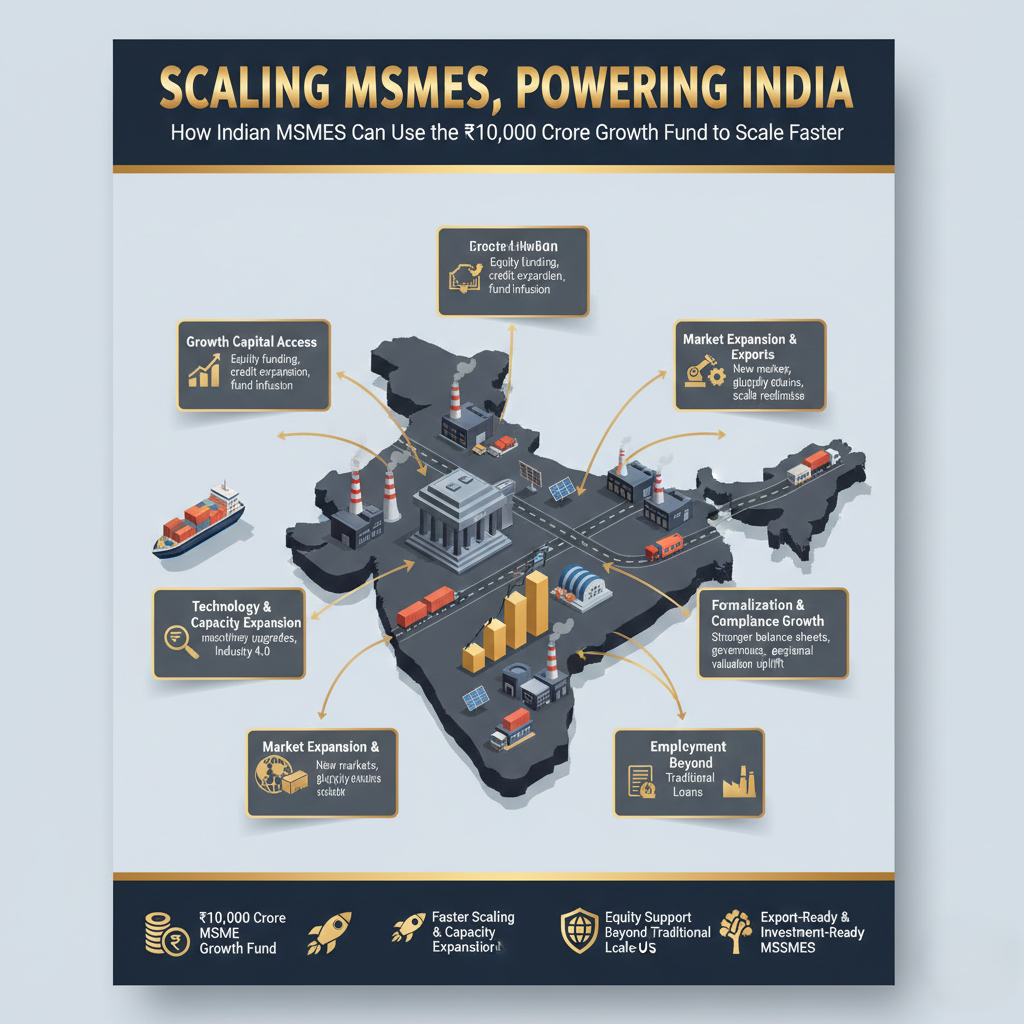

Strategic Ways MSMEs Should Use Growth Fund
Focus On Margin Improvement Not Just Volume Expansion
Many businesses make a mistake, which is that of adding production volume without gaining in profitability. A better strategy is to invest in efficiency and value added capabilities. MSMEs should consider automating to enhance their product consistency, optimize their manufacturing yields, and buttress high margin line products.(Indian MSMEs Growth Fund)
The level of profit margin improvement from even small improvements in efficiency is considerably higher than that from just growing low-margin production volumes.
Backward Integration – Invest in
Controlling the sourcing of raw materials can minimise supply chain risks and also enable better cost predictability. MSMEs in sectors like plastics, packaging, agro processing and specialty manufacturing can use growth capital to secure critical inputs or establish partial in-house processing capabilities.
Backward integration helps to improve competitive edge and hedges businesses against volatile supplier pricing.
Build Compliance To Export Growth
Export markets require strict compliance, certifications and documentation systems. Growth capital can be used to invest in quality certifications, traceability systems, testing infrastructures and international packaging standards.
Export readiness enables MSMEs to enter into more profitable international markets while expanding their income sources beyond local market competition.
Read More: High-Growth MSME Manufacturing Opportunities in India’s Power, Energy and Infrastructure Sectors
High-Growth Sectors That MSMEs Need to Consider
Electronics components and sub-assemblies
India manufacturing policy promotes the production of domestic components. MSMEs can grow by investing in precision tooling, clean room manufacturing and testing facilities. Demand for local suppliers is growing as companies try to wean themselves off imports.
Engineering Goods and Precision Manufacturing
Infrastructure expansion and industrial growth are driving a high demand for CNC-machined parts, fabricated structures and precision assemblies. Growth capital can be used to pay for advanced machinery, ERP systems, metallurgical testing facilities that enhance the production quality.
Export Oriented Food Processing
Global demand for processed foods, specialty ingredients and value-added agricultural products is increasing. MSMEs can access growth capital to implement cold chain integration, advanced packaging technologies and international food safety certifications to maximize export margins.
Lessons from the successful Indian Business Leaders
Indian business leaders have been showing that scaling is not merely about growing – it is about disciplined execution and good governance.
N.R. Narayana Murthy had stressed on transparency and governance which made investors have more confidence and have access to capital for the long-term. Rahul Bajaj and he built sustainable growth for his company through conservative financial management and operational efficiency. Sunil Mittal invested in network advantages with the ability to scale up instead of expansion that is heavy on assets.(Indian MSMEs Growth Fund)
MSMEs can learn from these approaches through focus on financial discipline, excellent internal processes and smart capital deployment.
Read More: Top 3 Profitable Manufacturing Opportunities in 2026: Ferrosilicon, Vedic Paint & Bamboo Wood Pellets
The Importance of Feasibility Studies: Techno-Economic Before Scaling
Before making an application for growth capital, businesses have to do detailed feasibility analysis. Scaling with no structured planning leads to greater financial risk and operational inefficiency.
A good feasibility study should include cost structure analysis, break-even sensitivity studies, demand forecasting, machinery and capacity planning, and long-term financial modeling. Businesses that invest in proper techno-economic planning put their capital more efficiently and attract more investor confidence.
Emerging MSME Project Opportunities
Growth capital functions as an ideal funding solution for business sectors which match the industrial development goals of India. Promising areas are specialty chemicals, precision tooling units, nutraceutical manufacturing, processed agri-inputs, and green manufacturing solutions aimed at recycling and sustainability.
These sectors have good growth of export potential and provide better margins and long term growth in demand backed by government policy initiatives.
Key Risks MSMEs Should Avoid While Scaling
The growth capital investment presents excellent business prospects but businesses need to stay away from particular mistakes which should be avoided. Expanding capacity without a profitability analysis can place financial strain. People who have too much debt will face difficulties when they need to repay their loans because their financial situation becomes more restricted during times of economic uncertainty.
The lack of governance and compliance procedures will create barriers which prevent access to future investment opportunities. Scaling up production before validating the market demand can result in unsold inventory and cash flow issues. Finally, when liquidity management is poor during expansion, operations can be disrupted despite good growth potential.
A disciplined data-driven approach is necessary to achieve sustainable business expansion.

Conclusion: Scaling is a Strategic Journey
The 10,000 Crore Rupee SME Growth Fund enables Indian MSMEs to achieve international competitiveness through its transformative funding program. The structured growth capital enables businesses to use their funds for automation implementation export readiness development operational efficiency improvements and strategic business expansion.(Indian MSMEs Growth Fund)
However, access to capital is not the only requirement for a successful outcome. Entrepreneurs need to soberly plan, govern, and be more interested in profitability and not just in volume. The MSMEs which combine disciplined execution with long-term strategic thinking can use this fund to achieve sustainable organization growth and become market leaders.
Frequently Asked Questions (FAQs)
1.Who should apply for SME Growth Fund?
MSMEs that have stable operations, with proven products and clear expansion plans are the perfect candidates.
2.Is the fund appropriate for startups?
It is more appropriate for growing stage business as opposed to experimental ventures that are early adjusted enterprising.
3.Should MSMEs opt for equity funding instead of loans?
For expansion involving uncertainty, structured growth capital often takes the pressure off the financial vs pure debt capital.
4.Can service based MSMEs be benefited from this fund?
Yes, especially technology services, Healthcare support and export-oriented service businesses.
5.How important is the feasibility study before capital raising?
Extremely important. Detailed techno-economic analysis and not basic projections is what investors expect.
6.What is the biggest mistake that MSMEs make while scaling?
Increasing production capacity without enhancing margins or governance systems