


India Geosynthetics Market Growth
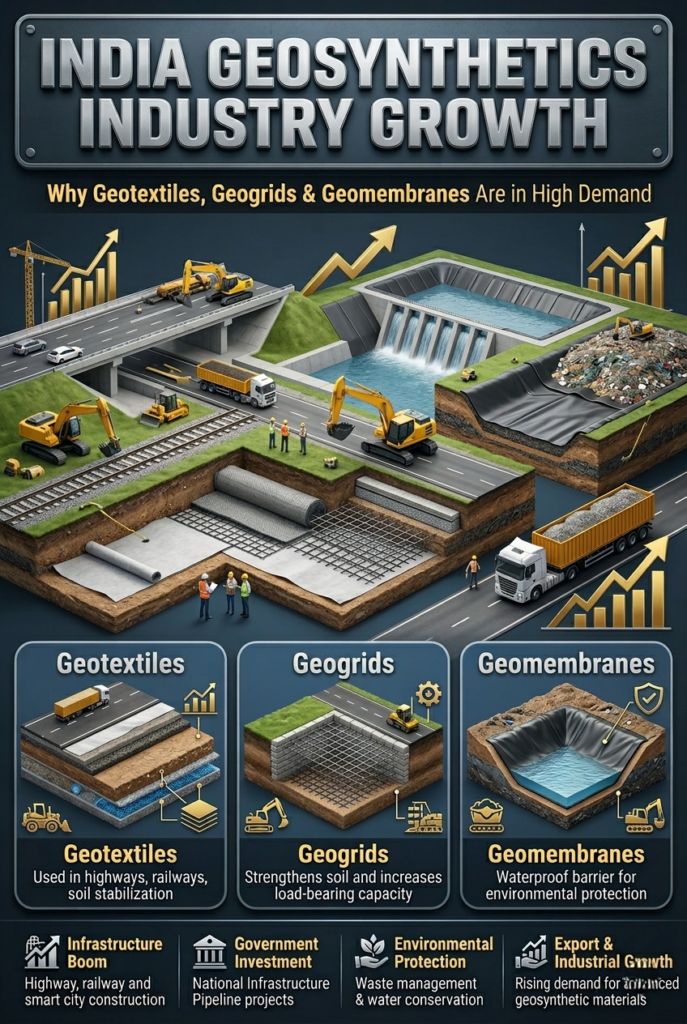
India’s infrastructure sector is growing rapidly providing huge demand for high-quality construction material. Among these materials, geosynthetics have become of crucial importance in civil engineering projects of modern times. Products such as geotextiles, geogrids, geomembranes and geocells are now being used widely in highways, railways, tunnels, water infrastructure and environmental protection systems.
The Indian geosynthetics market has shown a high growth in the past decade. In 2023-24 the market size was estimated in the range of USD 1.5 billion to USD 1.63 billion and according to the industry projections it could reach USD 2.73 billion by 2030 with a compound annual growth rate of around 9-10 percent.
India is currently the largest market in Asia-Pacific with a share of almost 10 percent globally in the market of geosynthetics which also makes it one of fastest growing markets.
This expansion has strong links to the large investments in infrastructure by the government. The Union Budget 2025-26 set aside over Rs 11.21 lac core for capital infrastructural spending which was the highest ever in India’s history.
Read More: Modern Technology of Textile Dyes & Pigments (3rd Edition)
What are Geosynthetics and Why are They Important?
Geosynthetics are the materials that are based on polymers and are used in construction and civil engineering for enhancing soil performance and structural stability. These materials are designed to perform such functions as separation, filtration, reinforcement, drainage and containment.
They help engineers to solve problems relating to weak soil conditions, erosion and water seepage. Because of the capacity of geosynthetics to include durability and decrease maintenance costs, they are now being extensively utilized in infrastructure development projects.
The major types of geosynthetics are:
- Geotextiles – for filtration, separation and drainage
- Geogrids for soil reinforcement of roads and embankments
- Geomembranes used as impermeable liners in landfills, reservoirs and canals
- Geocells used in slope protection and load transfer on weak soils
Amongst these products, geotextiles represent the major share in the Indian market with more than 70 per cent of the total revenue.
Infrastructure Projects Stimulating Demand in India
The growth of the geosynthetics industry is also directly associated with the infrastructural growth in India. Several national development programs are likely to generate sustained demand for these materials in the next decade.
Highway Construction
India’s road network of national highways is growing at a great rate under the program of Bharatmala Pariyojana. The initiative aims to build over 65,000 km of highways and economic corridors.
Geosynthetics are used in highway construction because they:
- strengthen pavement structures
- stabilize weak soil foundations
- reduce costs of road maintenance
Railway and Metro Projects
The Indian government allotted the development of the railways with the budget amount of Rs. 2.65 lakh crore for the year 2025-26. Large projects like dedicated freight corridors, metro rail expansions and high-speed rail lines need geosynthetic material for track stabilization and drainage.
Tunnel Construction
India is currently constructing a total of over 700 tunnels with a combined length of close to 2847 km at a national highway level. Tunnel construction require geosynthetics to waterproof, reinforce and protect structure.
Water and Waste Infrastructure Management
Government initiatives such as Jal Jeevan mission, Swachh Bharat Mission and Namami Gange are also making a dent in demand for geomembranes used in:
- canal lining
- reservoir sealing
- landfill containment
- wastewater treatment plants
Read More: Geotextiles for Road Construction – Manufacturing Plant, Detailed Project Report, Profile, Business Plan, Industry Trends, Market Research, Survey, Manufacturing Process, Machinery, Raw Materials, Feasibility Study, Investment Opportunities
Demand-Supply Gap Creating Business Opportunities
Despite the rapid growth of the geosynthetics market, India still relies on imports for a number of specialized products. Domestic manufacturing capacity is growing, but not at a level to satisfy the demand created by large infrastructure projects.
Products that remain widely imported are:
- Geogrids with high tensile polyester
- Drainage systems (e.g. geocomposite drainage systems)
- high-tech geomembranes for mine and landfill applications
International companies like Huesker, TenCate, Fiber Tex and Tenser are still supplying such products to the Indian market.
This situation provides a huge opportunity for Indian manufacturers and MSME entrepreneurs who are able to set up facilities in domestic production.(India Geosynthetics Market Growth)

Product Segments that Have Good Investment Potential
Different segments of geosynthetics industry provide different levels of investment and market potential.
Geotextiles
Geotextiles are the biggest market in the Indian geosynthetics market, contributing over 70 percent of the revenue. They are extensively used in road construction, railway ballast stabilisation and drainage systems.
Non-woven geotextiles are normally made by needle-punch technology with polypropylene or polyester fibres.
Geomembranes
Geomembranes are being used extensively for containment and waterproofing applications. They are necessary in landfill liners, mining tailings ponds and canal lining projects.
Demand for HDPE geomembranes is growing because of the growth of waste management and water conservation infrastructure.
Geogrids
Engineers design geogrids for soil reinforcement and use them in highway embankments, retaining walls, and airport runways. About 70-80 percent of the geogrid demand in India is from the road construction industry.
Geocells
Engineers use geocells, which are three-dimensional honeycomb structures, to stabilize weak soils and protect slopes from erosion. This segment is currently the fastest growing segment of the geosynthetics market.
Read More: Textile, Apparel, Clothing, Denim wear, Innerwear, Lingerie, Hosiery, Denim Jeans, Readymade Garments and Under Garments Industry.
Major Geosynthetics Manufacturers of India
The Indian geosynthetics industry comprises mix of domestic manufacturers as well as international companies. The moderately fragmented market allows new entrants to enter the industry.
Some of the major players in this sector are as follows:
- Strata Geosystems (India) Pvt.Ltd.
- TechFab India Industries Ltd.
- Garware Technical Fibres Ltd.
- Ocean Global
- Emmbi Industries Ltd.
- CTM Technical Textiles Ltd.
- Suntech Geotextile
Many of these companies provide products to national highway works, railway infrastructure developments and environmental engineering works.
Read More: 10 Best Manufacturing Business Ideas in India for 2026 (Low Investment & High Profit)
Why MSME Entrepreneurs Should Enter in This Industry
The geosynthetics industry can provide great opportunities for entrepreneurs seeking to invest in the production of these products. Steady demand, government backing, and the increasing need for infrastructure materials serve the industry.
Some of the major benefits include:
- Demand based on large government infrastructure spending
- Import substitution opportunity for products with special needs
- Government support in the form of technical textile initiatives
- Increasing demand for climate resilient infrastructure solutions
Government schemes like the National Technical Textiles Mission or NTTM and the Production Linked Incentive scheme are trying to build up the domestic manufacturing capacities in this sector.
Read More: Profitable Petrochemical Business Ideas in India for MSMEs: Textile, Agriculture & Auto Applications
Investment Requirements and Profit Potential
The capital investment needed for setting up a geosynthetics manufacturing unit depends on the type of product and capacity of production.
For example, a mid-scale non-woven geotextile manufacturing plant with a capacity of 5,000-7,000 tonnes per year needs an investment of between ₹8 crores and 20 crores.
Other segments of the products may need more investment because of special machinery and production technology. However, due to the high demand of the infrastructure, many projects can have a payback period of three to five years.(India Geosynthetics Market Growth)
Future Outlook of Geosynthetics Market in India
The geosynthetics industry in India will experience strong growth potential throughout its future development. The demand for these materials will grow because urban areas expand and infrastructure systems need upgrades and environmental conservation programs require implementation.
Climate change and extreme weather events are also spurring governments and engineers to apply advanced soil stabilization and erosion control technologies. Engineers and planners expect geosynthetics to provide essential support for developing these solutions.
With the country’s infrastructural investments projected to be quite high in the next 10 years, the Indian geosynthetics market is likely to continue to grow and could translate to be one of the biggest markets in the world by 2030.
Answers to Frequently Asked Questions (FAQ)
What is the size of geosynthetics market in India?
The market was valued at about USD 1.5 – 1.63 billion in 2023-24 and is expected to reach a value of about USD 2.73 billion by 2030.
Which of the geosynthetic products has the most demand?
Geotextiles dominate the market and have a total market share of greater than 70 percent.
Is geosynthetics manufacturing a profitable business in India?
Yes. The high demand for infrastructure projects combined with insufficient domestic production capacity will create profitable opportunities for geosynthetics manufacturing enterprises which can expect to recover their initial investments within three to five years.
What is the investment for a unit for geotextile manufacturing?
A mid-scale plant typically requires an investment of Rs 8-20 crore, which depends on the capacity and level of automation.
In which sectors geosynthetics are used in India?
Geosynthetics are in wide use in highways, railways, tunnels, mining, canals, landfills and waste water treatment facilities.