


However, despite the lack of publicity, hydrogen peroxide plays a major role in paper bleaching, processing in textile mills, ETPs, electronics manufacturing facilities and the emerging aquaculture industry in India. Domestic production has increased from approximately 139 KT in 5 years, which indicates that buyers are moving away from chlorine bleaches and looking closer at home for their needs. But the actual impetus was regulatory. When the Bureau of Indian Standards enforced IS 2080 through a Quality Control Order, it stopped allowing low-quality imports from South Korea and Thailand to enter the country. This one pivotal move created the competitive landscape for medium-scale Indian manufacturers. When a project has assured offtake, a first-generation entrepreneur should first focus on the inorganic chemicals space by analyzing it rigorously using data and numbers.
Why the Sector Now Rewards New Entrants
The Indian manufacturing plant cost equation has tilted in favour of the Indian manufacturing companies. Except for H2O2 which is currently slightly above the sector average for capacity utilisation, all basic major chemicals are running at around 79%. Data from the Annual Report 2025-26 of Ministry of Chemicals and Fertilizers (available at https://mocf.gov.in/) shows that the installed capacity is approximately 221 thousand MT while the production was 183 thousand MT, indicating debottlenecking and greenfield capacity.
Demand drivers are not cyclical. In Andhra Pradesh and West Bengal, the shrimp and fish farming system has elevated the aquaculture-grade H2O2 to a new category of procurement. The India Semiconductor Mission is organizing semiconductor assembly units which will require electronic grade peroxide of 30-35% purity. Technical grade volumes continue to be absorbed in the pulp industry of Tamil Nadu, and paper units around Vapi.
The entrance is not impossible to overcome, but it is not easy. The Factory Act approval, Pollution Control Board consent under Red category, PESO clearance for storage and IS 2080 compulsory BIS certification is required for licensing. Raw material access such as hydrogen gas and working solution, is beneficial to plants near the refinery or chlor-alkali complexes.
Get Detailed Project Report (DPR): Hydrogen Peroxide Manufacturing Plant Report
The Business Selection Logic
The margin structure of H2O2 is tighter than phenol or acetone, but much more stable. A typical technical grade 50% clears the EBITDA margins for efficient mid-size units at 14-18%. Variants for cosmetic and food applications are available at a higher margin, but with lower volumes. The anthraquinone-based autoxidation method described in the original publication is the only serious approach, and every major Indian producer uses some version of it.
This is a good place for scalability. The pilot plant can be set up at 2,000 MT per annum and scaled up to 8,000–10,000 MT after BIS licence, distributor network and working capital cycles stabilise. Consistent output is a good indicator for a mid-size operator, and HOCL Kochi has 10,450 MT of annual capacity.
We should candidly list the potential risks: fluctuations in hydrogen feedstock prices, the cost of replacing palladium catalysts, and seasonal declines in demand for textile bleaching. A realistic feasibility analyst brings them to the fore and not into the annexures.

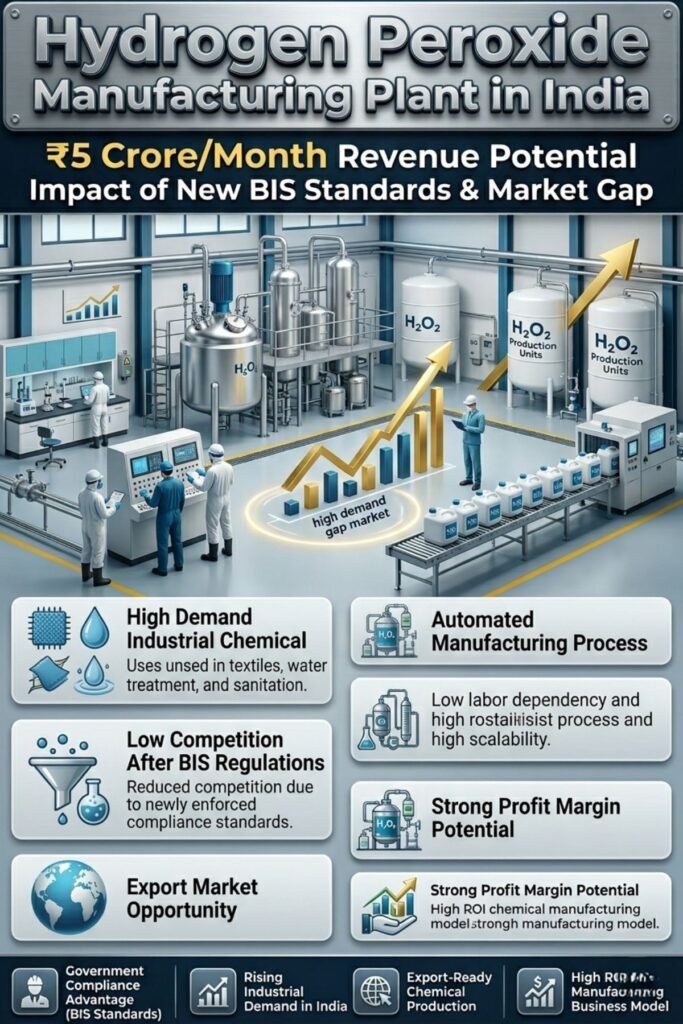
Concrete Project Opportunities Worth Evaluating
Technical Grade H2O2 Plant (50% concentration) First-time promoter can consider 6,000 – 8,000 MT per Annum capacity. Paper mill, textile processor and ETP operator are the primary buyers. A capex is a range between the price of Rs. The 45-60 crore working solution comprises of anthraquinone, a hydrogenator, oxidiser, extraction column, and distillation train. The land requirement is relatively small, 3-4 acres. EBITDA margin is in the 15-17% range, once the unit has reached 70% capacity utilisation. The break even is usually in month 22-26. Plots available at Gujarat’s Dahej PCPIR and Tamil Nadu’s SIPCOT estates are ready for immediate use, cutting down project timelines by nine months.
High-Purity Electronic Grade H2O2 (35%) A smaller, but higher-margin play. Semiconductor fabs, PCB manufacturers and solar wafer cleaning lines have a capacity of 1,500 to 2,500 MT per annum. The weight of Capex is Rs. This is because of ion-exchange purification, ultra-clean storage and tight particulate control—70-85 crore. Margins touch 28–32%. Sellers sell on a yearly basis, with premiums paid for certified consistency, as opposed to bulk commercial grade.
Aquaculture & Healthcare Grade (3-6%) Diluted and stabilised H2O2 for shrimp farms, veterinary use, hospital disinfection and personal care. Capex is lean at its Rs. If the promoter buys bulk 50% peroxide from the vicinity of the producer and only concentrates on the dilutions, stabilisation, and branded packagin into the product, the figure will be around 12–18 crore. Distribution intensity is high, while margins are at 20-24%. Andhra Pradesh is having a base of 2000+ farms ready for aquaculture as aquaculture belt.
Contract Manufacturing Model (Captive Plant For Paper/Textile Clusters): A model of 4000-5000 MT is setup by the promoter near a big paper manufacturing unit with a long-term offtake contract. Capex of Rs. 35-45 crore, reduced marketing budgets and steady cash flows. There is a 11-13% compression of the margins, but the risk is much lower.
Read the Complete Book Here: Detailed Project Profiles On Chemical Industries
Indian Entrepreneur References
National Peroxide Limited (Wadia Group) is the category leader for H2O2 capacity construction in India for the first major capacity. The Wadias have been methodically adding capacity, not acquiring.
Under the leadership of its managing director team in Vadodara, Gujarat Alkalies and Chemicals Limited (GACL) branched out from chlor-alkali and started producing hydrogen peroxide with its captive hydrogen from the caustic plant. The lesson is integration: make hydrogen as a by-product of something else and it makes sense to make H2O2 as a side product, not a standalone gamble.
Hindustan Organic Chemicals Limited (HOCL), which operates the Kochi phenol complex is operating a 10,450 MT H2O2 unit along with phenol and acetone as PSUs. The H2O2 line continued to produce at this level even during the restructuring period, demonstrating the product’s resilience even amidst a troubled balance sheet.(Learn hydrogen peroxide manufacturing plant setup in India)
Import-Export Picture
Prior to the enforcement of QCO, India was importing substantial quantity of commercial grade H2O2 from Thailand, South Korea and Bangladesh. Since then, imports have reduced significantly post-notification. There are niche export opportunities in water treatment for Africa, oilfield applications for the Middle East and textile-grade supply for South Asian neighbors. A founder targeting exports should include certification costs in the project budget and build connections with EPC contractors who specify end-users in different countries.
Discover business ideas that actually make money
Where NPCS Fits In
Most promoters are not aware of the difference between an idea and a bankable file. Niir Project Consultancy Service provides Market Survey cum Detailed Techno-Economic Feasibility Reports which incorporate process flow, capacity planning, list of machines, raw material procurement, financial statements with sensitivity analysis etc. A well-designed DPR is a tool that tests the assumptions before committing capital and can make a 300 basis point difference in the profit or loss of a category such as hydrogen peroxide. Bankers trust these reports more than in-house spreadsheets, too.(Learn hydrogen peroxide manufacturing plant setup in India)
Data Table: Product Category vs Capex & Margin Outlook
| Product Grade | Capacity (MTPA) | Capex Range (Rs. Cr) | EBITDA Margin | Primary Buyer |
| Technical 50% | 6,000–8,000 | 45–60 | 15–17% | Paper, textile, ETP |
| Electronic 35% | 1,500–2,500 | 70–85 | 28–32% | Semiconductor, PCB, solar |
| Aquaculture 3–6% | 2,000–3,000 | 12–18 | 20–24% | Shrimp farms, healthcare |
| Captive 50% | 4,000–5,000 | 35–45 | 11–13% | Anchor paper/textile mill |
Related Article: BIS Certification for Chemical Manufacturers: 55+ Mandatory QCO Products List
Closing Perspective
Hydrogen peroxide isn’t a top selling category. No one throws it at start-up events. It is for this reason that it is rewarded to those who are disciplined in their operations. The industry has well-documented process technology and known raw materials, and the end-user sectors are sufficiently diversified. Because of this, a 6,000 MT plant cannot saturate any single segment. Additionally, domestic producers follow mandatory BIS standards, which prevent aggressive dumping. While margins aren’t as grand, they are repeatable — and that is the interest of working capital cycles, bank covenants, and promoter fatigue.
For the first-time promoter: Do not target the electronic grade segment on day one: it’s the worst thing to do. Opt for technical grade, expand to two or three state markets, obtain BIS licence early and schedule second plant within 36 months of stabilisation. Variable cost risk is reduced significantly due to tie up with a chlor-alkali unit for providing hydrogen. Utilizing existing infrastructure at a PCPIR or at a PCPIR chemical estate reduces utility capex and time.(Learn hydrogen peroxide manufacturing plant setup in India)
The chemical industry has become a billion rupees industry in India. 15 lakh crore, and in inorganic chemicals, hydrogen peroxide is one of the safer options to pursue as a new manufacturing venture. The facts back it up. It is supported by the regulation. Its requirement is patience of capital and operational discipline — not marketing flair.
FAQ Section
Q1. What would be the minimum capex to start a viable hydrogen peroxide plant?
A technically feasible (technical grade) plant of 6,000 MT/annum requires Rs. 45-60 crores of land, plant, working solution, and utilities. Smaller units of dilution and packaging for aquaculture grade can begin at Rs. If the bulk supply of H2O2 is not produced locally, but purchased from outside, the cost will be 12–18 crore.
Q2. Typically, how long does it take to see break-even?
Typically, break-even is around month 22-26 for a 6000 MT technical grade unit with 70% utilisation. Electronic grade plants take longer — 30-36 months — due to slow buyer qualification cycles in semiconductor supply chains and contracts.
Q3. Which permissions and authorizations are required?
Factory Act Registration, Consent of State Pollution Control Board in Red category, Approval of PESO for bulk storage, GST & IEC in trading and BIS licence under IS 2080 QCO. BIS FMCS certification is mandatory for the foreign manufacturers for importing into India.
Q4. Which place is the most economical?
Dahej PCPIR (Gujarat), Tamil Nadu SIPCOT estates and Paradeep (Odisha) provide plug-and-play infrastructure with access to CETP. The risk of using hydrogen from a source is the greatest contributor to the total cost of H2O2 manufacture and is reduced if it is sourced near a chlor-alkali or refinery unit.
Q5. What are the key operational risks that need to be considered?
Degradation of palladium catalyst, loss of working solutions, fluctuations in hydrogen prices, and seasonal decreases in the demand for textile-grade during monsoon. Under the Major Accident Hazardous category, a quality safety protocol is essential — peroxide handling accidents have come to an end promising units.