


Pectin Manufacturing Business in India
A High-Demand Opportunity Most Entrepreneurs Miss
The food processing industry in India is growing at an astonishing rate and so is the demand for functional ingredients, which most of the entrepreneurs have been oblivious to. The quiet revolution is fuelled by pectin, a naturally-occurring polysaccharide derived mainly from citrus peels and apple pomace. Pectin plays an indispensable role in a wide variety of products, including jams, jellies, confectionery, pharmaceuticals, and cosmetics, and manufacturers across all sectors use it. However, India has to import most of its pectin requirement from Europe and China despite its high domestic consumption. This shortage creates a serious business opportunity for enterprising people interested in starting high-value import substitution manufacturing businesses. The timing is right. Pectin manufacturing is one of the most promising industrial opportunities for MSMEs currently as the availability of raw materials, government policies and increased demand in the downstream market are all contributing.
Why Pectin Manufacturing Is a Smart Business Right Now
India produces the second most citrus fruits in the world. In spite of this abundance, the country still imports a large percentage of pectin, a value-added derivative of fruits grown in the country. The lack of a link between the availability of raw materials and downstream processing capabilities is a situation that smart industrial entrepreneurs should be aiming for.
The global pectin market generates billions of dollars in revenue worldwide. It will continue to grow as food, pharmaceutical, and personal care companies increasingly use pectin across a wide range of applications. This trend has picked up in India quite a bit with demand for processed and convenience foods. Moreover, pectin is also becoming more popular as a natural, clean label alternative to synthetic thickeners, especially as food companies respond to health-conscious consumers.
In addition, there is a potential for export of pharmaceutical grade pectin. The robust foundation of India’s nutraceuticals and generics manufacturing industry provides a natural downstream market demand for high-purity pectin. Domestic production of food-grade and pharma-grade pectin by an entrepreneur will provide an alternative to the import of pectin and at the same time provide potential export market in Southeast Asia and Middle East.
Get Detailed Project Report (DPR): Pectin from Citrus (Manufacturing Project Report)
Government Policies and Incentives Backing This Sector
The Government of India has put in place a sound framework of support for food processing and chemical manufacturing enterprises. There are several policy and financial advantages for entrepreneurs in the pectin production business.
The Production Linked Incentive (PLI) Scheme for Food Processing provides incentives to food processing manufacturers for achieving predetermined sales growth levels. Large companies dominate PLI applications, but smaller businesses that produce specialised food ingredients such as pectin are also eligible under the relevant categories. Further, the Ministry of MSME has implemented Credit Guarantee Fund Trust for Micro and Small Enterprises (CGTMSE) which helps first-gen plant investors avail collateral-free loans of up to ₹2 crore.(Pectin Manufacturing Business in India)
The DPIIT’s Startup India scheme will continue to provide tax exemption for three years, self-certification under labour and environmental regulations, and speed up the recognition of patents for registered startups. Capital subsidy grants are also available for entrepreneurs who are interested in establishing pectin extraction units falling under the agro-processing category under the Pradhan Mantri Formalisation of Micro Food Processing Enterprises (PM FME) scheme, with 35% subsidy on the project cost, subject to a maximum of ₹10 lakh.
Some of the incentives provided in the states include power tariff subsidy, stamp duty exemption, infrastructure support in the food parks. Entrepreneurs should consider MOFPI-designated Mega Food Parks and Integrated Cold Chain projects as potential sites where they can benefit from co-location and logistics advantages.
Multiple Business Ideas Within Pectin Manufacturing
1. Citrus Peel-Based Pectin Extraction Unit
Maharashtra, Gujarat, Andhra Pradesh and Tamil Nadu are important orange, lime and sweet lime producers in India. Processing plants in these areas generate large amounts of citrus peel waste, but they do not use it efficiently and instead either discard it or sell it at very low value. The establishment of citrus peel-based pectin extraction unit near these processing centres is thus a judicious as well as economic decision. Extraction procedure consists of acid hydrolysis of citrus peel, filtration, concentration and spray or drum drying to obtain pectin in powder form.
Investing in a unit that produces 200–400 kg of finished pectin per day requires an investment of ₹60 lakh to ₹1.2 crore, depending on the level of automation and the utilities installed. The final product sells at ₹400 to ₹700 per kg in domestic market, which makes it a profitable business considering its cost of investment. Additionally, this model aligns directly with the tenets of the circular economy by transforming food waste into a high-quality ingredient for the industry – a trend that is gaining weight in the reporting of food enterprises on sustainability.
Related Article: Profitable Business Opportunity: Pectin from Apple Peels

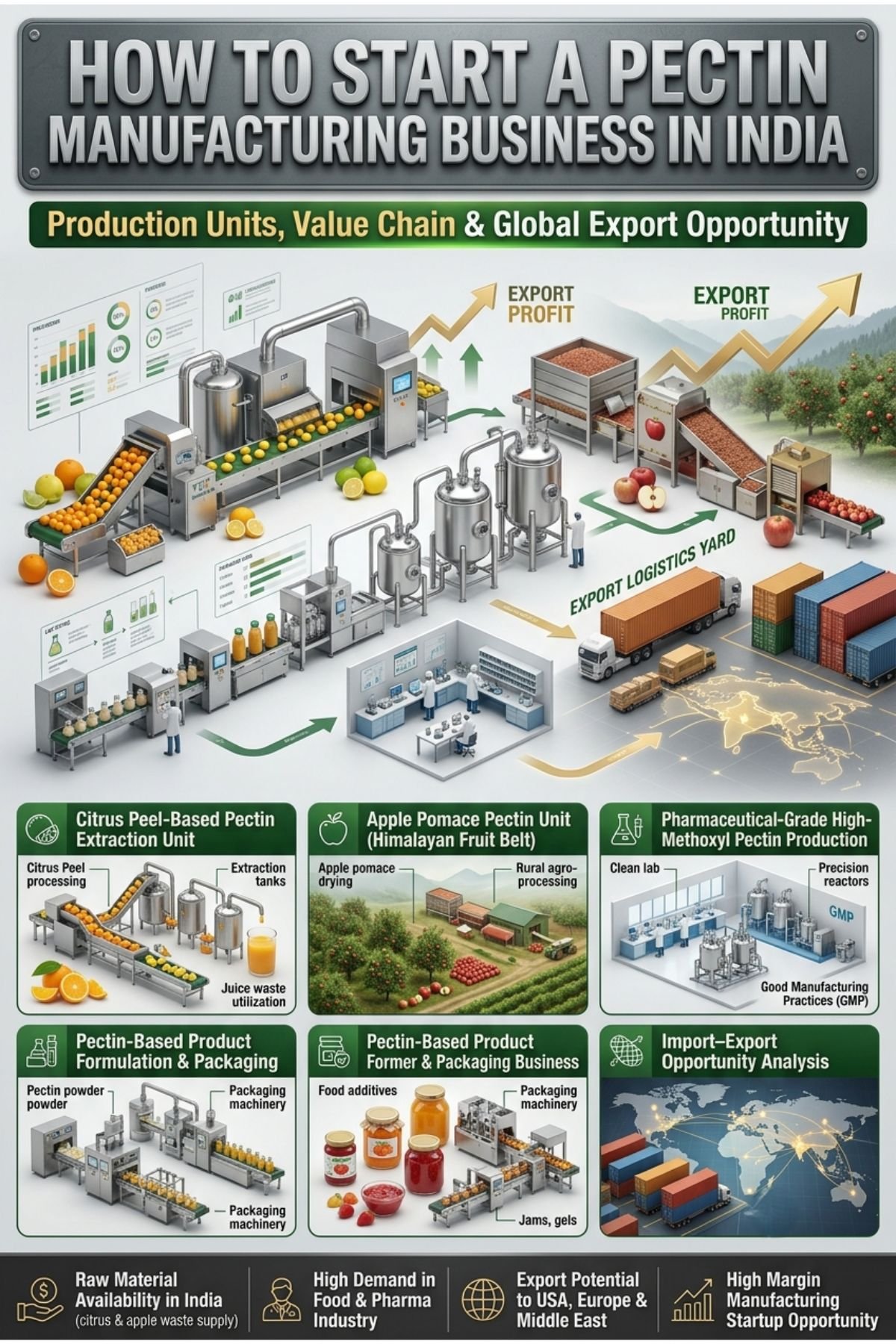
2. Apple Pomace Pectin Unit in Himalayan Fruit Belt
Apple production in India is important in the state of Himachal Pradesh and Uttarakhand. Moreover, Juice processing units in this belt generate apple pomace as a by-product, and most of it is either discarded or composted at low value. Therefore, Establishing a pectin extraction plant next to or within an apple juice processing plant in this area can convert this waste stream into a high-margin product. Furthermore, You can position this as a high-value import-substitute product for domestic API and nutraceutical manufacturers that have pharmaceutical manufacturing experience or operate GMP-ready facilities. Finally, For a small pomace-based processing unit, the required capital investment is around ₹50 lakh for basic processing and up to ₹1.5 crore for better drying and purification infrastructure-based units.
This model has the short-term benefit of being located near raw material sources and having quality-focused institutional buyers. The Himachal Pradesh Horticulture Produce Marketing and Processing Corporation schemes offer agro-processing entrepreneurs support from the State governments, which provides extra subsidies and marketing connections for the food processing industry in Himachal.(Pectin Manufacturing Business in India)
3. Pharmaceutical-Grade High-Methoxyl Pectin Production
In addition to the food industry, a high-value market is available for pharmaceutical grade pectin in drug delivery systems, wound care formulations, and dietary supplements. In particular, high methoxyl pectin is used as a controlled-release excipient in the production of capsules and tablets. The requirements for this grade are far more rigorous including GMP certification, extensive quality control, and careful degree of esterification control, but the margins are much wider.
Firstly, The price of pectin ranges from ₹1200 to ₹3500 per kg for Pharma Grade, while it is ₹400 to ₹700 per kg for food-grade pectin, depending on the specification. Moreover, You can sell this high-value import-substitute product to domestic API and nutraceutical manufacturers that have pharmaceutical manufacturing experience or operate GMP-ready facilities. Furthermore, Its investment is more – usually between ₹1.5 crore to ₹3 crore – and so is the return, and the domestic demand for excipients is growing immensely with the growth of the Indian pharmaceutical industry.
4. Pectin-Based Product Formulation and Packaging Business
Moreover, An enterprise with a formulation focus may purchase the food-grade pectin in bulk and then mix the pectin with other ingredients for the particular application, such as a mix of pectin and sugar and acid in volume, for use in jams and jellies; ready-to-use pectin blends for yoghurt; formulations for confectionery for pectin setting. Furthermore, This model is much easier on the pocket of the businessman since it does not involve the complexities of the extraction process and requires a minimum of ₹15–30 lakh to start up.
Moreover, The target audience consists of artisans making food, D2C food brands, cloud kitchen suppliers, and home food businesses, a segment that is increasing by leaps and bounds in Tier 1 and Tier 2 cities across India. Furthermore, such a business can export pectin blends with standardisation to food manufacturers in the neighbouring South Asian market, with proper labelling and a food safety-oriented certification like ISO 22000 and FSSAI registration.
Import–Export Opportunity Analysis
India’s demand for pectin has been increasing consistently, and European manufacturers—mainly CP Kelco in Denmark and companies in Germany—meet most of this requirement. China also has become an important source for less quality food pectin. The domestic opportunity has mainly been importing substitution at the food-grade level and there is export opportunity at the speciality and pharmaceutical-grade level.(Pectin Manufacturing Business in India)
Indian manufacturers export pectin to key markets in Southeast Asia, where well-developed food processing industries exist but local production of pectin is negligible. There are also opportunities in the Middle East, especially for pectin for confectionery and fruit products. Data From APEDA (Agricultural and Processed Food Products Export Development Authority) shows that processed food exports have been increasing in India, thus providing natural demand for value-added food ingredients such as pectin.
Entrepreneurs who are considering the export route should focus on FSSAI compliance, obtain Halal certification to target Middle Eastern buyers, and follow FDA quality standards when exporting pharmaceuticals. These qualifications require a higher initial investment, but greatly increase addressable market and enable premium pricing.
Explore This Book: Handbook on Fruits, Vegetables & Food Processing with Canning & Preservation
Indian MSME Success Stories in Food Ingredient Manufacturing
Lucid Colloids Limited, Rajasthan
Natural Biopolymer Industry, Tamil Nadu
A few small-scale food processors in the food processing belt of Tamil Nadu have taken up the processing of agar-agar and carrageenan from seaweeds, the latter also being capable of gelling.A few small-scale food processors have taken up agar-agar and carrageenan extraction from seaweeds both of which possess gelling properties similar to pectin. The units were first used for domestic confectionery and dairy companies, and since then, they’ve slowly been working their way up the value chain, creating pharmaceutical-grade versions with specific gelling properties. The story of their journey reflects how any small MSME can upscale a niche biopolymer from commodity pricing to specialty pricing margins within five to seven years with consistent quality and technical upgradation.(Pectin Manufacturing Business in India)
Shree Radha Overseas, Gujarat
Firstly, This agro-processing company of Gujarat successfully made a business model around citrus by-products valorisation: extracting essential oil, dry peel powder and bio-flavonoids from citrus by-products, moving on to more sophisticated functional ingredient production. Moreover, A pectin extraction business can directly apply this idea by co-locating with citrus processing units to secure low-cost captive raw materials and then progressively adding downstream value. Furthermore, Their growth shows that by-product utilisation firms usually start with small capital and limited resources, and they expand by reinvesting early profits instead of taking large initial loans.
Professional Feasibility Support: About NPCS
Investment in a pectin manufacturing plant requires some technical and financial choices that can be greatly aided by a structured pre-investment analysis. The Niir Project Consultancy Services (NPCS) offers professional consulting services for the development of a new industry or business to prepare Market Survey cum Detailed Techno-Economic Feasibility Reports (DPRs).
Firstly, We include detailed manufacturing processes, market research and demand analysis, process flow diagrams, product mix and capacity planning, machinery specifications, raw material details, and complete project financials with profitability analysis in our reports. Additionally, Our goal is to assist entrepreneurs assess feasibility, profitability and the potential for long-term expansion prior to investment. Moreover, A properly written DPR can be the key to a capital-intensive project such as pectin production becoming a bankable project that gets institutional financing or a plan that remains just that – a plan.(Pectin Manufacturing Business in India)
Start with clarity—choose the best business idea
Pectin Manufacturing: Indicative Project Economics at a Glance
| Parameter | Small Unit (200 kg/day) | Medium Unit (500 kg/day) |
| Land & Civil Work | ₹15–20 Lakh | ₹35–50 Lakh |
| Plant & Machinery | ₹30–50 Lakh | ₹80–1.2 Crore |
| Working Capital (3 months) | ₹12–18 Lakh | ₹30–45 Lakh |
| Total Project Cost (approx.) | ₹60–90 Lakh | ₹1.5–2.2 Crore |
| Avg. Selling Price (food-grade) | ₹400–700/kg | ₹400–700/kg |
| Avg. Selling Price (pharma-grade) | ₹1,200–3,500/kg | ₹1,200–3,500/kg |
| Estimated Annual Revenue | ₹1–1.8 Crore | ₹2.5–4.5 Crore |
| Payback Period | 3–4 Years | 3–5 Years |
| Key Raw Material | Citrus Peel / Apple Pomace | Citrus Peel / Apple Pomace |
*All figures are indicative and may vary based on location, technology, and scale.

Frequently Asked Questions (FAQ)
1. What is the minimum investment required to start a pectin manufacturing unit in India?
The basic infrastructure required for an extract unit to produce 100-200 kg per day of food grade pectin will be within the range of Rs 50 lakh – Rs 90 lakh (land, plant and machinery, utility and three months working capital). For production of pharma grade pectin in a facility conforming to Good Manufacturing Practice norms, you would need anything from Rs 1.5 crore – Rs 3 crore.
2. What raw materials are used for pectin production, and where can they be sourced in India?
Citrus peels (lemons, sweet lemons & oranges) & apple pomace are the principal raw materials for their extraction. Both of them are agricultural waste available in plenty in India as a byproduct of food processing industry. Citrus peels may be procured from the juice processors from the states of Maharashtra, Gujarat, A P and Tamil Nadu apple pomace is easily available from the apple processors in the states of HP & UK.
3. What licences and certifications do a pectin manufacturing unit need?
Mandatory licenses FSSAI registration – if applicable. (required for food-grade products) GST Registration Factory License as per Factory Act (if the number of employees exceeds minimum prescribed) Environmental Clearance (from State Pollution control Board) in case you have set up production. For manufacturing pharmaceuticals grade product, you’ll additionally need: -Drug Manufacturing License – Central Drugs Standard Control Organisation (CDSCO)GMP Certification Export oriented unit is supposed to get Halal and ISO 22000 for specific markets. Please verify from FSSAI official website the exact licenses & guidelines are latest.
4. Is pectin manufacturing a profitable business in India?
Yes, pectins yield significant profits because of the relatively higher selling price of the final product over the costs of raw materials, and because Indian customers are dependent on imports. At 70% utilization levels, a food grade plant can estimate for 35-45% Gross Profit on Sales. Profitability becomes still greater if, the entrepreneur is able to tie-in supplies on long-term basis with food / pharmaceutical players.
5. What government schemes can support a new pectin manufacturing startup?
Collateral-free credit can be provided through the CGTMSE scheme for new ventures. The PM FME Scheme provides capital subsidy grants, PLI Scheme for Food Processing Scheme covers eligible components and Starter India gives benefits such as tax exemption and procedural relaxation on compliance. State food processing schemes also include power subsidy, stamp duty concessions and provision of land in certain agro-processing parks.
6. Can pectin be exported from India? What are the key export markets?
India made pectin is exported along with its quality certifications. Major export destination includes Southeast Asia: Vietnam, Thailand, Indonesia, and Malaysia. GCC countries are the other significant export markets for India-made pectin in the Middle East. For pharmaceutical-grade pectin, there is also demand from European nutraceutical formulators who are diversifying their supply chains away from single-source European or Chinese manufacturers. For export registration and market access, entrepreneurs can consult APEDA’s resources for processed food exports.
Conclusion
The dream of building a pectin industry in India is not far-fetched; it represents a real opportunity that abundant raw materials, growing demand, and a strong import-substitution rationale support. But like any manufacturing business, there are scale, product grade, and location factors that determine success, and those factors are crucial. Business owners who do thorough pre-investment research, get the right government backing and develop basic institutional buyer relationships prior to ordering a plant have a much better chance of creating a profitable, viable enterprise. There is a window of opportunity. The issue is whether first movers will capture it before larger industrial players do.(Pectin Manufacturing Business in India)