


Neem Extracts Business
The neem sector in India is silently becoming one of the best green business ventures of the decade. A very unique commercial value of a tree that can be found in every village in India is Neem, which is rarely utilized by the entrepreneurs. Neem products are in great and increasing demand both within and outside the country, ranging from agriculture to pharmaceuticals, cosmetics to pest control and beyond. The early movers in this space might benefit from a market that is growing as consumers become more aware of alternative products that are chemical free and natural. The opportunity is here, the raw material is there, and the government involvement is greater than ever before.
Why the Neem Industry Is Growing Fast
The Neem Products market is expected to witness steady growth across the globe. As consumers and industry shift to non-synthetic chemicals, the global demand for neem products as biopesticides, personal care products and pharmaceuticals is rising rapidly. India is the largest producer of natural neem raw material in the world with an annual production of more than 5 million tonnes of neem seeds. This allows a considerable cost savings for Indian manufacturers. Europe, North America, and Southeast Asia have also been the primary importers of Indian neem extracts, including neem oil and neem cake, for use in organic farming and cosmetics.
In addition, the domestic market is growing quickly. Indian farmers are getting more inclined towards biopesticides to export their food produce and to minimize the chemical residue in the produce. Demand for neem-based ingredients also rose as a result of the trend in the cosmetic industry towards using herbs and Ayurvedics. Therefore, the demand situation of the neem extracts business that is introduced today is favourable on various sides.
Get Detailed Insights from This Book: Hand Book on Neem & Allied Products
Government Policies and Incentives Supporting New Entrepreneurs
The Government of India actively promotes the companies based on neem through various well-designed schemes. The Ministry of MSME’s Credit Guarantee Fund Scheme (CGTMSE), provides entrepreneurs and businessmen with loans without any collateral up to ₹2 crore. This is especially convenient for the first time founders who don’t have any fixed assets to pledge as security.(Neem Extracts Business)
Neem cultivation and processing is supported by the National Horticulture Board (NHB), in addition to the Ministry of Agriculture and Farmers Welfare, by providing technology subsidies and development grants. The Department for Promotion of Industry and Internal Trade (DPIIT) identifies agro-processing ventures under Start up India, and provides income tax exemptions for 3 years in a row and relaxed compliance procedures.
Furthermore, the Production Linked Incentive (PLI) scheme for food processing industry will indirectly impact the neem oil and extract producers in agro-processing value chain. Bio-input manufacturing units are eligible for subsidy under the National Mission for Sustainable Agriculture (NMSA). The MSME departments of states such as Gujarat, Rajasthan, Uttar Pradesh etc. also provide agro-industrial subsidies to the entrepreneurs.
The Agricultural and Processed Food Products Export Development Authority (APEDA) assists export market development for agricultural inputs made from Neem that can include part of the export promotion costs for small manufacturers. Entrepreneurs can approach the Bureau of Indian Standards (BIS) for quality certification and laboratory testing support to ensure that they fulfil the international quality standards needed for export markets.
Profitable Business Ideas in the Neem Extracts Sector
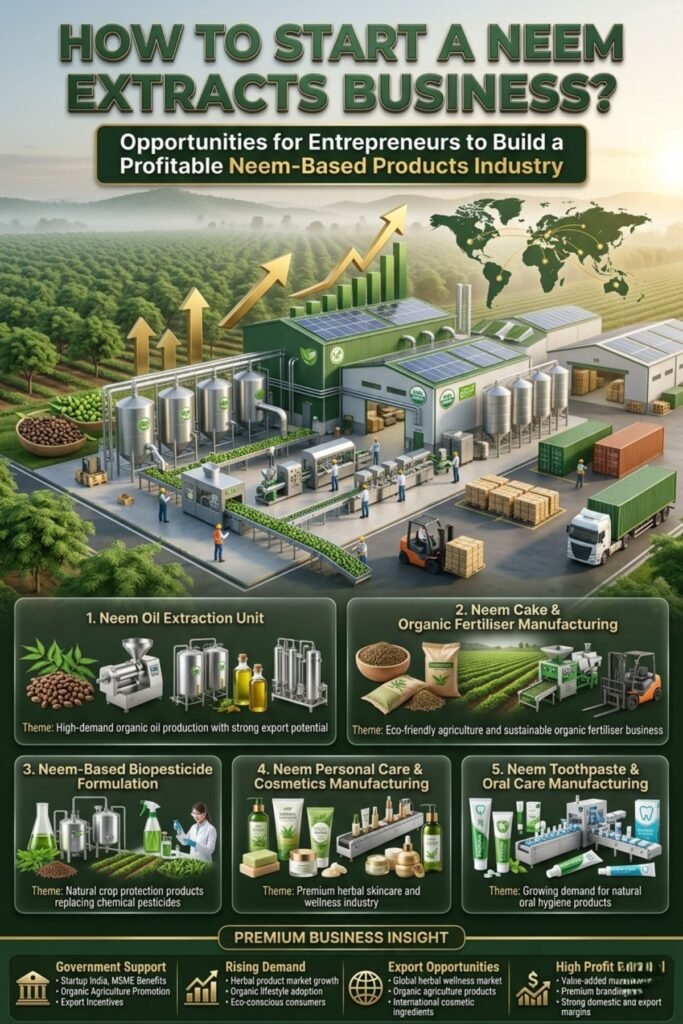
1. Neem Oil Extraction Unit
The easiest way for new entrepreneurs to get into neem oil production is to build a neem oil extraction unit. Manufacturers produce neem oil by cold-pressing or solvent extraction of neem seeds, and they use it in agricultural biopesticides, cosmetics, and pharmaceutical products. The investment required for a small-scale unit of 500kg/day is about ₹20-30 lakh which consists of the cost of machines, raw material procurement and working capital.
The major benefit is that raw material, the neem seeds are cheap and readily available in rural markets via aggregators. Neem oil prices remain strong in both domestic and export markets because buyers in Europe and North America prefer neem oil with certified azadirachtin concentration. So, the cost of basic quality testing machinery and getting relevant organic certification can make a big difference to per liter realizations.(Neem Extracts Business)
Get Detailed Project Report (DPR): Extraction of Neem Oil Manufacturing Plant Report
2. Neem Cake and Organic Fertiliser Manufacturing
The press cake from neem oil extraction has great commercial potential as an organic fertilizer and soil conditioner. Neem cake contains high nitrogen, sulphur and neem specific compounds capable of reducing soil pathogens and nematodes. Entrepreneurs can sell neem cake in bulk to fertiliser distributors or process it into branded organic fertiliser products to add value. The margins for branded fertiliser are much higher. The company opens premium retail channels and partners with organic farming cooperatives by offering neem cake packaging with a clear NPK composition label and ECOCERT/OMRI certification.It is an investment-driven business opportunity that does not demand an additional investment of anything apart from a basic pressing unit and packaging machinery, ideal for the rural MSMEs who want to expand their processing chain without taking a huge hit in terms of incremental investment.

3. Neem-Based Biopesticide Formulation
Formulation of biopesticides is a more lucrative venture in the neem extracts business. In this case, manufacturers mix neem oil or azadirachtin concentrate with emulsifiers, stabilisers, and carrier agents to create a marketable biopesticide product and sell it under a trademark or brand name.
Registration under the Insecticides Act, 1968, under the Central Insecticides Board and Registration Committee (CIBRC) is the central regulatory requirement. Registration takes time, but establishes a lasting competitive edge over informal competitors. Those who do these open opportunities for their businesses to access the Government procurement routes, the organic farming mission and farmer-entrepreneurs selling directly to the agri-input dealers. The product category is fast gaining acceptance due to residue issues of export produce like vegetables and fruits to European Union which has a stringent maximum residue level (MRL) requirement.
4. Neem-Based Personal Care and Cosmetics Line
Neem entrepreneurs who are willing to invest in branding can find opportunities in the personal care and cosmetics industry as it is a premium market. Moreover, Neem is one of the fastest growing herbal personal care categories in India, which includes face washes, soaps, shampoos, hair oils and toothpastes. Furthermore, the starting cost is not high as entrepreneurs can go into contract manufacturing and gradually establish their brand name before setting up their own production line. In addition, A neem cosmetics brand that follows Ayurvedic principles, obtains FDA, FSSAI, or BIS certification, and sells through an e-commerce distribution model can generate significant returns with a small initial investment. Likewise, buyers from overseas Middle East and south East Asian countries are keen to buy the Indian herbal personal care products market, but most of the small manufacturers are not actively exploring that market.
Discover business ideas that actually make money
5. Neem Toothpaste and Oral Care Manufacturing
Oral care using neem is a unique and highly scalable segment. In the past decade, there has been significant growth in the herbal toothpaste category in the Indian oral care market, with some established brands such as Patanjali and Dabur showing the consumers’ acceptance of neem formulations. However, Tier-2 and Tier-3 city markets and rural areas still offer great opportunities for the regional brands who can match their prices. Moreover, For starting a small-scale toothpaste manufacturing unit under GMP condition, the capital investment required is about ₹40 – 60 lakhs. Alternatively, Another route is to use private label manufacturing for pharmacy chains and FMCG distributors, which avoids the need for upfront brand-building investment and helps to ensure that cash flow is more stable before making the full investment in a brand.(Neem Extracts Business)
Import–Export Opportunity Analysis
The export of India’s neem extracts sector has distinct and structural benefit. Moreover, The country has a majority of the world’s supply of neem seeds and processors in India can provide competitive prices for all the products ranging from crude neem oil to refined azadirachtin concentrate. Furthermore, The biggest importers of Indian neem products are the United States, Germany, France, the Netherlands, and Japan. This market in particular appreciates products that are certified as organic, have a standardised amount of azadirchtin, and have documented heavy metal tests. Additionally, The premium pricing tiers, which are often 40-60% over commodity prices, are available for ISO-certified laboratory testing, as well as international certification like OMRI (Organic Materials Review Institute), and are available to entrepreneurs who invest in these certifications.
There are minimal dependencies on the import side. Major inputs like seeds, packaging material, basic chemicals for making formulation etc. are available in the country. This has made neem a relatively foreign exchange immune business. APEDA offers organised support for market development, participation in trade fairs and facilitation of foreign buyers for entrepreneurs with a keen interest in export. Association with the Federation of Indian Export Organisations (FIEO) can also help to locate dependable overseas buyers and the documentation procedures for essential export markets.
Indian MSME Leaders in the Neem Industry
There are several Indian entrepreneurs who have developed successful and scaled neem businesses and their stories provide some lessons for new entrepreneurs.
Fortune Biotech Ltd., Gujarat, emerged as a reputable neem oil and neem cake supplier for both agri-input dealers in the country and the buyers from abroad. The promoter’s approach was based on investing in the early development of cold-press extraction technology, which maintained high levels of azadirachtin, giving him a vital quality advantage in the competitive export tenders. For the new businessmen, the lesson is that the market for export of neem values is for the quality standardisation and not just for price.
EID Parry (India) Ltd. is one of the biggest biopesticide firms in India, which are based on neem. EID Parry is a large corporate, but MSME entrepreneurs can adopt its distribution model—based on rural agri-input networks and cooperative linkages—on a smaller scale. It showed that establishing distribution depth in rural areas can generate resilient revenue streams which are less exposed to commodity price fluctuations.
Agro Green India, a medium scale firm from Uttar Pradesh, targeted the export of personal care products based on neem to the Middle East market. The promoter realized from the beginning that aesthetics of the brand and packaging is as important as the formulation quality in the Gulf Cooperation Council (GCC) retail markets. Investing in high-quality packaging and labelling in Arabic has enabled the company to make a big mark above others sending unbranded bulk products.
Related Article: Pesticide Formulation Plant India: Raw Material, Technology & Setup Cost
How NPCS Can Help You Launch Your Neem Business
Entrepreneurs planning to enter the neem extracts and neem-based products industry can obtain Market Survey Reports and Detailed Techno-Economic Feasibility Reports (DPRs) from Niir Project Consultancy Services (NPCS). Furthermore, Our reports feature in-depth manufacturing processes, raw material sourcing strategies, machinery specifications, process flow diagrams, product mix and capacity planning, market research analysis and demand analysis and full project financial details such as profitability projections, break-even analysis, return on investment estimates and more. Additionally, The goal here is simple: to enable entrepreneurs to conduct feasibility studies and determine profitability and scalability before investing money. Therefore, A well-kept DPR can greatly enhance bank or MSME-related financial institution approval for funding.
Neem Business: Indicative Market and Project Data
| Business Segment | Estimated Setup Investment | Key End Markets |
| Neem Oil Extraction | ₹20 – ₹30 Lakh | Agriculture, Cosmetics, Pharma |
| Neem Cake / Organic Fertiliser | ₹10 – ₹20 Lakh | Organic Farming, Export |
| Biopesticide Formulation | ₹40 – ₹80 Lakh | Domestic Agri-Inputs, Govt. Procurement |
| Neem Cosmetics & Personal Care | ₹25 – ₹60 Lakh | Retail, E-commerce, Middle East Export |
| Neem Toothpaste / Oral Care | ₹40 – ₹60 Lakh | Domestic Retail, Pharmacy Chains |
Frequently Asked Questions (FAQs)
1. What capital is required for establishing a basic neem oil extraction business?
An investment of 20-30 lakh is typically needed to set up a small neem oil extraction unit with a capacity of 500 kg/day. This capital will cover the machinery (cold press or solvent extraction machine), simple quality checking tools, storage facility and the initial working capital to purchase raw materials. If organic or international certification is aimed from the beginning of the project, additional investment of 5-10 lakh will be required to meet the required certification process and testing.
2. Is a license required to manufacture neem-based bio-pesticides?
Yes, products falling under the category of biopesticides meant for agriculture use must be registered with the Central Insecticides Board and Registration Committee (CIBRC) under the Insecticides Act, 1968. Besides this, your manufacturing unit would require a factory license, G.S.T registration and possibly clearance from state pollution control board, if operations on a large scale. For personal care-based products the certification required is either from BIS or FSSAI depending on the type of product.
3. Is there export demand for Indian neem-based products?
Yes, it’s high. The U.S.A, Germany, France, Japan, Netherlands etc are among the major importers of neem oil, azadirachtin concentrate and neem cake from India. Being awarded with OMRI or ECOCERT certification definitely increases your export realization from that of domestic bulk price. Assistance is provided by APEDA to facilitate the export of neem products from India through market development and trade support services.
4. What government schemes would be relevant to a neem extracts startup?
There are several relevant government schemes for this kind of startup. The Ministry of MSME schemes includes CGTMSE for providing credit up to 2 crore at a collateral-free basis, Ministry of Commerce & Industry schemes like Startup India, which aims at giving tax exemption, as well as NMSA scheme providing subsidies for bio-input manufacturing. The states of Rajasthan, Uttar Pradesh, Gujarat, Madhya Pradesh have their own schemes for giving capital subsidies and supporting infrastructure at state level for agro processing units.
5. Can a neem business be established in a rural or semi-urban area?
Of course-a rural or semi-urban location would be more advantageous for a neem business as this is where you will get highest availability of the raw materials which will decrease the purchasing price of raw material and you would find cheap labour and land too which otherwise would be an obstacle to get the required business infrastructure at urban industrial areas. Many of the states’ departments of MSME prioritises investments in the agro processing units at the clusters and provides capital subsidy or infrastructure at the clusters in the backward/ tribal areas of their states.
6. When can I expect profitability in the neem oil business?
The break-even point for a well-planned neem oil extraction unit varies between 18-30 months depending on capacity utilization, product range and market access. Entrepreneurs who manage to have export market from beginning and simple quality certification of the product reach profitableness sooner as the prices in the export markets are always higher from the prices prevailing in the domestic bulk markets. Accurate and well-researched financial feasibility report will surely save your time.
Conclusion
The neem extracts industry is one of those few sectors in which abundance of natural resources, the trend of global demand and government policy combine to form a business case if there ever was one. Moreover, Entrepreneurs who design a product-centric strategy, prioritize quality, and plan for exports from the outset create lasting, sustainable businesses. Furthermore, Whether you go from a small-scale neem oil extractions unit to a biopesticide formulation, or even create a consumer-facing natural, sustainable herbal brand, the neem industry has a roll to offer that’s commercially viable and in harmony with India’s expanding credibility as a world supplier of natural, sustainable ingredients.
The essence of the problem is to build a good feasibility foundation. Knowing what costs you will incur, how the market values the processing, the regulatory factors involved and how much you can expect to make before you invest is a way to safeguard your investment and increase your chances of success. But that’s the whole point of expert guidance: a well-researched DPR and market study that converts a good idea into a viable business.