


Introduction: High-Tech Manufacturing Businesses in India
India’s manufacturing industry is fast evolving towards high-performance industrial materials to solve complex engineering issues. Beyond conventional manufacturing sectors, industries like, but not limited to, chemicals, pharmaceuticals, aerospace, defence and high-modulus carbon fibre composite materials are increasingly relying on the use of PTFE components, PTFE lined equipment and high modulus carbon fibre composites.
For entrepreneurs, MSMEs, and investors seeking scalable and future-proof manufacturing opportunities in India, these segments present great demand, technological barriers to entry, and long-term growth opportunities. As India develops self-sufficiency in advanced materials and engineering products, specialized manufacturing companies will see demand growth from domestic markets and international sales.
This article investigates three promising manufacturing opportunities in some detail, paying particular attention to practical use in the real world, production, market need, and potential profitability.
Read More: Teflon Tape (P.T.F.E. Tape) – Manufacturing Plant, Detailed Project Report, Profile, Business Plan, Industry Trends, Market Research, Survey, Manufacturing Process, Machinery, Raw Materials, Feasibility Study, Investment Opportunities, Cost and Revenue
1. Manufacturing Teflon (PTFE) Gaskets, Rods and Sheets
Product Overview and Industrial Use
Polytetrafluoroethylene (PTFE) or Teflon is widely recognized for its superior properties of resistance to most chemicals, high-temperature tolerance and low friction. PTFE gaskets together with rods and sheets find extensive use in chemical plants and oil refineries and food processing plants and pharmaceutical plants and power generation facilities.
These components have critical functions such as sealing corrosive fluids, insulating high-temperature systems, and ensuring wear resistance in moving mechanical parts. Unlike many industrial products, PTFE components have ongoing replacement requirements that ensure repeated business opportunities.
Manufacturing Process and Production Insights
PTFE manufacture is not like processing conventional plastics. The process normally involves:
- Cold compression moulding of PTFE powder-
- Sintering at precise high temperatures
- Skiving or moulding to make sheets
- Extrusion or moulding for rods: – Ram extrusion
Consistency of the pressure application and precision of temperature control are important to ensure the density and strength of the product. MSMEs with good process discipline and quality control are often able to successfully compete with larger manufacturers.
Read More: POLY TETRA FLUORO ETHYLENE (PTFE) – Manufacturing Plant, Detailed Project Report, Profile, Business Plan, Industry Trends, Market Research, Survey, Manufacturing Process, Machinery, Raw Materials, Feasibility Study, Investment Opportunities
Raw Materials and Considerations of Operation
The main raw material is the PTFE resin powder from international or domestic supplier. Filled PTFE grades can contain additives such as carbon, glass fibre, graphite or bronze for extra mechanical performance.
Operational costs are more influenced by the accuracy of tooling, skilled labour and process efficiency than by fluctuations in the price of raw materials. Since the recycling of PTFE is limited, waste management and material optimization will be crucial to profitability.
Demand and Profitability Prospects of a Market
The Indian PTFE products market is estimated to be in the low four digit Crore range with a growth rate in the 8-10% range per annum. Demand is driven by:
- Chemical manufacturing expansion
- Bulk drug and pharmaceutical parks
- Speciality – gas and water treatment industries
Well-managed PTFE production units generally enjoy EBITDA margins of 18 – 25% with customization and repeat industrial orders.
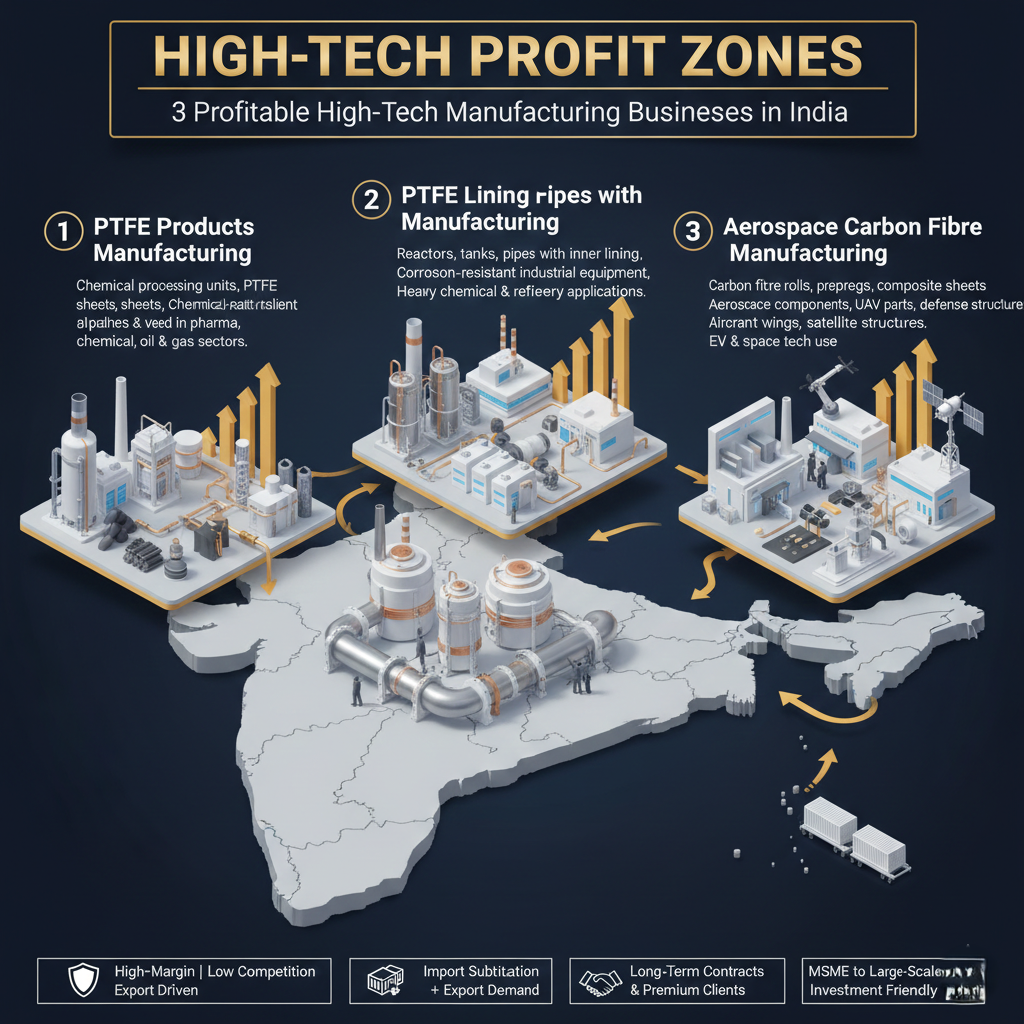

2. PTFE Lining of Pipes, Fittings, and Equipment
Product Overview and Industrial Applications
PTFE lining is used to cover steel pipes, reactors, columns and process equipment for protection against corrosion and contamination. Unlike standalone PTFE components, lining is a part of the industrial systems, extending the life of equipment and enhancing safety.(High-Tech Manufacturing Businesses in India)
Chemical plants use PTFE lined equipment to manage aggressive acids and solvents, while pharmaceutical plants use lining to maintain product purity and compliance with regulation.
Read More: Carbon Fibre Manufacturing: A High-Potential Opportunity for Startups and Entrepreneurs
Manufacturing Procedure and Production Requirements
PTFE lining is a combination of polymer processing and metal fabrication. Common techniques include:
- Paste-extruded PTFE liners
- Sleeves isostatically moulded
- Thermal expansion bonding
- Spray coating or electrostatic powder coating
Because of the technical sophistication, many successful manufacturers have the ability to fabricate their products or have close relationships with engineering companies.
Quality Assurance and Raw Materials
Besides PTFE resin, manufacturers need steel pipes, fittings, as well as special anchoring systems. Quality control is of importance and often includes:
- Spark testing
- Vacuum testing
- Thickness inspection
- Leak detection
Capital investment is greater than PTFE component manufacturing that come with larger equipment and testing infrastructure.
Market Demand and Growth Potential
Demand for PTFE lining is closely related to industrial capital expenditure in:
- Chemical plants and chlor-alkali plant
- Agrochemicals, bulk drugs
- Effluent treatment Environmental Infrastructure
This segment is growing at about 12-14% at a year rate in India. Technically capable manufacturers can achieve margins of 20-30% especially where rework rates are kept low.
3. Carbon Fibre Manufacturing for Aerospace and Defence using High-Modulus
Product Overview and Applications
High or ultra-high modulus carbon fibre is a special fibre for aerospace, defence and space applications where stiffness-to-weight ratio is very important. Common applications include aircraft structure, UAV frames and missile casings and satellite parts.(High-Tech Manufacturing Businesses in India)
Compared to commercial carbon fibre, materials for the aerospace sector demand extreme precision and sophisticated manufacturing processes.
Read More: Empowering the Future with a Carbon Fiber Plant in India
Manufacturing Process and Technological Issues
Carbon fibre production starts with precursor fibres such as PAN (polyacrylonitrile) which undergo:
- Stabilization
- Carbonization
- Ultra-high temperature Graphitization
Ultra-high modulus fibres require high precision of tension and heat treatment. Initial yield loss and learning curves can be costly, so this is an arena for capital- and visionary entrepreneurs.
Raw Materials and Strategic Issues
Key requirements include:
- Best quality precursor fibre supply
- High-temperature furnaces and automation
- Reliable power infrastructure
- Good intellectual property protection
Government approvals and certifications is critical because of defence sensitivity and strategic applications.
Market Demand and Profitability Potential
The defence indigenization initiatives and the growing space programme of India are major growth drivers. While the domestic market is still in the development stage, the international aerospace carbon fibre market demand is growing at a rate of more than 10% per year.
Once the utilization of production exceeds 65-70%, the manufacturers are able to reach strong profitability levels with long-term contracts and low competition.
Read More: 10 High-Demand Downstream Steel Product Manufacturing Ideas in India
Important Lessons from Indian Industrial Leaders
Successful Indian industrialists have paved the way for other Indian industries to grow by the virtue of patience and technical excellence in advanced manufacturing. Companies that invested early in aerospace materials developed strong partnerships and earned technical credibility, and aligned with national strategic priorities.
For the new entrepreneur, the most important lessons include:
- Invest in process mastery before scaling
- Focus on long-term contracts not quick margin
- Develop technical partnerships and certifications early

Conclusion
Manufacturing opportunities in PTFE components, PTFE lining, and aerospace-grade carbon fibre represent a major shift toward specialized, high-value industrial materials in India. The three sectors maintain their strength through high entry obstacles because of consistent industrial demand and increasing government support which promotes domestic manufacturing.(High-Tech Manufacturing Businesses in India)
The best chance for entrepreneurs to achieve success exists when they concentrate on establishing quality systems and following process disciplines and developing their technical skills. High-performance materials manufacturing operates as a financially stable business opportunity which maintains its value throughout time because industries need to achieve operational efficiency and safety standards while they pursue independent decision-making.
Frequently Asked Questions (FAQs)
- Is PTFE manufacturing suitable for new entrepreneurs?
Yes. PTFE gaskets, rods, and sheets are relatively accessible with moderate capital investment and stable industrial demand. - How important are certifications in PTFE lining and carbon fibre businesses?
Extremely important. Many clients audit facilities before placing orders, especially in pharmaceutical and defence sectors. - What is the biggest challenge in carbon fibre manufacturing?
High capital investment and technical complexity during early production stages. - Which industries create the highest demand for PTFE products in India?
Chemicals, pharmaceuticals, power generation, and specialty manufacturing. - Can MSMEs enter aerospace supply chains?
Yes. Many MSMEs participate as tier-2 and tier-3 suppliers with government support programs.