


India is at a nutritional inflection point. Consumers demand more than calories and carbohydrates – they seek protein, nutrition and food that powers an active, healthy lifestyle. High protein rich food products manufacturing offers entrepreneurs a thriving opportunity.
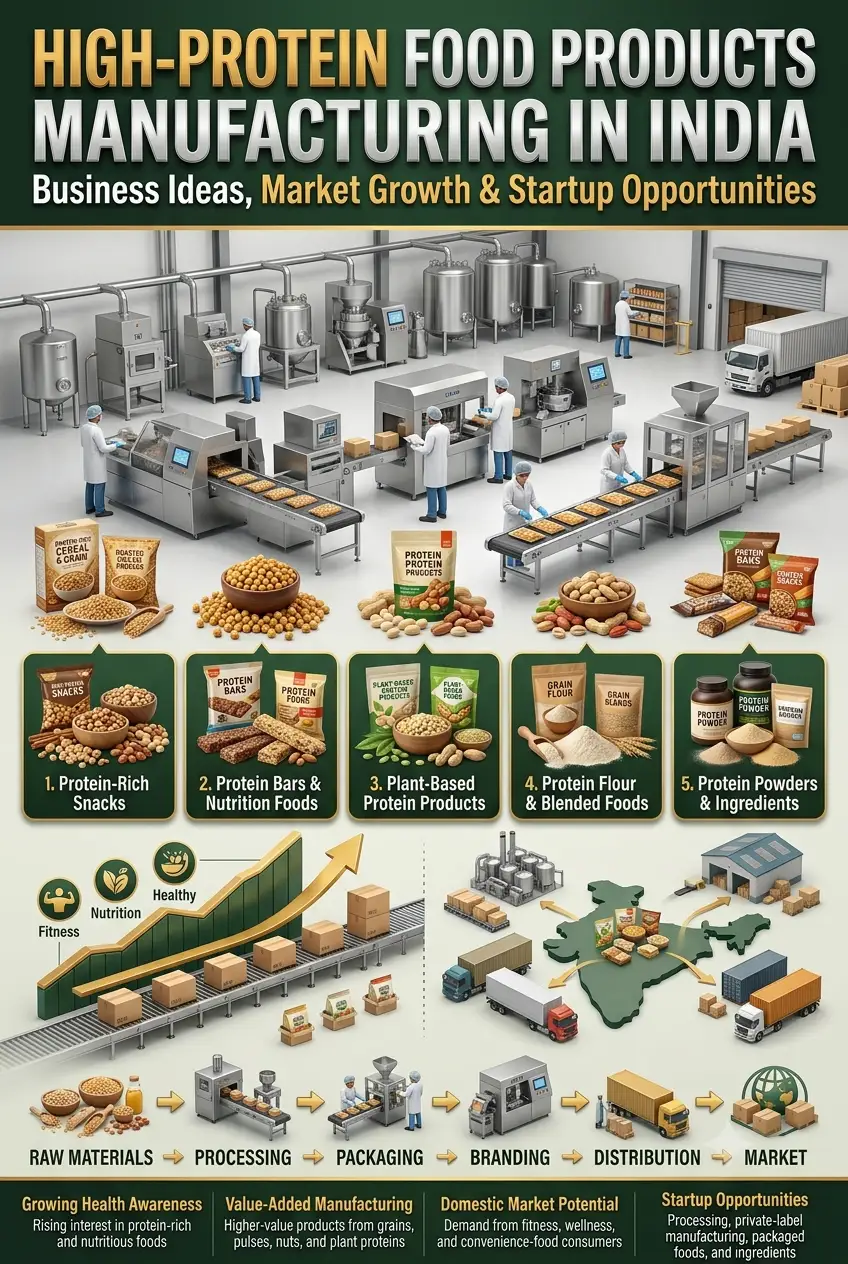
From whey protein powders and soya chunks to protein-fortified cereals and plant nutrition bars – this booming sector spans urban and semi-urban markets. What was once a niche supplement, restricted to the gyms and body-building communities is now a mainstream food segment. Contemporary Indian households, hospital patients, elderly consumers, fitness professionals, and children’s nutrition programmes all have protein needs.
For first-generation entrepreneurs and MSME investors, high protein food products manufacturing represents some of the most exciting investment opportunities in India’s booming food processing landscape, with the right raw material base, government support infrastructure, and consumer demand – what better time to begin than now?
Why the High Protein Food Products Sector Is Booming in India
Several factors are simultaneously driving this sector upwards, enabling entrepreneurs to capitalise on a growing market opportunity.
A Nation-Wide Protein Deficiency Gap
Research shows that most Indian households, regardless of income bracket, are protein deficient. The Indian Council of Medical Research (ICMR) recommends approximately 0.8 to 1 gram of protein to be consumed per kilogram of body weight per day. Most Indians fall significantly short of this recommended daily allowance, which translates to a significant market opportunity with protein-rich food products in a variety of price bands.
The Urban Fitness and Wellness Movement
The rise of gym culture, home workouts, and yoga in Indian cities has resulted in a surge in demand for protein-rich snacks, shakes, and staples. Brands that cater to this segment are seeing rapid growth rates – and as the category matures, the early movers still hold competitive advantages. This segment is young, with potential for premiumisation.
Aging Population and Healthcare Nutrition
India’s aging demographic is growing. This category has particular protein needs to maintain muscle mass, aid recovery, and support metabolism. Protein-enriched foods including porridges, shakes, and fortified cereals are in demand from this segment. Hospitals, elderly care homes, and clinical nutrition businesses are active buyers of protein-rich food products.
Vegetarianism and Plant-Based Demand
India has one of the world’s largest vegetarian populations. Many vegetarians struggle to meet their daily protein requirements, given the typical Indian diet of rice, wheat, and vegetables. Plant-based protein products address this gap, making this manufacturing segment highly viable in the Indian context where there is a ready audience for vegetarian protein products.
Corporate Wellness and Institutional Demand
Large corporate organisations and schools are increasingly investing in nutrition and wellness programmes for employees and students. Protein-rich meal options, high-protein snack selections, and mid-meal nutrition supplements constitute stable, high-volume institutional demand for protein food manufacturers.
Government Policies and Incentives Supporting Protein Food Manufacturing
The Government of India has a robust support framework for food processing entrepreneurs. Several schemes benefit those setting up high protein food products manufacturing units.
The Production Linked Incentive Scheme for the Food Processing Industry (PLISFPI) with a budget allocation of ₹10,900 crore targets manufacturers of innovative and value-added food products. MSME-category applicants manufacturing innovative or organic products will find a dedicated component.
The Pradhan Mantri Formalisation of Micro Food Processing Enterprises (PMFME) Scheme provides a credit-linked capital subsidy of 35% of project cost to micro food processing units. Entrepreneurs setting up small-scale protein food production units – protein powders, fortified snacks, soy products, etc., can access the support directly through state government nodal agencies.
APEDA’s Financial Assistance Schemes assist registered food processing exporters, giving them financial support for quality infrastructure, packaging, and certification. This is particularly relevant for protein food manufacturers eyeing overseas markets in the Middle East, Southeast Asia, and Europe.
The FSSAI Food Safety and Standards (Labelling and Display) Regulations govern how protein content claims can be made on food packaging. For a food product to claim “High Protein” or “Rich in Protein”, it must meet prescribed nutrient thresholds. Understanding these regulations will help entrepreneurs avoid compliance issues that could delay product launches.
The MSME Credit Guarantee Scheme (CGTMSE) provides collateral-free credit to micro and small enterprises up to ₹200 lakh. First-generation entrepreneurs without existing assets to pledge as collateral can access working capital and term loans to set up their protein food manufacturing operation.
States like Maharashtra are taking steps to develop food processing infrastructure. The Ministry of Food Processing’s Maharashtra state page outlines state-level investment incentives, industrial parks with food processing zones, and raw material strengths that benefit protein food manufacturers.
The Startup India government schemes platform offers DPIIT-recognised food processing startups tax exemptions, faster patent processing, and government procurement benefits – an additional opportunity for protein food innovators to scale with government support.
Invest India’s food processing sector page provides investors and manufacturers with project matching, single-window clearance support, and dedicated facilitation services. For entrepreneurs planning larger-format protein food processing investments, this platform offers direct access to policy support.
The Pradhan Mantri Kisan Sampada Yojana (PMKSY) creates the supply chain infrastructure – food parks, processing clusters, cold chain networks – that protein food manufacturers can use to reduce raw material logistics costs and improve supply chain reliability.
High Protein Rich Food Products: Manufacturing Business Ideas for Entrepreneurs
The high protein food sector is not a single industry – it comprises multiple distinct product segments, each with their own manufacturing profile, target consumer, and financial structure. Here are the most strategically viable business ideas for entrepreneurs entering this space.
Whey Protein Concentrate and Isolate Manufacturing
Whey protein is a by-product of cheese and paneer manufacturing. It is one of the most biologically complete proteins, with a rich essential amino acid profile and high digestibility scores. Manufacturing whey protein concentrate (WPC) and whey protein isolate (WPI) for the sports nutrition and clinical nutrition markets is one of the highest-margin opportunities in the food processing sector – this segment has seen explosive growth in the last decade.
Whey protein concentrate and isolate manufacturing involves ultrafiltration, microfiltration, and spray-drying of liquid whey obtained from dairy units. India has a significant dairy processing base, with states like Gujarat, Punjab, Rajasthan, and Maharashtra having robust dairy processing infrastructure. Establishing procurement partnerships with cheese and paneer manufacturers can ensure a steady whey supply at competitive costs.
Whey protein targets gym-goers, professional athletes, post-surgical patients, elderly individuals needing easy protein supplementation, and mothers seeking infant nutrition solutions. Branded whey protein supplements command strong price premiums. Private label manufacturing for domestic nutrition brands and contract manufacturing for export buyers are viable revenue models. As demand for premium, India-sourced whey protein grows internationally, this segment also has export potential.
Soy Protein Isolate and Textured Soy Protein Manufacturing
India is one of the world’s largest soybean producers, making soy-based protein manufacturing a logistics-efficient and cost-competitive opportunity for Indian entrepreneurs. Soy protein isolate (SPI) is produced using an alkaline extraction and acid precipitation process, yielding a product with over 90% protein by dry weight. SPI is utilised extensively in sports nutrition, food fortification, and meat processing.
Textured soy protein (TSP), commonly sold as soya chunks or nutri-nuggets, is manufactured by extruding defatted soy flour through high-pressure extruders. This product is a staple protein source for Indian vegetarians. Distribution through traditional grocery retail is well-established. Madhya Pradesh, Rajasthan, and Maharashtra – India’s primary soybean belts – are natural locations for soy protein manufacturing units.
Manufacturers can target multiple customer segments – branded soya chunk retail packs, bulk industrial-grade soy protein isolate for food companies, institutional supply to hospitals and canteens, and export to the Middle East, Africa, and South Asia. This multi-channel approach reduces revenue concentration risk and allows the business to grow across several markets concurrently.
High-Protein Snack Bar and Nutrition Bar Manufacturing
Protein bars, energy bars, meal replacement bars, and wholesome snack bars are one of the fastest-growing premium food categories in urban India. From post-workout gym protein bars to clean-label, whole-food nutrition bars for office workers and travellers, this segment spans a wide range of product types.
Protein bar manufacturing involves ingredient procurement (protein bases, sweeteners, binders, flavours), blending and forming, cutting and coating, and packaging. This is not a particularly capital-intensive process, and small and medium-scale units can commence with semi-automated batch lines and scale with demand growth. Specialised product differentiation – clean-label, no artificial sweeteners, plant-based formulations, and region-specific Indian flavours – can help new entrants stand out against established brands.
Distribution strategies for protein bar manufacturers include modern trade retail chains, health-oriented quick commerce platforms, gym partnerships, corporate pantry supply, and airline catering. The digital-first nature of nutrition product discovery means well-packaged, quality-consistent protein bars can build significant brand presence through e-commerce before investing heavily in offline retail. The market is still establishing its dominant brands, which makes early entry valuable.

Plant-Based Protein Powder Manufacturing
Pea protein, brown rice protein, chickpea protein, hemp protein, and mung bean protein powders are gaining rapid traction globally. They are popular among vegan consumers, dairy-intolerant individuals, and environmentally conscious nutrition seekers. Plant protein manufacturing involves wet fractionation. This includes soaking, grinding, pH adjustment, centrifugation, and spray-drying of plant raw materials. These processes produce clean, high-concentration protein powders.
This segment aligns well with the global shift toward sustainable, plant-based nutrition. India grows substantial quantities of peas, chickpeas, and lentils. Rajasthan, Madhya Pradesh, and Uttar Pradesh are major producing states for these crops. Entrepreneurs building sourcing networks in these states can access raw material at competitive prices. They can then process it into high-value plant protein ingredients.
Export potential is particularly strong for plant-based protein powder manufacturers. The US, Europe, and Gulf markets have well-established, growing demand for certified vegan, non-GMO, clean-label plant protein ingredients. Indian manufacturers can enter global supply chains from a position of genuine cost-competitiveness. They need FSSAI licensing and international quality certifications such as ISO 22000 and HACCP. They can also obtain organic certification where required.
Protein-Fortified Breakfast Cereals and Porridge
Protein fortification of everyday foods is an accessible and high-volume opportunity with wide consumer reach. For example, standard breakfast cereals – oats, muesli, corn flakes – can be protein-enriched using soy protein concentrates, milk protein isolates, or pulse protein powders during processing. Similarly, traditional Indian staples like daliya (broken wheat porridge), sattu (roasted gram flour), and murmura (puffed rice) can be fortified to create higher-protein versions of familiar foods.
Moreover, the target consumer for protein-fortified cereals and porridge is broad – working families looking for quick, nutritious breakfasts; children needing protein-dense school meals; elderly individuals who need soft, easy-to-digest protein sources; and health-conscious professionals managing caloric intake. In addition, protein-fortified cereals carry better margins than commodity cereal products and face less private label pricing pressure. Furthermore, distribution through traditional retail, modern trade, and e-commerce channels is well-developed.
Therefore, for entrepreneurs seeking an accessible entry point into high protein food manufacturing without the capital intensity of protein extraction equipment, protein-fortified cereal and porridge products offer a viable starting strategy. Additionally, formulation can be developed with food technologist support. Likewise, manufacturing can be established with standard food mixing, cooking, and packaging equipment. Finally, market entry can leverage existing distribution relationships in the food category.
Pulse-Based High-Protein Flour and Premix Manufacturing
Pulse flours – made from chickpeas, lentils, black gram, green gram, and kidney beans – are natural high-protein alternatives to refined wheat flour. Moreover, Besan (chickpea flour) already holds a culturally entrenched position in Indian cooking. Furthermore, Extending this foundation to high-protein multigrain flour blends, protein premixes for bakeries, and functional cooking mixes creates a scalable product portfolio that serves both traditional and modern consumer segments.
Additionally, Manufacturers blend pulse flours with added protein concentrates and micronutrients to create high-protein flour products. For example, These can be marketed directly to health-conscious consumers seeking to reduce refined grain intake, to diabetics seeking low-glycaemic alternatives, to athletes needing protein-rich cooking staples, and to elderly individuals seeking easily digestible protein sources. Moreover, The manufacturing process is milling-based, making it capital-efficient and suitable for MSME-scale operations.
Furthermore, Distribution options include health food retail chains, e-commerce platforms like Amazon, Flipkart, and BigBasket, modern trade retailers, and institutional buyers including hospitals, school midday meal programmes, and corporate cafeterias. In addition, Entrepreneurs with existing flour mill operations can upgrade with protein fortification and new product formulations at comparatively low additional cost. Therefore, This represents a meaningful adjacent opportunity for agri-processing businesses already operating in the grain milling space.
Import-Export Opportunity Analysis for High Protein Food Manufacturers
India’s protein food manufacturing sector offers genuine and growing export potential. Therefore, Entrepreneurs should integrate this into their planning from the outset.
The global protein ingredient market is expanding steadily. Moreover, Key import regions for Indian protein foods include the Middle East, Southeast Asia, Africa, Europe, and North America. Furthermore, Indian manufacturers hold competitive advantages. These include abundant raw materials (soybean, pulses, dairy), cost-efficient labour, an improving quality certification ecosystem, and the legacy advantage of being a trusted supplier of agricultural commodities.
Soya chunks and textured soy protein from India already reach significant export markets. For example, These include Sri Lanka, Bangladesh, countries in the Gulf Cooperation Council (GCC), and parts of East Africa. In addition, These markets have strong demand for affordable, shelf-stable, high-protein vegetarian products. Therefore, Entrepreneurs can build export-compliant facilities with APEDA registration, ISO 22000 or BRC food safety certification, and quality labelling systems. As a result, This can help them access these markets within the first few years of operations.
Whey protein manufactured from Indian dairy by-products has emerging export potential in the Middle East. Meanwhile, Demand for halal-certified protein supplements is rising alongside growing gym and fitness culture. Similarly, Plant protein powders, particularly chickpea and pea-based products, are in increasing demand in Europe and the US. Moreover, The vegan and flexitarian nutrition market has gone mainstream in these regions.
On the import front, entrepreneurs should carefully plan sourcing strategies. However, Some specialty ingredients must be procured internationally. These include specific amino acid blends, certain vitamin premixes, flavourings, and packaging materials. Therefore, Building reliable import sourcing reduces formulation inconsistency. In addition, It also protects product quality.
The overall trajectory of global protein food trade favours Indian manufacturers. Furthermore, India’s government is actively working to expand processed food export capacity. At the same time, Quality standards are rising. Moreover, The global protein demand growth outlook is also strong. This growth is driven by population expansion, rising income levels in emerging markets, and the global transition toward healthier diets.
Indian MSME Success Stories in the High Protein Food Sector
Patanjali Ayurved – Haridwar, Uttarakhand
Baba Ramdev-led Patanjali Ayurved is one of the most compelling MSME-origin success stories in the Indian food and nutrition sector. Starting as a small pharmacy and health products operation, Patanjali expanded aggressively into protein and nutrition foods – from protein supplements to fortified atta and nutraceutical powders. The company’s strategic positioning combined Ayurvedic trust signals with modern nutritional marketing, resonating deeply with middle India’s desire for credible, affordable health products. Patanjali’s lesson for new protein food entrepreneurs is clear: consumer trust is built through consistent quality and brand authenticity, not just advertising. Positioning and brand story matter as much as product formulation. A manufacturer who earns the consumer’s trust can command premium pricing and command loyalty that imported brands struggle to replicate.
MuscleBlaze (HealthKart) – Gurugram, Haryana
MuscleBlaze, the flagship protein brand of HealthKart, transformed India’s sports nutrition market by identifying a real gap – imported whey proteins were expensive, inconsistent in quality, and often adulterated. The founding team-built manufacturing and quality verification processes specific to Indian conditions, launched India’s first protein authenticity testing programme, and used e-commerce channels to establish direct consumer relationships before investing heavily in offline retail. From an MSME startup, MuscleBlaze became India’s best-selling protein supplement brand with measurable trust equity. The key lessons: solving a real consumer problem with operational excellence builds a defensible market position; transparency about quality becomes a brand differentiator in categories where trust is scarce.
Yoga Bar (Sproutlife Foods) – Bengaluru, Karnataka
Founded by Suhasini Sampath and Anindita Baruah, Yoga Bar identified an opportunity where few others were looking – India-specific protein bar formulations that balanced nutrition, taste, and price for the Indian consumer. At a time when protein bars were largely an imported, gym-only product, Yoga Bar built a clean-label, naturally sweetened, Made-in-India alternative that could sit on supermarket shelves and command consumer confidence. ITC later acquired a significant stake in Sproutlife Foods, validating the brand’s market position and growth potential. Yoga Bar’s success demonstrates that first-mover discipline in a new Indian food product category – combined with product quality, consistent branding, and retail distribution expertise – can create significant business value and attract strategic investors.
How NPCS Can Help You Plan Your High Protein Food Manufacturing Business
We at Niir Project Consultancy Services (NPCS) provide professional consulting for the preparation of Market Survey cum Detailed Techno-Economic Feasibility Reports (DPRs) for setting up new industries or businesses. Our reports include detailed manufacturing processes, market research and demand analysis, process flow diagrams, product mix and capacity planning, machinery and raw material details, and complete project financials with profitability analysis. Our objective is to help entrepreneurs evaluate feasibility, profitability, and long-term scalability before investing.
NPCS has published a comprehensive printed reference book on food processing technology and agro-based industries, covering protein products, manufacturing processes, market analysis, investment parameters, and plant economics in depth – the printed book: Handbook on Food Biotechnology (Extraction, Processing of Fruits, Vegetables and Food Products)
For a detailed techno-economic Project Report on setting up a soy protein manufacturing business — including plant economics, machinery lists, raw material sourcing, financial projections, and applicable government incentives — the NPCS Project Report: Soya Protein Manufacturing Plant – Detailed Project Report, Profile, Business Plan, Industry Trends, Market Research, Survey, Manufacturing Process, Machinery, Raw Materials, Feasibility Study, Investment Opportunities, Cost and Revenue
Key Market Data: High Protein Rich Food Products Manufacturing in India
| Product Segment | Key Raw Materials | Primary Target Segments | Export Markets |
| Whey Protein Concentrate / Isolate | Liquid whey from dairy units | Sports nutrition, healthcare, elderly | Middle East, Southeast Asia, GCC |
| Soy Protein Isolate | Defatted soy flour | Vegetarians, food fortification, industrial buyers | GCC, Africa, Southeast Asia |
| Textured Soy Protein (Soya Chunks) | Defatted soy flour | Mass retail, institutional, households | Sri Lanka, Bangladesh, GCC, Africa |
| Protein Bars / Nutrition Bars | Whey/pea protein, dry fruits, oats, honey | Urban fitness enthusiasts, corporate professionals | Europe, US (online D2C), GCC |
| Plant-Based Protein Powders | Peas, chickpeas, brown rice, hemp | Vegans, dairy-intolerant, health-conscious | US, EU, Australia, Canada |
| Protein-Fortified Breakfast Cereals | Oats, millet + soy/milk protein isolate | Families, children, elderly, office professionals | Southeast Asia, Middle East |
| High-Protein Pulse Flour / Premix | Chickpea, lentil, black gram flour | Households, bakeries, health food retailers | GCC, diaspora markets in UK and US |

Conclusion
High protein rich food products manufacturing is not a speculative venture. Instead, It is a well-established, growing market. Moreover, It has multiple proven product segments, a supportive government policy environment, and strong domestic and export demand fundamentals.
Furthermore, India’s unique strengths — abundant soybean and pulse raw materials, one of the world’s largest vegetarian consumer bases, and a growing fitness and health awareness movement — make this sector accessible to first-generation entrepreneurs. In addition, The manufacturing ecosystem also supports MSME entry.
For example, Whether you plan to manufacture soy protein isolates for industrial buyers, craft protein bars for the urban retail market, or build a plant protein powder brand for export, the opportunities are strong. Moreover, You can also fortify traditional Indian foods with high-quality protein.
Therefore, The market fundamentals are in your favour. However, Success requires thorough feasibility groundwork. It also requires choosing the right product segment for your location, raw material access, and market relationships. Additionally, Regulatory compliance should be built into your operations from day one.
Meanwhile, The protein food market in India is still in its early growth phase. As a result, Entrepreneurs who enter now can help define this category’s future. Ultimately, Quality, compliance, and strategic market positioning should remain at the core.
Your Investment Deserves the Right Opportunity
Every serious investment begins with choosing the right sector and the right business model. With hundreds of industrial opportunities available across India’s manufacturing and clean-energy landscape, making the most informed choice is critical. NPCS Startup Selector tool helps entrepreneurs, MSMEs, and investors identify the most suitable business opportunities based on their investment capacity, location, and interests — so your capital is directed toward a venture with the strongest fit and potential.