


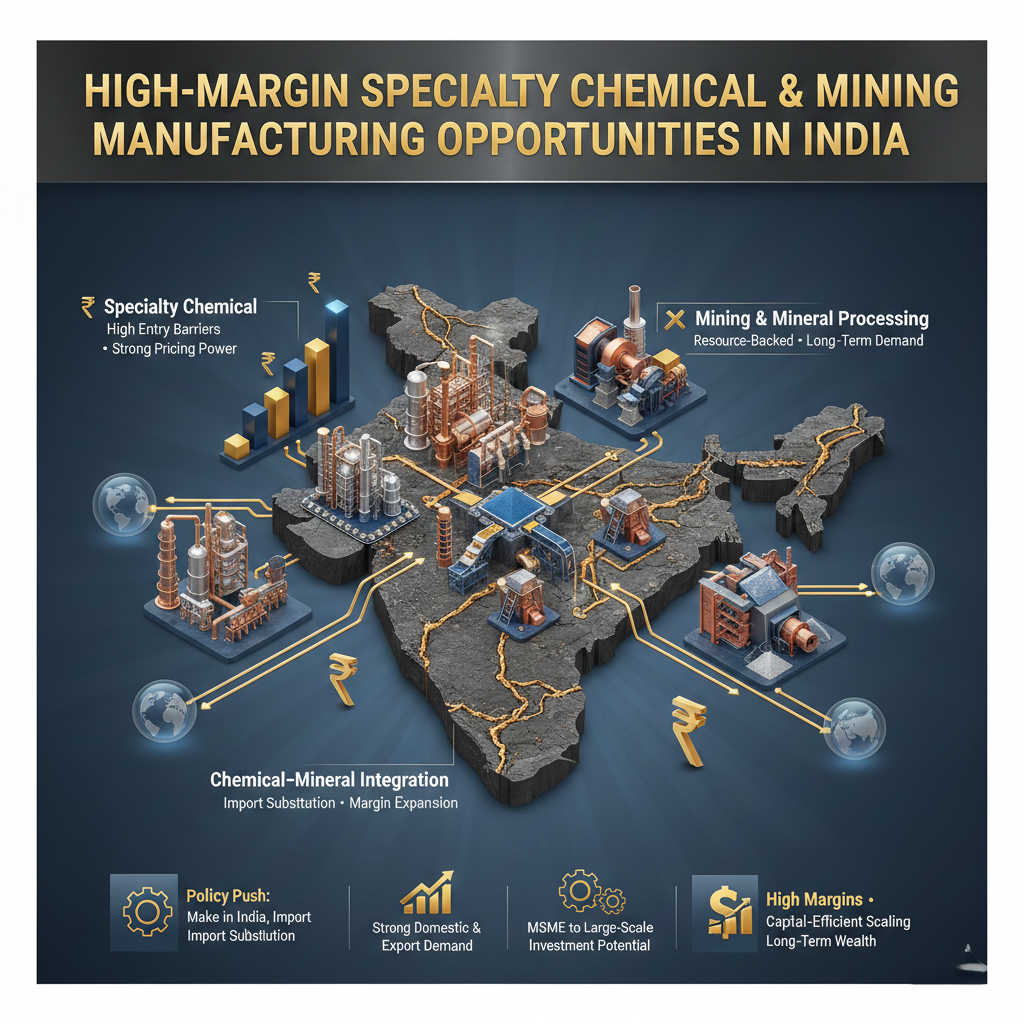
High-Margin Manufacturing Opportunities India landscape is undergoing structural transformation. While traditional sectors such as steel, cement and basic chemicals are still dominating volumes, what is really beginning to create value is specialty chemicals, advanced polymers and mineral beneficiation. These segments provide greater margins, technology-driven differentiation and long-term demand stability.
Importantly, such manufacturing opportunities are no longer the domain of the large industrial conglomerates. With the proper technical knowledge, regulatory preparedness and strict execution, MSMEs and first-generation entrepreneurs can move successfully into these sectors.
Among the most promising opportunities today are biomedical polyurethane manufacture, polymeric sulphur production and copper ore beneficiation. Each of these businesses have benefits from import substitution, domestic demand growth and a firm alignment with India’s industrial and infrastructure priorities.
Read More: Detailed Project Profiles On Chemical Industries (Vol II) (2nd Revised Edition)
Biomedical Polyurethane Manufacturing: A High Value Specialty Polymer Business
Biomedical polyurethanes are medical-grade specialty polymers that are intended for long contact with human tissue and body fluids. They provide a very special combination of flexibility, mechanical strength, chemical resistance, and biocompatibility – a position between elastomers and engineering plastics.
Biomedical polyurethane manufacturing in India is mainly required by the medical device industry. Key applications include:
- Long-term catheters and tubing for implants
- Vascular Grafts and Pacemaker leads
- (Wound dressings and controlled drug delivery systems)
- Flexible components in critical care/diagnostic equipment
The boom of minimally invasive surgeries, aging population and the growth of home healthcare devices is providing steady demand for medical grade polymers.
Unlike the production of commodity plastics, biomedical polyurethane production is precision driven (versus volume driven). Most plants are a batch or semi-continuous system that enable formulation level customization for specific medical applications. Critical technical focus areas are:
- Controlled polymerization in moisture free conditions
- Each of the following: – Clean room or controlled manufacturing environments
- Post curing and biocompatibility testing
- Full documentation that adheres to medical standards
Raw materials like medical-grade diisocyanates, polyols and chain extenders have strict consistency and purity requirements. In this segment, process reliability and quality assurance are much more important than the price of raw material.
With an increase in healthcare spending and Government initiatives to boost domestic manufacturing of medical devices, biomedical polymer manufacturing in India is a high margin niche opportunity.
Read More: Detailed Project Profiles On Plantation (Agro Based Projects)
Polymeric Sulphur Manufacturing: Volume Driven Business with Agricultural Demand
Polymeric sulphur is a stabilized Steele sulfur that is developed to address the brittleness and storage instability of traditional sulfur. Its molecular structure allows for controlled sulphur release, thus making it very suitable for use in agriculture and industry.
Polymeric sulphur production in India supports a number of sectors such as sulphur-enriched fertilisers, rubber compounding and sulphur-modified asphalt. In the case of Indian agriculture, there is a wide spread of sulphur deficiency in soils of all types and the slow-release nature of polymeric sulphur enhances the nutrient efficiency.(High-Margin Manufacturing Opportunities India)
The manufacturing process consists of heating elemental sulphur to a temperature above its polymerization temperature followed by rapid cooling to stabilize the long chain polymeric sulphur. Temperature control and cooling rates are absolutely crucial. Operational success is dependent on:
- Energy-efficient heating and cooling systems
- Proper storage and handling
- “The consistent sourcing of elemental sulphur”
The high availability of elemental sulphur from refineries and gas processing units in India makes polymeric sulphur a very attractive import substitution manufacturing opportunity. Among the three possibilities discussed, polymeric sulphur is the one with the best scalability (in the shortest time) with relatively lower capital intensity.
Read More: Top 10 Chemical Import-Export Trends India’s Entrepreneurs Can Capitalize on
Copper Ore Beneficiation – Capital Intensive but Structurally Strong Business
Copper beneficiation plants are used to upgrade low-grade copper ore to high-quality copper concentrate, usually with a copper content of between 28 and 35 percent. This concentrate is made available for smelters and refineries for further processing. Copper demand in India is related to power transmission, renewable energy, electric vehicle manufacturing, electronics and industrial machinery.
A typical copper ore beneficiation plant consists of:
- Crushing and grinding of ore
- Froth flotation mineral separation
- Thickening, filtration, dewatering of concentrate
Modern plants make greater use of automation, cutting-edge flotation reagents, and real-time process monitoring to achieve higher recovery rates and lower operating costs.
Copper beneficiation is capital intensive and needs careful planning. Key factors to consider are secure long-term supply of ore to the mill, access to water, tailings management and environmental compliance. Well managed beneficiation plants are viable across cycles as they have long asset life and long-term offtake contracts.
Read More: India Active Pharmaceutical Ingredient (API) Market, Growth Rate, Covid-19 Impact, Economic Impact, Size, Share, Trend, Drivers, Competitive Landscape, Opportunity, Limitations, Technological Landscape, Regulatory Framework, Analysis, Forecast up to 2027

Strategic Lessons of Indian Industrial Leaders
Industrial leaders such as Ratan Tata, Baba Kalyani, and Rahul Bajaj built their enterprises for the long term by focusing on capability development rather than short-term gains. Their approach underscores some of the principles relevant in specialty chemicals and mineral processing: A discipline with respect to capital allocation, constant adoption of new technologies, high levels of quality and compliance systems, and patience to work through industry cycles.(High-Margin Manufacturing Opportunities India)
Importance of Techno Economic Feasibility Studies
Many manufacturing projects are lost because of underestimation of technical complexity, regulatory requirements and capital requirements. A detailed techno-economic feasibility study is useful to assess the viability of a process, regulatory compliance, capital investment, operating costs, the projected return and risk factors. Engaging professional project consultants at the planning stage goes a long way in reducing the execution risk and increasing capital efficiency.
Read More: Top 25 Chemical Business Ideas
Government Support and Manufacturing Ecosystem
Moreover, Policy initiatives support India’s manufacturing ecosystem by focusing on ease of doing business and improving the competitiveness of Micro and Small Enterprises (MSEs). Furthermore, Institutions like the Ministry of Micro, Small and Medium Enterprises (MSME) help in providing access to incentives, policy guidelines, and capacity building programs.

Conclusion
Overall, The manufacturing opportunities discussed are based on long-term demand fundamentals as opposed to short-term trends. Moreover, Biomedical polyurethanes are a reward to precision and regulatory discipline; meanwhile, polymeric sulphur is a child of agricultural necessity; and additionally, copper beneficiation is a step in line with India’s electrification and infrastructure growth. Therefore, Entrepreneurs who are focused on process excellence and realistic planning with patient capital can create resilient and scalable manufacturing businesses that can perform through market cycles.(High-Margin Manufacturing Opportunities India)
Frequently Asked Questions (FAQs)
Is Biomedical polyurethane manufacturing suitable for small entrepreneurs?
Yes. Niche medical applications where the quality system is strong are good for technically oriented entrepreneurs.
How sensitive is polymeric sulphur pricing to raw material prices?
Moderately sensitive, but stable sulphur availability in India helps to manage volatility.
Does copper beneficiation require having a mine?
No. Many plants operate using ore supply agreements or toll beneficiation models.
What is the average gestation period of projects?
Biomedical polymers 12 to 18 months, polymeric sulphur 9 to 12 months, copper beneficiation 24 to 36 months
Which industry has the quickest scalability?
Polymeric sulphur, because of lower capital and widespread demand in the agricultural segment.