


Introduction: Why Healthcare Manufacturing Business India
The manufacturing industry in India experiences a fundamental transformation. The healthcare manufacturing sector grows better than all other business sectors because it delivers better results than all existing industries. The fundamental factors of rising life expectancy and growing chronic disease rates and expanding diagnostic systems and government efforts to improve healthcare access and domestic production capacity are driving this expansion.
Medical disposables and essential consumables present the most attractive investment possibilities within healthcare manufacturing. Hospitals and laboratories and clinics and public health programs all utilize insulin syringes and blood collection needles and sterilized ORS liquid as essential products that they need for their daily operations. These products meet essential needs which customers buy repeatedly so their demand stays constant throughout economic downturns.
This article examines three high-demand healthcare manufacturing opportunities through a business and operational analysis which explores market demand and manufacturing needs and profitability and scalability.
Read More: Business Ideas for Startup in Drugs & Pharmaceutical Industry with Project Profiles (3rd Edition)
Insulin Syringe Manufacturing Business in India: Precision-Driven, Volume-Led Growth
India is among the largest insulin-consuming markets globally. Diabetes treatment which requires insulin has become standard practice in medical care because of the increasing diabetes rates that result from urban development and changing lifestyles and the growing number of elderly people. The requirement for insulin syringes in India has developed into a continuous need which keeps increasing throughout time.
Insulin syringes serve as manufacturing medical devices which need automated production processes and controlled operating conditions and complete quality management systems. The organization achieves its maximum production capacity after it acquires regulatory permissions and establishes reliable production processes.
Key manufacturing stages include:
- Medical-grade plastic barrel molding
- Stainless steel needle preparation and attachment
- Automated assembly and inspection
- Sterilization (ETO or gamma)
- Tamper-proof packaging under cleanroom conditions
Critical success factors:
- ISO 13485-certified cleanroom infrastructure
- Consistent medical-grade raw materials
- The organization maintains validated sterilization and quality control systems
- The organization meets all requirements set by CDSCO and export regulations.
Manufacturers who achieve these standards gain access to permanent partnership agreements with hospitals and government supply agencies and distributors. Insulin syringe production usually results in EBITDA margins between 18 and 25 percent at commercial production levels while the business attains investment break-even within a three to five year period based on its operational capacity and market reach.(Healthcare Manufacturing Business India)
Blood Collection Needle Manufacturing Plant: The Backbone of Diagnostics
Blood sampling serves as the starting point for all diagnostic assessments. The increasing demand for blood collection supplies results from expanding preventive healthcare services and growing insurance coverage and the establishment of organized diagnostic networks throughout India. The manufacturing of blood collection needles stands as one of the most stable business areas within the production of medical disposable products.
Blood collection needles exist as institutional medical supplies which hospitals and pathology laboratories and diagnostic networks use. The vendor approval process requires manufacturers to deliver consistent supply and high-quality products which they must maintain throughout their entire production process.
Read More: Handbook on Herbal Medicines (Ayurveda Cream, Oil, Pain Balm, Tablet, Herbal Capsules, Churna, Syrup, Medicines with Composition, Rasa Preparations with Production Process, Machinery, Equipment Details and Factory Layout) 2nd edition
Manufacturing capabilities required:
- Precision grinding and multi-angle beveling
- The process of electro-polishing creates a surface that allows for smooth penetration
- The silicone coating system decreases patient discomfort during medical procedures
- Automated inspection identifies burrs bends and surface defects in production items
Stainless steel wire quality determines both rejection rates and customer acceptance of products. The process requires strict adherence to discipline because even small errors can result in complete batch failure.
The company achieves EBITDA margins of 15–20% through its institutional customers who place high-volume repeat orders despite insulin syringe margins which remain slightly lower. Manufacturers with regulatory approvals can achieve strong growth through export demand from Africa and Southeast Asia and Middle Eastern markets.
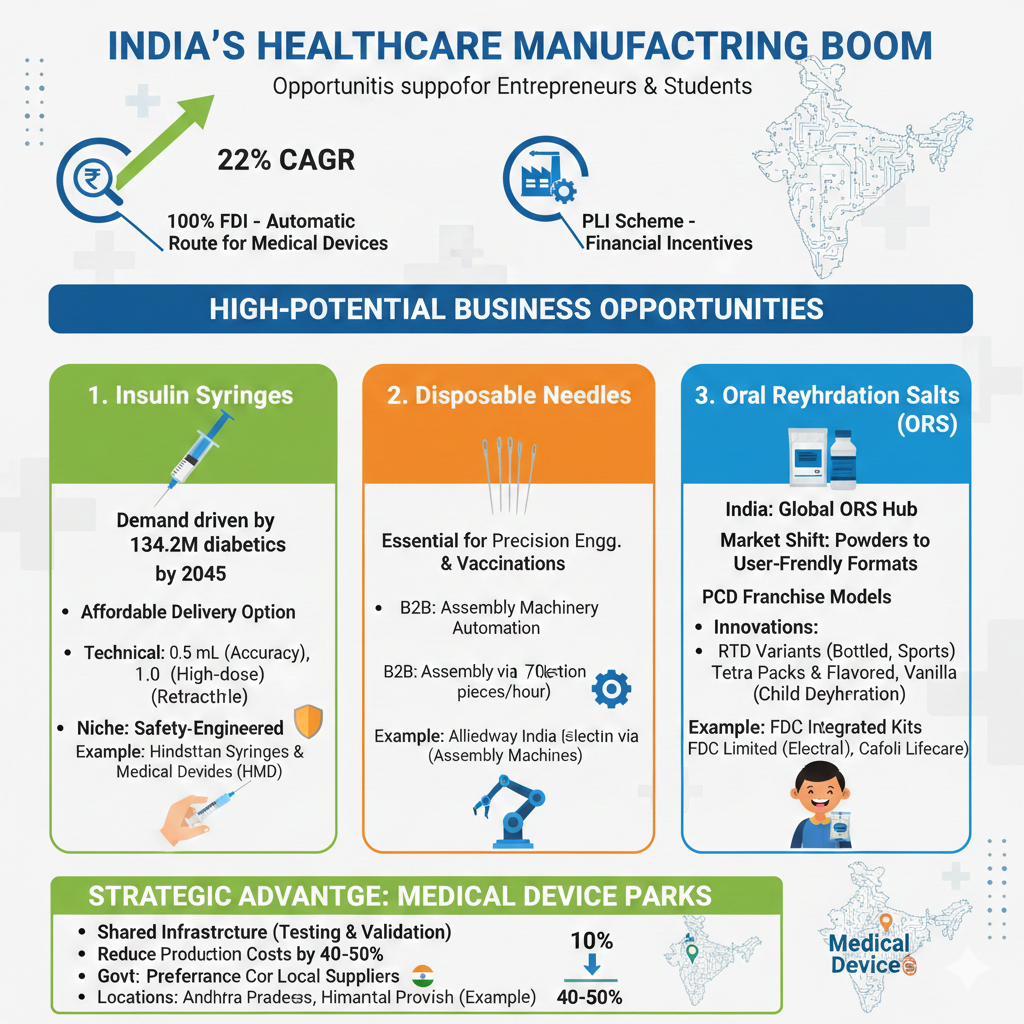

Sterilized ORS Liquid Manufacturing: Essential, Scalable, and Impact-Oriented
The Oral Rehydration Solution (ORS) functions as the primary treatment for dehydration in children and shows effectiveness in rural medical facilities and emergency disaster relief operations. Hospitals and public health systems prefer sterilized ORS liquid because it eliminates more potential risks of incorrect mixing and contamination which exist with powdered ORS. The ORS liquid formulation process requires precise control because its basic components are easy to produce.(Healthcare Manufacturing Business India)
Product safety and regulatory compliance depend on two factors: water quality and the maintenance of sterilization standards.
Read More: Flour Milling – Manufacturing Plant, Detailed Project Report, Profile, Business Plan, Industry Trends, Market Research, Survey, Manufacturing Process, Machinery, Raw Materials, Feasibility Study, Investment Opportunities, Cost and Revenue, Plant Economics
Core production process includes:
- RO, UV, and filtration-based water purification
- Precise electrolyte formulation and blending
- Heat or aseptic sterilization
- Controlled filling, sealing, and labeling
- Shelf-life and stability testing
Demand for sterilized ORS liquid is seasonal, with peaks during summer and monsoon months. However, institutional supply contracts with hospitals, NGOs, and government programs provide baseline demand throughout the year.
Typical EBITDA margins range from 12–18%, making this a lower-margin but highly stable and socially impactful healthcare manufacturing business.
What Successful Indian Healthcare Manufacturers Teach Us
The initial infrastructure investments of Poly Medicure and their quality certification efforts and their export market preparation work, which started in their initial development phase under the leadership of Ashok Choudhary, allowed the company to achieve its growth objectives through rising domestic and international market demand.
Sun Pharmaceutical Industries, which Dilip Shanghvi established, demonstrates that companies need to establish operational efficiency and maintain extensive knowledge of regulations while developing long-range strategic plans. The same regulatory requirements and operational standards which create competitive advantages in pharmaceuticals will also benefit medical disposable manufacturing operations.
Read More: Top 25 Healthcare Business Ideas
Importance of Feasibility Study and Project Planning
Many healthcare manufacturing projects fail not due to lack of demand, but because of inadequate planning. First-generation entrepreneurs often underestimate regulatory timelines, validation costs, and working capital requirements.
A professional feasibility study typically covers:
- Market demand and competitive analysis
- Manufacturing process and technology selection
- Plant layout, cleanroom design, and machinery planning
- Financial projections, cash flow, and ROI analysis
The execution risk of a project decreases while capital efficiency increases through preparation because the healthcare manufacturing industry operates under strict compliance requirements.
Read More: Top 10 Profitable Pesticides and Insecticides to Manufacture
Policy and Regulatory Environment in India
The healthcare manufacturing sector in India receives backing from various government agencies which include the Ministry of MSME and the Department of Pharmaceuticals and the Central Drugs Standard Control Organization (CDSCO).The manufacturing sector in the country receives backing through its domestic production facilities which handle local manufacturing needs and its importation process and its quality control requirements.
The Production Linked Incentives (PLI) program together with export promotion initiatives and infrastructure development programs create a positive impact on the future of both medical device production and medical supply manufacturing.
Conclusion: Building Sustainable Returns in Healthcare Manufacturing
The essential components of contemporary medical treatment include insulin syringes and blood collection needles together with sterilized ORS liquid. These products, which drive high volume sales, require strict adherence to regulations, yet their operational performance depends more on disciplined management than on competitive pricing strategies.(Healthcare Manufacturing Business India)
The healthcare manufacturing sector in India provides fundamental investors and entrepreneurs with investment opportunities that deliver continuous market demand and sustainable growth according to India’s long-term healthcare development plan. The organizations that develop their quality management systems and their regulatory compliance procedures together with their operational efficiency measures will establish business operations that continue to function after their initial setup.
Frequently Asked Questions (FAQ)
Is healthcare manufacturing suitable for first-time entrepreneurs?
Yes, provided regulatory compliance, quality systems, and professional planning are implemented from the beginning.
How long does it take to recover investment in medical disposable manufacturing?
Most projects achieve break-even within three to five years, depending on scale, capacity utilization, and market access.
Is export mandatory for success?
Exporting products to foreign markets does not create a requirement for success but it helps businesses develop better operational capacity and product output and profit reliability.
What is the biggest operational risk in healthcare manufacturing?
Quality lapses and regulatory non-compliance are the most critical risks.
Can insulin syringes, needles, and ORS be manufactured in one facility?
The process should not be done because the two operations require different cleanroom standards and different regulatory standards and different operational methods.