


Published by: Niir Project Consultancy Services (NPCS) | Author: Dr. H. Panda | ISBN: 9788178331317
While opening any packaged food product on Indian supermarket shelves you would find a stabilized flavor in yoghurt, a cream biscuit, a tetra pack fruit drink or a cheese slice. Somewhere in the fine print of the ingredients on the packaging one would find stabilizers or thickeners or hydrocolloids. These are words that pass by many consumers as they flip through the fine print. But for food manufacturers, technologists and processing entrepreneurs, they form the crux of a consistent and competitive product offering.
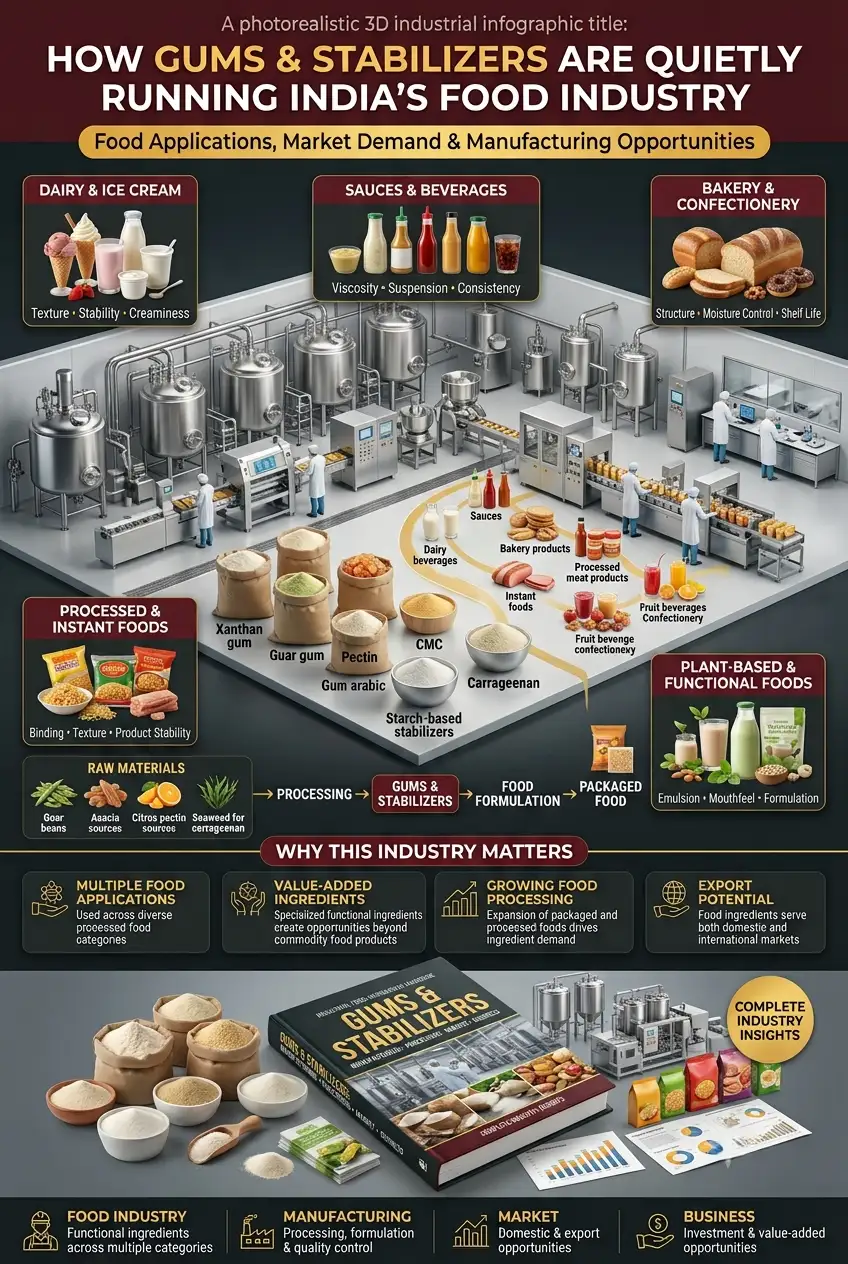
Gums and stabilizers – the category that includes guar gum, xanthan, carrageenan, pectin, agar, locust bean gum, gum arabic, gelatin, modified starch, and other ingredients are used in bakery, dairy, confectionery, beverages, meat processing, nutraceuticals and other industries. India has one of the world’s largest food processing industries and is both a major producer and consumer of these inputs. The industry is growing rapidly and with tightening regulations the technical know-how of gum and stabilizers is becoming even more important.
It is in this context that Niir Project Consultancy Services (NPCS) has announced the publication of the Complete Book on Gums and Stabilizers for the Food Industry – a technical-commercial handbook for food technologists, manufacturers, MSMEs, R&D professionals and investors.
A Market That’s Still Expanding: The Numbers Behind Food Hydrocolloids
The global food hydrocolloids market was valued at USD 3.9 billion in 2023 and is expected to reach USD 5.5 billion by 2032, at a CAGR of around 4.1%. The gum hydrocolloids market – covering industrial and pharmaceutical applications – was valued at USD 12.7 billion in 2024 and is expected to witness a CAGR of 5.7% to reach USD 22 billion by 2034.
India’s hydrocolloids market is valued at USD 155 million (approximately) currently and is expected to grow at a CAGR of 7.3% to reach USD 254 million by 2032. The boom in packaged foods, increased purchasing power of the growing middle class, and government initiatives like the Production Linked Incentive (PLI) scheme to boost food processing are supporting the higher-than-average growth of the India market.
India is also a major global supplier of certain gums like guar gum. The state of Rajasthan along with Haryana supplies guar to over 70 countries. This gives significant potential to Indian entrepreneurs, especially given the Government’s push for PLI in the food processing industry.
Clean Labels, Plant-Based Foods, and the Functional Ingredient Revolution
The Indian food industry is undergoing a structural change. Consumers are more informed and want to know what goes into the food they buy. This has led to a demand for products with clean labels and natural additives. As a result, food manufacturers are turning to alternatives like plant-based gums and stabilizers that meet the ‘natural’ requirements of consumers.
In addition, the burgeoning plant-based food movement has created special processing requirements. Manufacturers need the right blends of gums and stabilizers to be able to replicate the cooking and eating qualities of animal-based products in plant-based variants. This is particularly crucial in dairy analogues, confectionery, and meat analogues where the correct hydrocolloids blends contribute directly to the eating experience.
On the regulatory front, FSSAI has revised and updated the list of permitted food additives and stabilizers – with multiple amendments in recent years – under the Food Safety and Standards (Food Products Standards and Food Additives) Regulations, 2011. Knowledge of permitted gums and dosages is becoming increasingly important for food businesses.

Where the Business Opportunities Are: From Guar Processing to Specialty Hydrocolloids
Entrepreneurs and MSMEs evaluating a foray into the manufacturing of gums and stabilizers can consider a range of options depending on the capital outlay:
- Guar Gum Powder Manufacturing: India is one of the world’s largest producers of guar. But around 80% of it is exported as raw seeds. Processing the guar into food grade, industrial grade, and pharma grade gum powder is a lucrative vertical to explore. Small and mid-scale processing units are already operational in Rajasthan and Gujarat with good export realization.
- Xanthan Gum Manufacturing: Xanthan gum is produced by fermenting glucose or sucrose using Xanthomonas campestris bacteria. Xanthan is a viable MSME-level manufacturing opportunity with rising domestic demand in the food sector.
- Pectin from citrus and apple waste: India generates large volumes of citrus and apple waste that can be processed to extract pectin – a valuable hydrocolloid. This is a good option for MSMEs looking to participate in the circular economy. The Ministry of Food Processing Industries (MoFPI) has identified value addition from agro-industrial waste as a priority area.
- Agar and Carrageenan from seaweeds: India has coastal states like Tamil Nadu and Gujarat that are suited for seaweed cultivation. There is a growing domestic demand for agar and carrageenan, which are used in food, pharmaceuticals, and cosmetics.
- Customized stabilizer blending: Customized blending of food stabilizers can be a lucrative opportunity, especially for manufacturers looking to serve specific applications like ice-cream, processed cheese, yoghurt and salad dressings.
All these opportunities require a solid technical grounding – understanding the chemistry of polysaccharides, individual gums, and their applications. That’s where the Complete Book on Gums and Stabilizers for the Food Industry comes in – published by Niir Project Consultancy Services (NPCS) – India’s premier industrial publishing and consulting services organization with over 30 years of experience and 1.5 lakh+ projects handled across 85 countries.
Introducing the Complete Book on Gums and Stabilizers for the Food Industry
Authored by Dr. H. Panda, this book is part of Niir’s extensive series of technical handbooks on various food processing verticals. While there are a number of books on hydrocolloids, they tend to be either highly technical (for the academia) or very niche (limited to a particular industry vertical). NIIR’s handbook offers a comprehensive look at the entire industry – from the chemistry of food gums and stabilizers to the technical and commercial aspects of manufacturing and trading.
What the Book Covers
The handbook covers the following areas in-depth:
- Chemistry and structure of polysaccharides and protein-based gums: Understanding the science behind food gums and stabilizers provides greater insight and helps in making informed choices.
- Individual gum profiles: Details of all major food-grade gums – guar, xanthan, gum arabic, locust bean gum, carrageenan, agar-agar, pectin, gum tragacanth, gum karaya, tara gum, konjac gum – including their sourcing, processing, functional properties, and permitted uses.
- Application of gums and stabilizers in different food categories: Separate chapters cover the use of gums and stabilizers in dairy and ice cream, bakery and confectionery, beverages, sauces and dressings, meat products and health foods.
- Manufacturing processes: An overview of the various processes involved in extracting and processing individual gums and hydrocolloids.
- Quality standards and regulations: Information on FSSAI regulations related to permitted gums and stabilizers, food-grade quality control, and BIS specifications, along with Codex Alimentarius and EU standards (important for exporters).
- Market demand, trade and commercial prospects: Information on domestic and international demand, key export markets, pricing, and trade opportunities.
- Formulation and application: The book provides detailed information on how to utilize individual gums and stabilizers in food formulation – including solubility, hydration requirements, and other parameters.
Who Should Read This Book
The handbook is designed to be genuinely useful to a wide range of readers:
- Food technologists and R&D professionals who formulate food products and need reliable technical references.
- Entrepreneurs and MSME operators interested in processing companies, stabilizer manufacturing, or customized blending.
- Food processing companies looking to adopt domestic substitutes for imported stabilizers or to build in-house formulation capabilities.
- Agricultural entrepreneurs in gum-producing states looking to expand into value-added gum processing.
- Investors and business development professionals evaluating opportunities in the food ingredient processing space.
- Food Science Students and Educators looking for a comprehensive, India-contextualized reference on functional food ingredients.
- Export-Oriented Businesses exploring global demand for Indian gums and hydrocolloids.
Why This Handbook Stands Apart
Technical books on food ingredients are not rare. What is rare is a book that gives Indian food manufacturers exactly what they need in one place: the chemistry, the process technology, the regulatory landscape, the quality specifications, and the market intelligence — all presented from an industry application standpoint rather than as a purely academic exercise.
Niir’s approach to technical publishing has always prioritized practitioner usability. Over three decades, the organization has produced handbooks that entrepreneurs, consultants, and food professionals across India and in 85 countries have relied on to make real investment and production decisions. This handbook on gums and stabilizers reflects that same approach: detailed enough to be authoritative, practical enough to be actionable.
Given India’s dual position as a global producer of key raw gums (guar, tamarind kernel powder, seaweeds) and a fast-growing domestic market for value-added food ingredients, the timing for this kind of reference could not be better.
Whether you are planning a guar gum processing unit in Rajasthan, formulating a new dairy product range, or sourcing food-grade stabilizers for a packaged food business, the technical foundation this book provides is directly applicable.
Book Details at a Glance
Title: Complete Book on Gums and Stabilizers for the Food Industry
Author: Dr. H. Panda
Publisher: NIIR Project Consultancy Services (NPCS) / Asia Pacific Business Press Inc. (APBP)
ISBN: 9788178331317
Format: Hardcover | Available as Print & eBook
Pages: Comprehensive multi-chapter volume
Price: Available on niir.org, Amazon India (ASIN: 8195744753), and Flipkart
Subject: Food Technology | Industrial Gums | Hydrocolloids | Stabilizers | Food Additives
Reference Links (Government & Authoritative Sources)
The following authoritative sources support the market data and regulatory information referenced in this article:
- FSSAI — Food Safety and Standards Authority of India https://www.fssai.gov.in Regulatory framework for food additives, stabilizers, and processing aids in India.
- Ministry of Food Processing Industries (MoFPI), Govt. of India https://www.mofpi.gov.in Policy and investment data for India’s food processing sector, including PLI scheme for food ingredients.
- APEDA — Agricultural and Processed Food Products Export Development Authority https://www.apeda.gov.in Trade data and export promotion for gums, guar, and food ingredients from India.
- Spices Board India — Gum Resins https://www.indianspices.com Information on gum-resin export from India, regulatory compliance, and market linkages.
- Invest India — Food Processing https://www.investindia.gov.in/sector/food-processing Government investment facilitation body — sector overview, investment opportunities, and policy environment for food ingredient manufacturing.
Get Your Copy — Complete Book on Gums and Stabilizers for the Food Industry
If you are a food technologist, processing entrepreneur, MSME operator, or investor in the food ingredient space, this handbook belongs on your desk. It consolidates years of technical and commercial knowledge into a single, India-contextualized reference. You can apply it immediately — whether you are formulating a new product, setting up a manufacturing unit, or evaluating a business opportunity.
Order Online:
Niir Official Website (niir.org): https://www.niir.org/books/book/complete-book-on-gums-stabilizers-for-food-industry/isbn-9788178331317/zb,,176,a,0,0,a/index.html
Amazon India: https://www.amazon.in/dp/8195744753
Flipkart: https://www.flipkart.com/complete-book-gums-stabilizers-food-industry/p/itmdyugjhxan9zhy
Published by: NIIR Project Consultancy Services (NPCS) / Asia Pacific Business Press Inc. (APBP)
106-E, Kamla Nagar, New Delhi — 110007 (India)
www.niir.org | www.entrepreneurindia.co

Your Investment Deserves the Right Opportunity
Every serious investment begins with choosing the right sector and the right business model. With hundreds of industrial opportunities available across India’s manufacturing and clean-energy landscape, making the most informed choice is critical. NPCS Startup Selector tool helps entrepreneurs, MSMEs, and investors identify the most suitable business opportunities based on their investment capacity, location, and interests — so your capital is directed toward a venture with the strongest fit and potential.