


Gujarat Shipbuilding Policy
India’s Maritime Moment Has Arrived
Something historic just happened in India’s manufacturing landscape. Economic Times recently reported that Gujarat launched its Shipbuilding and Repair Policy 2026, targeting investments worth over ₹27,000 crore — a policy that could redefine India’s industrial identity for the next two decades.
For many years, India used to import most of its ship components. The ships that transported Indian goods around the world were constructed by South Korea, Japan, and China. Its time has passed and the opportunity it has created for the Indian manufacturers, MSMEs and Startup entrepreneurs is immense.
Chief Minister Bhupendra Patel officially launched this policy in Gandhinagar on July 27, 2026. At the same time, the Central government gave its in-principal approval to a Mega Greenfield Shipbuilding Cluster at Kuchhadi in Porbandar district. The plan involves the creation of two Integrated Mega Shipbuilding Parks, expansion of shipbuilding capacity to more than 50 lakh Deadweight Tonnage (DWT) and training of over five lakh people in skills.
All MSME owners, manufacturing startup founders, and investors seeking the next big industrial trend should take note of this development reported by The Economic Times. The complementary manufacturing value chain which will arise due to this policy may be worth several thousand crores of rupees by itself. And the early bird is gone, and the early bird’s egg is gone, and the early bird’s nest is gone.
What Recent Economic Times Reporting Means
The Economic Times’s take on Gujarat’s shipbuilding policy is a sign of much more than a single state level policy announcement. The Economic Times news report does mention an MSME procurement policy, which will provide incentives to MSMEs who are supplying components for large shipyards, thereby encouraging and in certain instances also subsidizing them to do so.
The single most important of all sentences to know for every founder: The policy does not only create big ships. It creates a full-scale industrial ecosystem that embraces ships. That ecosystem, from steel fabrication, marine coatings, electrical systems, hydraulic systems, navigation systems, precision machined parts and more is where the MSME opportunity exists.
The economic times’ signal is loud and clear. Presently, India’s share in the global shipbuilding market is less than 1%. In this context, the government’s Maritime Vision 2047 aims for a first 5 position in the world ranking. To achieve this goal, the country must develop hundreds of ancillary manufacturers to supply shipyards. They are made because of the Gujarat’s policy.
For founders: it’s not a fad. It is a government promoted and funded industrial revolution, and already ₹27,000 crore has been pledged for it. The intelligent approach is to grasp the supply chain weak points and arrange your manufacturing unit to meet those needs.(Gujarat Shipbuilding Policy)
Get Detailed Project Report (DPR): Gujarat Entrepreneurship & Business Guide
Why India’s Shipbuilding Industry Is Growing Now
The Numbers Tell a Compelling Story
The shipbuilding industry in India was estimated at $90 million in 2022. Industry research projects the market to grow at a 60% CAGR and reach $8,120 million by 2033. That is not a typo. One of the most important manufacturing opportunities in the Indian industrial history is a sector that is growing at the pace of 60% per year.
The major ports of India recorded 915.17 million tonnes of cargo in FY 2025–26, which is a 7.06% increase from the previous year. Cargo-handling capacity has reached about 2,771 million tonnes per annum (MTPA). The government aims to increase it to 3,500 MTPA by 2030 and 10,000 MTPA by 2047. More ships needed, more cargo. The more cargo, the more ships. omponents a ship has the more ships it requires. The more the components, the more the manufacturers.
Why Gujarat Is the Right Epicentre
Gujarat is the longest coastline State of India with 2,340 kilometres of total coastline which is about 30% of the total coastline of India. There are existing major ports in the state at Mundra, Kandla, Pipavav and Hazira. Its strong industrial base in chemicals, engineering, textiles, and steel provides the essential building blocks for a shipbuilding cluster.
Two to three world-class shipyards with ancillary industries will be set up in the cluster at Porbandar in Kuchhadi. Private investment in shipyards is expected to reach ₹23,700 crore, while common infrastructure investment is projected at ₹3,300 crore. These are not hypothetical ones, but the Gujarat Maritime Board (GMB) is already working on the Detailed Project Reports (DPRs), it is also the main institute for EOI applications, cluster licensing and maritime approvals in Gujarat.(Gujarat Shipbuilding Policy)
The Global Context: Why Now
About 85% of the world’s shipbuilding activity is now in South Korea, Japan and China. But with the inflationary trend in labor costs in these countries, among other geopolitical supply chain diversification pressures, there is a window for India to make meaningful inroads. India recently inked ground breaking ship-building partnership deals with South Korea in 2026, which includes technology transfer and scale up industrial cooperation.
Government Policies and Incentives
Gujarat Shipbuilding and Repair Policy 2026 — Key Fiscal Benefits
The Gujarat government has announced a huge incentive package through the Gujarat Maritime Board on various aspects of investment incentives.
- Capital subsidies to eligible shipyard projects
- Interest subvention on project loans
- The interest’s subvention provided on project loans to farmers.
- The provision of dredging support to mitigate infrastructure costs of the ports.
- Incentives for large shipyards to purchase goods from MSMEs directly.
- Support for electricity tariff and water charge subsidies.
- Special incentive for the clusters of marine equipment manufacturers
- Early Bird Bonus to investors who start investing in the given time frame
- No time limit for single window clearance system for approvals
- A mechanism for the resolution of grievance.
The investors or MSMEs can register their project and apply for all these incentives through the Gujarat Investor Facilitation Portal (IFP), the one-stop Internet portal for pre-establishment approvals, application for all incentives and grievance redressal by the Gujarat Government.
Central Government Support
The policy is directly connected to Central government Shipbuilding Financial Assistance Scheme 2025 (SBFAS) and Maritime Vision 2047. The Centre has committed ₹69,725 crore for its maritime and shipbuilding package nationally. The support for startups and MSMEs is provided under Make in India initiative and MSME ministry schemes through msme.gov.in.
The government’s demand aggregation plan calls for 80 ships (estimated value $2.8 billion) by 2035, 200 green tugs (value $2.6 billion) by 2036 and 1,000 inland ships (under various schemes) by 2036. This ensured demand for ancillary manufacturers as a part of this ecosystem.
Gujarat MSME Support
MSMEs can avail of electricity duty exemption, interest assistance and capital subsidy at the state-level through the Industries Commissionerate Gujarat — MSME Portal for manufacturing MSMEs setting up in Gujarat. This is the place where State GRs (Government Resolutions), incentive forms and MSME Gazette notifications are published.
The founders can visit the MSME Commissioner portal of Gujarat, the state’s dedicated MSME facilitation portal with more than 1.76 lakh registered manufacturing units across the state, for day-to-day MSME facilitation activities such as query about MSME schemes, grievances, and registering with MSME.(Gujarat Shipbuilding Policy)
Start-Up India Support
All manufacturing startups in the marine sector can register on Startup India and avail the benefits. Eligible manufacturing ventures can benefit from Fund of Funds, tax exemptions under Section 80-IAC and quicker processing of patents.
Manufacturing Business Ideas for MSMEs and Startups
The Gujarat Shipbuilding Policy 2026 and the approval of Shipbuilding Cluster in Porbandar brings the following manufacturing opportunities. The sectors are under-served in India, and big ship yards are looking for consistent Indian suppliers.
1. Marine Steel Fabrication and Structural Plate Manufacturing
Shipbuilders use marine-grade steel plates because they offer high durability and resist seawater corrosion in harsh marine environments. In India, a considerable amount of fabricated marine steel components are being imported. One of the most direct opportunities is a manufacturing unit that specializes in laser-cut structural plates, T-beam formation and welded subassemblies for consumption in a shipyard.
Average investment: ₹4 crore
Key Markets: Gujarat shipyards, Cochin Shipyard, Mazagon Dock
Key Input: IS 2062, ABS/DNV certified Marine Grade Steel Plates.
Competitive advantage: Proximity to Porbandar cluster, low logistics cost as compared to import.
Get Detailed Insights from This Book: Handbook on Steel Bars, Wires, Tubes, Pipes, S.S. Sheets Production with Ferrous Metal Casting & Processing
2. Marine Paints and Anti-Corrosion Coating Manufacturing
Ship manufacturers use special coatings to protect vessels from corrosion, marine growth, and harsh operating conditions. These coatings include anti-corrosion primers, anti-fouling hull paints, deck coatings, and engine room coatings. Manufacturers sell these sophisticated products at high margins. The current market is dominated by global brands such as Jotun, Hempel and AkzoNobel. As domestic shipbuilding expands, an Indian manufacturer making certified marine coatings, which have received approvals such as ISI and some international classification societies (DNV, Bureau Veritas) will see a huge market in their favour.
EIR (Estimated Investment Range): ₹1.5 crore to ₹5 crore
Intermediates: Polyurethane, epoxy resins, solvents, zinc oxide,
CERTIFICATION: BIS certification, Classif. society approval
The export potential is high for Southeast Asia, Middle East and Africa.

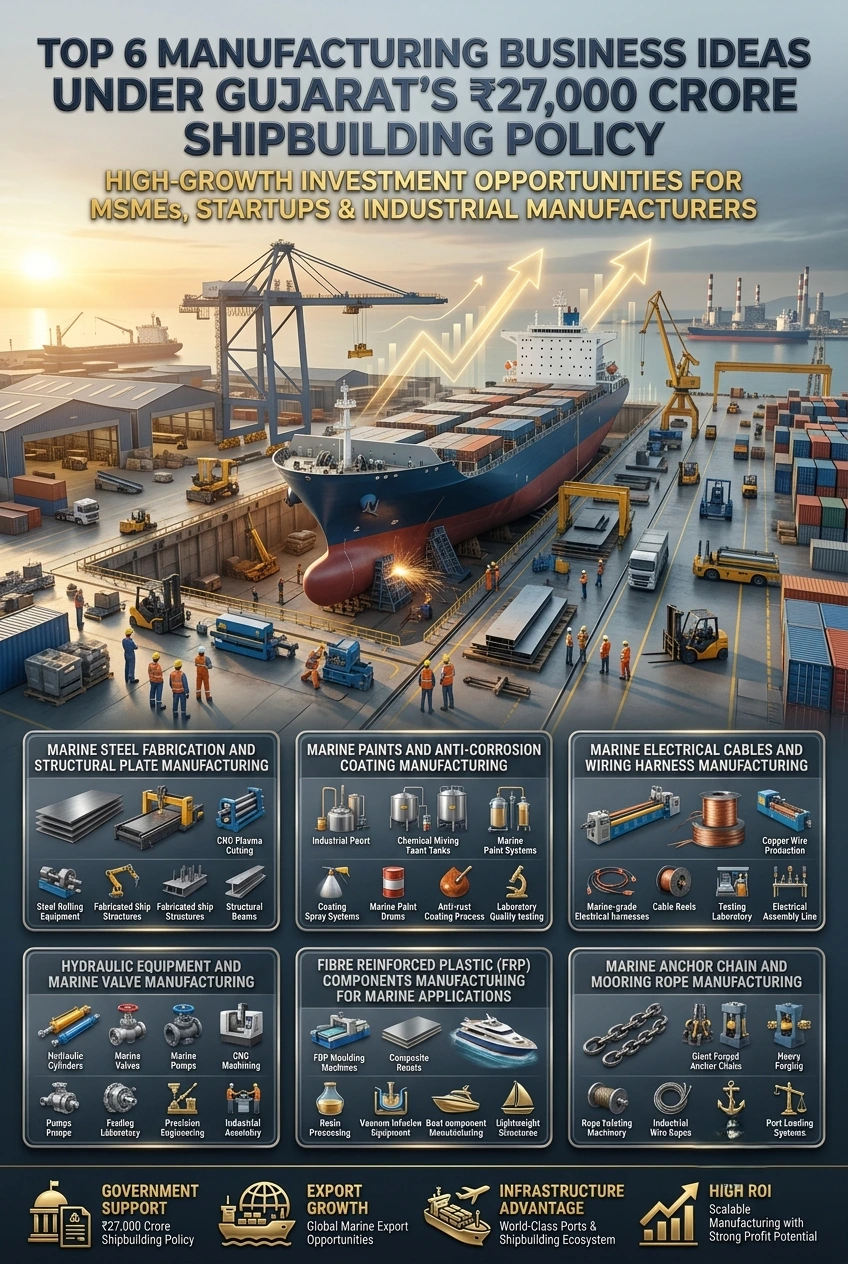
3. Marine Electrical Cables and Wiring Harness Manufacturing
Every vessel has kilometres of specialist marine electrical cables: fireproof, halogen-free, waterproof and internationally tested cables. This is a product with a high specification which Indian cable manufacturers are able to manufacture but have been under serviced. The Porbandar cluster has demand from 2–3 large shipyards for wiring harnesses. A marine cable manufacturing unit in Gujarat can secure a regular order flow within two years of starting operations.
Estimated Investment Range: ₹3 crore to ₹10 crore
Certifications: IEC 60092 series; Lloyd’s Register type approval
Growth Potential: Scale-up: Expansion with a potential revenue of up to ₹30 crore/annum.
Shipyards: Defence shipyards, Porbandar shipyard complex
Related Article: How to Start an Electrical Manufacturing Business in India – Profitable Ideas & Complete Guide
4. Hydraulic Equipment and Marine Valve Manufacturing
The hydraulic systems employed on ships are very large for steering gear, hatch covers, cranes, anchor winches, and mooring gear. Marine valves such as gate valves, ball valves and butterfly valves are essential parts required in thousands of units of each vessel. Most Indian shipyards currently import these products from Europe, Korea, and China. A precision marine valve and hydraulic cylinder manufacturing unit in Gujarat is IBR and BIS certified, which can replace the import of valves and cylinders and provide shorter delivery time and lower price.(Gujarat Shipbuilding Policy)
Estimated Investment Range: ₹5 crore to ₹15 crore
Material: aluminum, alloy, brass, copper, plastic, stainless steel, brass, and various other metals.
Target Certification: IBR approval / DNV/ABS type approval
The key differentiator is the ability to be made in India with International Certifications.
5. Fibre Reinforced Plastic (FRP) Components Manufacturing for Marine Applications
Modern ships extensively use FRP and composites for lifeboats, hatches, deck fittings, interior panels, and small vessel hulls. FRP components are lightweight and corrosion-resistant. Industries increasingly use them for non-structural applications instead of steel. The manufacturing area is not as difficult to enter as the heavy steel fabrication area and can be open to companies that have a medium investment. Access to ready raw material is available in Gujarat existing chemicals and polymers industry.
Estimated Investment Range: ₹75 lakh to ₹3 crore
Material: 8000 Series epoxy resine
Use: Weather seating, interior lockers etc.
Export potential: medium high, coastal countries in Indian Ocean region.
6. Marine Anchor Chain and Mooring Rope Manufacturing
All ships must have anchor chains, mooring ropes and safety lifting gear that must adhere to specific weight-bearing certifications. To manufacture anchor chain, it’s necessary to have a heavy steel wire drawing and forging capability. The production of synthetic mooring rope (HMPE or polyester) is more of an entry point, and is currently mostly imported from Europe. As the Indian government expands its shipping fleet, the domestic production of certified marine ropes and chains should grow and be strong.
Estimated Investment: ₹2 crore to ₹8 crore (rope); ₹10 crore+ (chain)
Coatings: BIS IS 3116, Lloyd’s Register, Bureau Veritas
Target Market: Commercial shipping, Indian Navy, port authorities
The synthetic ropes are a product of the future and are the distinguishing feature of the green ships.
Import–Export Opportunity Analysis
India’s Marine Components Import Dependency – The Gap to Fill
India still relies on substantial amounts of marine components like navigation systems, propellers, safety equipment, and deck machinery for its marine imports. This import dependency is equivalent to a direct manufacturing opportunity. The more the import dollars come in the mallards, the more each category is eligible for domestic substitution. The larger the import dollars come in — from 90 million to possibly $8 billion over the next ten years — the more each of the import categories becomes eligible for domestic substitution.
Export Opportunities for Indian Marine Manufacturers
DGFT can be used by the Marine equipment manufacturers of India to get into the export market supported by the export promotion council. Key markets include:
- This is a high demand area for fishing vessels and coastal cargo ships in Southeast Asia (Vietnam, Myanmar, Bangladesh).
- This Middle East tanker maintenance and offshore support vessel market offer includes tanker maintenance and offshore support vessel market in the Middle East.
- Coastal ferry and inland waterway market in Africa, 2017–2021.Coastal ferry and inland waterway vessel market in Africa, 2017–2021.
- South America — fishing trawler part market
One can certify a marine equipment manufacturer’s product for both domestic supply and export at the same time. Engineering Export Promotion Council (EEPC India) offers market intelligence and linkages with buyers for engineering product exporters.
Green Shipbuilding: The Export Premium Market
The shipping sector is facing a heavy push towards decarbonization, worldwide. Green ships, including those powered by LNG, methanol, ammonia, or hybrid-electric propulsion, require components that differ from those in traditional marine equipment and systems. Indian manufacturers that look for green marine technology will now have export demand in Europe and Asia as the IMO 2030 regulations drive the replacement of marine fleets.
Indian MSME Success Stories in Maritime Manufacturing
Kirloskar Brothers — Pumping Success in Marine Markets
Firstly, Kirloskar Brothers, based in Pune, made a successful transition of their marine pump manufacturing from the domestic supply to international classification society certification. The current company provides bilge pumps, ballast pumps and firefighting pumps to various shipyards in India and also export to the markets of Southeast Asia. Over the past 10 years, they transformed an industrial pump into a certified marine pump, creating a model that Indian engineering MSMEs can follow.
Premier Explosives Ltd — From Niche to Naval Supply
The fireworks company, Premier Explosives, of Hyderabad grew from commercial fireworks to special pyrotechnics for ships such as distress signals, emergency flares and rocket parachute signal. The company became IMO SOLAS compliant and were able to provide the Indian Navy as well as commercial shipping companies. This is a good example of how MSMEs involved in precision manufacturing can break into the marine chain of supply in niche, high-margin products.
Finolex Cables — Marine Grade Ambition
Finolex, which is mainly into manufacturing industrial cables, has been gradually building up its marine-grade wiring capabilities, and continues to provide shipyards in Cochin, Goa and Kolkata. The company started investing in international certification, which took five years before it gained big shipyard contracts. In Gujarat, this path is clear for cable manufacturers.
Choose the right startup backed by real market demand
About NPCS — Niir Project Consultancy Services
Building a marine manufacturing facility involves more than just enthusiasm for the market. It requires careful feasibility analysis, plant layout planning, machine specification, process engineering, financial modelling, and regulatory compliance mapping. That’s where NPCS (Niir Project Consultancy Services) comes in handy to MSME founders.
NPCS has been helping thousands of manufacturing entrepreneurs in all industrial sectors, such as chemicals, food processing, engineering, specialty coatings, and others, prepare bankable project reports, provide technology transfer advice and help with sourcing of machinery. Founders who wish to venture in the marine manufacturing field as part of the new policy in Gujarat can avail of the project reports from NPCS with detailed information on:
- The design of the plant and layout.
- The need to source raw materials and to plan procurement.
- Identify the machinery needs for carrying out the work and estimate the machinery cost.
- Predictive financial statements and break-even analysis
- A regulatory and certification roadmap
- Market demand and competitive landscape analysis
While Economic Times tracks India’s maritime manufacturing growth, entrepreneurs who act on professionally prepared feasibility reports can gain a first-mover advantage. Banks and financial institutions in India accept NPCS project reports for project financing.
Data Snapshot: Gujarat Shipbuilding Policy 2026 at a Glance
| Parameter | Details |
| Policy Name | Gujarat Shipbuilding and Repair Policy 2026 |
| Launch Date | July 27, 2026 — Gandhinagar |
| Total Investment Target | ₹27,000+ crore |
| Private Investment | ₹23,700 crore (shipyards) |
| Common Infrastructure | ₹3,300 crore |
| Key Cluster Location | Kuchhadi, Porbandar District |
| Shipbuilding Parks | 2 Integrated Mega Shipbuilding Parks (IMSPs) |
| Capacity Target | 50 lakh+ Deadweight Tonnage (DWT) |
| Skill Training Target | 5 lakh+ people |
| Central Scheme Alignment | SBFAS 2025, Maritime Vision 2047, Aatmanirbhar Bharat |
| MSME Benefits | Procurement subsidies, capital assistance, interest subvention |
| Sector Growth Rate | 60% CAGR projected (2022–2033, Finextra Research) |
| India Market Target | Top 5 globally by 2047 |

Frequently Asked Questions (FAQs) for Founders
Q1. I am an MSME owner. If you don’t build ships, what is the benefit of Gujarat’s Shipbuilding Policy?
The policy supports ancillary manufacturers that produce components, coatings, cables, hydraulics, ropes, and fabricated structures for shipyards. The policy clearly outlines MSME procurement incentives. Shipyards with more than 50 employees support MSMEs by offering subsidies. Don’t make ships, provide ship parts.
Q2. What is the least amount of money to start marine manufacturing?
The number of entry points differs greatly among products. The price of manufacturing FRP components is as low as ₹75 lakh to ₹1.5 crore. The cost of marine rope can begin from ₹2 crore. The capital required for steel fabrication units is usually between ₹3 crore to ₹8 crore. The manufacturing of marine paint can be started with an initial investment of ₹1.5 crore. This will vary with the scale, product type and certification requirements.
Q3. So, what certifications does a marine component manufacturer require?
The requirements for certification vary according to the product. International classification societies, such as Bureau Veritas (BV), DNV GL, Lloyd’s Register, and the American Bureau of Shipping (ABS), must approve most structural and safety-critical parts. Indian Register of Shipping (IRS) certification applies in the case of domestic naval supplies. Electrical components are manufactured to IEC 60092. Marine coatings must be BIS and IMO PSPC approved. A professional feasibility consultant can draw out the exact track of certification that is required for your product.
Q4. Does this policy offer any advantage for such a manufacturing start-up in Gujarat?
Capital assistance, stamp duty and subsidy on electricity are fiscal incentives which are applicable in the units established in Gujarat. But the opportunity to manufacturers in the entire country of India is a supply chain. No matter where in the state they are located, shipyards buy from the best supplier there is. With the establishment of new shipyards in Gujarat, any manufacturer of certified marine parts at competitive rates in any part of India becomes one of their potential buyers. But leaving for Gujarat brings the policy benefits and the close proximity!
Q5. What are my options for government loans to build a marine manufacturing unit?
Several options exist. Credit-linked capital subsidy schemes are part of the MSME ministry schemes which are available on the website of MSME ministry (msme.gov.in). The growth capital products of SIDBI can be availed at sidbi in. Shipbuilding Financial Assistance Scheme 2025 (SBFAS) is a direct financial assistant. Businesses can access Gujarat-specific incentives, including capital assistance, interest subvention, and stamp duty reimbursement, through the Gujarat Investor Facilitation Portal. The portal brings all approvals under one roof.
Q6. How long does it take to begin earning from a marine manufacturing company?
This will depend on the complexity of the products and the certification needs. The certification process is relatively quicker and the frp & rope manufacturing units can be able to start their business with the first sales in 12-18 months. The time for precision valve manufacture or classified cable production can be as long as 24 to 36 months from investment to regular revenue, much of which is due to the time required to secure international classification society approvals. Early revenues can be generated by providing to non-classified domestic uses until complete maritime certification is attained.
Conclusion: The Window Is Open — Act Before It Closes
Economic Times’s reporting on Gujarat’s ₹27,000 crore Shipbuilding Policy 2026 is not just another policy announcement. It is the opening signal of a structural shift in Indian manufacturing — one that will play out over the next 20 years and generate hundreds of thousands of manufacturing jobs, thousands of supplier businesses, and a genuinely new industrial identity for coastal India.
The timing is ideal. The policy is freshly launched. The Porbandar cluster is in DPR stage — meaning the shipyards are not yet built, and the supply chain has not yet been locked in. Manufacturers who enter the marine component space today will have two to four years to build certifications, establish supplier relationships, and position themselves as preferred vendors before the big demand wave arrives.
South Korea and Japan built their shipbuilding supremacy over 30 years by developing deep ancillary ecosystems. India is attempting to compress that journey through policy acceleration. Every MSME that enters marine manufacturing in 2026 and 2027 becomes a foundational piece of that ecosystem.(Gujarat Shipbuilding Policy)
The question is not whether India’s shipbuilding sector will grow. Economic Times, industry analysts, and the government’s own investment commitments have settled that question. The key question is whether your manufacturing business can supply the demand when orders start flowing.