


The National Green Hydrogen Mission aims to achieve a production capacity of 5 million tonnes of hydrogen per year by 2030. As of early 2026, India’s actual commissioned capacity remains far below this target. India must increase its commissioned capacity by more than 600 times within the next four years to meet its goal.
This gap is not a red flag for the sector. Instead, it highlights the enormous amount of work still required in construction, manufacturing, and project development. It also points to significant business opportunities supported by nearly ₹20,000 crore in committed government incentives.
What Is Green Hydrogen?
Green hydrogen is produced by electrolyzing water (H₂O) with renewable energy from solar or wind sources. This differs from grey hydrogen, which the industry currently produces using natural gas, and blue hydrogen, which uses natural gas along with carbon capture technology. The main production technologies are:
- Alkaline electrolysis – the older, more cost-effective technology that is the dominant technology in India, and is currently used in alkaline solution as an electrolyte
- PEM (Proton Exchange Membrane) electrolysis – has faster response times and higher purity output, more appropriate to variable renewable power input but requires specialised catalysts (usually iridium or platinum) which are highly import reliant
- Solid Oxide Electrolysis (SOEC) – an emerging, higher-efficiency technology still at an earlier commercialisation stage
Beyond raw hydrogen production, India offers major manufacturing opportunities across the green hydrogen value chain. Green ammonia production combines hydrogen and nitrogen to create a product that is easier to transport and store. Manufacturers can also produce hydrogen stacks, membranes, catalysts, and Balance-of-Plant (BOP) components for electrolysers. These segments create parallel manufacturing opportunities in India and hold significant potential alongside hydrogen production itself.
View Full Project Details: Renewable Energy & Green Power Business Opportunities
India’s Green Hydrogen Market Size and Targets
The Government launched the National Green Hydrogen Mission (NGHM) in January 2023 and allocated ₹19,744 crore to the mission through 2029–30. The mission aims to:
- Production capacity of green hydrogen of 5 million metric tonnes (MMT) per year by 2030
- 125 GW of related renewable energy generation capacity committed to this generation.
- Equipment and systems manufacturing capacity of 15-100 GW installed in the country (figures vary by source and mission phase)
- Investment of over ₹8 lakh crore (~USD 100 billion) puts India in the position of claiming about a 10% share of the global green hydrogen market.
- Import of fossil fuels have been cut by more than ₹1 lakh crore; this is directly relevant as India imports 85% of its petroleum and 50% of its natural gas
- More than 600,000 new jobs created across the value chain
On figures: The figures are given at various stages because the sector is still in its infancy, “capacity” being reported at three stages: awarded/contracted, under construction and actually commissioned, and these can vary significantly, as detailed below. NPCS can provide you with an investor-grade numbers-based techno-economic feasibility study, scoped to your position within the value-chain (production, electrolyzer production or green ammonia/derivatives).
The Execution Gap: Awarded vs. Commissioned Capacity
In this sector it is the one and only number to know. By May 2025, the government had allocated 862,000 tonnes per annum of green hydrogen production capacity to 19 companies and awarded 3,000 MW of annual electrolyzer manufacturing capacity to 15 companies, supported by ₹4,440 crore in dedicated manufacturing incentives. They are genuine and substantive pledges of key Indian businesses.
Awarded capacity refers to contracted capacity, not operational capacity, and only commissioned projects count toward the 2030 target. India had commissioned only about 8,000 tonnes per annum of green hydrogen production capacity as of February 2026. Meanwhile, authorities had awarded contracts for a total of 862,000 tonnes per annum, against the final target of 5 million tonnes.
In other words, India has achieved less than 1% of its 2030 goal. However, the awarded project pipeline could theoretically cover about 17% of the target.
This is not a story of failure of a policy, it is a story of an industry that is still in the infrastructure building phase – and the “contracted” versus “commissioned” paradigm is just the sort of construction, engineering, procurement and project execution work for which entrepreneurs, EPC contractors and component manufacturers have to step up.
Policy Tailwinds
- SIGHT (Strategic Interventions for Green Hydrogen Transition) scheme: The financial spine of the mission, with a total outlay of ₹17,490 crore — ₹4,440 crore (Component I) specifically for domestic electrolyzer manufacturing incentives, and ₹13,050 crore (Component II) for green hydrogen production incentives, both administered by the Solar Energy Corporation of India (SECI).
- An increase in budget allocation: NGHM’s budget outlay has increased from ₹100 crore (FY2023-24) to ₹300 crore in FY2024-25 and FY2025-26, which reflects better utilisation of funds.
- Viability Gap Funding (VGF) and production linked incentives: Substantially mitigate the centre affordability challenge – cost gap between green hydrogen (₹397 to 560/kg) and grey hydrogen (₹150 to 200/kg).
- Mandated green hydrogen consumption targets: Definition of green hydrogen standards requiring a specific percentage of green hydrogen use in refining, fertilizers, and city gas sectors creates guaranteed baseline demand independent of pure cost competitiveness.
- Pilot projects in steel, mobility, shipping, and ports: The technical and commercial track record in difficult-to-abate sectors is being established through demonstration projects supported by the government, which can then be scaled up for industrial use.
Explore This Book: Solar PV Power and Solar Products Handbook

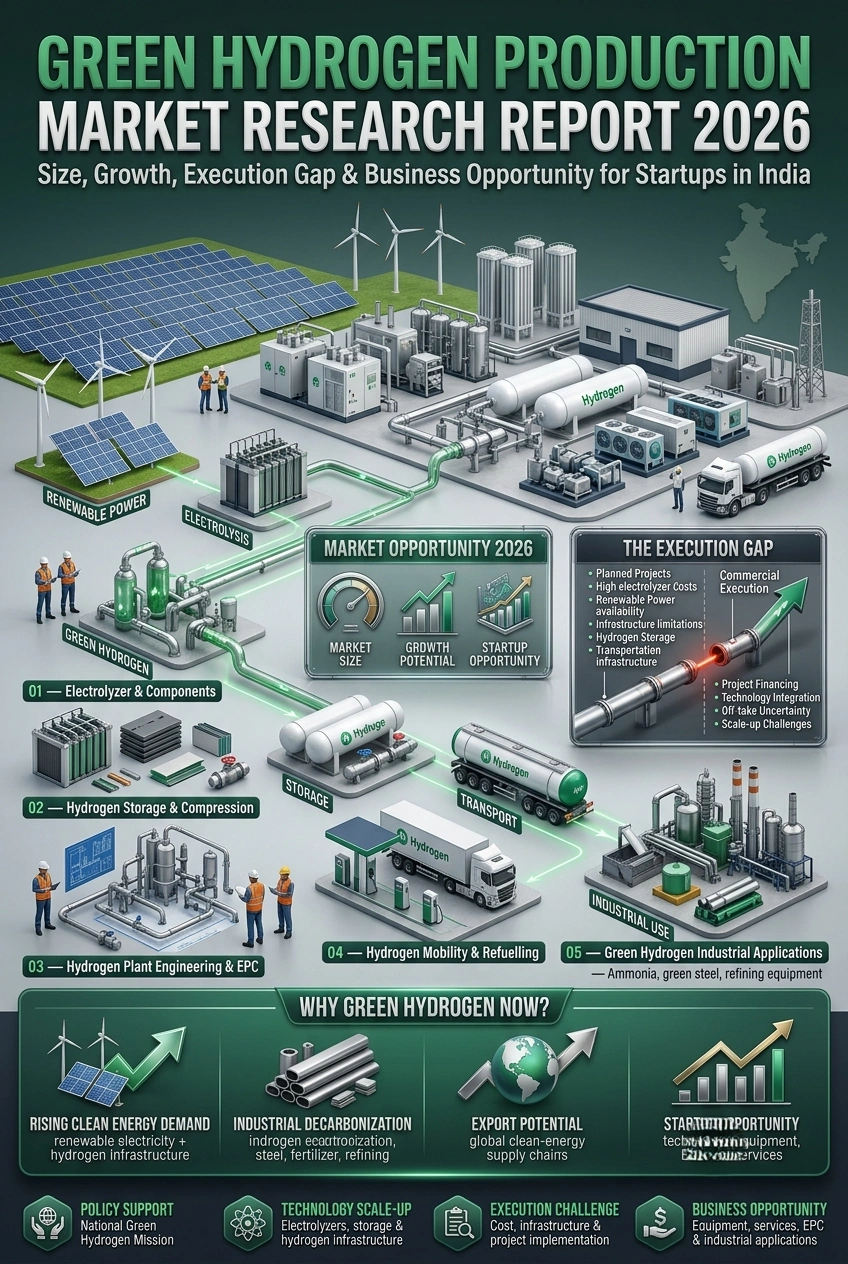
India Demand-Supply/Execution Gap: Green Hydrogen
| Parameter | Current Position |
| 2030 target | 5 million metric tonnes (MMT) annual production capacity |
| Capacity awarded (May 2025) | 862,000 tonnes per annum, across 19 companies |
| Capacity actually commissioned (February 2026) | ~8,000 tonnes per annum |
| Gap between commissioned and target | Commissioned capacity would need to scale by 600+ times in four years to reach the 5 MMT target |
| Electrolyzer manufacturing capacity awarded | 3,000 MW annual capacity across 15 firms, targeting 15 GW installed electrolyzer capacity by 2030 |
| Current green hydrogen cost | ₹397-560/kg, expected to fall to ₹260-310/kg as the scheme scales |
| Grey hydrogen cost (comparison) | ₹150-200/kg — the cost gap green hydrogen must close to achieve unsubsidised competitiveness |
| Import dependency within the value chain | India remains heavily dependent on imported electrolyzer stack components — specialised membranes and catalysts, including iridium and platinum |
| Nature of the gap | A massive execution and construction gap — the target, funding, and even much of the contracted capacity exist on paper; what’s missing is built, commissioned, operating infrastructure, which represents the core opportunity for EPC contractors, component manufacturers, and project developers |
Reading the gap: Green hydrogen in India isn’t short on policy ambition, funding commitment, or even corporate interest — it’s short on physically completed projects. That 600x gap between commissioned and targeted capacity, alongside 100x-plus gap between commissioned and merely awarded capacity, reflects genuine execution bottlenecks: land acquisition, water availability, renewable power integration, grid connectivity, and electrolyzer supply chain constraints (particularly for imported PEM stack components). Every one of those bottlenecks is a discrete business opportunity — from EPC and project development services through domestic manufacturing of currently import-dependent electrolyzer components.
Major Indian Green Hydrogen Producers and Electrolyzer Manufacturers
| Company | Base/Region | Notes |
| Reliance Industries Ltd. (Reliance New Energy) | Jamnagar, Gujarat | Invested over ₹75,000 crore in its new energy business, including a green hydrogen ecosystem at Jamnagar targeting 1 million tonnes per year production capacity; partnered with Nel ASA (Norway) for electrolyzer technology |
| Adani Green Energy Ltd. | Kutch, Gujarat | Building what is described as the world’s largest green hydrogen plant, with plans for 1 GW of electrolyzer capacity |
| NTPC Limited | Leh, Ladakh (and other locations) | India’s largest power generation utility; established an advanced green hydrogen ecosystem in Leh including a 1.7 MW solar plant, battery storage, and an alkaline electrolyzer producing 80 kg of high-purity hydrogen daily, powering India’s first hydrogen fuel-cell bus refuelling station |
| Larsen & Toubro (L&T) / L&T Electrolyzers | Multiple locations including Kandla, Gujarat and Panipat, Haryana | Announced India’s largest green hydrogen plant at IOCL’s Panipat refinery (10,000 tonnes/year for 25 years); developing a Gujarat green hydrogen hub (7 MTPA green ammonia, 1.4 MTPA green hydrogen) with Reliance at Deendayal Port Authority; first electrolyzer factory commenced with 150-200 MW initial capacity |
| Indian Oil Corporation Limited (IOCL) | Panipat, Haryana; Mathura, Uttar Pradesh | Setting up green hydrogen production at its refineries, blending hydrogen with natural gas for cleaner refining operations |
| Bharat Heavy Electricals Limited (BHEL) | Multiple locations | Major public sector engineering company committed to electrolyzer manufacturing capacity under the National Green Hydrogen Mission |
| Matrix Gas & Renewables / Gensol Engineering (JV) | Sanand, Gujarat | Secured 63 MW electrolyzer manufacturing contract under the PLI scheme; announced ₹500 crore investment for 350 MW electrolyzer manufacturing capacity, funded partly by ₹400 crore PLI incentive |
| Hild Electric Private Limited | India | Indian electrical engineering and contracting company; awarded a contract by NTPC to manufacture and deploy 600 MW of alkaline electrolyzers |
| Juno Joule Green Energy | Andhra Pradesh | Signed MoU with Germany’s Select Energy GmbH for a $1.3 billion export-oriented green hydrogen and ammonia facility, targeting ~180 KTPA green hydrogen (up to 1 million tonnes green ammonia annually) by 2029 |
Major International Electrolyzer and Green Hydrogen Technology Players (India-Active)
| Company | Country | Notes |
| Nel ASA | Norway | Major global electrolyzer manufacturer; partnered with Reliance Industries, granting RIL exclusive rights within India |
| Stiesdal A/S | Denmark | Developing and manufacturing HydroGen electrolyzers in India in partnership with domestic firm RNESL |
| John Cockerill | Belgium | Developing 2 GW/year electrolyzer manufacturing capacity in Kakinada, India, in partnership with AM Green |
| Peric Hydrogen Technology | China | Delivered electrolyzers to Indian steel companies; among China’s leading electrolyzer exporters actively targeting the Indian market |
| Longi | China | Major renewable energy equipment company; signed its first electrolyzer export order with an Indian client |
| Sungrow | China | Major Chinese electrolyzer manufacturer among the top producers actively eyeing India as an export market |
Market Segmentation
Production Technology
- Alkaline electrolysis — currently dominant, more mature and cost-effective
- PEM (Proton Exchange Membrane) electrolysis — faster response, higher purity, but import-dependent on catalysts
- Solid Oxide Electrolysis (SOEC) — emerging, higher-efficiency technology
Value Chain Position
- Green hydrogen production (electrolysis facilities)
- Electrolyzer manufacturing (stacks, membranes, balance-of-plant)
- Green ammonia and derivative production (primary export format)
- Renewable energy supply infrastructure (solar/wind dedicated to hydrogen production)
End-Use Sector
- Refining (blending with natural gas for cleaner operations) — early adopter sector
- Fertilizers (green ammonia feedstock)
- Steel (direct reduced iron/DRI transition) — major decarbonisation target sector
- City gas distribution
- Mobility (fuel cell buses, heavy-duty transport pilots)
- Shipping and ports
- Export (primarily as green ammonia)
Project Type
- Large-scale, centralised industrial complexes (Reliance Jamnagar, Adani Kutch)
- Government/PSU pilot and demonstration projects (NTPC Leh, IOCL refineries)
- Export-oriented coastal hubs (Gujarat, Andhra Pradesh port-linked facilities)
Related Article: Green Hydrogen Production in India: The Next Trillion-Rupee Opportunity for Entrepreneurs
Key Growth Drivers
- Large-scale explicit government financial commitment. The policy commitment on this sector is significant and not just on a one-off basis, with ₹17,490 crore specifically earmarked for the SIGHT incentive programme, in addition to ₹19,744 crore allocated to the mission fund.
- Large-scale corporate capital to be put to work already. The $75,000 crore+ new energy investment by the private sector company, Reliance, the world’s-largest-plant plans by Adani, and active projects by NTPC, L&T and IOCL are not just policy commitments but a massive $75,000 crore+ of private sector capital investment.
- India’s structural fossil fuel import dependency. With 85% of petroleum and 50% of natural gas imported, green hydrogen’s potential to reduce over ₹1 lakh crore in fossil fuel imports provides a powerful, non-climate-related economic rationale independent of environmental considerations alone.
- Falling green hydrogen production costs. Competitive bidding has already reduced green hydrogen prices to the ₹397-560/kg range, with further declines to ₹260-310/kg expected as the scheme scales — narrowing the gap to grey hydrogen’s ₹150-200/kg baseline.
- Global export demand potential. As global net-zero commitments intensify demand for green hydrogen derivatives in markets without India’s renewable energy cost advantage, India’s abundant land and renewable resources position it for a significant export role, particularly via green ammonia.
- China’s electrolyzer manufacturers actively targeting India. The presence of major Chinese electrolyzer exporters (Peric, Longi, Sungrow) confirms international recognition of India’s demand potential — while also underscoring the domestic manufacturing opportunity to reduce dependency on these imports.
Challenges and Restraints
- The commissioned-vs-awarded execution gap. As detailed above, this remains the central challenge — turning contracted capacity into operating infrastructure requires solving land, water, grid connectivity, and financing bottlenecks at scale.
- High capital intensity and reliance on imported technologies. The manufacture of electrolyzers involves special materials and high precision engineering and India is highly dependent on imports of components for electrolyzer stacks such as PEM catalyst, which contains iridium or platinum.
- Green premium and cost competitiveness. Green hydrogen is still considerably more expensive than grey hydrogen – unless it is clearly supported by the SIGHT scheme, the industrial user will not switch on its own at the current price difference.
- Land, water, and infrastructure constraints. Independent research (including Belfer Center analysis) highlights land availability, water scarcity, and infrastructure gaps as genuine limiting factors on India’s ability to scale production at the pace required.
- Difference between delivered cost and production cost. The new policy thinking urges India to consider delivered cost (which also incorporates storage, transportation, and distribution infrastructure) instead of production cost and to market the modular electrolyser project for SMEs in addition to the centralised, large-scale projects.
- Funding and bankability of smaller projects. The existing mission design focuses mainly on large-scale producers and thus, there is a need for a support for smaller scale, decentralised, or SME oriented green hydrogen applications.
Competitive Landscape
The Indian green hydrogen industry is fragmented and dominated by a handful of conglomerate firms, most of them well-capitalised, who are working on the centralized, large-scale projects, to which they have direct access through SIGHT scheme. There are also large local players in the field of manufacturing electrolyzer systems (like L&T, BHEL, Hild Electric, Matrix Gas/Gensol), and foreign technology providers and Chinese exporters actively looking at India due to the lack of capacity locally. This configuration leaves relatively easy entry points in to the market relatively available to smaller players that do not compete directly with the large SIGHT backed production capacity, but for the EPC, component supply and modular/ SME segments not fully addressed by the mission (large scale) structure.
Green Hydrogen: Business Opportunity for Startups and MSMEs
- EPC and project execution services for the awarded-but-uncommissioned pipeline. With 862,000 tonnes of awarded capacity against only 8,000 tonnes commissioned, there is substantial near-term demand for engineering, procurement, and construction services to help awarded projects actually reach commissioning — a service opportunity distinct from producing hydrogen itself.
- Manufacture of electrolyzer components (balance-of-plant, membranes and catalysts). With PLI/SIGHT incentive support, there is a documented shortage of supply of specialised electrolyzer stack components with domestic manufacturing of membranes, catalyst coatings, or BOP components.
- Modular / decentralised electrolyzer systems for SME and industrial cluster applications. The market for smaller scale, decentralised hydrogen use is increasingly identified in policy analysis as a gap in market support; modularized electrolyzer systems that cater to SME industrial clusters (as opposed to mega-projects) fill this unmet need.
- Hydrogen project renewable energy infrastructure supply.
Solar/wind EPC and component suppliers can capture a significant adjacent opportunity in green hydrogen production projects, as the mission aims to achieve 125 GW of renewable energy capacity.
- Storage and transport of green hydrogen. Policy analysis focuses on “delivered cost” rather than production cost; and the businesses interested in storage, compression, and hydrogen transportation are not as developed as those interested in production, creating a true infrastructure gap.
Green hydrogen production requires significant capital investment. The sector is also still in the early stages of execution. Therefore, direct large-scale green hydrogen production is generally better suited to well-capitalized corporates than typical MSMEs.
However, MSMEs can participate in more accessible segments of the value chain. These include EPC services, component manufacturing, and modular or decentralized green hydrogen projects.
NPCS offers in-depth, bankable Project Reports with technology-specific machinery lists. It also provides guidance on the SIGHT/PLI scheme based on your realistic position in the green hydrogen value chain.
Find the most profitable startup for your investment range
How NPCS Supports Entrepreneurs Entering This Space
The initial step for any entrepreneur or business looking at a green hydrogen-related project is to write a well-defined Detailed Project Report (DPR) that covers value-chain positioning, plant/facility capacity, sourcing technology and equipment, integration strategy with renewable power, manpower planning, project cost, and financial viability for the selected segment and targeted market.
About NPCS (Niir Project Consultancy Services)
Founded in 1994, NPCS is a techno-economic and project consultancy company based in New Delhi and is an ISO 9001:2015 certified organization having more than 30 years’ experience in the field of techno-economic and project consultancy. NPCS has produced over 150,000 project reports and profiles in 85 countries in over 30 years, for virtually every manufacturing and process industry, renewable energy, electrolysis technology, clean fuel infrastructure and more.
A key set of services that NPCS can provide to a green hydrogen project are:
- Project Reports (DPRs) complete with plant capacity, machinery specification, layout etc.
- Techno-economic feasibility studies including guidance for SIGHT/PLI scheme eligibility
- Financial modelling — project cost, Profitability analysis, ROI, Break even analysis
- Assessment of raw material availability and market demand for renewable energy and industrial demand corridors in India.
- Information for scheme applications and funding and regulatory approval processes
Government and Institutional Reference Links
The Royal Norwegian Embassy in New Delhi, the Royal Danish Embassy in New Delhi, and the Embassy of Belgium in New Delhi each maintain trade and clean-energy cooperation desks that can support technology partnerships and joint ventures with their countries’ electrolyzer manufacturers. Domestically, the CII Green Hydrogen Task Force and FICCI offer industry-body support for navigating SIGHT scheme participation and OEM partnerships.
- Ministry of New and Renewable Energy (MNRE) — National Green Hydrogen Mission
- Solar Energy Corporation of India (SECI) — SIGHT Scheme
- Department for Promotion of Industry and Internal Trade (DPIIT) — PLI Schemes
- Ministry of Micro, Small and Medium Enterprises (MSME)
- Development Commissioner, MSME (DCMSME)
- Bureau of Indian Standards (BIS)
- Press Information Bureau (PIB), Government of India
- Startup India
- Invest India (National Investment Promotion and Facilitation Agency)
Entrepreneurs are advised to verify the latest SIGHT scheme guidelines, PLI incentive rates, and NGHM funding allocations directly on these portals, as these provisions are periodically revised.
Conclusion
Green hydrogen in India presents an unusual opportunity. The challenge is not a lack of demand but a massive execution gap. India has set a target of 5 MMT and committed ₹19,744 crore in funding. It has also awarded 862,000 tonnes of production capacity. However, only 8,000 tonnes has been commissioned so far.
The near-term business opportunity goes beyond competing with large conglomerates for the next mega project. Strong opportunities also exist for EPC companies, component manufacturers, and modular technology providers. These businesses could play a crucial role in turning awarded capacity into operational projects.
On the investment side, green hydrogen offers a unique opportunity for entrepreneurs and established businesses. The sector has strong government and corporate funding commitments. It also presents clear execution challenges and multiple entry points across the value chain. These opportunities extend beyond hydrogen production alone.