


India’s Aviation Infrastructure Supercycle Has Begun
India is a country with an upcoming decade to define its airport infrastructure, and the statistics are astounding! GMR Airports Ltd, a fierce competitor with Adani Airport Holdings, has announced its plans to expand and modernise its airports at New Delhi and Hyderabad with an investment of up to ₹19,400 crore or around $2 billion. The investments will be made over a span of five to seven years, says Navbharat Times report.
The plan has allowed for an allocation of about ₹13,800 crore for Rajiv Gandhi International Airport in Hyderabad, which will become a world class facility with an annual passenger handling capacity of nearly 80 million, against 34 million, and up to ₹5,600 crore for Indira Gandhi International Airport, New Delhi. This investment represents a significant shift in the market and will have a ripple effect throughout the construction, manufacturing, logistics, retail, and technology industries.
The ₹19,400 crore commitment is no corporate boast for Indian entrepreneurs, MSMEs, manufacturers and startups. It’s a procurement pipeline, a market signal and a business opportunity all rolled into one. This article clears the confusion surrounding what this opportunity might entail, and how you can make your business the beneficiary.
What Recent Reporting Means for India’s Business Ecosystem
The decision to expand was confirmed by GMR Airports Executive Director for Finance and Strategy Saurabh Chawla in an in-depth interview with Navbharat Times. The company already has six airports in India, and has airports in the Philippines and one under construction in Greece.
The Delhi-Hyderabad call could go on to be the first of many. GMR is also considering investment plans for the Nagpur Airport that it acquired in June 2026. The expansion brings international credibility and standards of governance to GMR Airports, with France’s Aeroports de Paris SA holding a stake of 26.5%.
There are five important reasons why this development is important:
- India is now the world’s third largest domestic aviation market, behind the USA and China.
- The number of passengers is expected to increase sixfold to 1.1 billion in the next 14 years.
- India will have more than 2,350 commercial aircraft in service by 2040, up from about 400 in 2014.
- The Indian government has been actively looking to privatise airports, thereby ensuring investment momentum.
- The market for airport adjacent businesses including retail, food, maintenance, repair and operation (MRO) is a huge market for the Indian MSMEs.
If India’s aviation infrastructure is growing or not is an irrelevant question for founders and entrepreneurs. It clearly is. The challenge is how to share a piece of the supply chain that will be constructed to support it?
Why India’s Airport Infrastructure Industry Is on a Structural Growth Curve
The Indian aviation boom is not just a cyclical phenomenon; it is a structural shift, as a result of growth in middle-class incomes, the increased demand for domestic tourism and the government’s push for the privatisation of airports. The Airports Authority of India (AAI) has been making an effort to sell the airports to private players with operators such as GMR and Adani making a rapid pace towards scalability.
A key feature of this cycle is that large-scale airport expansions are a multiplier effect for MSMEs. For every rupee that goes into the construction of the terminal, there is a downstream demand for electrical fitting, fire safety systems, access control, baggage handling, food and beverage, ground transportation, and digital infrastructure.
The National Civil Aviation Policy (NCAP) of the Indian government has laid the vision of building 100 new airports by 2025 and making air travel affordable for the masses with the introduction of the UDAN scheme. Even more staggering is the level of ancillary businesses that will be created if the airport at Hyderabad is able to process 80 million passengers per year, which is over twice the current figure of 34 million.
Government Policies & Incentives Supporting Airport-Linked Businesses
Indian entrepreneurs have access to a robust set of government programmes designed to support infrastructure-linked manufacturing and services:
1. UDAN – Ude Desh Ka Aam Naagrik
The UDAN Regional Connectivity Scheme subsidises airlines flying to smaller cities, boosting passenger volumes and creating demand for regional airport services and retail.
2. AAI Privatisation & Tender Programme
The Airports Authority of India (AAI) regularly issues tenders for airport construction, IT upgrades, ground handling, and facility management. MSMEs registered with AAI can directly bid for subcontracts.
3. PLI Scheme for Defence & Aerospace
The Ministry of Civil Aviation and the Department of Defence Production have introduced Production Linked Incentives (PLI) for aerospace components and MRO services, encouraging domestic manufacturing.
4. MSME Credit & Export Support
The MSME Ministry’s Credit Guarantee Scheme provides collateral-free loans up to ₹5 crore for small businesses entering high-growth sectors like aviation services, construction materials, and smart infrastructure.
5. Make in India – Infrastructure Vertical
The Make in India initiative actively promotes domestic manufacturing of airport equipment — from boarding bridges to baggage carousels — replacing imports with local production.
6. National Logistics Policy
The National Logistics Policy links airport cargo infrastructure with inland logistics networks, creating fresh opportunities for warehouse operators, freight forwarders, and last-mile delivery businesses near GMR airports.
7. Telangana & Delhi State Investment Support
The Telangana State Industrial Infrastructure Corporation (TSIIC) and Delhi’s investment promotion body offer land allocation, single-window clearances, and fiscal incentives for businesses setting up near the Hyderabad airport corridor.
8. Startup India & DPIIT Recognition
Airport-tech and aviation-services startups can gain DPIIT recognition via the Startup India Portal, unlocking tax benefits, fast-track IP registration, and government procurement preferences.
9. DGCA – Directorate General of Civil Aviation
All aviation-related businesses must engage with the DGCA for regulatory approvals. Early engagement helps MSMEs understand compliance timelines and align product development with regulatory standards.
Related Article: YEIDA Noida Airport Industrial Corridor: ₹36,000 Crore Business Opportunities for MSMEs & Startups
Manufacturing Business Opportunities Directly Linked to GMR’s ₹19,400 Crore Expansion
As Navbharat Times reported, the GMR expansion will lead to huge procurement process in six manufacturing verticals. Let’s see the most feasible and scalable opportunities for Indian MSMEs and Indian Manufacturers:
1. Modular Airport Furniture & Interior Fit-Out
Millions of passengers move through airports. The number of seating units, kiosks, information desks, retail counter fit-outs and lounge furniture for every terminal expansion add up to thousands. There is very little competition for the Indian manufacturers of modular, fire-resistant and ergonomic airport furniture. The procurement of the interior is estimated to cost hundreds of crores for this project for the Hyderabad airport, which is aiming for 80 million passengers.
Conditions for GMR’s Hyderabad expansion with full fit-out of terminals: The new terminal infrastructure is a green field procurement opportunity for the domestic furniture manufacturers.
2. Airport Signage, Wayfinding & LED Display Systems
Dynamic digital signage is the hallmark of a modern airport, including departure boards, gate information boards, wayfinding totems and advertising screens. The local manufacturers of LED panels, aluminium signage frames and control software can directly supply the GMR’s expansion contractors. There is also a good export demand for this segment from airports of South Asia and South East Asia.
Why it is emerging: Both Delhi and Hyderabad’s airports are in the grip of infrastructure modernisation and need a whole new signage system and passenger information.
3. Aviation MRO Components & Ground Support Equipment
Once again, Maintenance, Repair, and Overhaul (MRO) is one of the fastest-growing sub-sectors in aviation in India. GMR’s growth of its fleet facing infrastructure will lead to a surge in the demand for domestic manufacture of tow tractors, aircraft stairs, baggage belt loaders and ground power units. India presently purchases more than 80% of its ground support equipment (GSE), which is a huge opportunity for import substitution.
Why this comes about: A large airport with 80M passengers will need a bigger ground fleet. The doubling of its capacity in Hyderabad is a direct outcome of the procurement of ground equipment. The Hyderabad capacity doubling directly translates to ground equipment procurement for GMR.

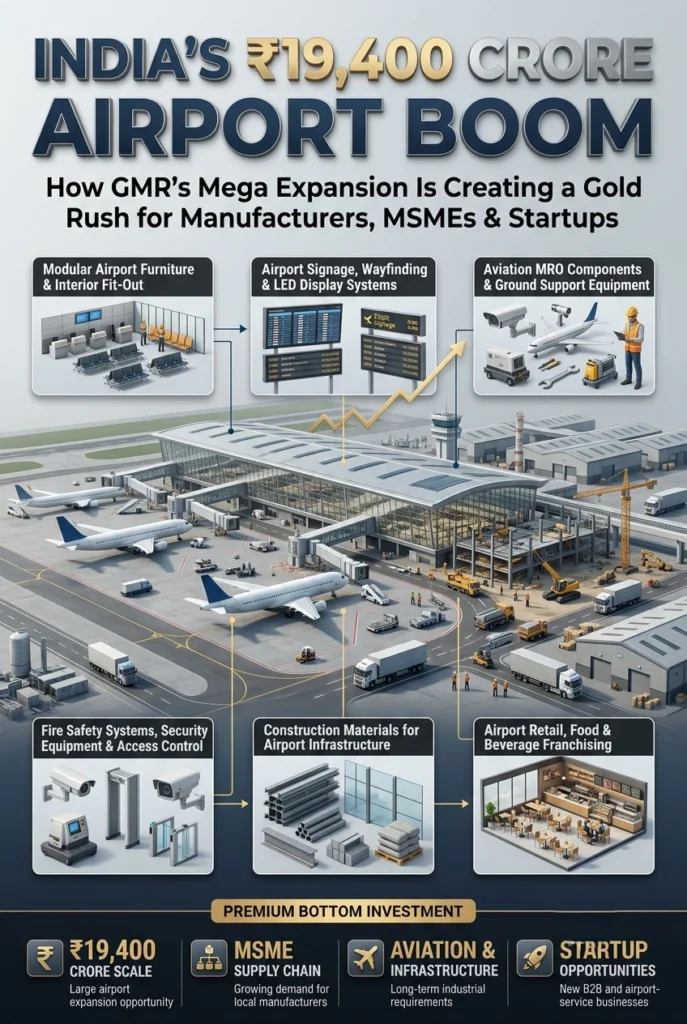
4. Fire Safety Systems, Security Equipment & Access Control
DGCA certified airports are required to have fire suppression and fire alarm systems, CCTV systems, biometric access control and perimeter security systems. Indian manufacturers that are BIS certified and meet the international airport security standards (ICAO) can tap this procurement pipeline directly. The upgrade to the Terminal 3 at the Delhi airport will require next generation security systems as it is already handling 32 million international travellers.
5. Construction Materials for Airport Infrastructure
Aerobridges, car parks, terminal buildings, taxiways, aprons, runways etc. of the budgetary estimate are the important civil construction projects that would come under the purview of this amount of ₹19,400 crore. This translates to a long-term increase in demand for high strength concrete, specialty steel, glass curtain wall systems, waterproofing membranes and runway marking compounds. MSMEs with supply of construction materials certified by ASTM or IS can create recurring revenues opportunities with GMR’s EPCs.
The reasons for this are that the Hyderabad expansion is mainly a civil construction project of Rs 13,800 crore. It cascades to hundreds of MSME suppliers in the materials procurement chain.
Get Detailed Insights from This Book: The Complete Book on Construction Materials
6. Airport Retail, Food & Beverage Franchising
The airport retail segment is a lucrative operation with captive traffic and offers a variety of high-margin businesses such as food courts, convenience stores, duty-free stores and branded shops. GMR’s new terminals at Delhi and Hyderabad will need new retail tenants. The Indian F&B industry, the small and medium sized artisan food producers and the local specialty stores have a real chance to create and install the airport facing franchise and talk to the retail management team of GMR.
The reasons for this: The growth of an airport from 34 million to 80 million passengers almost triples the retail floor space, making Hyderabad Airport one of the most appealing airport retail markets in Asia.
View Full Project Details: Food Processing & Agro-Based Projects
Import–Export Opportunity Analysis
The GMR expansion presents Indian manufacturers with export opportunities and import substitution imperatives.
Export Markets
The aviation supply ecosystem, particularly the MRO parts, information technology and system, and airport management software segment, is highly exportable to markets all across the Southeast Asia, Middle East and Africa (MEA) region. Indian companies that build the competence to operate at GMR’s airports in Delhi and Hyderabad will be able to leverage these as reference projects to secure contracts at airports in Malaysia, UAE, Kenya and Bangladesh.
Import Substitution
India currently imports large volumes of airfield lights systems, precision approach path indicators (PAPIs), airport meteorological equipment and ground support vehicles. All of the following are domestic manufacturing opportunities. Once a company gets BIS and DGCA certification, it can confidently replace imports and establish itself in a niche market with high barriers to entry.
International Demand
Aeroporto de Paris (ADP) of France is the holding company with a 26.5% stake in GMR Airports and actively looks for equipment and services from around the world. Indian manufacturers can benefit from GMR’s network of international airports, including the one being built in Greece, as well as its quality standards, and have a direct export access with a strategic shareholding agreement.
Trade Opportunities
Financing support is available to infrastructure exporters from the India’s ECGC (Export Credit Guarantee Corporation) and EXIM Bank. MSMEs can avail working capital facilities and export credit insurance facilities on airport equipment, construction materials or technology services exported to the overseas airports of GMR, which will mitigate the financial risk involved in exports.
Indian MSME Success Stories in Airport-Linked Sectors
1. Menzies Aviation (India JV) – Ground Handling at Delhi Airport
Delhi airport’s ground handling companies based in India earned GMR’s contracts at various airports. They emerged as multi-airport companies and small start-ups. Many of these companies started as MSMEs. Now, they work at major airports across India. Thousands of employees handle cargo, ramp, and passenger operations.
2. Kitex Garments – Airport Retail & Uniform Supply
Kitex Garments, a small textile MSME in Kerala, now supplies uniforms and retail garments to airports across India. The company’s move into airport supply chains is a good example of how domestic manufacturers can access airport procurement. This can be achieved through strong quality systems without requiring large capital.
3. Innoppl Technologies – Airport Tech Startup
The Hyderabad-based company, known then as Innoppl Technologies, started off as a company creating mobile apps for businesses at the airports. The company created a reference portfolio of passenger apps and airport retail management applications designed for Rajiv Gandhi International Airport, which led to extending towards international airport clients. It was on this GMR-Hyderabad relationship that it got its start.
Discover scalable startups tailored to your goals
About Niir Project Consultancy Services (NPCS) – Your Airport Business Partner
The easy part is already done—you’ve spotted an opportunity. To make it into a business plan that can be funded and that can be implemented, it needs the help of a professional consultant. Niir Project Consultancy Services (NPCS) specialize in that.
Properly designed NPCS (www.niir.org) offers the following services for entrepreneurs/ MSMEs in infrastructure-related sectors:
- Detailed Project Reports (DPRs): Bankable project reports which are acceptable by SIDBI, NABARD and commercial banks.
- Feasibility Studies: Market related feasibility study for manufacturing and service businesses.
- Market Research: New product demand assessment, competitive mapping and product pricing analysis.
- Technologies Advisory Services: Manufacturing process designs, equipment selection and plant layouts.
- Export-Import Advisory: Analysis of trade data, HS code classification, Market entry Strategy.
Entrepreneurs aiming at becoming part of the airport related manufacturing process, ranging from fire safety systems to airport furniture can make a difference with a well-thought-out DPR by NPCS which can make the difference between the bank granting them a loan or the bank turning them down.

Quick Reference: Business Opportunity Data Table
| Parameter | Details |
| Industry | Airport Infrastructure & Aviation Services |
| Market Driver | India aviation traffic expected to grow 6x to 1.1 billion passengers in 14 years |
| Total Investment | ₹19,400 crore ($2 billion) by GMR Airports for Delhi & Hyderabad |
| MSME Opportunity | Construction materials, airport retail, MRO services, IT systems, cargo logistics |
| Export Potential | Airport equipment manufacturing, MRO spare parts, aviation software & tech solutions |
| Government Support | AAI privatisation, UDAN scheme, National Civil Aviation Policy, PLI for aerospace |
| Risk Level | Medium – long gestation period, regulatory compliance required |
| Growth Outlook | Highly positive – fleet to grow from 400 planes to 2,350 by 2040 |
Conclusion: The Runway Is Open — Are You Ready to Take Off?
The expansion of GMR Airports’ Delhi and Hyderabad locations, which Navbharat Times reported in its extensive coverage, is not only an infrastructure project, but a testament to a company’s strategic vision and execution. It is truly a landmark moment for Indian entrepreneurs, manufacturers and MSMEs on the market.
The aviation industry is the fastest growing industry in India. Hyderabad Airport will see passenger numbers almost quadruple. By 2040, there will be more than 1,900 additional aircraft added to the country’s commercial fleet. And private airport operators like GMR are investing billions to keep pace with this demand.
For every rupee invested there requires materials, services, technology and talent. The supply chain that will be developed by GMR’s expanded airports in Delhi and Hyderabad will keep thousands of businesses alive, from big EPC contractors to MSME component manufacturers or single-product startups.
The entrepreneurs who make the cut now — by securing vendor registrations, building the capabilities of the product, getting DPGC / BIS certifications and preparing bankable project reports — will be best equipped to grab this opportunity at the time of issuance of procurement tenders.