


Furfural Manufacturing Business
A Green Chemical Business Hiding in Plain Sight
Indian farmers have to discard millions of tonnes of corn cobs and rice husk as agricultural waste every year. Most of this is being burned in the fields, which is creating pollution and providing no solution. But a number of bright business owners are considering the waste differently. In every tonne of that discarded biomass they can see furfural oil, a high value bio-based industrial chemical.
Furfural production is a rare business opportunity that first-generation founders and MSME investors have been looking for: low cost of raw materials; steady demand for furfural in industries; export potential and financial support from the government. Not an educated guess on some new material. The production of furfural has been commercially carried out for almost 100 years. But its market is expanding at an ever-increasing rate.
The article delves deep into the broader potential of the furfural market, covering feedstock economics, production models, government policies, export corridors, and concrete avenues for startups in India to explore the furfural market.
Why Furfural Deserves Serious Entrepreneurial Attention
A Renewable Chemical in a World Moving Away from Petroleum
Furfural is a bio-based organic aldehyde, which can only be synthesized from agricultural lignocellulosic biomass. The fossil carbon footprint of furfural is zero, in contrast to the fossil carbon footprint of petroleum-based solvents and chemical intermediates. This is so important today. International regulations in the European Union, Japan and more recently in the United States, are favoring the transition to bio-based alternatives in industry.
Furfural is used by foundries, petroleum refiners, pharmaceutical manufacturers, paint and coatings manufacturers, and agrochemical producers. All of these industries are seeking to hedge their supply chains against the risks of fluctuating petro pricing. All these industries are pursuing de-risking of their supply chains against the risk of volatile petroleum pricing. Furfural is poised to be a viable and technically viable alternative.
In addition, the global foundry binders’ market is dominated by the furfuryl alcohol, which is the major derivative of furfural. Automobile, aerospace and heavy engineering industry metal casters around the world cannot operate without furfuryl alcohol as their furan resin. There is a long and expanding value chain at the beginning of which furfural is in the ascendant.
View Full Project Details: Furfural Manufacturing from Agricultural Waste
India’s Agricultural Waste Is a Strategic Feedstock Advantage
India is one of the leading countries in the production of rice and corn. Consequently, the nation produces huge amounts of rice husk and corn cobs, the two most popular raw materials for furfural. In total, these agricultural residues are generated by millions of tonnes annually in Punjab, Uttar Pradesh, Maharashtra, Andhra Pradesh and Odisha. This material is burnt or discarded at a negligible cost, the majority of it.
The entrepreneurs that establish furfural plants near such agricultural clusters have a head start over the furfural producers in Europe or North America because of the cost advantage of the feedstock. India is the raw material cost advantage for furfural vs. other producers, thus directly enhancing gross margin.
The Global and Indian Furfural Market: Numbers That Command Attention
The furfural market isn’t a small-scale endeavor. It is a well-known industrial commodity and is emerging as a commodity of increasing demand. Corncob is the largest feedstock, accounting for the majority of global furfural production and rice husk is still an important feedstock due to its availability in the Asia-Pacific region.
Asia-Pacific is the largest market for furfural in the world and accounts for over 80% of the world furfural trade. China is the leader with large scale manufacture based on corncob. India follows, taking advantage of its huge agricultural production to guarantee steady availability of raw materials.
Import critically, India generates a small quantity of furfural, but also imports a considerable quantity, mainly from China, Germany and the United States, to satisfy industrial demand. This domestic demand shortage is just the opportunity that new MSME manufacturing units can avail.
Key Market Indicators:
| Parameter | Detail |
| Global Furfural Market Size | USD 772 million (current) |
| Projected Market Size (2040) | USD 1.97 billion |
| Market CAGR (Forecast Period) | 6.44% |
| India Annual Production | ~33 kilotons/year |
| China Annual Production | ~310 kilotons/year |
| Corn Cob Market Share (Feedstock) | ~58–70% of global furfural production |
| Rice Husk Market Share (Feedstock) | ~19% of global furfural production |
| Asia-Pacific Market Share | >80% of global production and trade |
| Key End-Use Sectors | Foundries, Petroleum Refineries, Pharma, Agrochem, Paints |
| India’s Import Sources | China, Germany, United States |
| Primary Furfural Derivative | Furfuryl Alcohol (86% application share) |
Sources: Market data synthesised from Grand View Research — Furfural Market, Fortune Business Insights — Furfural Market, and Roots Analysis — Furfural Market.
Government Policies and Incentives Supporting This Business
MSME Support Schemes: A Strong Safety Net for New Founders
A strong support mechanism has been established by the Government of India for the manufacturing entrepreneurs who are entering into the specialty chemicals/bio-based industry. A number of schemes are directly applicable to the manufacturing start-up of furfural.
ASPIRE Scheme (A Scheme for Promotion of Innovation, Rural Industries and Entrepreneurship), under the Ministry of MSME is especially fit for manufacturing businesses using agro-waste. It facilitates the incubation of agricultural residues-based livelihood businesses and technology-based start-ups. This scheme, ASPIRE — Ministry of MSME, provides some funding and mentorship support for entrepreneurs to explore agro-industrial business such as furfural production.
Collateral free working capital loans are offered under the Credit Guarantee Fund Trust for Micro and Small Enterprises (CGTMSE). This scheme will lessen the financing burden considerably for the furfural startups who are getting rice husk and corn cob feedstock.
The Credit Linked Capital Subsidy Scheme (CLCSS) offers a capital subsidy of 15% for technology upgradation in MSME manufacturing sector using institutional finance. Furfural plants with modern continuous distillation can benefit from this support.
The Prime Minister Employment Generation Programme (PMEGP) offers project finance for manufacturing projects for first generation entrepreneurs and will cover a significant part of the project cost in the form of government subsidy, thus easing the path for first generation entrepreneurs to enter the manufacturing business.
In addition to this, the Department of Commerce’s Chemicals and Allied Products division actively promotes exports of specialty chemicals through CHEMEXCIL, an export promotion council set up by the Department which organises B2B exhibitions, market access enquiry programmes and export incentive programmes for chemical manufacturers including bio-based specialty chemicals.
DPIIT and Make in India — Policy Tailwinds
The IBEF Chemicals Industry Report states that the Indian specialty chemicals industry is ready to witness double-digit growth with Government’s thrust on import substitution and domestic manufacturing. Specialty bio-chemicals have been consistently identified as a priority segment by Make in India, by the Department for Promotion of Industry and Internal Trade.
Furfural, being an agro-waste based non-petroleum chemical product is exactly aligned with India’s manufacturing vision of sustainability and Atmanirbhar Bharat. MSME units in this sector will be eligible for capital subsidy at the state level, single window clearance and priority lending from financial institutions such as SIDBI.

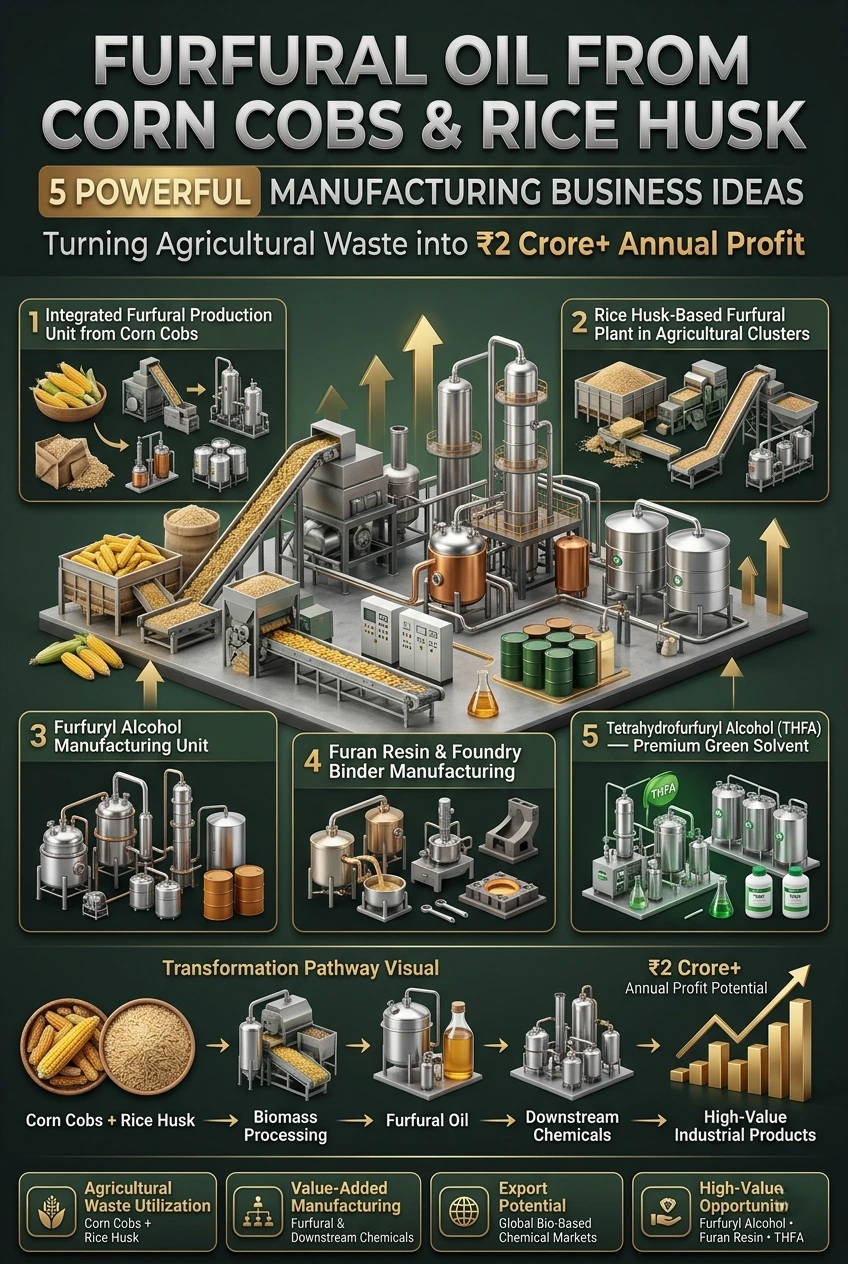
Multiple Business Ideas for Startups: Entry Points in the Furfural Value Chain
The furfural industry is a poly-product industry. It is a value chain that can be tapped by entrepreneurs at various levels depending on their capital, technological skills, and closeness to the market.
Business Idea 1: Integrated Furfural Production Unit from Corn Cobs
A corn cobs integrated furfural production line processes corn cobs directly by acid hydrolysis and steam distillation to get raw furfural. This is the basic manufacturing pattern from this industry.
The hemicellulose fraction of corn cobs are pentosans that can be hydrolized into pentose sugars which then undergo dehydration under dilute sulphuric acid and steam to produce furfural, 25–35% of the corn cobs. An optimum yield is achieved, and waste acid is discharged 96-99% of its original furfural is recovered using multi-stage distillation. The cost of feedstocks is as low as ₹1,500–₹2,500 per tonne for entrepreneurs who set up their plant in the major corn-producing states of Andhra Pradesh, Karnataka, and Bihar. This model has the advantage of backward integration and the maximum value capture. The plant can provide the domestic refineries, foundries chemical manufacturers and direct export customers in Germany, Japan and south-east Asia with furfural.
Business Idea 2: Rice Husk-Based Furfural Plant in Agricultural Clusters
Rice husk is one of the least utilised agricultural residues in India. In total, cities in Punjab, West Bengal, Tamil Nadu, and Andhra Pradesh generate millions of tonnes of rice husk waste each year. Although the pentosan concentration of rice husk is less than that of corn cobs, it is still a viable and commercial furfural feedstock, especially since it is available practically all year round, and the cost of procurement is very low.
MSMEs can design a furfural production plant with a capacity of 500–2,000 tonnes per annum using rice husk as the raw material. This model is useful in Odisha since the state has a policy for MSMEs providing capital subsidy for agro-waste industrial projects. Rice husk plants produce furfural in addition to the silica rich residue, which is a new addition to the market that is increasingly finding its applications in the construction and electronic industry. The same rice husk feedstock can produce both furfural and amorphous silica, significantly improving unit economics for entrepreneurs.
Get Detailed Insights from This Book: Manufacture of Value Added Products from Rice Husk (Hull) and Rice Husk Ash (RHA)
Business Idea 3: Furfuryl Alcohol Manufacturing Unit
The largest use of furfural is in the manufacture of furfuryl alcohol and it represents the largest proportion of furfural consumption worldwide. It serves as the main resin binder precursor in the foundry casting industry, and its demand in India directly depends on the growth of automotive and engineering production.
The furfuryl alcohol unit can operate as a stand-alone business that buys furfural as a raw material and hydrogenates it into furfuryl alcohol. Alternatively, businesses can add the unit as a downstream extension to an existing furfural plant. Furfural converts to furfuryl alcohol with high efficiency using copper chromite or copper-zinc catalysts. The product has direct customers like furan resin manufacturers, foundry operators, adhesive companies and corrosion-resistant coating manufacturers. India presently imports much of its furfuryl alcohol needs and provides export markets for the rest of Southeast Asia and the Middle East.
Related Article: Furfuryl Alcohol Manufacturing Plant Cost in India: Raw Material, Profit & Project Report Guide
Business Idea 4: Furan Resin and Foundry Binder Manufacturing
One step further up in the value chain is a furan resin, or foundry binder, manufacturing company which is one of the most profitable ventures in this sector. Furan resins are formed by the acid-catalyzed polymerisation of furfuryl alcohol (FA). They use these no-bake binders for metal casting moulds to manufacture automotive engine blocks, pump bodies, pipe fittings, and industrial machinery components.
India has one of the largest foundry industries in the world and there is an amalgamation of foundries in Kolhapur, Coimbatore, Rajkot, and Faridabad. These clusters are virtually relied on by the foundries to import furan resins or to rely on a few domestic suppliers. If a local furan resin manufacturer establishes a small plant of furan resin, he can negotiate long-term B2B supply contracts with foundry operators, providing a steady income that most product suppliers can’t offer. Technical barrier is not a problem; the customer acquisition model is not dependent on mass marketing but on relationships.
Business Idea 5: Tetrahydrofurfuryl Alcohol (THFA) as a Premium Green Solvent
An additional derivative of furfuryl alcohol is tetrahydrofurfuryl alcohol (THFA), which is sold at a higher price in specialty applications. THFA application is as a green solvent in agricultural formulations (pesticide/ herbicide carrier), in electronics cleaning, in pharmaceutical synthesis and in specialty coatings. It comes from bio-based sources and supports environmentally friendly applications, such as bio-labelling and low-toxicity products for European and North American markets.
The production of THFA from furfuryl alcohol by catalytic hydrogenation under controlled pressure conditions. In This value chain makes THFA an ideal export-oriented product for Indian entrepreneurs because it commands ₹200–400 per kg, India produces only limited quantities, and pharma and agro-input industries show strong international demand for it. The premium realisation is not possible with commodity chemical products and a THFA manufacturing unit with GMP certification and registered to REACH can directly reach to European buyers of pharmaceutical and agroindustry.
Import–Export Opportunity Analysis
India’s Furfural Trade Gap — A Structural Opportunity
India is in a dilemma in the world furfural market. From one side it’s one of the most important importers of furfural, where purchasers mainly come from China, Germany and the USA. However, India has some of the world’s largest sources of furfural feedstocks such as rice husk, corn cobs and sugarcane bagasse.
This shortfall is directly attributable to the lack of investment in the production of domestic furfural capacity. The biggest reason entrepreneurs should enter this business is that the domestic market already buys these products and imports them from foreign companies.
India’s specialty chemicals industry has an annual market value of more than $220 billion. It is a major and growing consumer of organic chemical intermediates. The industry is growing at an annual rate of 9–12%.
Furfural and its derivatives have several industrial applications. They are used as extraction solvents for lubricants in petroleum refining. They are also used to make furan resins for foundry casting. In addition, furfural serves as an intermediate in pharmaceutical synthesis. Its derivatives are used as carriers in agricultural formulations, including THFA. They also have applications in paints and coatings.
The countries that are regular imports of furfural are the U.S., Russia, Japan, and European countries worldwide. As global buyers diversify their supply chains after pandemic, consistent quality, reliable supply volumes, and right certifications such as ISO 9001, REACH for EU and US EPA compliance can make Indian manufacturers alternative suppliers to Chinese furfural.
CHEMEXCIL — the Basic Chemicals, Cosmetics and Dyes Export Promotion Council — actively supports specialty organic chemical exports from India. Entrepreneurs can leverage its market access initiative scheme, B2B trade fair participation support, and export credit facilitation to establish international buyer relationships.
Indian MSME Success Stories: Learning from Those Who Got There First
Aarti Industries — Backward Integration as the Growth Engine
Aarti Industries, founded by the Gogri family, is based in Vapi, Gujarat. It is one of India’s notable examples of specialty chemical MSME scaling. The company started as a small chemical intermediates manufacturer. It later grew into a large-cap listed company. Its growth stemmed from deep process chemistry expertise, backward integration into feedstocks, and systematic export market development.
The lesson for furfural entrepreneurs is direct. Aarti’s model — co-locate near feedstock, develop product depth, and build export discipline — is precisely the template for a furfural-to-furfuryl-alcohol-to-furan-resin integrated business. Entrepreneurs who start with furfural production and systematically move downstream toward derivatives and resins will find themselves in a structurally defensible position that a commodity chemical manufacturer cannot match.
Rossari Biotech — Proving Bio-Based Chemistry Can Become Investor-Grade
Rossari Biotech, founded by Edward Menezes and Sunil Chari, is headquartered in Mumbai. It started as an MSME focused on specialty enzymes and textile chemicals. The company later grew into a BSE-listed specialty chemicals manufacturer. Today, it serves customers across India, Bangladesh, Vietnam, and Mauritius. Its journey shows how fermentation-based and bio-derived chemical businesses in India can gain investor confidence and market credibility.
For entrepreneurs entering rice husk or corn cob-based furfural production, Rossari’s story establishes that bio-based chemical businesses — if managed with quality rigour, export focus, and customer engagement discipline — can transition from founder-led MSMEs to structured, scalable enterprises. The starting position matters less than the trajectory.
Deepak Nitrite and Praj Industries — The Value of Technology Partnership
Deepak Nitrite, promoted by the C.K. Mehta family, began as a single-product fertiliser business and systematically diversified into technical ammonium nitrate and specialty chemicals through consistent reinvestment and backward integration. Meanwhile, Praj Industries has developed agri-residue-based processing technology that covers fermentation, distillation, and specialty biochemical extraction and supports both domestic and international projects.
For example, For new furfural startups, Praj can serve as a technology partner. Its services include plant design, engineering, and process commissioning for agro-residue-based biochemical plants. Therefore, Entrepreneurs should evaluate technology partnerships early in project planning. Process optimisation and yield efficiency can significantly affect furfural production margins.
About NPCS: Professional Feasibility Support for Furfural Projects
At Niir Project Consultancy Services (NPCS), we provide professional consulting for the preparation of Market Survey cum Detailed Techno-Economic Feasibility Reports (DPRs) for entrepreneurs and investors planning to establish new industrial ventures in specialty chemicals, bio-based manufacturing, and agro-processing sectors.
For a furfural production business — whether from corn cobs, rice husk, or integrated multi-feedstock setups — our DPR covers the complete manufacturing process and process flow diagrams, detailed market research and demand analysis for furfural and its derivatives, product mix and capacity planning, machinery and raw material sourcing details, and complete project financials with profitability analysis and sensitivity scenarios.
Our objective is to help entrepreneurs evaluate feasibility, profitability, and long-term scalability before committing capital. A well-prepared DPR removes guesswork and gives investors, banks, and government agencies the structured documentation they need to proceed confidently.
Discover business ideas that actually make money
Data Table: Furfural from Corn Cobs/Rice Husk — At a Glance
| Parameter | Corn Cob (Feedstock) | Rice Husk (Feedstock) |
| Pentosan Content | 30–35% | 14–20% |
| Furfural Yield (Approx.) | 10–12% by weight | 5–8% by weight |
| Feedstock Procurement Cost (India) | ₹1,500–₹2,500/tonne | ₹500–₹1,500/tonne |
| Annual Availability in India | Abundant (corn belt states) | Very high (rice-growing states) |
| Key Production States | Andhra Pradesh, Karnataka, Bihar | Punjab, WB, Tamil Nadu, Odisha |
| Typical Plant Scale (MSME) | 500–5,000 TPA | 500–3,000 TPA |
| Purity Achievable | 95–99% | 95–99% |
| Primary Market Use | Furfuryl alcohol, solvents, agrochem | Bio-chemicals, silica co-production |
| Key Export Markets | EU, Japan, Southeast Asia | EU, Middle East, ASEAN |
| Price Realisation (Furfural) | ₹70–₹120/kg (domestic) | ₹70–₹120/kg (domestic) |
| Key Downstream Derivative | Furfuryl Alcohol | THFA, Furfuryl Alcohol |
| Global Raw Material Share | ~58–70% of furfural market | ~19% of furfural market |
Sources: Fortune Business Insights — Furfural Market; Roots Analysis — Furfural Market; industry data compiled from MSME sector reports.
Key Citation References Embedded in This Article
For entrepreneurial due diligence, the following authoritative sources provide detailed sector intelligence:
- IBEF — Chemicals Industry India Export Report: https://www.ibef.org/exports/chemical-industry-india
- MSME CGTMSE — Credit Guarantee Scheme for MSMEs: https://my.msme.gov.in/MyMsme/Reg/Home.aspx
- APEDA — Agro Export and Agro-Processing Commodities: https://apeda.gov.in/apedawebsite/index.htm
- Invest India — Chemicals Sector: https://www.investindia.gov.in/sector/chemicals
- Make in India / DPIIT — Chemicals: https://www.makeinindia.com/sector/chemicals
- Grand View Research — Furfural Market Analysis (Global): https://www.grandviewresearch.com/industry-analysis/furfural-market
- World Bank — Agro-Industry and Bio-Economy Sector Overview: https://www.worldbank.org/en/topic/agriculture/brief/growing-the-bio-economy-agro-industrial-value-chains

Conclusion: Agricultural Waste Is Waiting to Become Your Most Profitable Raw Material
Furthermore, First-generation entrepreneurs and MSME investors who move quickly can establish a meaningful position in this market before it attracts larger capital. The entry barriers are real — process chemistry knowledge, environmental compliance, and feedstock procurement discipline all require attention. However, they are manageable, and the reward for getting them right is a business with genuine pricing power, export market access, and downstream expansion optionality.
In addition, The corn cobs piled outside your nearest agricultural market and the rice husk accumulating at the rice mill in the next district are not waste. They are the raw material for a chemical business with ₹2 crore or more in annual revenue potential at MSME scale. Therefore, The entrepreneurs who recognise this first will build the most durable positions.
If you are seriously evaluating this business idea, begin with a professionally prepared feasibility report. Understanding your specific feedstock economics, the right product mix for your market, and a clear path to financial break-even will be the most important investments you make before spending a single rupee on land or equipment.