


India is steadily moving towards its goal of becoming a ₹47 lakh crore electronics manufacturing economy by 2030. A quiet but significant transformation is reshaping the nation’s industrial landscape. This transformation goes beyond assembling mobile phones or shipping IT hardware.
For the first time in decades, the government is aligning industrial investment with the creation of the deep manufacturing layer that India has been lacking for decades. This includes manufacturing components for every device, every circuit, and every system.
India is no longer just an assembly centre as the Union Budget 2026-27 increased the outlay of the Electronics Components Manufacturing Scheme (ECMS) from ₹18,000 crore to a massive ₹40,000 crore, and approved 106 projects across 15 states covering 30 product categories.
It’s quickly emerging as a true Electronics Parts Manufacturing Country. There are over 38 plants already operational and government investments worth ₹69,548 crore have already crossed into production pipeline; estimated production to be at ₹5.34 lakh crore.
This is a significant time for entrepreneurs, MSMEs, manufacturers and investors. It’s a development that’s more than a policy statement: it’s a structural change at the bottom, where printed circuit boards (PCBs) are being bought and used, lithium ion cells are being utilized, camera modules are being used, display sub-assemblies are being employed, rare earth magnets are being used, connectors are being bought, and dozens of other components that were virtually all imported until now are now being purchased locally.
What This Development Means for Indian Businesses
The production value of electronics in India has increased from ₹1.9 lakh crore in 2014-15 to ₹13.11 lakh crore in 2025-26 and export of electronics has grown from ₹2.78 lakh crore in 2011-12 to an incredible ₹4.24 lakh crore in 2025-26 in just over 10 years. However the country was still very reliant on parts imports. From the PCBs in the smartphone’s interior to the camera module, the display glass, lithium-ion cell — nearly everything originated in China, Taiwan, South Korea and Japan.
This dependency is now being directly challenged by the Electronics Components Manufacturing Scheme (ECMS) that explicitly focuses on sub-assemblies, bare parts, capital goods and supply chain components essential to the electronics value chain. What this translates to is that the opportunities for import substitution have arisen in an entire class of industrial products. Companies are now having to directly face the tailwind of policy, as policymakers have made the policy environment more favourable for businesses that produce PCBs, capacitors, connectors, camera modules, display modules, optical transceivers, aluminium products for enclosures, electrolyte materials, and anode materials for lithium-ion cells. This is thanks to government capital expenditure incentives, financial support linked to turnover, and being part of a massive global value chain.
The effects aren’t just felt by electronics experts. ECMS has been cited as a ‘horizontal scheme’. It can benefit the automotive electronics industry, industrial electronics, telecom equipment, energy storage and strategic defence electronics.
If any manufacturer is already manufacturing precision fabricated parts, chemical processed products, specialty materials, tooling or advanced metallurgy, they should be considering whether or not to pivot or expand into manufacturing electronics components. This is given the current incentive landscape.
The domestic market for electronic components and sub-assemblies is expected to hit $240 billion by 2030, representing five times the current value of the market, in this decade. India simply cannot import that much. The time for manufacturing companies at entry and intermediate levels to cater to this local demand is more open than ever.
Why This Industry Could See Stronger Growth
The electronics component manufacturing sector in India is one of the most interesting growth options in the manufacturing sector in the coming decade as a result of several structural forces.
First of all, scale has already made an appearance. Currently, India is now the world’s No. 2 producer of mobile phones. Moreover, in FY24-25, electronics came to be the third largest export category. In addition, the number of assembled electronics is also increasing at a high rate in India. Therefore, this makes the demand for components quite huge. As a result, in such a scenario, the manufacturers don’t have to go abroad to satisfy the global demand and compete with their products.
Second, geopolitical supply chain diversification is being practiced to actively diversify global sourcing away from China. Meanwhile, Electronics supply chain (ESC) managers all over the world are preparing to diversify their source chain by India, which has established an enhanced manufacturing capacity in the electronics sector, improved logistics infrastructure and stable policy. Furthermore, Indian component manufacturers can now realistically look forward to getting customers from overseas, along with their domestic customers.
Third, deepening of semiconductors is driving demand up stream. As a result, as the Semiconductor India Programme scales up to ₹1,27,500 crore under Semicon 2.0, it will attract more fab investments. Furthermore, the component-level ecosystem must also grow around semiconductor production. For example, this includes substrates, packaging materials, precision chemicals, testing equipment, and more. Consequently, government incentives and institutional procurement will benefit electronics component manufacturers serving this ecosystem.
Fourth, policy continuity and escalation of budgets indicate a long-term commitment of the government. For instance, the outlay increased from ₹22,919 crore to ₹40,000 crore in just one year of the scheme’s implementation, which is not a sign of prudence. Instead, It’s a sign of aspiration. Therefore, this significantly reduces the risk for any investment in this sector, and entrepreneurs should consider it when allocating capital.
Government Policies and Incentives
There is a robust policy framework in place for electronics component manufacturing in India and funding is available at various stages in the electronics value chain.
The most direct access is the Electronics Components Manufacturing Scheme (ECMS). ECMS provides differentiated financial incentives based on the component segment, such as turnover linked payouts, capital expenditure (capex) subsidies and hybrid incentive structures, notifying in April 2025 for six years. Up to 25% of capital goods for electronics manufacturing and supply chain products are eligible for CapEx linked incentives. Applications are to be made through the official Portal – ecms.meity.gov.in.
Production Linked Incentive (PLI) 2.0 Scheme for IT Hardware provides incentives for manufacturers of laptops, tablets, all-in-one PCs, servers and ultra-small form factor devices on similar lines. It provides up to 5% incentive on net incremental sales and a budget outlay of ₹16,939 crore, which results in a good complementary demand for locally made parts.
The India Semiconductor Mission (ISM) — operating under Digital India Corporation — administers the Semicon India Programme, which has been expanded to ₹1,27,500 crore under Semicon 2.0 approved in July 2026. ISM supports fab construction, ATMP (Assembly, Testing, Marking and Packaging) units, chip design, and semiconductor ecosystem development. Component manufacturers in the semiconductor supply chain — substrates, specialty gases, photoresists, advanced packaging materials — can explore support through ISM.
The Ministry of Electronics and Information Technology (MeitY) remains the nodal ministry for the entire electronics manufacturing ecosystem. Its ESDM (Electronics System Design and Manufacturing) division houses the National Policy on Electronics 2019, Electronics Manufacturing Clusters (EMC) scheme, and the Electronics Development Fund — a ‘fund of funds’ mechanism that channels venture capital into ESDM startups and design companies.
For MSME entrepreneurs, Udyam Registration is the mandatory first step to access MSME benefits including priority sector credit, capital subsidy under CLCSS (Credit Linked Capital Subsidy Scheme), procurement preferences on government portals, and eligibility under state-level industrial incentive schemes. Registration is free, fully online, and Aadhaar-based.
Startups entering electronics component manufacturing can register through Startup India — DPIIT Recognition to access tax exemptions under Section 80-IAC of the Income Tax Act, self-certification compliance, fast-track patent applications, and access to the Fund of Funds for Startups (FFS) channelled through SIDBI.
For electronics component exporters, Electronics and Computer Software Export Promotion Council (ESC India) is India’s apex trade promotion organisation for electronics exports. ESC facilitates RCMC (Registration-cum-Membership Certificate) issuance, export market intelligence, trade fair participation, and buyer-seller meets for electronics manufacturers and exporters.
Tamil Nadu has emerged as India’s leading state in electronics manufacturing. The Tamil Nadu Industrial Development Corporation (TIDCO) offers state-level incentives for electronics and component manufacturers. These include concessional land rates, power tariff subsidies, and employment generation subsidies under the State Industrial Policy 2021.
Entrepreneurs seeking a comprehensive view of available electronics manufacturing zones and cluster infrastructure can refer to the Electronics Manufacturing Clusters (EMC) Scheme under MeitY — which funds world-class plug-and-play industrial infrastructure specifically for the electronics sector, with financial support of up to 50% of project costs for greenfield clusters.

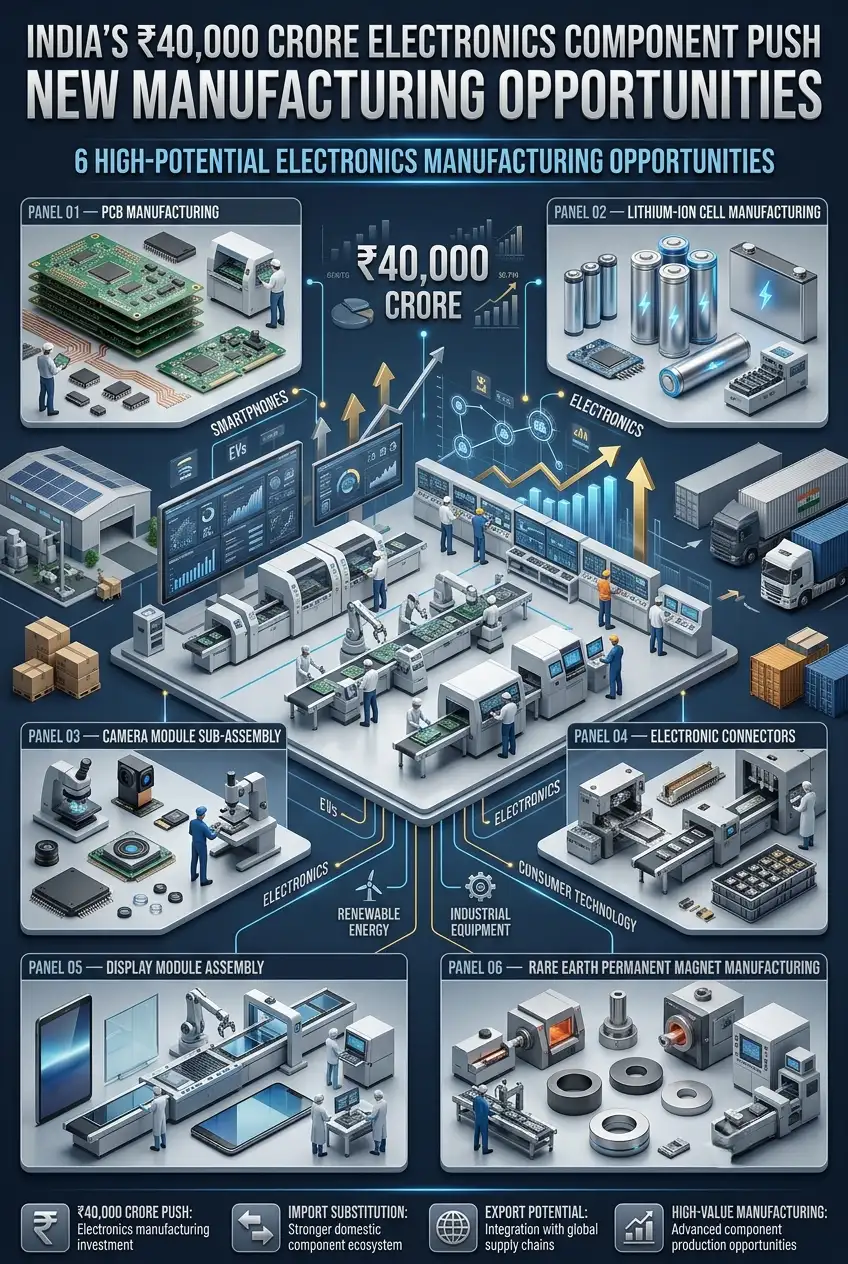
Manufacturing Business Opportunities Emerging From This Development
1. Printed Circuit Board (PCB) Manufacturing
PCBs are the backbone of all electronic products, ranging from smartphones to servers, automotive ECUs to medical monitors. India presently imports almost all its requirement of PCB. Nine companies, comprising of players such as BPL, AT&S India and India Circuits, have received the ECMS approvement for the manufacture of PCBs and government localisation targets have set a goal to produce 50% of PCB demand locally.
For those who have the precision manufacturing infrastructure, multi-layer PCB and HDI (High-Density Interconnect) PCB fabrication is one of the largest opportunities available. The raw materials employed are copper-clad laminates, prepreg material and specialty chemicals. Mobile phone, automotive electronics, and IT hardware OEMs, and industrial equipment manufacturers are all targeted customers. There is potential for exporting to Southeast Asia, the Middle East and Africa. Investment cost of a medium scale PCB manufacturing unit would range anywhere in between ₹30-80 crore and on the simpler boards, MSME and SME level entry would be very possible.
2. Lithium-Ion Cell Manufacturing
Mobile phones, laptops, EVs, energy storage and wearables have all got Lithium-ion cells as their energy core. Though India is manufacturing millions of battery packs every year, the country had no cell manufacturing until the launch of ECMS, under which ATL Battery Technology (India) received approval to manufacture cells. The localisation goal (61%) of lithium-ion battery aims to show the importance of this segment. The production of lithium-ion cells is a capital-intensive process (₹100 crore plus for a viable scale). However, it is a long-duration investment opportunity with the ongoing demand from the EV sector, consumer electronics and grid storage. The materials used for raw materials are anode materials (graphite, silicon); cathode materials (NMC, LFP); electrolyte; separators; current collectors. Many of these materials, used to produce battery components, now have domestic production targets under ECMS supply-chain approvals.
3. Camera Module Sub-Assembly Manufacturing
One of the most import-dependent camera segments in India is camera modules. These include flexible PCBs, voice coil motors, lens assembly, and the image sensor. All premium and mid-range smartphones feature several cameras. Demand is also increasing due to the growing use of tablets, laptops, vehicle dashcams, and surveillance systems. Kunshan Q Tech Microelectronics (India) has received the ECMS approval for camera module sub-assembly. Those entrepreneurs who have experience in manufacturing precision components or assembling camera modules can consider a joint venture with overseas camera module manufacturers. They can also explore contract manufacturing opportunities with companies that wish to shift camera module production to India. Assemblies can be done with a minimum investment of ₹20-50 crore, while integrated module manufacturing demands higher investments.
4. Electronic Connectors Manufacturing
Connectors (mechanical and electrical interfaces that join components, modules and systems) are a huge and widely dispersed market opportunity. They are ideal for MSMEs. Whether it’s a mobile phone charger port or an in-socket data connector in a server, the need for connectors is widespread. Wire harnesses in automobiles also require connectors. Amphenol High Speed Technology India has received ECMS certification to manufacture high-speed connectors. The connector segment covers thousands of product sub-types. However, the country does not cater to significant niches at home. For MSME manufacturers, the investment required for precision connector fabrication ranges from Rs 5 to 25 crore. This investment is realistic. Immediate export potential to Southeast Asia and West Asia.
5. Display Module Assembly
The most expensive imported sub-assemblies used in India’s mobile and IT hardware industry are display modules that include display glass (LCD/OLED/AMOLED), backlight units, touch panels and driver circuitry. Samsung Display Noida gets approval from ECMS for display sub assembly. Though the Glass itself must be fabricated using technology at a different scale, the module integration, testing and assembly layer is readily available to well capitalised Indian fabricators. Opportunities are available in the assembly of display modules for the smartphone and tablet market. Opportunities are also available in the industrial HMI market and the automotive infotainment market. This is also a good job creation option for states with established electronics clusters, such as Karnataka, Tamilnadu and Telangana.
6. Rare Earth Permanent Magnet Manufacturing
This ₹700 crore investment in India’s first rare earth permanent magnet manufacturing plant marks the beginning of a new section of the valuee chain. Moreover, Rare earth magnets (mostly NdFeB — Neodymium-Iron-Boron) play an important role in electric motors, hard disk drives, speakers, headphones, and EV drivetrains. Currently, India is completely dependent on imports of rare earth magnets. Therefore, Under ECMS projects, the government’s goal is to achieve domestic production to meet 25% of the demand. Furthermore, This area also has domestic market and excellent export prospects for investors, who can source rare earth materials (or have partnerships in place). As a result, It is expected to meet the growing demand for materials for the development of electromobility and high-quality audio equipment worldwide. However, The entry investment in the mid-scale facility is also high, ranging from ₹50 to 200 crore. Nevertheless, However, the strategic value and policy support are equally high…
Import-Export and International Market Opportunity
India’s export performance in electronics has been exceptional. It rose from ₹38,000 crore in FY 2014-15 to ₹4.24 lakh crore in FY 2025-26. Electronics was the third largest export category in FY 2024-25 and the second largest in selected years. Electronics exports increased by 41.9% in the first quarter of 2025 (April to September) to USD 22.2 billion. Smartphone exports also rose by 58%. India has become the third largest exporter of smartphones in the world.
Export Opportunity: Indian manufacturers will be able to take advantage of the scaling up of domestic component manufacturing, by providing alternative supply chain partners to global OEMs, as well as export to Southeast Asian electronics assemblers (Vietnam, Thailand, Indonesia), West Asian technology markets, African ICT Infrastructure developers and importantly, to export components to Southeast Asian, West Asian and African markets. In camera modules, PCBs, connectors and precision aluminium extrusions, India can potentially carve a niche for itself in the global market this decade. The government’s electronics export target of USD 150 billion by 2030 provides institutional support for the development of export markets.
Import Substitution: One of the biggest opportunities at present for the electronics components manufacturing industry is import substitution. ECMS targets these import-dependent categories: PCBs (mainly from China and Taiwan), camera modules (from China and Taiwan), display panels (from South Korea and China), rare earth magnets (from China), and capacitors (from Japan, South Korea, and China). The localisation targets in ECMS are 50% for PCBs, 61% for Lithium-ion batteries, and 25% for Rare Earth magnets. These targets give a clear floor for domestic manufacturers to enter these categories.
Indian MSMEs and Startups in Related Industries
India Circuits Private Limited
India Circuits is one of the PCB Manufacturer Approved by ECMS. The company works in the printed circuit board (PCB) manufacturing division. It is an example of the capabilities of mid-tier Indian manufacturing companies. These companies can improve from making standard PCB boards to developing high-density interconnect (HDI) boards. These boards cater to the needs of high end-phone manufacturers and industrial electronics companies.
The takeaway for entrepreneurs: Specialised high complexity PCB types (flexible, rigid-flex or HDI) get premium prices and less competition compared to commodity 2-sided boards.
Deki Electronics Limited
Deki Electronics, one of the well-established capacitor manufacturers in India got approval from ECMS for increasing the manufacturing of capacitors. Energy storage and signal filtering are essential functions of capacitors in almost every electronic circuit, making them a passive component.
This is a technically challenging segment as it is being fought by Japanese and South Korea players. Deki has managed to come through this competition. This is proof that if Indian MSME manufacturers adopt a disciplined quality system and process engineering, they can utilize the framework ECMS.
The lesson: If you invest in quality of your component manufacturing processes at Six Sigma standards, it’s the minimum standard. Companies that do will be the ones that’ll be approved by the OEM customers and be preferred by them.
Dixon Technologies India Limited
Dixon Technologies is India’s top electronics manufacturing services (EMS) company. It has got clearance from ECMS through its subsidiary Dixon Electroconnect to manufacture optical transceivers.
Dixon’s career arc from contract TV assembly to white goods, mobile phones and IT hardware to precision optical components is a typical progression. This progression is available to any serious EMS or component manufacturer ready to invest in technology and capabilities.
Dixon developed the scale by engaging in all PLI and manufacturing incentives in a systematic manner. The takeaway is to be disciplined to enter into one ECMS eligible component segment, prove quality, and grow with government backing.
What Entrepreneurs Should Evaluate Before Investing
Opening electronics component manufacturing in India creates an opportunity, but it is not a low-barrier market. Businesses must conduct an honest pre-investment analysis of any investment or business venture from several points of view:
Market Demand Verification: Determine which component categories are likely to be most import dependent (and which where domestic demand is large and structurally expanding). Established high-priority areas include PCBs, camera modules and Li-ion cells. Other new opportunities are in rare earth magnets and specialty chemicals.
Precision Manufacturing Processes: Most electronics components have precision manufacturing processes, such as clean room assembly of the display and camera module, electroplating of the PCBs, high-temperature sintering for magnets, and specialty chemical handling for battery electrolytes. Determine the feasibility of the necessary process technology by equipment purchase, joint ventures with world class technology partners or technology licensing.
Capital Requirements: For component manufacturing, capital requirements tend to be higher than for assembly. In case of a viable PCB plant, the minimum requirement is of ₹30–100 crore. Contract manufacturing of camera module and display assembly can be introduced into the market at the price of ₹20-50 crore. The cost of Li-ion cell manufacturing is above ₹100 crore. The cost of rare earth magnets is ₹1,000 crore or more.
Quality Standards: OEM customers in the mobile phone, IT hardware, and automotive electronics domains require international quality certifications, including IATF 16949 for automotive, IPC standards for PCBs, and ISO 9001. Companies can purchase quality management systems before applying for ECMS incentives, which will help ensure easier approvals and OEM customer acquisition.
RM&SC: Sources and provision of the raw materials early. Copper-clad laminates (CCL) are an important input for PCBs — ECMS has approved Wipro Global Engineering to produce CCL. Domestically, companies are targeting anode materials and electrolytes for Li-ion cells. In the case of rare earth magnets, the most important constraint is the supply of NdFeB alloy ingots.
Location and Infrastructure: Electronics manufacturing clusters (EMCs) provide plug-and-play infrastructure. Tamil Nadu (Chennai, Hosur), Karnataka (Bengaluru), Telangana (Hyderabad), Uttar Pradesh, and Maharashtra have mature electronic manufacturing ecosystems. They offer access to skilled workers and a well-connected supply chain.
Application Window for ECMS: For some segments, the initial cohorts of ECMS applications have already been closed. But the scheme remains open for supply chain and capital goods and the government could create more windows in the budget expansion. A techno-economic project report, investment plan and employment generation projection should be prepared by the entrepreneurs before applying.
Risk Factors: Key risks include Chinese competitor pricing pressure, technology obsolescence in fast-moving components (especially camera and display modules), delays in raw material sourcing, and the challenge of achieving quality standards accepted by global OEMs. Mitigating these risks requires technology partnerships, market diversification, and maintaining lean operations while scaling.
