


The national capital is about to unleash one of its most significant chapters in industrial development in recent times. The Delhi government has so far identified about 1,148 acres of greenfield sites across three locations – Kanjhawala, Ranikhera, and Baprola. The aim is to set up new purpose-built industrial estates. These estates will focus specifically on clean, technology and knowledge-based industries. The announcement comes with a proposed New Industrial Policy 2026 – 2036 and other legislative changes. It marks a fundamental change in Delhi’s approach and intent for the next decade. The goal is to become a business and investment hub.
This development has significant commercial implications for entrepreneurs, MSMEs, manufacturers, startup founders and investors. Delhi offers large markets and skilled manpower. It also has uncommon institutional infrastructure and close proximity to the corridors of power. These factors make it an ideal place to set up next generation businesses. The new industrial zones are purpose-built to welcome high value but low impact industries. These include IT, ITES, biotechnology, research and development, artificial intelligence, advanced robotics, media, gems and jewellery, and business services, among others. They will also offer modern plug-and-play infrastructure. The amount of the proposed investment is significant. The scope of the policy backing it is also large. Therefore, it is a development that every serious entrepreneur should consider in the light of today.
What This Development Means for Indian Businesses
Industrial land has always been in short supply in Delhi. Businesses have been forced to the outskirts of NCR and into outdated flatted factories and non-conforming developments for decades. That calculus is changing with the identification of 1,148 acres of structured greenfield industrial land. Of this, 920 acres are at Kanjhawala, 147 acres at Ranikhera and 81 acres at Baprola.
The proposed hubs have different attributes. Ranikhera is located on the Urban Extension Road-II (UER-II). It connects with a major part of the capital and its neighbouring NCR. Baprola park, which will be based on the premise of ‘walk to work’, will feature mixed use development. This will comprise industrial plots, flatted industries, accommodation for the working public and commercial areas. Kanjhawala is projected to be a fully-fledged industrial township. It will have the largest land parcel.
The proposed New Industrial Policy 2026-2036 is being worked out by industry associations like NASSCOM and real estate corporates. It will offer the regulatory framework for this development. Additionally, a new Startup Policy, the Delhi Ease of Doing Business Bill 2026, and a new Export Promotion Policy are all in the pipeline. These indicate an overall revamp of the startup ecosystem, rather than a one-off announcement on land.
The opportunity for entrepreneurs in IT, ITES, biotech, R&D, media, professional services and precision manufacturing is the early mover advantage. This includes securing plots and structuring business models in line with the new policy framework. It also involves preparing for concessionary land rates and institutional support that will be available when the hubs open for allotment.
The government has also said it is looking to transform the 8-acre Jhandewalan Flatted Factory Complex into modern industrial and commercial facilities. This will cater to the need of the emerging businesses. It will offer an immediate facility if the large greenfield ones take time to get ready.
Why This Industry Could See Stronger Growth
The existing economic strength of Delhi is quite strong. The national capital’s GDP has been on a steady path upward, bolstered by service, trade and new technology industries. However, the city has been limited by the lack of a dedicated and modern industrial space for the clean industries and knowledge-based businesses that it has sought. These three new hubs directly address this supply gap.
There are several structural factors that increase the opportunity. Delhi has the maximum number of Global Capability Centres (GCCs) in North India with hundreds of multi-national companies having Research, Analytics, Legal and Technology Centres in the capital. The new policy framework clearly states its focus on bringing more such centres, establishing a continuous demand chain for built-up industrial and office spaces in these new centres.
The National Industrial Corridor Development Programme (NICDP) of India, which is developing industrial smart cities along the key freight corridors, also complements the overall manufacturing and logistics support for Delhi. The national corridor programme by NICDC is putting in extra efforts to connect Delhi with various industrial states to make the capital more attractive for businesses in supply chains.
The government’s clear emphasis on industries with low environmental impacts also fits into the increasing pressure from investors and regulations on sustainability. A clean process and clean technology-based operations will make it easier for businesses to comply while enjoying policy continuity. An important other factor is the import substitution of high value components that are currently imported from abroad, especially in electronics, precision instruments, medical goods and IT hardware, where domestic production is still not sufficient.
The walk-to-work design philosophy of Baprola, coupled with the mixed-use philosophy of planning in all three hubs, translates into reduced operational costs, increased employee retention and a robust commercial ecosystem which in turn directly impacts on MSME profitability and growth.
Government Policies and Incentives
A wide range of policy instruments is available for entrepreneurs who are thinking about entering these hubs.
At the state level, the Department of Industries, Government of NCT of Delhi is the nodal authority for industrial development in the capital. Its One Window Information Service provides entrepreneurs with assistance on industrial licences, environmental clearances, and Udyam registration. The department is also mandated to roll out the Single Window Portal under the new startup and industrial policies.
The development of these new hubs is the responsibility of the Delhi State Industrial and Infrastructure Development Corporation (DSIIDC), which is the main implementing entity for this city’s industrial zones. Earlier, DSIIDC has established important complexes like Narela, Bawana, and Patparganj and will oversee the allotment of plots, making of infrastructure, and maintenance of Kanjhawala, Ranikhera, and Baprola estate.
The Delhi government has also been preparing its Draft Delhi Startup Policy to transform Delhi into a global innovation hub by 2030 with support of 15,000 startups. Under the policy, start-ups can avail of loans without providing any collateral, access to incubation centres across the Delhi universities and simplified procurement procedures for start-ups.
At the national level, the Credit Guarantee Scheme for Micro and Small Enterprises (CGTMSE) provides collateral-free loans of up to Rs 10 crore to MSEs, with guarantee coverage ranging from 75% to 90%, making it a critical tool for first-generation entrepreneurs entering these new hubs without substantial collateral backing.
MSMEs can also register under the Udyam Registration Portal to unlock formal MSME status — which provides access to priority lending, government procurement preferences, interest rate subsidies, and technology support across multiple central schemes.
For technology-focused businesses, Software Technology Parks of India (STPI), operating under MeitY, provides IT/ITES export promotion infrastructure, 100% export-oriented unit registration, high-speed data communication, and incubation support. Companies setting up in the Ranikhera and Baprola hubs — both explicitly targeting IT, ITES, and biotech — may be eligible to register as STPI units and access associated duty and tax benefits.
Exporters can leverage the Export Promotion Capital Goods (EPCG) Scheme administered by DGFT, which allows zero-customs-duty import of capital goods for production, in exchange for an export obligation. This significantly reduces initial machinery costs for businesses targeting export markets from these new hubs.
Finally, the National Manufacturing Policy page on DPIIT provides the central government’s broader framework for manufacturing growth, including National Investment and Manufacturing Zones, skill development linkages, and public-private partnerships — all of which interact with Delhi’s new industrial push.

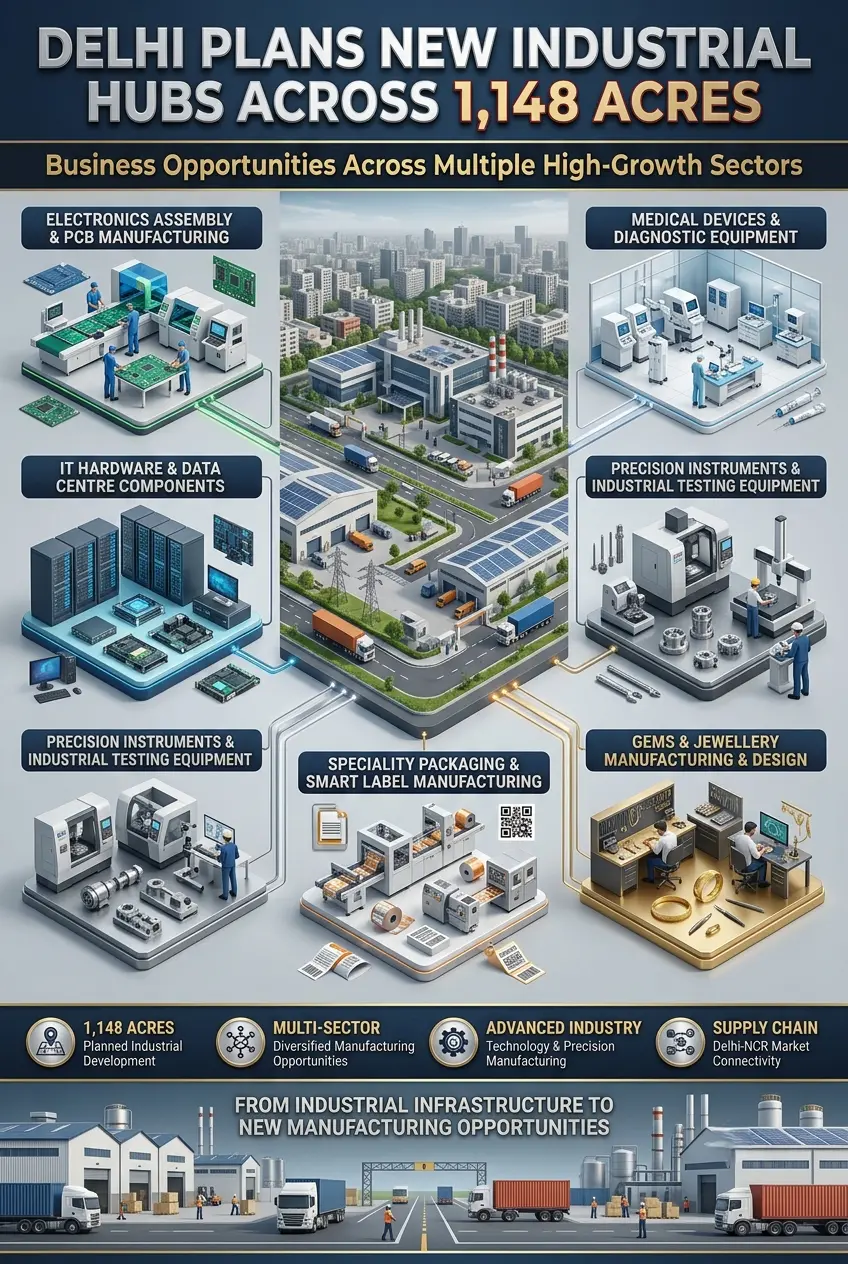
Manufacturing Business Opportunities Emerging From This Development
1. Electronics Assembly and PCB Manufacturing
Electronic assembly is one of the most obvious manufacturing opportunities given the new hubs focused on industries with low footprint and technology. Delhi’s distribution channels throughout North India and its close proximity to import logistics through IGI Airport makes it ideal for manufacturing mobile accessories, Consumer electronics components, Networking equipment and Printed circuit boards for mobile devices. Customer segments include OEMs, system integrators and the expanding pool of customers in GCC who need locally produced hardware. Import bill for electronics continues to be significant in India, which offers good import-substitution potential. The MSME-scale assembly units can be set up with moderate investment and the walk-to-work design of Baprola is more suitable for labour-intensive electronics assembly.
2. Medical Devices and Diagnostic Equipment Manufacturing
The Ranikhera biotech and R&D push, with its tight healthcare web of AIIMS, private hospitals, hospital chains and a wide network of diagnostic centres, all make it an appealing place to manufacture medical devices. Disposable syringes, diagnostic consumables, hospital furniture and fixtures, patient monitoring equipment components, and sterilisation systems all are targets for manufacturing. India is a rapidly growing medical devices market and dependence on imports is high in various product segments. Government procurement opportunities like Government e-Marketplace (GeM) or PLI benefits from the national push for healthcare manufacturing are available for MSME that are entering this space.
3. IT Hardware and Data Centre Component Manufacturing
The new hubs’ clear emphasis on Artificial Intelligence, R&D and infrastructure in the GCC region downstream demands for IT hardware, server rack components, UPS systems, structured cabling products and data centre cooling equipment. The city already has a number of hyperscale and colocation data centres in its NCR geography and this is expected to keep rising as the capital becomes a tech hub. Local production of data centre components has great potential for import substitution, especially in power systems and thermal management. While large manufacturers should focus on corporate end-users, small and medium manufacturers can see the institutional procurement market, or government-owned data centres, enterprise IT deployments, and telecom infrastructure providers, as their main target.
4. Precision Instruments and Industrial Testing Equipment
5. Speciality Packaging and Smart Label Manufacturing
In Kanjhawala, Ranikhera and Baprola, IT, biotech, gems & jewellery and media businesses are located. Specialised, quality packaging and tracking solutions will be needed. Tamper-evident pharmaceutical packaging, anti-counterfeiting smart labels, smart retail tags with RFID and custom institutional packaging are examples of direct demand niches. These are directly related to the tenant life story of the new hubs. They are low-pollution manufacturing business operations. These operations are suitable for the environmental parameters of the planned zones. They can also be scaled up from MSME to mid-scale operations. Customised packaging solutions have export potential for pharmaceutical, FMCG and electronics exporters in the South Asian region.
6. Gems and Jewellery Manufacturing and Design
Gems and jewellery is a specific target sector in the Baprola hub. The city of Delhi already has one of the biggest gems and jewellery trading hubs in India. It includes places like Chandni Chowk, Karol Bagh and Lajpat Nagar. The establishment of this sector in a purpose-built industrial zone provides opportunity to entrepreneurs with manufacturing skills. They can establish jewellery fabrication units, CAD/CAM based design operations, diamond sorting and polishing units and jewellery export business. Delhi’s formal industrial infrastructure helps provide access to export facilitation, banking and export certifications. These are important for the gems and jewellery export sector, one of the largest foreign exchange earners of the country.
Import-Export and International Market Opportunity
The new industrial zones of Delhi have a definite export drive. The government is also developing a new Export Promotion Policy, which sets the policy background for their linkages with international markets.
Export Opportunity: The technology sectors targeted are all exported: IT, ITES, biotechnology, precision instruments and electronics. Software exports, IT-enabled services (ITeS) and business process outsourcing (BPO) from the new zones of Delhi can attract markets in North America, Europe and the Middle East. These markets have strong demand for India-based services. Delhi-based medical device, jewellery, precision instruments and special electronics exporters have potential markets in Central Asia, Gulf Cooperation Council and ASEAN. High-value, time-sensitive exports also benefit from Delhi’s proximity to IGI Airport. The airport is a major air freight hub.
Import Substitution: India is presently importing a huge quantity of medical equipments, electronic components, precision instruments, IT hardware etc. The new Delhi-based clusters facilitate access to technology-driven manufacturing units, skilled workforce, and R&D facilities. They create an environment conducive to developing domestic production capabilities in these clusters. The government is also focusing on Global Capability Centres. These centres bring together technology talent and create IP. They also provide further opportunities for India to move beyond being a services exporter. India can become an originator of products and IP in high-value technology goods. This further strengthens import substitution in technology goods.
Indian MSMEs and Startups in Related Industries
The new Delhi hubs are meant to foster several kinds of businesses, and several Indian companies are examples of them.
For example, Agilisium Consulting is a technology consulting and data analytics company in the Delhi region that has expanded through offering digital transformation solutions to enterprise clients. Moreover, It’s the archetype of the knowledge-based, low-impact IT services business that the new hubs are expected to draw and help to succeed. Therefore, Data analytics, AI consulting and enterprise software entrepreneurs can learn from this model as a blueprint for their type of business in these areas.
Similarly, Healthians is a Delhi-based diagnostic services company that has built a large-scale healthcare data and diagnostics network across India. In addition, The proximity of Ranikhera’s biotech-oriented hub to Delhi’s healthcare ecosystem creates opportunities for entrepreneurs building health technology, diagnostics equipment, or biotech research services. Thus, Healthians illustrates how Delhi’s dense institutional healthcare base translates into real commercial traction for health-sector businesses.
Likewise, Shalimar Paints has historically operated manufacturing facilities within Delhi’s industrial zones, demonstrating that legacy manufacturers can successfully evolve into cleaner, more technology-led production models within the city’s industrial infrastructure. Furthermore, Entrepreneurs considering manufacturing businesses within the new hubs can learn from such examples — particularly around how to secure government allotments, navigate environmental compliance, and scale from a single unit to a multi-site operation within Delhi’s formal industrial ecosystem.
What Entrepreneurs Should Evaluate Before Investing
Before committing capital to a business targeting the new Delhi industrial hubs, a prospective entrepreneur should systematically evaluate the following:
- Market demand: Confirm that the product or service has verifiable demand within Delhi and the broader NCR market, not just theoretical demand.
- Raw materials and supply chain: Assess the availability and cost of inputs, and whether supply chains are accessible from Delhi or NCR Import-dependent inputs carry currency and lead-time risk.
- Technology and machinery: Identify whether required technology is readily available domestically or must be imported. Evaluate technology obsolescence risk.
- Location and infrastructure: Understand which hub (Kanjhawala, Ranikhera, or Baprola) is most suited to the specific business type. Evaluate transport, power, and water availability.
- Manpower: Assess availability of skilled and semi-skilled workers. Delhi’s large working-age population is a positive factor, but specialised technical talent may need to be recruited carefully.
- Working capital: Technology and services businesses have different working capital profiles from manufacturing. Ensure funding for a sufficient operating runway before revenue reaches break-even.
- Regulatory requirements: Understand Delhi Pollution Control Committee (DPCC) clearances, fire NOC requirements, and any sector-specific regulatory approvals before finalising the business plan
- Competition: Identify the existing players in the sector, their pricing, and what competitive advantages the business can develop and defend.
- Export potential: If the business model includes exports, evaluate which markets are most accessible, what certifications are required, and how the EPCG scheme and STPI registration can reduce capital costs
- Risk management: Identify key risks — land allotment timelines, policy implementation delays, demand-side fluctuations — and build contingency plans.
How NPCS Can Help Entrepreneurs Evaluate the Opportunity
NPCS — Niir Project Consultancy Services — is one of India’s most established industrial consultancy organisations. It has over three decades of experience helping entrepreneurs, MSMEs, and investors evaluate and plan manufacturing and service industry projects. For entrepreneurs considering opportunities connected to Delhi’s new industrial hubs, NPCS provides the analytical tools and professional guidance needed. These resources help entrepreneurs make well-informed investment decisions.
NPCS services include Detailed Project Report (DPR) preparation, market research and demand assessment, and techno-economic feasibility studies. They also include plant and machinery evaluation, manufacturing process guidance, investment cost estimation, and regulatory compliance guidance. These services are particularly relevant when applying for bank loans, government scheme benefits, or industrial plot allotments. All of these typically require a structured, bankable DPR.
NPCS has published a comprehensive printed reference book on this subject, covering technology, market analysis, investment parameters, and manufacturing processes in depth. You can access the printed book here: Handbook on Small & Medium Scale Industries (Biotechnology Products) For a detailed techno-economic Project Report on setting up a manufacturing or technology business in sectors aligned with Delhi’s new industrial hubs — including plant economics, machinery lists, financial projections, and applicable government incentives — visit NPCS Project Reports here: Computer Products and Information Technology (IT) Based Projects
Business Opportunity Snapshot
| Parameter | Details |
| Industry | IT/ITES, Biotechnology, R&D, AI, Robotics, Media, Gems & Jewellery, Business Services, Electronics |
| Market Driver | Delhi’s new greenfield industrial hubs (1,148 acres), New Industrial Policy 2026–2036, GCC expansion, import substitution |
| Key Development | Delhi government identifies Kanjhawala (920 ac), Ranikhera (147 ac), Baprola (81 ac) for clean tech industries |
| MSME Opportunity | Plot allotment at concessional rates, walk-to-work mixed-use zones, DSIIDC support, collateral-free CGTMSE loans |
| Manufacturing Potential | Electronics assembly, medical devices, IT hardware, precision instruments, smart packaging, gems & jewellery fabrication |
| Export Potential | Software exports, IT services, medical devices, jewellery, precision instruments to ASEAN, Middle East, Africa, Europe |
| Import Substitution | Electronics components, medical equipment, precision instruments, IT hardware, data centre components |
| Government Support | CGTMSE, STPI, EPCG, DSIIDC, Udyam Registration, Delhi Startup Policy, National Manufacturing Policy |
| Investment Consideration | Early-mover advantage in plot allotment; align business plan with incoming policy before formal notification |
| Risk Level | Medium — hub development timelines, policy implementation pace, land allotment completion are key variables |
| Growth Outlook | Positive for 10-year horizon, aligned with India’s GCC expansion and clean manufacturing push |

Conclusion
Delhi’s announcement of three new greenfield industrial hubs spanning 1,148 acres — at Kanjhawala, Ranikhera, and Baprola — is one of the most consequential industrial developments in a generation. Moreover, the national capital has made this move as part of a major industrial push. Furthermore, the move is backed by a comprehensive New Industrial Policy 2026–2036, a new Startup Policy, an Ease of Doing Business Bill, and an Export Promotion Policy. Together, these policies represent a major policy ecosystem overhaul. Therefore, it is not just a land announcement.
For entrepreneurs, the opportunity is clear and time-sensitive. Specifically, the hubs are designed for clean, high-value industries. These include IT, ITES, AI, biotechnology, research and development, gems and jewellery, and precision manufacturing. Therefore, early movers can align their business models to this vision. They can also prepare strong DPRs and engage with the allotment process ahead of formal notifications. As a result, this approach will position them to secure concessional land, institutional support, and a strategic position in what could become one of North India’s most important industrial ecosystems.
The right approach for any serious entrepreneur is straightforward. First, conduct rigorous market research and commission a professional feasibility study. Next, prepare a bankable Detailed Project Report and build a structured investment plan. The plan should anticipate policy timelines and land allotment processes. Ultimately, the opportunity is real, and the policy direction is clear. Therefore, the window to act early is now open.
Your Investment Deserves the Right Opportunity
Every serious investment begins with choosing the right sector and the right business model. With hundreds of industrial opportunities available across India’s manufacturing and clean-energy landscape, making the most informed choice is critical. NIIR’s Startup Selector tool helps entrepreneurs, MSMEs, and investors identify the most suitable business opportunities based on their investment capacity, location, and interests — so your capital is directed toward a venture with the strongest fit and potential.</p>