


A Regulatory Turning Point for Delhi-NCR’s Mobility Sector
The capital region of India is at the edge of one of the most comprehensive transport changes ever. Commission for Air Quality Management (CAQM) — the statutory body to regulate pollution control across Delhi and adjoining states — has allowed phase-wise ban on the registration of new petrol, diesel and CNG-powered Light Goods Vehicle (LGV) in Delhi-NCR. The move, which is widely reported on by the Navbharat Times, indicates a structural change in how commercial and last-mile transport will function around the city of Delhi, in the state of Haryana, Uttar Pradesh, and Rajasthan for the next two to three years.
The directive is not just an environmental regulation. It’s a very special market indicator. Thus, all fleet operators, delivery services, logistics companies and commercial vehicle manufacturers in the NCR now have a clear and binding deadline: either invest in clean energy vehicles or get out of the market. It’s not a threat for entrepreneurs but a trillion-rupee opportunity waiting to be grabbed by the entrepreneurs and MSMEs and manufacturers.
The business around this regulation is enormous, useful and underused – from electric three-wheeler manufacturers to battery servicing centers, from installation of ANPR cameras to fleet management software.
What Navbharat Times Reporting Means for Indian Business
According to Navbharat Times, one of the most read Hindi-language news and business newspaper in India, the CAQM has approved phased and time-bound registration ban for all new petrol, diesel, and CNG vehicles in the light commercial and goods vehicle category in Delhi-NCR.
Navbharat Times reports that the following are key provisions of the phased restrictions of CAQM:
- No new petrol or diesel LGVs, light commercial vehicles and 2 wheelers will be joining aggregators and delivery companies from 1 January 2026.
- Only CNG, Electric vehicles will be allowed for fresh induction in their fleet by cab aggregators, e-commerce logistics firms, delivery service providers.
- From July 2025, End-of-life (EoL) vehicles (those more than 15 years old for petrol and 10 years for diesel) have been denied petrol access in Delhi and extended to Gurugram, Faridabad, Ghaziabad, Gautam Budh Nagar and Sonipat from November 2025.
- From 1st November 2025, entry of non-registered, non-BS-VI compliant commercial goods vehicles into NCR banned.
- In Uttar Pradesh, Haryana and Rajasthan, only CNG and electric auto-rickshaws will be registered from January 2026 while all diesel autos will be phased out by the end of this year.
The uniqueness of this regulation is that it affects an estimated 1.5-2 crore registered vehicles in NCR, thousands of fleet owners, and hundreds of thousands of last mile delivery people. Economically, that’s a huge disruption, but the economic opportunity is a huge disruption.
Related Article: Electric Vehicle Manufacturing Business Ideas in India
Why This Clean Mobility Market Is Growing Rapidly
The Indian market for EVs and clean fuels was already expanding on its own prior to the CAQM rules. Even without considering the impact of rising fuel prices, the stricter emission standards and government support, the two-wheeler EV market had already crossed the 10 lakh sales per annum barrier. But even rules such as the one reported by Navbharat Times shift the scope from voluntary adoption to forced transition — and a growth market into a captive market.
There are three structural forces driving this sector:
1. Regulatory Compulsion at Scale
Commercial delivery vehicles account for the highest number of vehicles in the NCR. Regulatory requirements in this area extend to the supplier ecosystem, finance and manufacturing demands of the nation.
2. Infrastructure Deficit Creates Supply Opportunities
There are less than 1500 public EV charging points currently spread across Delhi-NCR, which is far from meeting the need for a mandated EV fleet shift for tens of thousands of commercial vehicles. This infrastructure deficit is a business chance in itself of hundreds of crores.
3. Policy Momentum Is National
Delhi NCR’s regulatory model is being closely looked at by states such as Maharashtra, Karnataka and Tamil Nadu. Businesses that will develop to address this transition now will be in a place to be replicated nationally in the future.
Government Policies & Incentives Supporting Clean Mobility Businesses
A robust policy mechanism is in place to nurture entrepreneurs and MSMEs in this area:
- FAME III Scheme (Faster Adoption and Manufacturing of Electric Vehicles): Ministry of Heavy Industries still continues to provide demand subsidies for electric 2 Wheelers, 3 Wheelers and commercial vehicles. Visit:
Ministry of Heavy Industries – FAME Scheme
- Production Linked Incentive for Scheme for Advanced Chemistry Cell (ACC) Battery Storage: Scheduled to offer ₹18,100 crore of production linked incentive for battery manufacturers. Details at:
PLI for ACC Battery – NITI Aayog
- Delhi EV Policy 2.0 (Draft): calls for a phase-out for CNG 2-wheelers by August 2026 and purchase subsidies and scrapping incentives. See:
Delhi Government Transport Department has issued Delhi EV Policy.
- MSME Ministry’s Credit Guarantee Fund Scheme: Provides loans without collateral to MSMEs for new manufacturing zones up to ₹5 crore. See:
MSME Ministry – Credit Guarantee Scheme
- Haryana EV Policy 2022: Provides 100% exemption from road tax, discounts in the electricity tariff for EV charging stations and capital subsidy for EV producers in Haryana. Visit:
Haryana Government – EV Policy
- Uttar Pradesh EV Manufacturing & Mobility Policy 2022: Offers capital subsidy up to 25% on the fixed investment, reimbursement of SGST and free land for EV parks. See:
- SIDBI Green Finance for MSMEs: Offers credit facility at concessional interest rates to MSMEs involved in the manufacturing of sustainable / green products. Visit:
- National Green Hydrogen Mission: Provides assistance in integration with clean energy for commercial fleet and manufacturing. Refer:
Ministry of New and Renewable Energy has rolled out the Green Hydrogen Mission.
- Tax benefits, faster regulatory clearances, and DPIIT recognition for registered clean-tech startups, through Startup India Portal. Visit:

Manufacturing Business Ideas Emerging From This CAQM Directive
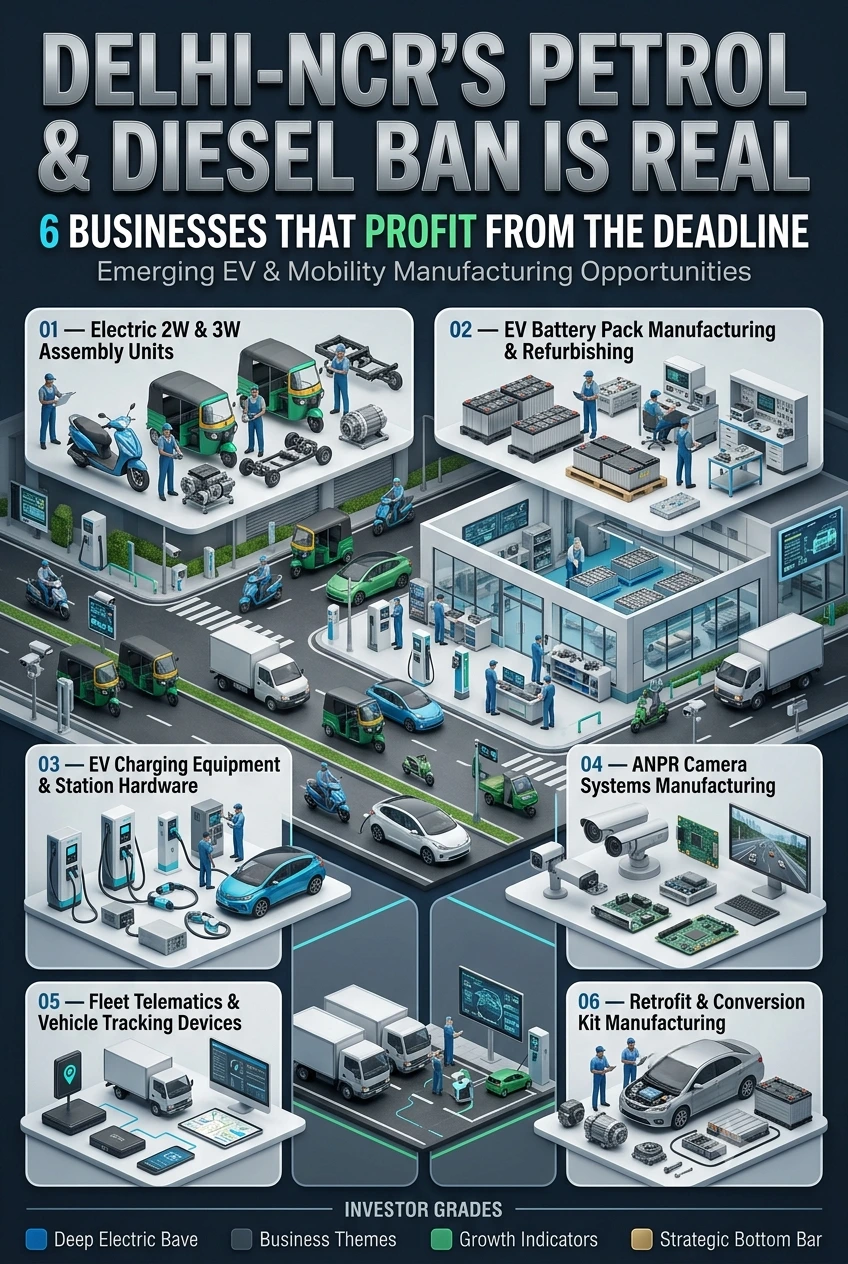
As reported by Navbharat Times, the CAQM bans have made it a direct and immediate need for the production of physical products and manufacturing. Here are the six top manufacturing business opportunities out there:
1. Electric Two-Wheeler & Three-Wheeler Assembly Units
As petrol/diesel aggregators will discontinue their 2-wheelers and CNG auto-rickshaws will be phased out in the states of NCR, the demand for electric two-wheelers and electric auto-rickshaws will grow by a significant margin. There are potential for setting up small scale EV assembly units, especially in Haryana, Rajasthan and Uttar Pradesh under MSME status with an investment of only ₹50 lakh. Although the components like the motor controllers, battery management units and the chassis can be obtained locally or partly imported, the final assembly is completed in the NCR hinterland. These units will directly benefit from EV policy subsidy of both UP and Haryana.
2. EV Battery Pack Manufacturing & Refurbishing
The expense of the battery pack accounts for 35-40% of an electric vehicle’s total cost. As tens of thousands of delivery vehicles converge on electric, battery pack production is a key upsteam industry. The entrepreneurs can set up MSME level lithium-ion battery pack assembly units comprising imported 1L-cell, locally made casing, BMS circuit, and thermal management system. Furthermore, a retired battery pool is building with early EV adopers as a result of which refurbishing and second-life battery market is developing. Investment size: ₹75 lakh to ₹3 crore as per capacity.
View Full Project Details: E-Vehicle & Battery Technology
3. EV Charging Equipment & Station Hardware Manufacturing
The current charging infrastructure in Delhi-NCR is clearly not up to the mark to support the transition of the fleet as per the directive issued by the CAQM as reported in the Navbharat Times. The production of smart charging controllers, DC fast chargers, and AC slow chargers is a good business opportunity. The investment required to produce them is between ₹30 lakh and ₹1.5 crore and they can be sold to fuel station operators, housing societies, fleet operators and highway developers. Chargers with Indian manufacturing are also expected to enjoy good export potential to the ASEAN and African markets.
Get Detailed Insights from This Book: Handbook on Electric Vehicle Manufacturing
4. Automatic Number Plate Recognition (ANPR) Camera Systems Manufacturing
The CAQM has issued instructions to all the fuel companies in Delhi-NCR to install the ANPR cameras with mParivahan database to ensure the implementation of end-of-life vehicle fuel ban. The city of Delhi has more than 500 fuel stations alone, thousands more across the NCR, which makes the immediate need for ANPR hardware. Indian manufacturers can manufacture ANPR camera assemblies, housing enclosures and embedded software integration kits. It is a hardware niche category that has a specific customer base in the regulatory market and has high margins.
5. Fleet Telematics & Vehicle Tracking Devices
Under the Delhi Motor Vehicle Aggregator and Delivery Service Provider Scheme, 2023, all the fleet operators will be required to register and keep track of the vehicles on the dedicated government portal. This is a rule that will drive captive demand for units that track moving vehicles, such as GPS trackers, OBD dongles, and real-time monitoring equipment. These devices can be provided to fleet operators by the small-scale electronics manufacturers and PCB assembly units at a price of ₹1,500 to ₹3,000 each. This is a scalable and recurring-revenue manufacturing opportunity with hundreds of thousands of vehicles being required to be compliant.
6. Retrofit & Conversion Kit Manufacturing
Numerous existing petrol and CNG commercial vehicle owners can’t afford to buy new EVs. This represents a huge market opportunity for vehicle retrofit kits — systems that offer to retrofit an existing ICE vehicle’s power train to electric. For 2-wheelers and 3-wheelers, retrofit conversion units can be manufactured and assembled, to address the base of end-of-life vehicles and near end-of-life vehicles. Delhi’s draft EV policies specifically mention CNG auto-rickshaws as a ‘transitional’ vehicle class that will be retrofitted.
Import–Export Opportunity Analysis
Export Markets
Import Substitution Opportunities
Currently, India imports substantial quantities of lithium-ion cells, EV motor controllers, and precision battery management system (BMS) components from China, South Korea, and Japan. CAQM directives are driving a large-scale fleet transition. This shift can create sufficient demand to support local manufacturing of these components. PLI schemes and ACC battery incentives are specific to enable import substitution to be viable and profitable.
International Trade Opportunity
The OEMs can export EoR vehicles that may have some residual value in the Delhi-NCR markets to Africa and some other South Asian countries with weaker emission norms. It establishes an export for used vehicles business structure in line with the regulatory timeline.
Indian MSME Success Stories in Clean Mobility
1. Euler Motors (New Delhi)
2. Altigreen Propulsion Labs (Bengaluru/NCR)
Altigreen produces three-wheelers with electric power and CNG-electric hybrid three-wheelers for goods transportation. The company’s retrofit and purpose-built EV solutions target the same segment of commercial delivery vehicles that Navbharat Times has discussed under the CAQM directives. Altigreen has attracted a lot of VC funding and has built up a service network throughout NCR.
3. Spiro Technologies (Delhi-NCR)
Spiro Technologies is a MSME scale Telematics and Fleet Management Solutions provider serving Delhi and NCR. They offer GPS and OBD-based fleet monitoring systems. These systems address the compliance needs created by the Delhi Aggregator Scheme, 2023. The company shows that non-manufacturing tech firms can also generate substantial revenue from regulatory-mandated fleet compliance.
Build a profitable business with the right idea
About NPCS – Niir Project Consultancy Services
Niir Project Consultancy Services (NPCS) has been providing industrial and business consultancy services to entrepreneurs, MSMEs, manufacturers and investors across India for more than 30 years. NPCS provides:
- Detailed Project Reports (DPR): Techno-economic feasibility reports of new manufacturing projects like EV component manufacturing, battery assembly and Charging Equipment manufacturers.
- Market Research Reports: Sector-specific demand assessments, competition mapping, pricing analysis, and regulatory environment reviews.
- Feasibility Studies: Pre-investment analysis (Plant Economics, ROI projection, Break-even analysis, Raw material sourcing plan etc.).
- Technology Consultancy: Selection of process, selection of machines, plant layout design, identification of supplier for new industrial ventures.
- Business Plan Preparation: Bankable project reports for MSME loan applications, VC pitch decks, and government incentive applications.
Entrepreneurs considering entering the clean mobility manufacturing sector triggered by CAQM’s directives — as covered by Navbharat Times — should commission a detailed DPR and feasibility study before committing capital. Visit NPCS at www.niir.org for sector-specific project reports.
Quick Reference: Business Opportunity Summary Table
| Parameter | Details |
| Industry | Clean Mobility, Electric Vehicles, Charging Infrastructure, Retrofit Technology |
| Market Driver | CAQM phased ban on petrol/diesel/CNG LGVs & two-wheelers in Delhi-NCR (2025–2027) |
| Investment Range | ₹10 lakh – ₹5 crore (MSME scale); ₹5–₹50 crore (mid-scale manufacturing) |
| MSME Opportunity | EV component manufacturing, charging equipment, telematics, battery servicing, fleet conversion |
| Export Potential | EV components to ASEAN, Africa, Middle East; charging hardware to European markets |
| Government Support | FAME III, PLI Scheme, Delhi EV Policy 2.0, SIDBI MSME Green Finance, State EV Incentives |
| Risk Level | Moderate – dependent on regulatory timeline adherence and supply chain readiness |
| Growth Outlook | High – Mandatory fleet transition across 3 states and Delhi NCR by 2026–2027 |

Conclusion: Act Before the Registration Window Closes
The CAQM’s phased ban on new petrol, diesel, and CNG LGV registrations in Delhi-NCR — as reported by Navbharat Times — is one of the most consequential clean transport regulations India has issued. It is mandatory, timeline-bound, and covers one of the largest commercial vehicle markets in Asia.
For entrepreneurs and MSMEs, this is not a distant trend. It is a current, legally enforceable mandate creating immediate demand for electric vehicles, charging infrastructure, retrofit kits, compliance technology, fleet software, and battery services. The businesses that position themselves in these supply chains today will capture the outsized rewards of mandatory market transformation.
The government policy architecture is in place. The PLI schemes, FAME incentives, SIDBI green credit, and state-level EV policies collectively create a favourable financial environment for new manufacturing and service businesses. The only missing ingredient is entrepreneurial action.
India’s clean mobility transition will not wait. The first-mover advantage in this space is real and closing fast. Founders who commission feasibility studies and register under MSME will be well positioned. Starting manufacturing or service operations within six to twelve months can help them serve the mandatory fleet transition across the NCR and eventually India.