


Delhi NCR Manufacturing Business Opportunities
A Market Signal Entrepreneurs Cannot Ignore
An event of great importance occurred in India’s industrial economy! A recent development has caught the attention of every MSME owner and startup founder in Northern India, as reported by the Economic Times. Delhi NCR has become the largest logistics/industrial real estate market in India accounting for 24% of total leasing demand in the first half of 2026.In fact, Delhi NCR has become the single largest logistics/industrial real estate market in India with 24% share of total leasing demand in the first half of 2026. It’s a bold message — for real estate developers, but for all entrepreneurs, contract manufacturers and supply chain startups in or near the National Capital Region.
Those are the numbers to not look at. Logistics and industrial real estate market had the largest volume of leasing transactions in the first half of the year (36.2 million square feet across 8 cities), in its best-ever year. Of the above, 8.7 MSF was from Delhi NCR which increased by a massive 69% YoY. The other cities were Chennai (39%) and Pune (32%). However, none of other cities could match Delhi NCR in dominance.
What impact does this have on you as a founder or MSME operator? It denotes the coming of new industrial infra in Delhi NCR at unprecedented speed. Warehouses are being stocked. Factories are expanding. The automobile component industry is doubling up its floor space. Every square foot of industrial leasing is backed by a chain of smaller companies—packaging, precision parts makers, suppliers of industrial consumables and contract logistics companies—also awaiting construction.
This article is a deep dive into that opportunity. It’s based on new Economic Times reporting and relies on government data, and is designed for founders who want to get going early.
What Recent Economic Times Reporting Means for Business Founders
Delhi NCR has seen an unprecedented growth to become the No. 1 logistics and industrial market in India, the Economic Times reported in detail on August 5, 2026. The data comes from a report by Cushman & Wakefield and serves as a testament to what on the ground observers have already seen for months – the NCR corridor, stretching from Gurugram and Manesar, in Haryana, to Noida, Greater Noida and Faridabad, is undergoing a rapid industrial transformation.
This is the message the Economic Times development conveys to the founders:
- Real and increasing demand from occupiers: Manufacturing, automobile companies, and third-party logistics (3PL), among other sectors, accounted for more than 60% of all leasing in the first half of 2026. It’s industrial demand, not speculative investing.
- The automobile sector is a breakout driver with almost doubling of the leasing from H1 2025 and a contribution of 4.8 MSF or 13% share of national demand. Delhi NCR is experiencing a booming growth in the auto component industry.
- 3PL operators dominated all sectors, as they accounted for 34% of all leased space. All 3PL operators represent an opportunity to be an anchor client for packaging producers, pallet producers, and industrial materials producers.
- Seasonal e-commerce, festive retail, and auto-related demand to keep H2 2026 buoyant: Record H1 volume sets tone for H2 2026 volume expected to remain strong due to seasonal e-commerce, festive retail activity, and auto sector activity. This window of opportunity for early-mover advantage is open — but not for long.
Market Signal: When 3PLs, auto makers and engineering companies all seem to be adding layers to their floor space at the same time in Delhi NCR, the same is the time for ancillary manufacturing ecosystem to grow.
Related Article: Top 10 Industrialists of Delhi NCT: Success Stories, Business Ideas, and Future Vision
Why Delhi NCR’s Logistics and Industrial Sector Is Growing This Fast
In 2026, the industrial strength of the Delhi NCR is no coincidence. It’s the culmination of a combination of policy, infrastructure and market trends which have been gathering momentum over the past three to four years.
Highway and Expressway Connectivity
The Delhi-Mumbai Industrial Corridor (DMIC), Eastern Peripheral Expressway, Kundli-Manesar-Palwal (KMP) Expressway and Western Dedicated Freight Corridor have completely revolutionised the logistics infrastructure of the NCR. With a minimum hassle, goods can now be transported from a warehouse in the Greater Noida region to a port in Mumbai. This connectivity is bringing more industrial tenants into the area each quarter.
PLI Scheme Magnetism
Production-Linked Incentive (PLI) Scheme has spurred investment in manufacturing in 14 sectors. There are several PLI eligible autos component and electronics manufacturing companies that have picked NCR as their base, contributing to the leasing surge highlighted in Economic Times.
A big Consumer Demand Base.
The total addressable market in Delhi NCR is estimated to be USD 160-185 billion, making it the largest consumer market in India. This is a target base for every FMCG company, automotive brand, e-commerce site and industrial goods supplier. This has led to continuous industrial space absorption.
Skilled Workforce and Industrial Ecosystem
The industrial towns of Haryana – Gurugram, Manesar, Dharuhera, Bawal – and industrial clusters of UP – Noida, Greater Noida, Ghaziabad – provide a large pool of skilled and semi-skilled industrial labour. This availability of labor is a good reason for manufacturers to grow in this area over greenfield sites.
Government Policies and Incentives Backing This Growth
The industrial growth reported by ET is being actively promoted by several national and state level policy initiatives. Founders entering this space can tap into multiple support mechanisms.
- The MSME Ministry Schemes include the Credit Guarantee Fund Trust for Micro and Small Enterprises (CGTMSE), which provides collateral-free loan facilities for eligible manufacturing MSMEs, with a loan limit of ₹5 crore. MSME Sambandh is a portal that brings MSME to the big public procurement opportunities.
- Startup India — Registered Startups get income tax exemption for three years, fast-track Patent Processing & access to the Fund of Funds (FoF) corpus of ₹10,000 crore managed through SIDBI.
- DPIIT and make in India: The Department of Promotion of Industry and Internal Trade (DPIIT) offers production-linked incentives and single-window industrial licensing for start-ups.
- Invest India — a national investment promotion agency offers specific support for manufacturing investors, such as identifying sites, advising on regulatory matters and offering advisory services for specific sectors.
- Electricity duty exemption, stamp duty concession and priority plot allotment in industrial estates are some incentives provided by the Haryana State Industrial Policy in the cities of Gurugram, Faridabad, Manesar and Rewari.
- UP Industrial Investment & Employment Promotion Policy — Uttar Pradesh is an active industrial policy for Noida and Greater Noida which offers capital subsidy, interest subsidy on term loans and special packages to auto component and electronics manufacturers.
6 Manufacturing Business Ideas Born from Delhi NCR’s Industrial Surge
All the ideas listed below are direct results of the market signal by Economic Times. The ideas mentioned here are not abstract ones. They are industry specific and are being created in Delhi NCR at the present time.
1. Industrial Packaging Material Manufacturing
3PL operators make up 34% of all industrial leasing in H1 2026. Corrugated boxes, stretch wrap films, bubble cushion rolls, strapping bands and pallets are all must have items for every warehouse. The increase in 3PL space being absorbed generates immediate and on-going demand for packaging consumables. A corrugated box or packaging film making plant in Faridabad/Bahadurgarh/Greater Noida can absorb this captive requirement as it is located in close proximity to the major corrugated box and packaging film ware houses.
- Investment range: ₹ 50 lakh – ₹ 2.5 crore as per the capacity.
- Key buyers include 3PL companies, e-commerce fulfilment centre’s and FMCG distributors.
- Increased government support through MSME loan under CGTMSE and cluster scheme under SFURTI.
Get Detailed Project Report (DPR): Packaging Industry Business & Manufacturing Guide
2. Auto Parts Manufacturing (Precision Parts)
Leasing in the automotive sector increased by almost 200% in H1 2026. The data from Economic Times reveals that the auto companies occupied 4.8 MSF of space across the country with NCR being the main center. There are large manufacturing/assembly facilities in NCR-Haryana corridor from Maruti Suzuki, Honda, Hero MotoCorp and Eicher Motors. Several thousands of Tier-2 and Tier-3 suppliers are needed by each OEM. A precision parts CNC machining company or stamping metal components manufacturer for these types of OEMs is a profitable and stable company.
- Investment range: ₹80 lakh – ₹5 crore
- Key buyers: Auto OEMs, Tier-1 suppliers, defense component buyers
- Government support: PLI for auto components, NSIC vendor development programme
3. Industrial Racking and Storage Systems Manufacturing
With the advent of every new warehouse, Delhi NCR has had to install heavy-duty racking systems, material handling equipment and mezzanine floors – and 8.7 MSF of new leasing translates to many new warehouses. This warehouse growth goes hand-in-hand with the demand for locally produced pallet racking, cantilever shelving, and mobile storage systems. A business that fabricates and powders coat industrial storage systems can easily establish a solid B2B customer base in no time.
- This is a figure that will go up to ₹2 crore and down to ₹40 lakh.
- Key buyers: Logistics parks, 3PL operators, Industrial Companies establish new plants
- MSME Cluster Scheme, DPIIT fast-track manufacturing registration: Government supports

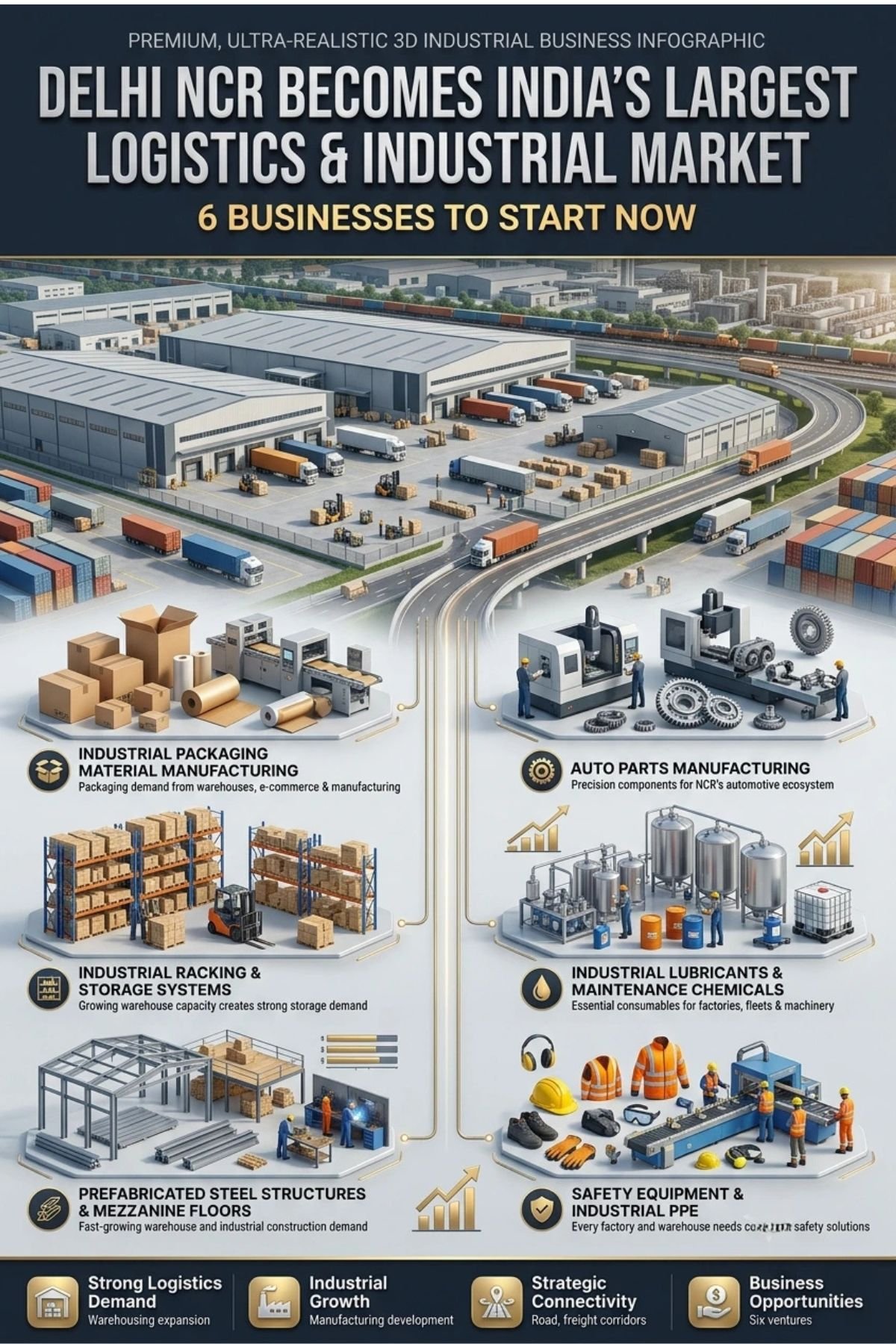
4. Industrial Lubricants and Maintenance Chemicals Manufacturing
Industrial Lubricants, cutting fluids, coolants, rust preventives and cleaning chemicals are needed continually in manufacturing plants. The demand for industrial maintenance chemicals in NCR will gradually increase as more engineering and manufacturing firms expand their presence in the area, accounting for a quarter of all leasing in the first half of 2026, according to the data from Cushman & Wakefield. A Blending and Bottling Plant for Speciality Industrial Lubricants (SIL) catering to the sector of Auto and Engineering is a capital light, high margin and highly repeatable business.
- Investment range: ₹30 lakh – ₹1.5 crore
- Key buyers: Auto component manufacturers, engineering companies, tooling companies
- The government support includes SIDBI MSME loan and Startup India tax benefits.
5. Prefabricated Steel Structures and Mezzanine Floor Manufacturing
Modular steel structures are now becoming a necessity for large industrial parks and logistics hubs for offices, security rooms, electrical rooms and material staging areas. The massive volume of new industrial leasing in the country (36.2 MSF in H1 2026) has led to a record demand from contractors and end-users for prefabricated steel structures. Small steel fabricators focused on pre-engineered modular units can secure consistent B2B business from industrial park developers, logistics firms, and auto manufacturers.
- Investment Minimum: ₹60 lakh to ₹3 crore.
- Key buyers: Industrial Park developers, logistics companies, factory operators
- Government support: MSME Udyam Registration; Make in India procurement preference
Get Detailed Insights from This Book: Steel and Iron Handbook
6. Safety Equipment and Industrial PPE Manufacturing
All manufacturing units, warehouses, and auto plants in the Delhi NCR area must legally maintain safety standards and supply workers with personal protective equipment (PPE). The demand for helmets, safety gloves, high-visibility jackets, safety boots and fire-safety gear is rising in sync with the overall rise in the number of industrial workers in NCR and the 69% increase in the number of workers leasing these items. The unit that produces gloves or protective helmets that conform to IS standards is in a captive and legally ordered market.
- Investment range: ₹25 lakh – ₹1.5 crore
- Key buyers: Auto OEMs, 3PL companies, construction contractors, industrial parks
- Government support: BIS product certification support, MSME Technology Upgradation Fund
Import–Export Opportunity Analysis
The industrial explosion in the Delhi NCR isn’t a local phenomenon. Growth in the manufacturing sector provides ample opportunities for exports, which founders can access if they position their products correctly in the region. The export expansion from NCR can be observed in NCR based manufacturers as per data from the Directorate General of Foreign Trade (DGFT) who are clearly targeting the export markets of the Middle East, Southeast Asia as well as Africa.
Export Opportunities Linked to the Industrial Surge
- Auto components prepared in Gurugram, Manesar and Noida are prepared to export to automotive aftermarkets in Middle East and Africa. Reduction of export barriers through bilateral trade agreements under FTA framework.
- The use of industrial packaging material from NCR markets is in demand e.g. Bangladesh, Sri Lanka and Nepal for importing finished inputs for packaging in the industrial market.
- NCR-based blending units are now getting markets in the Gulf Cooperation Council (GCC) countries, where Indian manufactured products are gaining good price competitiveness as industrial lubricants and specialty chemicals.
Import Substitution Opportunity
Much of the precision auto components, specialty industrial chemicals and warehouse automation components are still imported. The deliberate expansion of the industrial sector is a government policy goal for Delhi NCR in terms of import substitution. The PLI incentives are available to the manufacturers who develop manufacturing capacity for import substitute products, aimed at OEM chains, and the import substitution policy push of DPIIT is a plus.
Indian MSME Success Stories from Delhi NCR’s Industrial Corridor
Minda Industries Ltd. — Auto Component Pioneer from NCR
Founded as a small auto component company in Delhi, Minda Industries has since become a multi-thousand crore listed organization that has always catered to the OEMs in the NCR auto belt. They demonstrate how the NCR auto component supply chain can scale—from a family-run business to a listed company that supplies Maruti, Honda, and Bajaj.
Delhivery — 3PL Giant Born in the NCR Ecosystem
Founded in Gurugram in 2011, Delhivery became India’s largest fully integrated logistics platform. The company built its early infrastructure in the very logistics corridors that are now witnessing record leasing. Their success proves that the NCR logistics ecosystem is fertile ground for infrastructure-linked businesses.
Mayur Uniquoters — Industrial Manufacturing from Rajasthan to NCR Distribution
Mayur Uniquoters, a synthetic leather manufacturer supplying auto companies including Ford and Chrysler globally, built its NCR distribution network leveraging the region’s logistics infrastructure. Their export success demonstrates how NCR-linked manufacturers can achieve global supply chain integration.
Identify high-growth industries before others do
About NPCS — Niir Project Consultancy Services
If you are seriously evaluating any of the manufacturing business ideas highlighted in this article — whether it is industrial packaging, auto components, safety equipment, or prefabricated structures — Niir Project Consultancy Services (NPCS) offers detailed feasibility reports, project profiles, and technical-economic analysis for over 5,000 industrial products. NPCS reports cover plant layout, machinery specifications, raw material sourcing, financial projections, and regulatory compliance guidance.
NPCS has supported thousands of first-generation entrepreneurs, MSME promoters, and industrial investors across India in making informed project investment decisions. Their industrial business opportunity reports are among the most comprehensive pre-feasibility resources available to Indian manufacturing entrepreneurs. For any founder inspired by the Delhi NCR industrial surge that Economic Times has spotlighted, an NPCS project report is the right starting point before investing a single rupee.
Data Table: Delhi NCR vs. Major Cities — Logistics & Industrial Leasing H1 2026
| City | H1 2026 Leasing (MSF) | Market Share (%) | YoY Growth (%) |
| Delhi NCR | 8.7 | 24% | 69% |
| Chennai | 6.1 | 17% | 39% |
| Pune | 5.9 | 16% | 32% |
| Bengaluru | 4.8 | 13% | ~18% |
| Hyderabad | 4.1 | 11% | ~15% |
| Mumbai (MMR) | 3.6 | 10% | ~12% |
| Kolkata | 1.9 | 05% | ~10% |
| Ahmedabad | 1.1 | 04% | ~8% |
| TOTAL | 36.2 | 100% | 18% |

FAQ: Founder-Focused Questions on Delhi NCR’s Industrial Market
Q1. Why did Delhi NCR grow 69% in industrial leasing while other cities grew at only 15–39%?
Delhi NCR benefits from a unique combination of highway connectivity (Eastern Peripheral Expressway, KMP, DMIC corridor), a massive consumer market, a dense auto OEM cluster, and active state industrial policies from both Haryana and Uttar Pradesh. This multi-driver advantage produced outsized growth relative to other metros.
Q2. What is the minimum investment needed to start a manufacturing unit linked to Delhi NCR’s logistics boom?
For light manufacturing businesses like industrial packaging or safety equipment, founders can start with ₹25–50 lakh using MSME loans under CGTMSE. More capital-intensive sectors like auto components may require ₹80 lakh to ₹5 crore, eligible for PLI incentives and SIDBI term loans.
Q3. Which specific districts or industrial areas in Delhi NCR offer the best opportunities for new manufacturing units?
For auto components: Manesar and Dharuhera (Haryana). For packaging and logistics-linked manufacturing: Faridabad, Bahadurgarh, and Greater Noida. precision engineering: Noida Phase II and Ecotech zones in Greater Noida. Each micro-market has specific GIDC/HSIIDC/UPSIDC plot availability.
Q4. Can an MSME without prior manufacturing experience enter auto component supply chains?
Yes, but with preparation. New entrants should start with Tier-2 or Tier-3 components (fasteners, brackets, sub-assemblies) rather than complex engineering parts. NSIC’s vendor development programme and CII’s QMS certification support helps new MSMEs become OEM-eligible suppliers.
Q5. How does the PLI scheme directly benefit manufacturers starting in Delhi NCR?
PLI schemes across auto components, electronics, and pharmaceuticals offer 4–20% production-linked incentives over 5 years for qualifying manufacturers. Factories in Delhi NCR’s industrial zones — particularly Haryana’s Gurugram-Rewari corridor and UP’s Noida-Greater Noida stretch — are eligible for PLI benefits, as both states have identified strategic manufacturing locations.
Q6. What regulatory approvals does a new manufacturing unit in Delhi NCR require?
A new manufacturing unit needs MSME Udyam Registration, state factory licence (from Haryana or UP Labour Department depending on location), GST registration, Pollution Control Board consent (NOC), and product-specific certifications such as BIS for safety equipment or IATF-16949 for auto components.
Q7. Is the industrial packaging market already too crowded in Delhi NCR?
The 3PL leasing surge — 34% of all industrial leasing nationally — means new warehouses come online every quarter. Each new 3PL facility generates fresh packaging procurement needs. The market is active rather than saturated, especially for customised and speciality packaging formats serving e-commerce and cold chain logistics.
Q8. How can a small MSME identify the right 3PL company or auto OEM as an anchor buyer?
NSIC’s market intelligence services, CII industrial directories, and GeM (Government e-Marketplace) procurement listings are useful starting points. Attending CII NCR industrial summits and Haryana state investment conclaves allows direct introduction to procurement managers from large industrial occupiers expanding in NCR.
Q9. What is the export potential for auto components manufactured in Delhi NCR?
ACMA (Automotive Component Manufacturers Association) data shows Indian auto component exports reached USD 21 billion in FY25. NCR-based manufacturers supply to Middle East, African, and Southeast Asian markets. DGFT provides Export Promotion Capital Goods (EPCG) scheme support and drawback benefits for export-oriented auto component units.
Q10. Does the industrial leasing surge mean land and factory costs will rise sharply in NCR?
Some micro-market rentals have already moved 4–8% upward. However, Haryana’s HSIIDC and UP’s UPSIDC continue to allot new industrial plots at subsidised rates in peripheral zones. Founders who move in H2 2026 still have access to reasonably priced industrial accommodation before a potential rent correction in 2027.
Q11. How should a founder approach the NPCS project report as a decision-making tool?
A: An NPCS pre-feasibility report provides capital cost estimates, machinery specifications, break-even analysis, and market size data for a specific industrial product. It is best used after a founder has identified a target product category (e.g., industrial packaging, precision auto parts) and wants a structured, data-backed foundation before approaching a bank for a loan or a state government for a plot allocation.\
Conclusion: The Industrial Clock Is Running — Will You Move First?
Economic Times has laid out the evidence clearly: Delhi NCR is India’s largest logistics and industrial market in 2026. The 69% year-on-year leasing growth is not a statistical blip. It reflects a structural shift in where Indian manufacturers, logistics operators, and auto companies want to build their next facility.
For startup founders and MSMEs reading this, the question is straightforward: are you positioned inside this wave or outside it? The manufacturing businesses discussed here — packaging, auto components, industrial racking, lubricants, prefabricated structures, and safety equipment — are not speculative bets. They are direct supply chain requirements of the companies already leasing space in Delhi NCR’s industrial corridors.
Government policy actively supports entry into these spaces. Startup India provides three-year tax exemptions. MSME Ministry schemes offer collateral-free credit. State industrial policies from Haryana and Uttar Pradesh provide land, electricity, and capital subsidies. The infrastructure is in place. The demand is proven. The market signal from Economic Times is unambiguous.
The founders who move in the next six to twelve months — before H2 2026 seasonal demand peaks — will establish themselves as preferred suppliers inside a fast-maturing industrial ecosystem. Those who wait may find anchor buyers already locked into existing vendor relationships.