


Creatine Gummies Manufacturing Business
The Business Opportunity Inside Every Gummy
The Indian sports nutrition & wellness supplements market is becoming a mainstream segment. It is an ideal commercial real estate area for businessmen to grow with authentic business opportunities for both first generation entrepreneurs and manufacturing investors. Of the many products benefiting from this growth, Creatine Gummies are a stand-out opportunity. They are an effective combination of creatine monohydrate with the gummy delivery system that has proven effective and the taste is popular — and demand is growing at a higher pace than domestic production.
Creatine powder or creatine capsules had been on the market for decades. There were adoption barriers with both formats. Powders had to be mixed and capsules had to be swallowed whole. The gummy format addresses both issues at the same time. It’s portable, pre-dosed, flavoured and now popular among gym goers, athletes and even those not about fitness at all! For Indian businessmen, this is an obvious manufacturing window and any who act first will be taking a bigger share of the profits.
This article provides an in-depth look into the Creatine Gummies business, including market dynamics, government support, various business models, trade opportunities, and the factors required to establish a successful manufacturing or distribution business in India.
Why the Creatine Gummies Market Is Growing at an Exceptional Rate
The fitness supplement industry has seen a complete structural change in the past few years in India. Increased gym attendance, increased awareness of the importance of performance nutrition and the younger, health-conscious audience has combined to drive the demand for sports nutrition products to new heights. Creatine Gummies are among the fastest-growing segments within this category.
Global and Domestic Demand Drivers
The creatine supplement market is worth billions of dollars worldwide. It is expanding at a compound annual growth rate (CAGR) of more than 8%. The organised sports nutrition market is growing even faster in India. Consumers in tier-2 and tier-3 cities are just starting to explore structured sports supplements. Creatine Gummies can benefit from two other positive trends. The first is the shift from powder to gummy supplements across supplement categories. The second is premiumisation, where consumers are willing to pay more for convenience and taste.
This presents an interesting scenario for entrepreneurs looking into manufacturing possibilities. Creatine Gummies is still being made domestically, but in limited quantities. Majority of the products in India are either imported or made by a few big players. This gap allows new businesses — particularly those with the ability to provide low cost, flexible contracts or export quality — to enter the market.
Related Article: Magnesium Bisglycinate Manufacturing: Business Ideas, Market Opportunity & How to Start in India
Profit Margins and Commercial Logic
Creatine monohydrate, the primary compound found in most Creatine Gummies is among the most extensively researched and affordable sports nutrition supplements on the market. It has a comparatively low raw material price compared to the price of the end consumer. This yields margin architecture that’s appealing to manufacturers. Even at the B2B level, a finished gummy product is priced at a good premium over raw creatine powder. In the case of a branded consumer product, the margin is even bigger.
Further, gummy production facilities significantly share the same machinery as confectionery. Quality certifications and ingredient source improvements to existing confectionery units can allow them to be used for nutraceutical gummy production. This makes it easier for people who have had previous experience in the food processing or confectionery industry to become entrepreneurs.
Government Policies and Incentives Supporting Creatine Gummies Manufacturing
The policy landscape in India is becoming more conducive to the production of nutraceuticals and food supplements in the country. There are a number of initiatives from the central government that are especially beneficial for entrepreneurs thinking of venturing into the Creatine Gummies manufacturing business.
Production Linked Incentive (PLI) Scheme for Food Processing
The nutraceutical and processed food segment business owners can avail Production Linked Incentive (PLI) scheme through the Ministry of Food Processing Industries. PLI scheme provides funding based on the incremental sale of Indian products. Include nutraceuticals, health supplements and functional foods. This scheme helps to lower the effective capital costs and bring down payback periods for new manufacturing investments. Please see PLI Scheme for Food Processing Industries for details.
MSME Registration and Credit Support
The creatine gummy producers can access numerous financial and operational advantages once they register as an MSME via the Udyam portal. These include special consideration in loan repayment under the MSME Credit Guarantee Scheme, finances without any collateral up to ₹2 crore, and preferential consideration in government procurement. The units also get subsidised rates for ISO and FSSAI certification, which are both essential for food supplement manufacturers.
FSSAI and Regulatory Framework
In India, the production and sale of nutraceuticals and dietary supplements are regulated by the Food Safety and Standards Authority of India (FSSAI). Creatine Gummies fall under FSSAI’s health supplement and nutraceutical regulations. Regulatory compliance is a procedural obstacle, but it is also a quality barrier, helping to keep compliant manufacturers safe from low-quality manufacturers. Proper license enrollment at the outset gives entrepreneurs a long-term credibility edge in the domestic and foreign markets.
Startup India and DPIIT Support
The Startup India – DPIIT scheme offers tax benefits for the first three years, compliance via self-certification, and other simplified wind-up benefits to eligible nutraceutical startups. The government’s Make in India initiative also actively encourages local production in the food processing and health supplement industry with investor assistance and facilitation services.

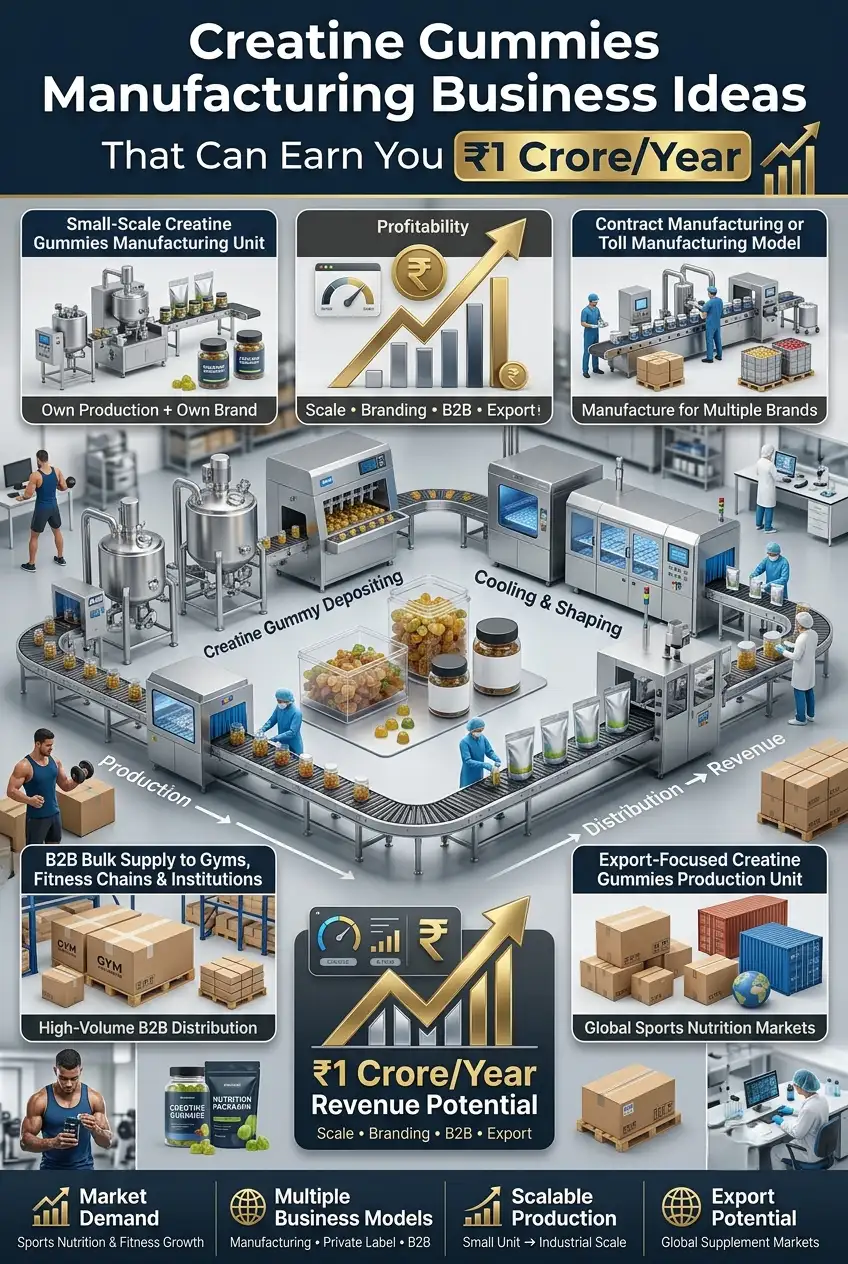
5 Powerful Creatine Gummies Business Ideas for Indian Startups
There’s no single business model for the opportunity in Creative Gummies. Firms can make their way into this market in a variety of ways, depending on capital availability, existing infrastructure and market access, with varying levels of risk, return and growth potential.
1. Small-Scale Creatine Gummies Manufacturing Unit
For those looking for an entrepreneur with moderate capital and a long-term vision of the category, the most straightforward path to setting up a dedicated, small-scale manufacturing unit for Creatine Gummies is to pursue it. In this model, creatine monohydrate is the active ingredient, pharmaceutical grade creatine monohydrate is purchased, the rest are gummy base materials (gelatin/pectin for vegan), natural flavors and sweeteners and colourants. Standard gummy-manufacturing equipment is used, such as mogul depositing systems, cooling tunnel and packaging lines.
The unit should target FSSAI’s nutraceutical manufacturing license from the outset. GMP certification significantly enhances credibility with B2B clients and export buyers. Initial production can serve domestic wholesale distributors, sports nutrition retailers, and gym chains. This model offers the highest long-term margin and builds genuine brand or contract manufacturing equity over time. Entrepreneurs with food processing backgrounds or those who have operated confectionery units will find the production knowledge transfer relatively manageable.
Get Detailed Insights from This Book: Biotech & Pharmaceutical Handbook
2. Contract Manufacturing or Toll Manufacturing Model
In the contract manufacturing scheme, the entrepreneur runs a manufacturing unit and produces Creatine Gummies for a third-party brand. This is the less risky steady income model, without the manufacturer needing to create their own consumer brand. Both domestic and foreign established brand manufacturers of supplements regularly look to contract manufacturers to produce gummies that comply with the quality, capacity and certification standards.
Here the key to success is having relevant quality certifications like FSSAI, ISO 22000 and optionally GMP and to have a portfolio of standardised formulations clients can choose from. A well-managed toll manufacturing unit can produce multiple brands while operating with high capacity utilisation and with predictable revenue. The model is especially good for entrepreneurs with a food production facility, looking to diversify to the high growth supplement category but without the expense of retail brand building.
3. Private Label and White-Label Creatine Gummies Supply
The private label model is placed between full manufacturing and pure distribution. In this strategy, the entrepreneur can produce or source ready-to-use Creatine Gummies and provide them to either retailers or fitness chains or ecommerce sellers who market them using their brand labels. The private label model has now seen a significant takeoff in India, where both small fitness businesses such as fitness studios and big fitness brands such as D2C wellness companies are looking to build their own supplement lines without capital investment in manufacturing.
The business value is the ability for the private label supplier to create a reliable, compliant and customisable product catalogue. The following are usually the most common areas where clients are willing to pay more for formulations:The following are some of the more typical areas where a client will pay more for a formulation: This model can be scaled quickly, as the entrepreneurs who have built effective sourcing agreements with ingredient suppliers and reliable co-packers can target a larger number of gym-label and e-commerce supplement brands without having to invest in marketing and sales to consumers.
4. B2B Bulk Supply to Gyms, Fitness Chains, and Institutions
The organised fitness industry in India, including gyms, sports academies, university fitness departments and corporate fitness centres, is a massive B2B market opportunity for Creatine Gummies. Institutional buyers are driven by product consistency, price, and supply reliability, and are not necessarily interested in brand appeal. This is a great opportunity for the manufacturers and distributors who can provide competitive unit prices and consistent delivery.
The B2B supply model for Creatine Gummies is ideal as a white-label or co-branded product. It suits gym chains that want to offer branded supplements with their memberships. The sales cycle is longer than consumer retail, but margins remain sustainable. Reorder rates are also high. Additionally, the risk of returns and brand reputation issues is lower. Gym owners, sports coaches, and nutritionists already have strong relationships in the fitness sector. Therefore, they can easily take advantage of this opportunity.
Get Detailed Project Report (DPR): Manufacturing Business of Protein Bar, Health Bar, Energy Bar, Nutrition Bar
5. Export-Focused Creatine Gummies Production Unit
India has export potential for the sale of quality, competitively priced nutraceutical gummies to international markets, especially Middle East, South East Asia, and Africa. The lower manufacturing cost is an advantage for Indian manufacturers as compared to their western counterparts, the well-established pharma-grade ingredients supply chains and the rising reputation of the Indian nutraceutical exports. An export-focused Creatine Gummies unit targets buyers in these markets through participation in international food and nutraceutical trade fairs, engagement with APEDA’s export promotion programmes, and direct outreach to international supplement distributors
In order to be competitive in the export markets, manufacturers are required to obtain international standard certifications, including Halal (required for Middle Eastern markets), Kosher, Non-GMO, and USFDA for products to be exported to the USA. The export model helps to spread the receipts across currencies and protects from the volatility of the domestic markets. Moreover, export incentives by the government, such as Remission of Duties and Taxes on Exported Products (RoDTEP) scheme, make exporting more cost effective and competitive with the international market.
Import–Export Opportunity Analysis for Creatine Gummies
The import-substitution possibilities in trade of Creatine Gummies are immediate and there is a good export potential in the medium term. It’s vital to grasp this two-sided story when it comes to any entrepreneur who wants to create a long-term enterprise in this category.
Import Substitution: A Domestic Manufacturing Imperative
Many of the Creatine Gummies consumed in India are imported, mostly from the USA, UK and Germany. As these imports come in at an import premium due to international shipping, import duties, and distributor margin added to the landed cost. Indian manufacturers that can do the same at a lower cost offer a compelling value proposition: equivalent or better product for a meaningful lower price.
The import-substitution angle also resonates with government procurement departments and institutional buyers seeking Made in India products under the ‘Make in India’ and ‘Aatmanirbhar Bharat’ initiatives. Entrepreneurs targeting this segment should obtain an Import Export Code (IEC) from DGFT. They should also ensure that their products meet Indian customs and FSSAI standards. Finally, they should build their products as quality domestic brands that can compete with foreign brands.
Export Markets: High Growth Potential
The story of exports from India is also very interesting – Nutraceutical exports. India is emerging as a global hub for nutraceuticals with a planned growth in export volumes, according to Invest India’s Nutraceuticals Sector overview. Creatine Gummies as a finished product, a value-added nutraceutical, enjoys significantly higher margins when sold overseas as compared to raw ingredients exports.
Indian Creatine Gummies manufacturers are likely to find the following markets as the most promising options in the near future: UAE and GCC countries (large South Asian population with a growing fitness culture), Southeast Asian countries, including Malaysia, Indonesia, and Vietnam, (growing middle class and the adoption of supplements is still in its early stages), Africa (organized supplement retail is a nascent industry). Important competitive edges of India as mentioned in the IBEF Health & Wellness sector report are the country’s growing export capability in nutraceuticals and health products.
Indian MSME Leaders in the Creatine and Nutraceutical Gummy Space
The sports nutrition and nutraceutical gummy space are seeing several Indian entrepreneurs and MSME companies that have effectively created their businesses, which can prove to be helpful examples for the first-generation entrepreneurs entering the Creatine Gummies business.
MuscleBlaze (Vijaydeep Mohini Malhotra & Team, HKK Media)
MuscleBlaze, founded by a team backed by media and consumer goods expertise, grew to become one of India’s most recognised domestic sports nutrition brands. Their success demonstrated that Indian consumers are willing to trust domestic supplement brands — and that local manufacturing with strong quality controls can compete effectively against international imports. Product expansion into gummy and convenience formats reflects the broader market trend that Creatine Gummies entrepreneurs can leverage. Their model shows that quality, transparency, and digital marketing combine to drive brand credibility in this category.
Steadfast Nutrition (Aman Puri)
Steadfast Nutrition, founded by sports nutritionist Aman Puri, built its business on science-backed formulations and clinical credibility. By positioning products for serious athletes rather than casual gym-goers, Steadfast established premium pricing power and strong institutional sales through sports federations and academies. Their approach to product development — starting with expert validation and building consumer trust through transparency — is a replicable model for Creatine Gummies startups that want to enter the premium B2B and institutional segment without competing solely on price.
Wellbeing Nutrition
Wellbeing Nutrition represents the new generation of Indian nutraceutical brands built specifically around the gummy delivery format. Their success in building a premium gummy supplement brand in India — from product development through D2C e-commerce — demonstrates that Indian consumers are not only open to gummy supplements but actively prefer them for certain nutrition categories. For a Creatine Gummies entrepreneur, Wellbeing Nutrition’s model offers a clear playbook: premium formulations, clean-label positioning, e-commerce-first distribution, and strong social media-driven brand building.
Discover business ideas that actually make money
How NPCS Can Help You Launch Your Creatine Gummies Business
At Niir Project Consultancy Services (NPCS), we provide professional consulting for the preparation of Market Survey cum Detailed Techno-Economic Feasibility Reports (DPRs) for setting up new industries and businesses — including Creatine Gummies manufacturing units. Our comprehensive reports cover detailed manufacturing processes, market research and demand analysis, process flow diagrams, product mix and capacity planning, machinery and raw material sourcing details, and complete project financials with profitability analysis.
Our objective is simple: help entrepreneurs evaluate the feasibility, profitability, and long-term scalability of their business before they invest capital. Whether you are planning a small-scale unit, a contract manufacturing operation, or an export-oriented facility, our reports provide the foundation you need to make confident, well-informed investment decisions. We have supported hundreds of MSME founders and startup investors in successfully establishing businesses across the food processing, nutraceutical, and specialty chemical sectors. You can also refer to the World Bank’s Global Nutraceuticals & Health Products Market overview to understand broader global trends shaping this industry.
Creatine Gummies Market and Business Overview: Key Data Points
| Parameter | Detail / Estimate |
| Global Creatine Supplement Market Growth (CAGR) | ~8–10% annually |
| Indian Sports Nutrition Market Growth Rate | ~15–18% annually |
| Preferred Delivery Format Trend | Gummies overtaking powders in several categories |
| Key Active Ingredient | Creatine Monohydrate (Pharmaceutical Grade) |
| Typical Creatine Gummy Serving Size | 3–5 gummies (delivering 3–5g creatine) |
| Key Consumer Segments | Gym-goers, Athletes, Fitness Enthusiasts, Young Professionals |
| Primary Export Markets | UAE, Southeast Asia, Africa, Europe |
| Regulatory Body (India) | FSSAI (Nutraceutical & Health Supplement Division) |
| Key Certifications for Export | Halal, Kosher, Non-GMO, GMP, ISO 22000 |
| Government Support Scheme | PLI (Food Processing), MSME Credit Guarantee, Startup India |
| Key Distribution Channels | E-commerce, Gym retail, Pharmacy, B2B institutional |
| Domestic Competitors | Limited — significant supply gap for domestic manufacturers |

Conclusion: The Window Is Open — Move Early in the Creatine Gummies Market
The Creatine Gummies market sits at the intersection of three powerful trends: the global mainstreaming of sports nutrition, the shift toward gummy supplement formats, and India’s rising demand for premium, science-backed wellness products. Together, these trends create one of the most compelling business ideas for Indian manufacturing entrepreneurs and startup founders right now.
What makes this opportunity particularly attractive is the domestic supply gap. Unlike mature product categories where established players dominate every segment, Creatine Gummies manufacturing in India is still in its early innings. Entrepreneurs who enter with the right quality certifications, realistic production plans, and a clear go-to-market strategy — whether in B2B supply, contract manufacturing, private label, or export — can build defensible positions before competition intensifies.
Government support through the PLI scheme, MSME credit guarantees, and Startup India makes the financial entry barrier lower than it has been in years. FSSAI’s nutraceutical framework, while demanding, also protects compliant manufacturers from low-quality market entrants. And the export opportunity — backed by India’s growing reputation as a nutraceutical manufacturing hub — provides a second revenue runway beyond domestic sales.
For entrepreneurs serious about evaluating this opportunity, a professionally prepared Techno-Economic Feasibility Report provides the financial modelling, process engineering, and market intelligence needed to move from interest to investment with confidence. At NPCS, we have helped hundreds of founders build exactly that foundation. The Creatine Gummies business is real, the demand is growing, and the domestic manufacturing window is open. The question is whether you will be among the first to walk through it.
Citations and References
- IBEF — Indian Health and Wellness Sector Report
- PIB — MSME Ministry Schemes Press Release
- MSME Credit Guarantee Trust Fund (CGTMSE)
- APEDA — Nutraceuticals Export Commodity Page
- Make in India — Food Processing Sector