


India’s manufacturing industry is at a turning point. To speed transition to solar thermal energy for industrial process heat, a significant new government initiative is in place, providing financial support up to ₹2 crore per project through ‘Viability Gap Funding’. The Ministry of New and Renewable Energy (MNRE) is leading the plan, and it is aimed at energy-intensive industries, which have traditionally been using energy from coal, furnace oil, diesel, and LPG to generate the required process heat. From an entrepreneur’s, MSMEs, technology developer or a Startup founder’s perspective, the message is not just about energy savings, but a shift in the structure of India’s industry’s energy production and consumption.
In its industrial process heating uses, energy use is approximately 40-50 percent of the total energy usage. Energy costs are impacting margins, the global landscape is demanding more sustainable processes, and the cost of solar-powered process heat is becoming a reality. With a top up of 50 per cent of project cost, up to ₹2 crore, the business case for industrial units, which have been waiting for the right trigger, is now stronger.
What This Development Means for Indian Businesses
Concentrating Solar Thermal (CST) is the technology that harnesses the sun’s energy by focusing and heating it up to industrial temperatures, without combustion of any fuel. CST systems can provide heat directly to production processes, and they suit industry sectors that need continuous thermal energy during the working day, unlike solar PV systems which generate electricity.
The government’s newly launched Renewable Energy Research and Technology Development (RE-RTD) Programme invites the industries, start-ups, private institutes and entrepreneurs to showcase their CST systems in actual production plants. The programme addresses a number of technologies, such as parabolic trough, linear Fresnel, parabolic dish and power tower systems, solar PV coupled heat pumps with thermal energy storage (TES). Up to 50 per cent of the capital expenditure is provided as grant funding, the balance in the form of funding from the industry host.
For manufacturers, this means that they can reveal a definite cost decrease chance. Cost of energy is a major operating cost for most small and medium-size industrial units running furnaces, dryers, boilers and sterilisation equipment. In addition to lowering the up-front investment cost, a funded demonstration project creates operational confidence in solar thermal technology, which has a near-zero fuel cost when compared with combustion-based technologies, and requires very little maintenance.
In addition to energy savings, it establishes a new opportunity for CST equipment manufacturers, system integrators, civil contractors, thermal storage specialists, digital monitoring vendors and O&M providers. Each funded project, it is basically a procurement, a procurement across numerous product and service categories, a new business opportunity at the industrial client level, and a new business opportunity at the supply chain level.
Solar PV Power and Solar Products Handbook
Why This Industry Could See Stronger Growth
Industrial decarbonisation is moving beyond the policy level and into becoming a procurement reality. Buyers are setting scope 3 emission targets for Indian suppliers in the apparel, food, auto and pharma sectors. The pressure on factories to have a credible pathway to cleaner energy is increasing, as they are being prioritized less in supply chains if they do not have a credible pathway to cleaner energy.
In the domestic sector, increasing fossil fuel prices and concerns of energy security are making solar thermal solutions competitively viable for their own merits. The prices of diesel and LPG have gone up significantly during the last few years and industrial users cannot be completely shielded from the fluctuations of commodity prices. Once installed, a CST system achieves a significant proportion of process heat at no fuel cost for 20-25 years, which is a major shift in the risk profile of industrial energy management.
Based on the estimates worked out by the MNRE in collaboration with the international partners, the market potential of CST in industrial heat is estimated at ~6.45 GWth in India. This is an underdeveloped market. Dairy, food processing, paper & pulp, chemicals, textiles, fertilisers, breweries and pharmaceuticals have particularly strong potential for CST integration. Several of these industries predominantly run by the MSMEs, and the government funding scheme is particularly relevant for small-scale manufacturers.
This fits into the policy framework of India’s overall renewable energy push to meet 500 GW of non-fossil fuel generation by 2030. The introduction of policy support measures like the existing VGF scheme is necessary to reach national emissions goals, and financial support measures should continue in the foreseeable future, with the first round followed by further rounds as the number of participants grows.
Government Policies and Incentives
The lead scheme for this industrial green heat initiative is administered by the Ministry of New and Renewable Energy (MNRE), which has opened the proposal submission window from September 8 to October 7, 2026 under its RE-RTD Programme. Eligible applicants include industries, startups, private research institutes, and entrepreneurs seeking to demonstrate CST technology at operational industrial sites.
Financial disbursement is channelled through the Indian Renewable Energy Development Agency (IREDA), which has maintained a dedicated loan scheme for CST projects in India for several years. IREDA’s CST loan facility complements the VGF grant by providing concessional debt financing for the portion of project cost not covered by the government grant, making it viable for smaller industrial units with limited capital.
MSMEs investing in energy efficiency and renewable energy projects can additionally access support through the Ministry of Micro, Small and Medium Enterprises (MSME). Technology Up-gradation support, credit guarantees, and cluster-level infrastructure development programmes that the MSME Ministry administers can be used in conjunction with MNRE support to reduce the financing cost for smaller manufacturing units.
Startup founders entering the solar thermal technology manufacturing or project development space can leverage the Startup India initiative for tax incentives, regulatory fast-tracking, and access to incubation networks. The RE-RTD programme explicitly includes startups as eligible applicants, making this a genuine entry point for early-stage companies with innovative CST product propositions.
Explore Our Renewable Energy Projects
The Bureau of Energy Efficiency (BEE) under the Ministry of Power administers energy audit, star-labelling, and energy conservation schemes that align with the industrial energy transition being driven by MNRE’s CST initiative. BEE’s Partial Risk Guarantee Fund and other financing facilitation tools are relevant for industries evaluating the full transition path.
Industrial manufacturers seeking export market advantages from their green credentials can access support from the Agricultural and Processed Food Products Export Development Authority (APEDA) and from export promotion councils in textiles, chemicals, and leather—all sectors explicitly identified as CST candidates by MNRE.
State-level investment promotion authorities such as the Tamil Nadu Industrial Development Corporation (TIDCO) and their counterparts in Rajasthan, Gujarat, Maharashtra, and Karnataka have begun integrating green energy compliance requirements into new industrial approvals. Entrepreneurs setting up new manufacturing units in these states benefit from both central government VGF support and state-level capital investment subsidies where applicable.
Exporters in energy-intensive sectors can access facilitation support through the Federation of Indian Export Organisations (FIEO) to develop sustainability documentation that demonstrates process-heat decarbonisation to international buyers—a growing procurement requirement across European and North American markets.
The National Institute of Solar Energy (NISE)—an autonomous R&D institution under MNRE—provides testing, certification, and technical consultancy for solar thermal technologies. Technology developers and entrepreneurs entering the CST manufacturing space should engage with NISE for product validation, which is critical for accessing government procurement and funded demonstration programmes.
Manufacturing Business Opportunities Emerging From This Development
1. Parabolic Trough Collector (PTC) Manufacturing
Parabolic trough systems are one of the most mature and scalable CST technologies, and are effective for process heat applications in an industrial setting at temperatures and pressures in the range 100°C to 400°C. Most industrial process heating applications in food, dairy, beverages, and chemicals fall into this temperature range. All the present reflector, receiver tube and tracking mechanisms for the Indian market are imported products.
An MSME-ready manufacturing facility with a capacity of 500 kW of parabolic trough collectors (PTC) can feed the market demand of the country for PTCs as spurred by the VGF programme and the anticipated ensuing rounds. The target customers are EPC companies who assemble demonstration projects, and direct industrial buyers. The business is capital moderate, technically challenging and has a high growth potential. Southeast Asia, Africa and the Middle East offer potential export markets for industrial solar thermal, which is early in the growth cycle.
2. Thermal Energy Storage (TES) System Manufacturing
Thermal energy storage—storing the heat collected during the high sunshine hours for use during the low sunshine hours—is one of the most important enabling technologies for reliable solar thermal in industry. Depending on the temperature requirements, the current TES solutions involve molten salts or phase-change materials or a solid media such as rock or ceramic beds.
Manufacturing TES vessels, insulation systems, heat exchangers, and control electronics for the industrial segment represents a genuine opportunity for an engineering-oriented MSME. The government’s programme explicitly requires TES integration in demonstration projects, ensuring near-term demand. The technology is complex enough to create sustainable competitive advantage for a specialised manufacturer, yet accessible enough that an experienced engineering firm can enter with modest R&D investment.
3. Solar Thermal System Integration and EPC Services
In addition to equipment manufacturing, there are also project development, engineering, procurement and construction (EPC) services that are required for the deployment of CST systems at industrial sites. Site assessment, Optical Design, Civil Foundation, Piping Integration, Heat Exchange Coupling with existing Boilers or Process Equipment etc. are all billable works which currently do not exist at scale.
The industrial solar thermal market is increasingly going down the path of fast-track startups or service providers in the solar thermal field. Lower initial investment than equipment manufacturing, market is coming into view now with funded projects; and successful installations are bankable references for the next round. This is a business model that would benefit technically trained entrepreneurs who have a background in project management and networks of industrial clusters.

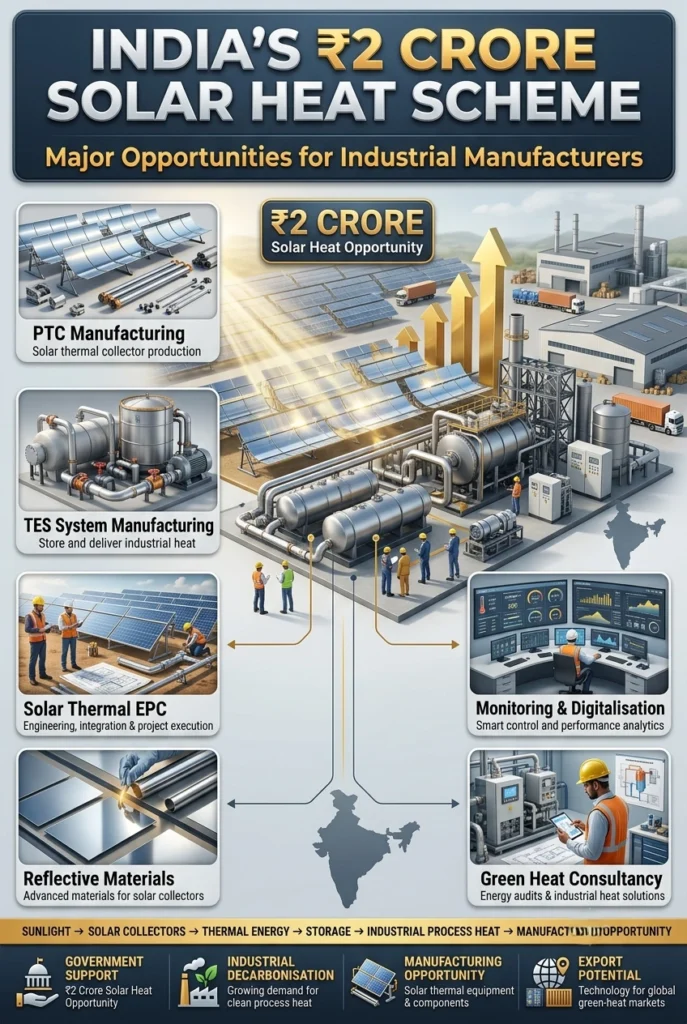
4. Solar Thermal Monitoring and Digitalisation Solutions
To verify the technical and economic performance, all the pilot projects of RE-RTD Programme of MNRE are required to monitored with the data. Therefore, this means that there is a demand for remote monitoring systems, data loggers, performance dashboards and analytics platforms tailored to the specific needs of industrial solar thermal systems.
Furthermore, an IoT or software startup developing infrastructure to monitor efficiency of collectors, heat delivery, displacement of fossil fuels and CO2 savings for CST systems can be a key partner in any project that funds these activities. In addition, the business model can be a mix of hardware installation income and software-as-a-service income. Moreover, the longer that systems are in place, the more the monitoring revenue will keep coming in without a corresponding increase in cost.
5. High-Performance Reflective Material Manufacturing
CST systems rely on optical reflectors, which consist of highly polished metal sheets or glass mirrors with state-of-the-art coatings that focus sunlight onto heat collection elements. In addition, the material should be durable, weatherproof, cost-effective, and highly reflective for long periods outside. Presently, India imports most of the high grade materials used for solar reflection.
Furthermore, prospective opportunity to develop an aluminium manufacturing unit for the CST market producing sheets of aluminium reflectors coated with protective polymer layers or thin-glass solar reflectors (mirror panels) is very substantial, i.e., import substitution.
6. Industrial Green Heat Consultancy and Energy Audit Services
The first step for any industrial unit interested in a CST project is to have a professional energy audit, technology selection study, financial modelling and proposal preparation. This consultancy service layer is vital to the ecosystem, but has not been well-served. A dedicated consultancy firm with expertise in the MNRE application process can generate income right away in the current window of opportunity for the feasibility, proposal writing, technology vendor selection and regulatory compliance process and also create a pipeline for future rounds of the MNRE application process.
It is a highly scalable, asset-light, small team of energy engineers’ business. It can gradually transform itself to become a full project development firm that acquires equity positions in the projects it supports – something that has already successfully used in the renewable electricity industry.
Import-Export and International Market Opportunity
India now imports almost all the components used in CST systems, such as precision mirrors, tracking drives, heat transfer fluids and selective coating tubes (heat collection elements). The MNRE initiative helps develop the domestic demand base to justify investment in these categories of products for import substitution. Once projects have commissioned and gathered performance data, domestic manufacturers with reasonable technical capability will feel more at ease to scale their businesses and, eventually, compete in the export market.
The global industrial process heat market – accounting for more than 20 percent of the global energy consumption – is now gaining solar thermal interest in the sun-rich developing nations. India, where engineering manufacturing exists, is cost competitive and has acquired domestic reference installations, and is well positioned to become a supplier of CST equipment and services to Southeast Asian, African and Gulf markets. There are industrial solar heat programmes in countries like Morocco, Egypt, Kenya, Vietnam and Thailand which can take Indian CST components.
The opportunity to prove the use of solar process heat within their food processing and textiles production is a real trade secret for these exporters, as is the opportunity to quantify the results of the scope 3 emission reductions. European import requirements are becoming more stringent on the carbon footprint of manufactured products, and Indian suppliers that can show products from verified third-party monitored systems for green heat will have an edge in securing and expanding export business.
Indian MSMEs and Startups in Related Industries
Thermax Limited
Thermax is an established Indian firm operating in the field of industrial energy and environment solutions, including solar thermal & waste heat recovery systems. The company has been developing products that are concentrating solar thermal for the process industries and therefore directly relevant to the current government push. Thermax experience also shows that industrial solar thermal is a viable business for entrepreneurs and smaller players, with potential for significant corporate investment within India’s market, thereby substantiating the market opportunity for MSME’s to join the business.
Clique Solar
Clique Solar India Ltd is a company that has been into the business of developing solar process heat systems for industries, especially food & beverages. Their projects indicate the commercial potential of certain industrial applications of solar thermal, and their business model (enabling CST to integrate into existing boiler systems) illustrates how a startup can develop a viable solar thermal business without the need for full green field installations. Entrepreneurs looking into the EPC or technology integration model can learn about their project packaging and their client management with industrial clients.
Megawatt Solutions
There are several MSME-based solar energy solution providers who have acquired the expertise of integrating solar thermal into their mainstream business of solar PV. These firms are ideally suited for targeted technical capability and to switch their business focus to CST project development for their industrial clients. The message for the aspiring entrepreneur is that solar project development, electrical engineering, and knowledge of industrial processes provide a solid basis to engage in the CST service market with relatively low entry costs.
What Entrepreneurs Should Evaluate Before Investing
The industrial solar thermal opportunity is real, but it requires careful evaluation before commitment. Therefore, key considerations include:
Market demand: Identify specific industrial clusters—dairy co-operatives, textile dyeing units, food processing parks, pharmaceutical clusters—within a radius where solar radiation levels are high enough to make CST economics attractive. For example, Rajasthan, Gujarat, Maharashtra, and Tamil Nadu offer particularly strong solar resource conditions combined with dense industrial activity.
Technology selection: Different CST technologies serve different temperature ranges. For instance, parabolic trough and linear Fresnel systems work well between 100°C and 250°C, covering most food, dairy, and textile needs. Meanwhile, higher-temperature applications in ceramics, chemicals, and metal processing require parabolic dish or power tower configurations. Therefore, technology match to the target industrial segment is critical to project performance.
Regulatory and approval pathway: CST projects at industrial sites require rooftop or land allocation from the host industry, net metering or heat metering arrangements, and in some cases environmental approvals depending on site and scale. As a result, clarity on the approval timeline is essential before committing to project development timelines.
Turn your budget into a successful business plan
Capital structure: The VGF support of up to ₹2 crore covers 50 percent of eligible project costs. The balance needs to come from the host industry’s own funds, bank loans, or IREDA concessional financing. Entrepreneurs developing CST projects for industrial clients need to structure the financial model carefully to ensure viability at the targeted project scale.
Operations and maintenance: CST systems require regular optical cleaning, tracker calibration, and heat exchanger maintenance. A five-year O&M commitment is part of the proposal requirements under the current MNRE scheme. Entrepreneurs need a credible O&M plan and, if acting as EPC, the ability to execute it reliably.
Competition and pricing: While the CST market in India is at an early stage, international players—particularly from Germany, Spain, Israel, and China—have established products and references. Domestic entrepreneurs need a cost or customisation advantage to compete effectively. Focusing initially on service integration and project development, rather than competing directly with established equipment manufacturers, is a lower-risk entry point.
How NPCS Can Help Entrepreneurs Evaluate the Opportunity
NPCS – Niir Project Consultancy Services has supported Indian entrepreneurs, MSMEs, investors, and industrial manufacturers in evaluating and executing manufacturing and industrial projects for decades. For those exploring the solar thermal business opportunity—whether as a technology manufacturer, EPC provider, or industrial unit seeking to adopt green heat—NPCS offers:
Detailed Project Reports (DPRs) covering solar thermal component manufacturing, process integration feasibility, plant layout, and investment analysis. Market Research studies covering industrial heat demand, sector-by-sector opportunity mapping, and competitive landscape assessment across domestic and international markets. Technology Consultancy helping entrepreneurs understand CST technology options, supplier ecosystems, performance benchmarks, and manufacturing process requirements.
Plant and Machinery Assessment identifying equipment suppliers, cost estimates, installation requirements, and vendor evaluation criteria for CST manufacturing and project development businesses. Feasibility Studies addressing financial modelling, break-even analysis, payback period projections, and investment return scenarios across different project scales and sector applications.
NPCS project reports and feasibility studies provide the analytical foundation that turns an interesting market signal into a properly evaluated investment decision—reducing the risk of entering a complex emerging sector without adequate preparation.
Business Opportunity Snapshot
| Industry | Industrial Solar Thermal / Concentrating Solar Thermal (CST) / Green Process Heat |
| Market Driver | Government VGF support up to ₹2 crore per project; rising fossil fuel costs; global sustainability procurement requirements |
| Key Development | MNRE RE-RTD Programme inviting proposals for CST-based industrial process heating demonstrations (deadline: October 7, 2026) |
| MSME Opportunity | High — VGF covers 50% of costs; eligible sectors include dairy, food processing, textiles, chemicals, pharmaceuticals, ceramics |
| Manufacturing Potential | CST equipment (reflectors, receivers, TES systems), monitoring hardware, heat exchangers, tracking drives, insulation systems |
| Export Potential | Medium to High — SE Asia, Africa, Gulf; also via green credential advantage for industrial exporters |
| Import Substitution | High — selective coating tubes, precision mirrors, tracking drives, speciality heat transfer fluids currently largely imported |
| Government Support | MNRE VGF (up to ₹2 cr/project), IREDA CST loans, MSME schemes, Startup India, BEE energy efficiency programmes |
| Investment Consideration | Moderate — manufacturing entry requires ₹2–10 cr depending on product; EPC and service businesses can enter at lower capital |
| Risk Level | Medium — technology performance risk, industrial client adoption pace, competition from global players |
| Growth Outlook | Strong — 6.45 GWth market potential identified; policy support expected to continue across multiple programme rounds |

Conclusion
India’s decision to back industrial process heat decarbonisation with direct capital support—up to ₹2 crore per project through Viability Gap Funding—is a materially important development for the manufacturing sector. Moreover, it signals that the energy transition in Indian industry is moving from aspiration to funded action, with a dedicated programme structure, a broad list of eligible sectors, and an open invitation to startups, entrepreneurs, MSMEs, and technology providers to participate.
Furthermore, the business opportunity this creates is multi-layered: industrial users can achieve direct energy cost savings, equipment manufacturers can tap opportunities in a largely import-dependent product category, EPC and service businesses can grow at the project development level, and startups can explore technology and monitoring software opportunities. In addition, the programme explicitly aims to generate replicable business models and scalable commercial deployment, which means that early movers who establish successful installations will gain an advantageous position as the market expands across subsequent programme rounds.
For this reason, for entrepreneurs, investors, and manufacturing businesses evaluating this opportunity, the recommended path forward is: begin with thorough market research to identify the target industrial segment and geographic cluster; commission a proper feasibility study addressing technology, finance, and regulatory dimensions; prepare a Detailed Project Report for investment planning; and engage with NPCS or other qualified consultancies to ensure the analysis reflects current market reality. However, the current proposal window is narrow—closing October 7, 2026—but the structural opportunity