


India’s coconut sector is witnessing a paradigm shift. From processing parks across Kerala, Tamil Nadu, Karnataka and AP emerge entrepreneurs who are building virgin coconut oil (VCO), desiccated coconut (DC), coconut milk powder, shell activated carbon and spray-dried coconut cream units that fetch a rich premium in global markets and fit India’s export strategy. Finding the best coconut and coconut value-added products industry consultants in India is therefore a critical decision for anyone launching a new venture in this domain. Be it a standalone VCO plant or an expansion of an existing copra milling unit to a comprehensive processing unit, professional consultancy support is the difference between a bankable project and a stalled investment.
The coconut sector in India is at an exciting crossroads. The Coconut Development Board (CDB), a statutory body under the Ministry of Agriculture and Farmers Welfare with its headquarters at Kochi, is promoting value addition, processing and exports. Coconut product exports hit ₹7,038.35 crore representing a 62% year-on-year jump. India accounts for 31.24% global coconut production and the domestic market for coconut-derived health and wellness products is set to grow rapidly. Yet for most founders, the technical intricacies of setting up a compliant, profitable coconut processing facility is underestimated, where experienced coconut industry consultants play a vital role.
What Do Coconut Industry Consultants Actually Do?
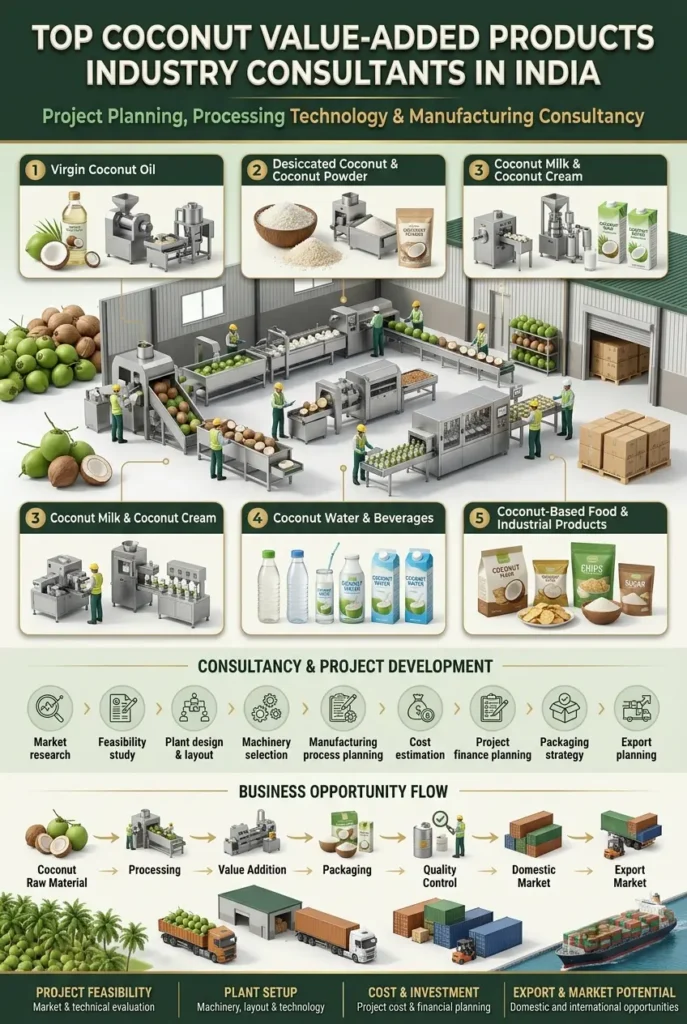
The role of a coconut industry consultant goes beyond document drafting, with credible consulting firms offering end-to-end support ranging from identifying the optimal product mix and capacity to commissioning. For a coconut processing project, this involves a Detailed Project Report (DPR) or techno-economic feasibility study that addresses raw material sourcing (copra, fresh coconut, coconut water), manufacturing process selection (plant layout and machinery specifications), manpower planning, and financial projections including breakeven analysis and internal rate of return.
Furthermore, Process engineering consultants help entrepreneurs choose between competing technologies (for example, whether to adopt a cold-press centrifugation route or a wet-mill fermentation process for VCO, or whether to integrate a spray dryer to produce coconut milk powder alongside a primary DC line). Meanwhile, EPC consultants help manage procurement of machinery, civil infrastructure, and utilities. In addition, Regulatory advisory support is critical (coconut food products have to conform to FSSAI licensing requirements, units seeking export markets must align with quality norms set by the Food Safety and Standards Authority of India (FSSAI) and international standards bodies) and compliance with the Factories Act and clearances from State Pollution Control Boards is required and is a role managed by capable consultants.
Beyond documentation, the best coconut plant consultants also offer market intelligence (buyer segment mapping, price benchmarking across domestic and export markets, competitive analysis) and for a first-generation entrepreneur entering the coconut value-added sector, this component often proves as valuable as the engineering content.
Why India Is a Hotspot for Coconut Value-Added Manufacturing
India’s status as the world’s top coconut producer (20,301 million nuts annually from 2.19 million hectares) provides a natural raw material advantage for processing entrepreneurs. Kerala alone cultivates nearly 7.54 lakh hectares of coconut and Tamil Nadu leads in production volumes with Andhra Pradesh recording the highest productivity. This makes southern India an attractive destination for VCO, desiccated coconut and coconut shell products manufacturing besides government support (the Ministry of Food Processing Industries (MoFPI) PLI scheme and the PM Formalisation of Micro Food Processing Enterprises (PMFME) scheme provide capital subsidies and linked incentives for coconut processing units).
Export potential is another draw, with India’s coconut product exports hitting USD 794.70 million and the trajectory pointing upwards. Key export markets include the USA, UAE, Germany, Australia, UK with demand concentrated in VCO, desiccated coconut, coconut milk powder, coconut shell charcoal. The IBEF data on India’s coconut sector and Invest India platform are a testament to coconut processing being one of the most investor-ready food processing sub-sectors in the country currently.
Import substitution is yet another driver (products such as coconut cream concentrate, spray-dried coconut milk powder and refined coconut oil enter India through imports for use by the food industry; domestic manufacturers can produce such products using a solid DPR and sound market intelligence, creating an opportunity) while India’s growing organised retail and D2C e-commerce channels are devouring branded coconut-based consumer products at a far greater rate than a decade ago…

How to Evaluate the Best Coconut Industry Consultants in India
Choosing a consulting firm for a coconut processing project requires careful evaluation. Domain expertise is the first consideration, with a consultant who has prepared feasibility reports for coconut oil from copra, VCO plants, desiccated coconut lines and coconut shell charcoal units offering fundamentally different depth of knowledge from a generalist advisor. Ask whether the firm has worked on FSSAI-compliant coconut food product projects and whether their engineers have hands-on exposure to spray drying, copra pressing, centrifugal separation, shell carbonisation processes.
The DPR and feasibility track record is the second critical criterion, with a bankable DPR for a coconut processing unit that includes details of process flow diagrams, equipment selection, utility load calculations, working capital cycle analysis, and sensitivity analysis on copra price volatility (known risk in this sector) proving vital. If a consultant cannot demonstrate prior work in food-grade plant documentation, the DPR they produce is unlikely to satisfy a bank’s credit appraisal committee or a government subsidy-linked disbursement process.
Engineering and EPC capability increasingly matter as projects scale up, with EPC support (covering civil work supervision, utility installation, commissioning assistance) representing significant cost and time savings for a DC-plus-VCO integrated plant targeting ₹5–10 crore in investment. In-house mechanical and electrical engineering teams are better suited for this than pure advisory firms, while a consultant must demonstrate verifiable knowledge of FSSAI licensing, CDB registration for export-focused coconut units and Factories Act compliance. Finally, the consultant’s client portfolio provides real-world validation, with proven engagements with coconut processing entrepreneurs in Kerala, Tamil Nadu, Karnataka, Andhra Pradesh signifying meaningful on-the-ground experience.
Role of NPCS in Coconut and Coconut Value-Added Products Project Consultancy
Niir Project Consultancy Services (NPCS), established in 1994 and headquartered in Delhi, is one of India’s most established industrial consultancy firms with consistent, multi-decade experience across the full coconut value-added products segment. With over 30 years manufacturing consultancy experience, 150,000+ projects delivered, and clients across 85 countries, NPCS brings both scale and depth to coconut processing project advisory work. The firm’s coconut industry expertise spans coconut oil from copra, virgin coconut oil (VCO), desiccated coconut (DC), coconut milk, spray-dried coconut milk powder, coconut cream, coconut shell charcoal, shell powder, related by-products.
NPCS prepares Detailed Project Reports (DPRs) and techno-economic feasibility studies for coconut processing and allied food manufacturing projects — covering manufacturing process selection and plant layout, machinery and raw material sourcing, market research and demand analysis, process flow diagrams and product mix planning, and complete project financials with profitability projections. These reports follow bank lending criteria, support government subsidy applications, and help investors conduct due diligence — making them genuinely bankable documents rather than generic outlines. For entrepreneurs who want to explore available coconut processing project profiles, NPCS maintains a curated catalog at niir.org coconut project profiles covering a wide range of products including VCO, DC, coconut milk powder, and shell-based derivatives.
NPCS has a documented track record of assisting clients across the coconut and related bio-based sectors, including M/s.
Sri Mahasakthi Mills Private Limited from Coimbatore, Tamil Nadu who engaged NPCS for an economic and financial viability analysis on activated carbon from coconut shell (a high-value downstream application gaining traction for water filtration). M/s. Valeo India Private Limited from Chennai, Tamil Nadu commissioned a feasibility study for activated carbon from coconut shell, which is a reflection of manufacturing companies’ interest in diversifying into coconut shell-based value chains. Dr. Varunkumar S from IIT Madras, Chennai engaged NPCS for detailed information on the economic, technical, financial, managerial and production aspects of activated carbon from coconut shell, signifying institutional-level research interest in the sector.
M/s. Vijaya Roof and Wall Cladding Systems Pvt. Ltd. from Mumbai, Maharashtra engaged NPCS for a project feasibility and market study for the establishment of a coconut oil from copra unit, demonstrating that even companies outside traditional agri-processing are entering the coconut sector. Additionally, Mr. Raghavendra Jakandi from Hospet, Karnataka engaged NPCS for an economic and financial viability analysis on activated carbon from rice husk, saw dust and coconut shell, a multi-feedstock approach allowing for raw material flexibility and stronger unit economics.
These client engagements across Tamil Nadu, Maharashtra and Karnataka and initiated by a stakeholder ranging from institutional researchers to infrastructure companies, reflect the broad applicability of NPCS’s coconut project advisory capabilities. All NPCS DPRs for coconut processing units use current market data, FSSAI food safety frameworks, and realistic assumptions about copra procurement costs, energy consumption, and product pricing, giving clients a sound foundation for investment decisions. Learn more at www.niir.org.
Delhi and the Broader India Consultancy Landscape for Coconut Processing
When entrepreneurs search for the best coconut industry consultants in Delhi, they are typically seeking firms with national-scale project expertise rather than purely regional exposure. For example, Delhi-based consultancies (including NPCS) serve clients across Kerala, Tamil Nadu, Karnataka, AP, Maharashtra, Gujarat, and even the northeastern states (where coconut processing opportunity is emerging). Therefore, the centralised nature of India’s industrial consultancy sector makes it possible for a boutique management consulting firm or a specialised process plant consultancy in Delhi to effectively serve a client planning a VCO unit in Thrissur or a DC manufacturing facility in Tirunelveli.
Meanwhile, regionally, the south Indian consultancy ecosystem (based in Kochi, Chennai, Hyderabad, Bangalore) hosts coconut-specialised process engineering consultants and food technology advisors. Additionally, the Coconut Development Board’s Technology Development Centre at Vazhakulam, Kerala and its regional offices in Chennai and Bangalore serve as knowledge hubs.
Consulting Service Types for Coconut Processing Projects: A Comparison
| Service Type | Key Deliverables | Best-Fit Client | Approx. Cost (₹) |
| Techno-Economic Feasibility Study | Market research, process overview, financial projections, risk assessment | First-time entrepreneurs, NRI investors, concept-stage evaluation | ₹25,000 – ₹75,000 |
| Detailed Project Report (DPR) | Full process engineering, plant layout, machinery list, CMA data, profitability | Bank loan applicants, subsidy seekers, MSME units scaling up | ₹50,000 – ₹2,00,000 |
| Process Engineering Consultancy | Process flow diagrams, mass-energy balance, equipment sizing, utility design | Mid-scale VCO, DC, or coconut milk powder plant developers | ₹1,50,000 – ₹5,00,000 |
| EPC Project Management | End-to-end procurement, civil supervision, utility installation, commissioning | Large-scale integrated coconut processing parks or export-oriented units | ₹5,00,000 – ₹20,00,000+ |
| Market Research Report | Demand-supply analysis, competitor mapping, export market potential, pricing trends | Investors or existing players evaluating diversification or export entry | ₹30,000 – ₹1,00,000 |
Conclusion: Making the Right Start in Coconut Processing
India’s coconut sector is evolving at a pace that rewards entrepreneurs who plan early and well. Moreover, the combination of abundant raw material supply, government support, export demand and domestic consumption of coconut-based health products create a compelling case for new manufacturing investment. However, the quality of the initial consultancy work almost always determines whether a project gets financed and commissioned or stalls at the planning stage.
Furthermore, the top coconut and coconut value-added products industry consultants in India bring more than document drafting skills to the table, with market intelligence, process engineering judgement and regulatory knowledge playing a vital role. Whether you are exploring VCO, desiccated coconut, coconut milk powder, shell charcoal or activated carbon from coconut shell – the right consultant will help you make the right choices before you commit capital.(Coconut Industry Consultants in India)
For entrepreneurs, investors and MSME business planners looking for expert support, NPCS offers a proven track record, a comprehensive library of coconut processing project profiles and a team that combines business intelligence with technical engineering depth. Take the time to explore your options, verify your consultant’s credentials, and commission a properly structured DPR before you move to plant setup. In the coconut processing business, good project planning is your first and most important investment.
Your Investment Deserves the Right Opportunity
Every serious investment begins with choosing the right sector and the right business model. With hundreds of industrial opportunities available across India’s manufacturing and clean-energy landscape, making the most informed choice is critical. Niir’s Startup Selector tool helps entrepreneurs, MSMEs, and investors identify the most suitable business opportunities based on their investment capacity, location, and interests — so your capital is directed toward a venture with the strongest fit and potential.