


The move toward single-use plastics has become a trend, and it is now being phased out of India’s market. The business case for biodegradable plastic bags becomes even stronger as the Ministry of Environment, Forest and Climate Change (MoEFCC) increasingly implements stricter regulations with successive amendments to the Plastic Waste Management Rules and as even small manufacturers are being compelled to comply with the Extended Producer Responsibility (EPR) norms. But for entrepreneurs planning to make their debut in this field, the regulatory complexity, technological requirements for biopolymer, planning for capital investment are indispensable without expert guidance.
This is where the role of the biodegradable plastic bags industry consultants in India becomes crucial for those who are thinking of establishing a plastic bag plant, for validating the project idea or if they want to increase the production scale of their existing plant. It has been written to include who these consultants are, what they do and how to assess them and why India is becoming a manufacturing hub for the world of eco-friendly alternatives to packaging.
The Market Opportunity: Why Biodegradable Plastic Bags in India, and Why Now
Every year, India produces millions of tonnes of plastic waste, many of which are in the form of carry bags for humans and flexible packaging for food. With the government’s ban on single-use plastics below 120 microns and new EPR targets under the Plastic Waste Management Amendment Rules, demand for certified and compliant alternatives such as compostable bags has increased significantly. The market for biodegradable plastic packaging in India is expected to experience robust double-digit growth in the future, fueled by the pressure of legislation, consumer awareness, and swift adoption by organised retailers, food delivery platforms, and e-commerce players.
The worldwide demand for biodegradable plastic bags and sacks is expanding steadily with Asia – and India especially – being a key consumption and potential export market. Corn starch (PLA), cassava starch, and also blended biopolymer products, such as PBAT, are actively demanded in the European, Southeast Asian and Middle Eastern markets. This is a potential opportunity for Indian entrepreneurs to reach the large domestic market as well as export markets where certified compostable packaging is a necessity. This is one of the most promising manufacturing investment opportunities for MSME investors today, thanks to the domestic policy push and international demand pull.
India’s Chemicals sector offers 100% FDI under the automatic route for most chemical manufacturing, including bioplastics-adjacent categories. The Packaging sector page on Invest India highlights a clear shift toward sustainable materials, noting growing investment in recyclable, reusable, and biodegradable packaging formats. Similarly, the Chemicals sector overview on Invest India confirms the government’s intent to position India as a global manufacturing hub for specialty chemicals and polymers, including bio-based alternatives. These policy signals make this a compelling moment to enter the market with the right planning and expert consultants behind you.
Explore This Book: Handbook on Biodegradable Plastics (Eco Friendly Plastics)
What Do Biodegradable Plastic Bags Plant and Process Consultants Actually Do?
Many entrepreneurs mix up a consultant and a machinery supplier. They are different and a wrong identification can cost an investor lakh of rupees in the selection of wrong equipment, plant layout or even in not getting the regulatory clearance. A knowledgeable biodegradable plastic bags industry consultant in India serves at least four levels of service: feasibility validation, technical design, navigating regulatory requirements, and financing the project.
Feasibility Studies and DPR Preparation
Any project is based on a Techno-Economic Feasibility Study (TEFS) or a Detailed Project Report (DPR). Consultants in the bioplastics and biodegradable packaging industry need to have an understanding of the manufacturing process, raw material costs and dynamics (corn starch, PBAT, importation of PLA, availability of cassava starch), market demand and competitive pricing of different types of packaging products such as shopping bags, compost bags, garbage bags and packaging pouches. Having a weak feasibility study based on general assumptions is better than not having a feasibility study at all, as it can fool investors into thinking that the project is economically viable.
Process Engineering and Plant Layout
The process route for the manufacture of biodegradable bags is different than the manufacturing of conventional LDPE or HDPE bags. The biopolymer systems used – twin-screw extrusion for thermoplastic starch compounding, blown film processing and heat-seal finishing – involve specific process domain expertise. A competent consultant is required to specify the machinery appropriately (extruder screw L/D ratios, die configurations, size of cooling tower), draw a process flow diagram and recommend various quality control measures based on the IS/ISO 17088:2021 or IS 17899 standards of the Bureau of Indian Standards (BIS).
Regulatory Compliance Support
This is the most common mistake entrepreneurs make when they seek to hire an inexperienced consultant. Under the Plastic Waste Management Amendment Rules, all manufacturers of products made using biodegradable and compostable bags must:
- Register under EPR obligations on the centralised portal.
- Obtain CPCB certification before selling the product.
- Ensure that their products comply with BIS standards.
- Label the product accordingly with certain biodegradability claims.
In addition to these, standard manufacturing requirements include State Pollution Control Board approvals, Consent to Establish and Factory Act registrations. Leading biodegradable plastic bags experts in India stay updated on the latest regulations and can save the founders a lot of time and money in complying with the rules.
View Full Project Details: Biodegradable Plastic Bag Manufacturing Industry
EPC and Project Execution Support
Some Consultancy companies provide services to the EPC sector – covering the coordination of civil construction, equipment procurement, vendor management, erection and plant commissioning. This is especially useful for first generation entrepreneurs who have not had experience in industrial project management. From groundbreaking to the first commercial production run, EPC consultants serve as one-stop accountable partner throughout the project’s entire lifecycle.
Why India Has Become a Hotspot for Biodegradable Plastics Consulting
The India market is gradually becoming favorable for manufacturing investments and consulting for biodegradable bags, with several macro forces coming together. Firstly, the government’s ban on single-use plastics has created an instant sizeable substitution market – all retail outlets, supermarkets, and food delivery services are looking for alternatives now. Secondly, the regulatory framework, Plastic Waste Management Rules and subsequent amendments (moef.gov.in), creates an environment of complying with the regulations by favouring certified biodegradable products over unverified substitutes.
Third, India’s agricultural strength in corn, cassava, and sugarcane — the primary feedstock crops for bioplastics — gives domestic manufacturers a natural raw material advantage over import-dependent producers in Europe or North America. Fourth, CIPET’s national network of 45-plus centres under the Department of Chemicals and Petrochemicals provides institutional testing and skill development infrastructure to biodegradable plastics manufacturers across the country. The Plastic Park Scheme, which offers government grants up to 50% of project cost (subject to a ceiling of Rs 40 crore per project) for setting up plastic-sector clusters, is another practical incentive for manufacturers scaling up.
Finally, global demand pull from eco-conscious import markets in Europe and ASEAN is creating an export opportunity for Indian manufacturers who achieve international compostability certifications such as EN 13432 and ASTM D6400. The Indian Compostable Polymer Association (ICPA) has been actively advocating for certified compostable bioplastics within India’s national waste management legislation, further strengthening the institutional environment for the sector. Boutique management consulting firms in India with both domestic regulatory expertise and international market knowledge are well-placed to support founders targeting this export pathway.
Check Out This Recommended Book: Bioplastics & Biodegradable Products Manufacturing Handbook
How to Evaluate and Shortlist the Best Biodegradable Plastic Bags Industry Consultants in India
The selection of a suitable consultancy partner is as crucial as selecting a suitable piece of machinery. The disadvantageous consultant, one with general manufacturing expertise but lacking the depth in biopolymer, can cost you money, time and regulatory hassles. The following framework is useful to the entrepreneurs to understand and filter the best India’s biodegradable plastic bags industry consultants.
1. Domain Expertise in Biopolymer Technology
This is non-negotiable. Your consultant should be familiar with thermoplastic starch (TPS) formulation, blending ratio of PLA and PBAT, compostability criteria, and difference between oxo-biodegradable and compostable plastics, as this difference has a huge impact for CPCB compliance. Inquire about the general requirements for blown film grade biopolymer compounds in terms of MFI (Melt Flow Index). A consultant that has a hard time with that question is not the right consultant for a bioplastics project.
2. Track Record in DPR and Feasibility Report Preparation
Ask for 2 to 3 reference DPRs from projects with similar packaging — biodegradable bags, bioplastic films or packaging that is very similar. Review the depth of the market analysis, the focus of proposed machinery and the financial modelling. If the DPR contains a general list of machinery without any details of the brands, machine capacity, etc., or the energy consumption parameters, then this is a red flag. Valid companies will have project histories that are easy to verify and have a lot of detail.
3. Regulatory Knowledge: CPCB, BIS, and PWM Rules
The best biodegradable plastic bags industry consultants in Delhi and other parts of India will have practical knowledge taking plastics manufacturers through the application procedure at the CPCB, procedure to comply with the BIS standards, and the procedure to register EPR. Have they guided any of their clients to get certified by CPCB under the Plastic Waste Management Rules? Are they able to talk about the requirement for mandatory labelling in the current PWM Amendment Rules? They will judge their answers by their actual ability, and they will let you know their competence in a quick manner.

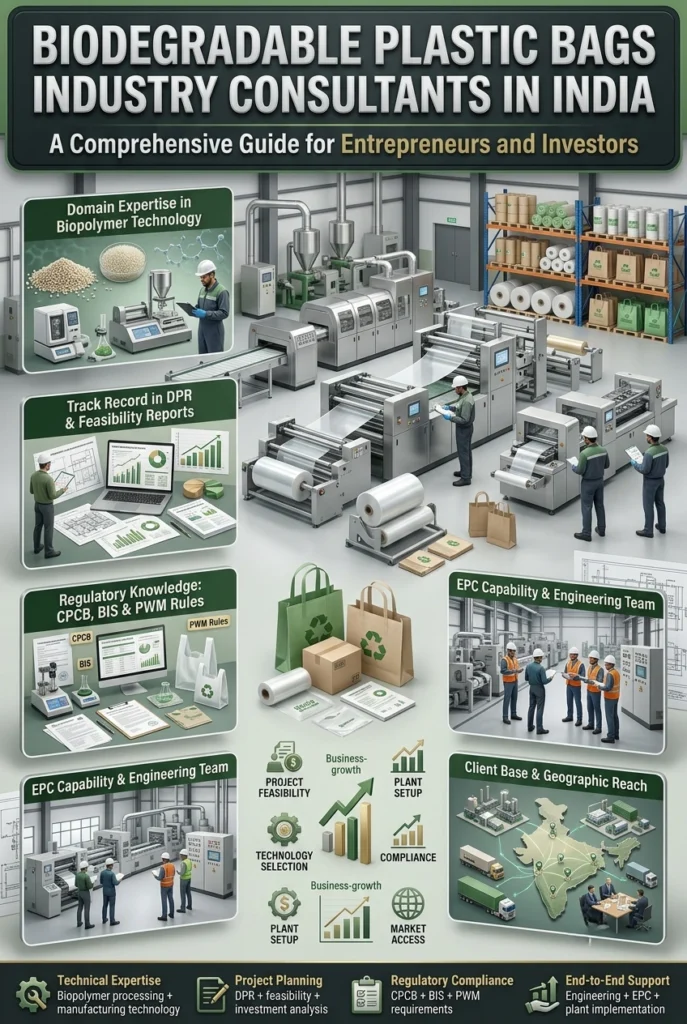
4. EPC Capability and Engineering Team Composition
Qualified polymer engineers or chemical engineers will be a part of the core team, not MBAs or finance people, for the top process engineering consultants and EPC consultants in the biodegradable packaging sector. A manufacturing project requires a workforce that is able to validate extruder supplier offers, examination of civil drawings, debugging processing problems in trial operations and more, for something that is capital intensive. Generalist management consulting firms which have no core of technical engineers are not good candidates for this type of plant project.
5. Client Base and Geographic Reach
The established process plant consultants and industrial consultancy firms, with pan-India presence, have an extensive vendor network, sound knowledge of the state-level incentives and have better connections with government agencies. Regional experts, especially with close ties in the highly concentrated manufacturing zones of biodegradable bags in the metros of Delhi, Haryana, UP, Gujarat, and Maharashtra, can contribute more than just the report. But domain expertise should always ride over geography.
Related Article: How to Start a Biodegradable Products Manufacturing Business in India (Opportunities & Profitable Ideas)
Role of NPCS in Biodegradable Plastic Bags Project Consultancy
Niir Project Consultancy Services (NPCS) is one of the leading industrial project consultancy services companies in India with a notable history in the biodegradable plastics/bioplastics sector. NPCS, established in 1994 with headquarters in New Delhi, has executed over 1,50,000 successful projects in over 85 countries – such is the size of few boutique management consulting firms in India over 30 years of continuous consulting activity.
For entrepreneurs who are considering biodegradable plastic bag projects, NPCS creates Detailed Project Reports (DPRs) and techno-economic feasibility studies that include all aspects of project planning like manufacturing process design including biopolymer compounding and blown film extrusion, machines and raw materials specifications, market research and demand analysis, process flow diagrams, product mix and capacity planning, and complete financials for the project with the project’s profitability analysis. These reports are designed to comply with the documentation needs of banks as well as the government incentive programmes and the MSME lending institutions.
What makes NPCS particularly relevant for biodegradable bag entrepreneurs is the breadth of project profiles available in their bioplastics catalog. The firm’s project portfolio — accessible at their Biodegradable Products and Bioplastics project profiles page — spans corn starch bags, cassava starch-based films, PLA packaging, oxo-biodegradable plastics, bio-nanocomposites using maize and sugarcane bagasse, and a wide range of eco-friendly disposable products. This breadth allows an entrepreneur to explore multiple adjacent project ideas before committing to a specific product line and investment level.
Find the most profitable startup for your investment range
NPCS’ experience in the chemical, polymer, packaging and agricultural-input sectors has given their feasibility work a footing in the real market that a newly-established consultancy or an all-round strategy consultancy wouldn’t be able to offer without the depth of manufacturing experience. If the project identification and business model validation process is still underway, NPCS has a series of pre-prepared project profiles, which can be used as a cost-effective starting point prior to the commissioning of a fully custom DPR.
Regional Landscape: Best Biodegradable Plastic Bags Industry Consultants in Delhi and Beyond
Delhi-NCR is still home to the biggest industrial consulting firms in India, including some for plastics and packaging, among others. Delhi-based consultants have extensive hands-on experience of the operational challenges of establishing production facilities in North India, thanks to the capital’s close proximity to Haryana and UP, both major centres for plastic and packaging production. The proximity to offices of MoEFCC, CPCB and BIS is also beneficial for consultants working here when it comes to applying for certifications and submissions.
But, the top biodegradable plastic bags consultants in India are not limited to the city of Delhi only. The polymer/packaging industry know-how is concentrated in Gujarat, and especially in the cities of Ahmedabad and Surat. Consultants are available in the organized food & retail packaging industry in Maharashtra, particularly in Pune & Mumbai. Tamil Nadu and Karnataka boast a vibrant chemical and industrial base, also yielding credible process engineering consultants in the bioplastics sector. In addition, there are CIPET centres in cities such as Chennai, Hyderabad, Bhubaneswar and Guwahati making technical support infrastructure truly pan-India.
For founders, the key is to prioritise domain expertise and regulatory competence over geography. India’s growing adoption of virtual DPR consultations means that a top consultant in Delhi or Ahmedabad can effectively serve a project in Bhubaneswar or Indore. What matters far more is whether the consultant can deliver a technically sound DPR, guide you through CPCB certification, and connect you to the right machinery suppliers — regardless of where their office is located.
Comparison of Consulting Service Types for Biodegradable Plastic Bags Projects in India
| Consulting Service Type | Core Focus / Deliverables | Best-Fit Client |
| Techno-Economic Feasibility Study | Market analysis, demand projections, cost-revenue modelling, break-even analysis | First-time investors, NRIs evaluating project viability before capital commitment |
| Detailed Project Report (DPR) | Manufacturing process, plant layout, machinery selection, raw material specs, financial model with profitability analysis | MSME promoters, bank-loan applicants, MUDRA/SIDBI-backed entrepreneurs |
| Process Engineering Consultancy | Biopolymer compounding design, blown film extrusion setup, twin-screw extruder configuration, quality protocols | Existing plastic manufacturers diversifying into biodegradable product lines |
| EPC / Turnkey Project Consultancy | End-to-end execution: civil, mechanical, electrical, commissioning, vendor tie-up | Corporate investors and first-gen entrepreneurs wanting a single-point solution |
| Regulatory and Compliance Advisory | CPCB certification, BIS IS/ISO 17088 compliance, PWM Rules adherence, EPR registration, NOC support | Startups and SMEs navigating the biodegradable plastics regulatory maze |
| Market Entry and Export Strategy | Export market mapping, buyer identification, quality certification (EN 13432, ASTM D6400), pricing strategy | Established manufacturers targeting European, ASEAN, and Middle East export markets |

Conclusion: Practical Next Steps for Entrepreneurs Seeking Biodegradable Plastic Bags Project Consultancy
India’s biodegradable plastic bags sector sits at the intersection of regulatory necessity and genuine commercial opportunity. Demand is real, policy support is growing, and the agricultural feedstock base for starch-based bioplastics is available domestically. However, the sector is technically specific and heavily regulated – not a category where you can wing the project planning process.
If you are at the idea stage, start with a market-scoping feasibility study or a standard project profile report to validate your product choice, plant capacity, and target geography. NPCS (www.niir.org) offers a range of pre-prepared project reports covering everything from corn starch bags and cassava starch films to PLA-based packaging and bio-nanocomposites, giving you a solid foundation for informed decision-making before you commission a full custom DPR.(Biodegradable Plastic Bags Industry)
If you are past the idea stage and ready to invest, commission a full Detailed Project Report from a consultant with demonstrated biopolymer technology expertise and regulatory competence. Simultaneously, initiate the CPCB pre-certification process and connect with state industrial boards to understand the incentive landscape for your chosen location.
Reference your compliance planning against MoEFCC’s Plastic Waste Management framework at moef.gov.in, BIS standards at bis.gov.in, and CIPET’s technical resources. For sector investment intelligence, consult IBEF and Invest India. The entrepreneurs who plan most carefully and partner with the right consultants will be best positioned to capture the growth that India’s biodegradable packaging market is about to deliver.