


low investment businesses in West Bengal
Setting the Scene: Why West Bengal Deserves a Second Look
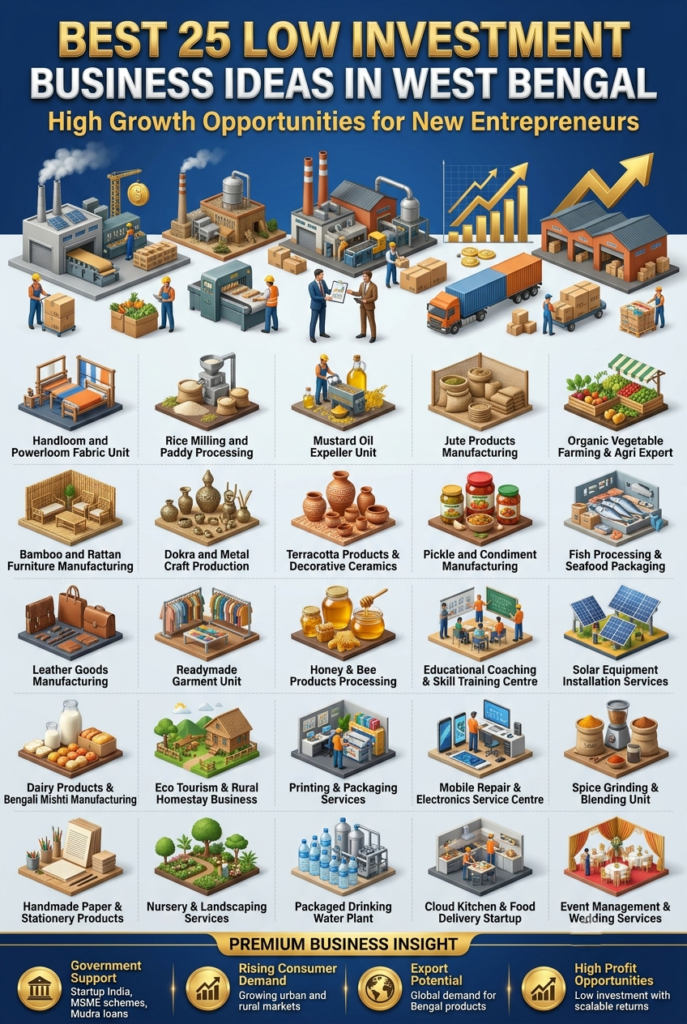
When experienced consultants and first-generation entrepreneurs scan the map for low-investment business ideas that can actually scale, West Bengal consistently surfaces as an underpowered but high-potential destination. The state combines a historically skilled workforce, competitive real estate costs, established trade corridors through Kolkata Port, and a government that has progressively warmed to MSME-led development. Yet the popular narrative often fixates on metros like Mumbai or Bengaluru, leaving West Bengal’s genuine economic potential underreported. This article cuts through that noise. It offers a frank, sector-by-sector analysis of the best 25 low-investment business ideas suited to the state’s geography, demographics, and trade dynamics — written not as an inventory of vague suggestions, but as an actionable reference that founders, feasibility analysts, and project consultants can actually use.
The state’s GDP composition is instructive. Services dominate, but manufacturing, agro-processing, and handicraft industries carry disproportionate employment weight. The Kolkata–Durgapur–Asansol industrial corridor, the tea gardens of North Bengal, the Sundarbans ecosystem, and the densely populated suburban belt around Kolkata each create different business micro-climates. Understanding which ideas suit which sub-region is the kind of intelligence that separates good business planning from generic advice.
Why West Bengal: Market Demand, Demographics, and Export Logic
The sheer number of people in West Bengal, over 100 million-are their own market long before exports are considered. Demand density within and in the close proximity of Kolkata is comparable to most national capitals, but costs per square foot for an establishment are a fraction. It is this combination of high demand against low input costs which provides a structural advantage, making small, low-investment businesses feasible where they may not be so easily feasible in larger, more expensive cities. [Source: IBEF – West Bengal Economy Overview]
This opportunity is magnified by the state’s geography. Bordering Bangladesh, a one of the fastest growing markets for consumption goods in the world, makes it an obvious export springboard for food articles, textiles, light manufactured goods and processed agricultural commodities. Trade facilitation through the Integrated Check Post at Petrapole, among others, has gradually improved logistics for MSME exporters. Simultaneously, North Bengal’s highland topography creates distinct demand for cold-chain infrastructure, organic produce processing, and tourism-linked services. [Source: ORF – Integrated Check Posts on the India–Bangladesh Border]
On the labour side, the state retains clusters of skilled artisans in weaving (particularly Jamdani, Tant, and Baluchari textiles), metalwork (Dokra craft), terracotta, and leather. These are not merely heritage activities — they feed global ethnic retail and export markets, and they can be organised into commercially scalable MSMEs with relatively modest capital investment. The combination of skilled legacy labour, coastal and river trade access, a large captive market, and progressively improving industrial policy makes this an exceptionally compelling environment for the business ideas outlined in this article.
Related Article: Manufacturing Opportunities in West Bengal
Government Policies and Incentives: The Structural Support Framework
Entrepreneurs entering West Bengal today benefit from a layered policy architecture at both the central and state levels. PMEGP (Prime Minister’s Employment Generation Program), CGTMSE (Credit Guarantee Fund Trust for Micro and Small Enterprises) and Technology Up gradation Fund, all the main schemes of Ministry of MSME are functional and open for new unit registration. Among all the above, PMEGP scheme is highly relevant to the business described in this article, since it offers a subsidy-linked term loan to first generation entrepreneurs in manufacturing and service sector subject to a maximum project cost of Rs. 50 lakhs for manufacturing and Rs. 20 lakhs for services. [Source: Ministry of MSME – PMEGP Scheme Details]
Under DPIIT’s Startup India initiative, MSME units registered in West Bengal can access income tax exemptions, simplified compliance norms, and government procurement preferences. The state government’s own West Bengal Industrial Development Corporation (WBIDC) runs dedicated land-allotment schemes and provides plug-and-play industrial shed infrastructure in districts including Purulia, Bankura, and Cooch Behar — specifically targeting MSMEs that would otherwise face high upfront infrastructure costs. The Shilpa Sathi portal, an industry-to-government single-window clearance system, has reduced time-to-operations for new factories in the state considerably.
The Make in India portal lists West Bengal among the states with active Sectoral Investment Promotion schemes, especially in food processing, electronics assembly, and garment manufacturing. PLI (Production Linked Incentive) schemes provided by Ministry of Food Processing Industries and Ministry of Textiles, are linked to performance and give incentive for scaling up production. But these plans are mostly aimed at businesses, who have already surpassed micro stage. For a growth-oriented startup, knowing about PLI eligibility criteria at formation stage will be a planning intelligence. Entrepreneurs are advised to check the entire scheme details at msme.gov.in.
25 Low Investment Business Ideas for West Bengal: A Detailed Analysis
1. Handloom and Powerloom Fabric Unit
West Bengal’s weaving tradition is among the most sophisticated in Asia, and it is far from commercially exhausted. A small handloom or powerloom unit producing Tant sarees, dress material, or export-grade fabric can be launched with investment levels that remain accessible to first-generation entrepreneurs, particularly with PMEGP support. The actual business isn’t making commoditised cloth, but in carving out a niche; woven organic cotton fabrics, bespoke jacquards for ethnic wear labels, or in providing exclusive wholesale supply to designers in Delhi and Mumbai. Facilities in Nadia, Murshidabad or Hooghly districts gain from a lower price for raw materials at the cluster level and the availability of the knowledge required for setting up complicated looms.
2. Rice Milling and Paddy Processing
West Bengal is a prominent rice producer of India. While the paddy farm gate prices and the retail milled rice margins offer a stable business opportunity that could always be exploited. A modern rice mill with parboiling and sorting equipment can process local paddy into branded packaged rice for the state’s urban retail market or for export through Kolkata Port to Middle East and African buyers. While larger mills dominate the bulk trade, there is a distinct and growing market for premium aromatic varieties — Gobindobhog being a nationally recognized example — where smaller, quality-focused units can command significantly better realizations. Entrepreneurs in Burdwan or Birbhum with land access are particularly well-placed. [Source: iGrain – West Bengal Sets Record Paddy Production 2024–25]
View Full Project Details: Rice Milling Unit Business Plan & Feasibility Study
3. Mustard Oil Expeller Unit
Mustard oil is the culinary default across West Bengal and Bangladesh, and demand is structurally stable regardless of macroeconomic conditions. A wooden-press (kachi ghani) or modern screw-press mustard oil unit can be set up at relatively low capital cost, especially if the entrepreneur has access to mustard-growing areas in Murshidabad or Nadia. The kachi ghani label — cold-pressed, chemical-solvent-free — has transitioned from a local preference to a premium health product recognised in urban organic stores and e-commerce platforms. This duality of local consumer staple and premium urban export product makes the mustard oil business one of the most capital-efficient ideas in this article.
4. Jute Products Manufacturing
India’s jute sector is centred in West Bengal, and the transition from bulk raw jute to value-added jute goods is one of the most commercially compelling transformations available to state-based entrepreneurs. Jute shopping bags, decorative items, floor mats, geotextiles, and composite packaging materials face growing global demand driven by anti-plastic regulations across the EU, North America, and Southeast Asia. Machinery requirement is very less, work force is also low to set up the jute bags/home furnishings unit with readily available raw jute from market channels through Calcutta. This value-addition unit can receive technical as well as financial assistance from the National Jute Board. [Source: IBEF – Jute Industry & Exports India]
5. Organic Vegetable Farming and Agri-Export Packaging
The fertile alluvial plains of West Bengal support year-round vegetable cultivation, and the organised transition to certified organic production creates a significant premium opportunity. Entrepreneurs who aggregate small farmers under a Farmer Producer Organisation (FPO) structure and build post-harvest grading, washing, and cold-chain packaging capacity can supply modern retail, institutional buyers, and export markets in a way that individual farmers cannot. The state’s proximity to the Bangladesh border, combined with Kolkata’s air cargo connectivity to Middle Eastern markets, makes this a commercially credible agri-export idea for entrepreneurs willing to build the back-end infrastructure.
6. Bamboo and Rattan Furniture Manufacturing
The forests of West Midnapore, Bankura, and Purulia yield bamboo at minimal procurement cost, and finished bamboo furniture commands dramatically higher price points in urban markets across India and in European export channels. The craft skill exists locally, and with modest investment in standardised joint fittings and surface treatment, bamboo furniture units can target interior designers, boutique hotels, and e-commerce platforms that specifically market sustainable home furnishings. Government support through the National Bamboo Mission covers plant material, toolkits, and training, lowering the effective capital entry point further.
7. Dokra and Metal Craft Production Unit
Dokra casting — the lost-wax metal craft indigenous to Bankura and Purulia — has evolved from village craft to a globally recognised art form with premium retail presence in Europe, the United States, and Japan. Organising existing artisan families into a structured production unit with design modernisation, consistent quality finishing, and export documentation capability transforms a fragmented cottage industry into a commercially scalable enterprise. The investment required is lower than most manufacturing businesses because the core skill already resides in the workforce. The business challenge is standardisation and market reach — precisely the gap that an entrepreneur with commercial training can bridge.
8. Terracotta Products and Decorative Ceramics
Bishnupur and Bankura represent the world with regard to terracotta artistry. The premium market for decorative ceramics (whether interior paneling or sculptural décor) has seen a phenomenal rise with the proliferation of hospitality, real estate and premium retail industry. A unit focusing on merging terracotta craft with inputs on design can be catering to architects, interior designers, and high-end home decor exporters. This is not a commodity like typical ceramics. The ‘provenance premium’ of West Bengal terracotta allows high mark-ups on both domestic luxury retail as well as in ethnic home decor markets internationally.
9. Pickle and Condiment Manufacturing
West Bengal’s culinary culture produces some of India’s most complex and regionally distinct pickles, chutneys, and condiments — from raw mango and olive (jolpai) preparations to date-and-tamarind concentrates. A branded pickles and condiment unit targeting the Bengali diaspora market in Indian metros and internationally, as well as health-conscious urban consumers through premium organic positioning, represents a low-capital but high-scalability food business. The capital requirement for a commercial kitchen, bottling line, and initial inventory is well within the PMEGP subsidy range, and the product has genuine shelf-life and export viability.
10. Fish Processing and Value-Added Seafood
Bengal, with its vast river network and coastline, is one of the richest producers of freshwater and brackish water fish in the country, but processing of fish, including cleaning, filleting, marinating, smoking, fish powder, and fish meal, has not kept pace with the catch. A small-scale processing unit, located either near the Howrah market in Kolkata, or on the coast in South 24 Parganas, could make available clean, value-added fish products for supermarkets, cloud kitchens, and export consumers that the informal sector can never produce. Prawn and hilsa products, in particular, command premium pricing in export channels.

11. Leather Goods Manufacturing
Kolkata has a historically established leather goods cluster — the Tangra and Cossipore areas specifically — though the industry has faced consolidation pressures. For a new entrepreneur, entering as a specialised manufacturer of leather wallets, belts, travel accessories, or custom corporate gifting products presents a lower-risk entry than attempting to compete in bulk footwear. Online direct-to-consumer sales through platforms like Amazon and Myntra, combined with export exposure through Kolkata’s leather trade networks, provide multiple revenue channels from a single production setup.
12. Readymade Garment Unit
Proximity to Tirupur’s fabric suppliers, the garment export infrastructure at Falta SEZ, and a large pool of stitching-skilled workers makes West Bengal an operationally viable garment manufacturing base. A readymade garment unit specialising in school uniforms, workwear, or ethnic women’s wear for the domestic market does not require the capital intensity of export-grade factories. Entry-level garment manufacturing with a cluster of industrial sewing machines, finishing equipment, and a modest workforce can be profitable at surprisingly small production volumes, particularly with forward-linked supply agreements with institutional buyers.
13. Honey and Bee Products Unit
The Sundarbans is home to one of the world’s most distinctive varietals of wild honey — dark, intensely flavoured, and carrying a global provenance story. A Sundarbans honey collection, processing, and branding unit can supply premium health food retail nationally and export channels regionally. Beyond honey, beeswax, royal jelly, and propolis represent additional revenue streams within the same business model. The Government of the State along with the Forest Department has established systematic guidelines for sustainable harvesting of Sundarbans honey and honey harvesting cooperatives can be partner to supply chain.[Source: Millennium Post – Sunderban Honey Receives GI Tag, 2024]
14. Educational Coaching and Skill Training Centre
West Bengal has among India’s highest densities of competitive examination aspirants — for West Bengal Civil Services, Railways, SSC, and various state-level entrances — creating a sustained, year-round demand for structured coaching and test preparation. A coaching centre with well-designed curriculum, experienced faculty, and digital content delivery does not require large physical infrastructure. Starting with a 50-seat classroom in a district town and building subject-matter reputation through result track records is a proven business model that scales through word of mouth and online reputation without requiring significant ongoing capital.
15. Solar Equipment Installation and Maintenance Services
The market for rooftop installations in West Bengal is at its nascent stage as compared to states like Rajasthan and Gujarat, however, the growth in terms of government support and consumer adoption trajectory makes it a high-growth prospect. Furthermore, An undertaking that supplies panels, installs them, and enters into annual maintenance contracts with housing, commercial and agriculture consumers, can operate with a negligible asset base-with investment concentrated only on trained technicians and working capital for the acquisition of panels. Moreover, MNRE subsidies and state level net-metering rules make the actual price of solar panel installation for the consumer cost-effective, thereby boosting up the consumption and deal-flow.
Get Detailed Insights from This Book: Solar PV Power and Solar Products Handbook
16. Dairy Products and Mishti Manufacturing
The chena-based sweet tradition of West Bengal — rasgulla, Sandesh, Mishti Doi, chomchom — represents both a cultural institution and a genuine food manufacturing opportunity. Furthermore, A branded dairy product unit producing either traditional sweets for the urban premium market or functional dairy derivatives like paneer, ghee, and flavoured yogurt can operate at low initial scale with high margins. Moreover, The diaspora market for authentic Bengali sweets through e-commerce gifting channels is particularly underserved, and Additionally, an entrepreneur with good quality control and attractive packaging can build a nationally recognised brand from a Kolkata-based kitchen.
17. Eco-Tourism and Rural Homestay Operations
The Sundarbans, the Dooars forests of North Bengal, Bishnupur’s heritage circuit, and the river islands of the Ganges delta collectively offer a rich eco-tourism product that is still largely informal and fragmented. Additionally, Organising a rural homestay network or managing eco-lodge accommodation for domestic and international tourists requires low permanent infrastructure but delivers steady seasonal revenue. Moreover, West Bengal Tourism Development Corporation offers marketing and listing support to genuine home stay providers, a quality marketing exposure, for which otherwise, much expenditure on advertisement may be incurred.
18. Printing and Packaging Services
Kolkata’s dense commercial economy — trading companies, FMCG manufacturers, food processors, pharmaceutical distributors — generates persistent demand for flexible packaging, carton printing, label production, and promotional print materials. As a result, A small offset or digital printing unit with poly-lamination capability can establish recurring supply relationships with dozens of local businesses. Moreover, The investment in entry-level commercial printing equipment has declined significantly, and therefore, the ability to offer fast-turnaround digital printing alongside conventional offset jobs gives modern print entrepreneurs a competitive service offering.
19. Mobile Phone Repair and Electronics Service Centre
As smartphones gain deeper traction in tier 2 and tier 3 towns throughout West Bengal, a supply deficit for mobile repair emerges-there are not enough skilled technically adept repair people for the volume of devices. As a result, A fully-stocked, certified-technician mobile and electronics service centre that is properly furnished (with pristine, customer-friendly front end, genuine spare parts and well-trained technicians) can build up a significant local presence rapidly. Moreover, For aspiring entrepreneurs with no previous technical training, a franchise set up with major brands like iCare or Cellbell can offer training and access to parts supply and brand value.
20. Spice Grinding and Blending Unit
Bengali cuisine relies on a distinctive set of whole and ground spice blends — panch phorone, Posto (poppy seed powder), mustard paste — that have limited commercial production infrastructure despite enormous household consumption. Moreover, A mechanized spice grinding and blending unit producing hygienically packed, brand-labelled spice products for modern retail and e-commerce can carve a compelling niche between mass commodity spice brands and unbranded bazaar purchases. Furthermore, Sourcing from spice-producing districts of West Bengal and neighbouring states, processing locally, and distributing to organized retail channels is a credible and scalable business model.
21. Paper and Handmade Stationery Products
Growth in demand for handmade papers, recycled stationery and environmentally friendly packaging items is also continuing. Furthermore, A small handmade paper unit based on easily accessible local raw materials (waste cotton, jute Fibers, banana Fiber, banana bark) may become a supplier of high quality writing material for high end stationery brands, for producers of gifting products and for users of eco-packaging. Moreover, Kolkata’s existing trading links with the national stationery distributors are a natural distribution channel which may be availed of by a new entrepreneur right from the stage of manufacture.
22. Nursery and Landscaping Services
The continued growth of both housing and commercial real estate in urban Kolkata ensures continuous demand for landscape designing, plant supplies, and garden maintenance. Furthermore, A well run commercial plant nursery offering a selected variety of ornamental and indoor plants and landscape quality trees to both consumers and businesses such as housing complexes, business campuses and hotels, can contribute to these needs. Additionally, The capital requirement for land, propagation infrastructure, and initial plant stock is modest relative to most manufacturing businesses, and therefore, repeat maintenance contracts create predictable recurring revenue.
23. Water Purification and Packaged Drinking Water
Ground water quality across large parts of South Bengal — affected by arsenic contamination in several districts — has, therefore, created a genuine, non-discretionary demand for packaged or purified drinking water. As a result, A community-scale water purification plant or packaged drinking water unit operating under BIS certification can supply domestic consumers, institutional buyers, and the horeca sector across a defined geographic radius. In fact, The operational model is asset-intensive at setup but generates extremely stable cash flows once customer contracts are established. Moreover, Rural sub-districts with documented water quality issues represent particularly compelling deployment zones.
24. Cloud Kitchen and Food Delivery Business
Kolkata’s food culture is among the richest in India. A large part of food consumption has also shifted to online delivery platforms like Swiggy, Zomato, and newer aggregators. This has created a low-overhead food business channel that did not exist a decade ago.
A cloud kitchen specialising in Bengali cuisine can work very well in this setup. Home-style cooking, which restaurants do not regularly offer, can help build a strong local customer base. It does not require the heavy capital investment of a dine-in restaurant.
Furthermore, Investment in a professional commercial kitchen is relatively low compared to a traditional restaurant. Food safety compliance and delivery logistics integration are also manageable at this scale.
25. Event Management and Wedding Services
Bengali weddings are elaborate, multi-day cultural events with significant per-event expenditure on decor, catering coordination, photography, entertainment, and guest logistics. Furthermore, An event management company specializing in Bengali wedding formats — deeply versed in specific rituals, vendor networks, and cultural preferences — can command premium fees in the Kolkata market and increasingly in the diaspora wedding segment. Moreover, The initial capital requirement is low, since the business model is service and coordination-based, but the relationship equity and cultural competence required to execute complex events well creates a genuine barrier to entry that protects established players.
Find the most profitable startup for your investment range
Import-Export Opportunity Analysis: West Bengal’s Trade Position
West Bengal’s trade geography is one of its most underappreciated strategic assets. Additionally, Kolkata Port handles significant volumes of rice, jute products, leather goods, and engineering goods exports. The land borders with Bangladesh and Nepal also create multi-modal trade opportunities. These opportunities are not available to landlocked manufacturing states.
For MSME entrepreneurs, the most actionable export opportunities fall into three categories. First, processed food products targeting the Bangladeshi consumer market and the South Asian diaspora in Europe and North America. Second, handloom and artisan products targeting the global ethnic retail segment. Third, industrial inputs such as jute geotextiles and agro-chemicals targeting African and Southeast Asian infrastructure markets.
On the import side, West Bengal businesses benefit from proximity to Kolkata’s established customs and freight-forwarding infrastructure. This is especially helpful for electronics assembly, pharmaceutical packaging, and technical textile manufacturing. This reduces import logistics costs compared to inland locations.
Entrepreneurs building manufacturing businesses often rely on imported components like precision parts, chemical intermediates, and specialized packaging materials. They should consider port proximity when choosing a location. They should also include it in their cost analysis.
The trade facilitation environment at Kolkata Customs has also improved. Single-window clearance for MSME importers has reduced dwell time for standard consignments.
Indian MSME Success Stories: Decision Logic and Lessons
1. Lux Industries — Saket Todi, Kolkata
Lux Industries, another one of India’s largest innerwear and hosiery players, is entirely of Kolkata MSME origin. The Todi family built the Lux brand on a small hosiery trading and manufacturing business in Kolkata. They expanded through backward integration into yarn and fabric. They also moved into forward integration through branded consumer marketing. Later, they added premium product offerings through side integration.
The key lesson for Kolkata MSME brand owners is clear: disciplined brand investment drives long-term growth. Moreover, Lux consistently invested in advertising and retail presence, even when financial logic suggested they could not afford it. Today, it shows entrepreneurs in any consumer goods segment that brand ambition is not limited by MSME origins.
2. Sresta Natural Bioproducts — Arun Nair (24 Mantra Organic)
Though operationally based outside West Bengal, the 24 Mantra Organic model, nevertheless, carries direct lessons for state-based agri-entrepreneurs. Furthermore, the company pioneered certified organic food marketing in India. It connects small farmers through FPO structures to premium urban retail and export channels. The model is highly replicable in West Bengal, especially for rice, spices, vegetables, and honey. This is because the state’s agricultural base and farmer density are similar to the conditions where 24 Mantra scaled.
Moreover, the key lesson is clear. Organic certification and structured farmer aggregation can transform commodity agriculture into a premium branded food business. It also improves economics at every stage of the value chain.
3. Biswa Bangla — West Bengal Government MSME Craft Enterprise
The Biswa Bangla initiative, while government-backed, functions as a premium craft marketing enterprise. It has systematically built export and domestic retail infrastructure for West Bengal’s artisan products, including Dokra, Kantha embroidery, Darjeeling tea, and Jamdani textiles.
For private MSME entrepreneurs, the Biswa Bangla experience shows the market validation of premium positioning for West Bengal crafts. It also demonstrates the logistical viability of organised artisan supply chains.
Private craft entrepreneurs can maintain similar quality standards and retail presence without government marketing support. They can earn premium margins in both domestic and international markets.
How NPCS Supports Entrepreneurs: Feasibility Intelligence for Confident Investment
At Niir Project Consultancy Services (NPCS), we understand that starting a new business is rarely an isolated decision. It comes from careful analysis, market validation, and financial modelling.
We provide professional consulting services. We prepare Market Survey and Detailed Techno-Economic Feasibility Reports (DPRs). These are for new industries and businesses. We cover all categories discussed in this article.
We also offer manufacturing process details and specifications. Our services include market analysis, demand forecasting, process flow diagrams, product mix and capacity planning, and equipment and raw material specifications.
In addition, we provide full financial analysis, including profitability, IRR, and NPV forecasts.
Firstly, For entrepreneurs evaluating any of the 25 business propositions listed here, an NPCS DPR provides strong analytical confidence. Moreover, It helps them approach banks, government schemes, and equity investors with a clear, well-documented rationale. In addition, Our aim is to help entrepreneurs assess the viability, profitability, and scalability potential of their ventures before investing capital. Therefore, We encourage market-driven investment decisions rather than decisions based on assumptions.

Data Table: Indicative Investment and Revenue Profile for Select Business Ideas
| Business Idea | Est. Setup Cost (Rs.) | Working Capital (Rs.) | Expected Monthly Revenue (Rs.) | Payback Period |
| Handloom Fabric Unit | 3–8 Lakhs | 1–2 Lakhs | 1.5–4 Lakhs | 18–30 Months |
| Rice Milling Unit | 8–15 Lakhs | 3–5 Lakhs | 5–10 Lakhs | 24–36 Months |
| Mustard Oil Expeller | 2–5 Lakhs | 1–2 Lakhs | 1–3 Lakhs | 12–24 Months |
| Jute Products Unit | 5–10 Lakhs | 2–3 Lakhs | 2.5–6 Lakhs | 20–30 Months |
| Pickle/Condiment Unit | 2–4 Lakhs | 0.5–1.5 Lakhs | 1–2.5 Lakhs | 12–18 Months |
| Solar Installation Services | 1–3 Lakhs | 2–4 Lakhs | 1.5–5 Lakhs | 12–20 Months |
| Cloud Kitchen | 3–7 Lakhs | 1–2 Lakhs | 2–6 Lakhs | 15–24 Months |
| Bamboo Furniture Unit | 4–8 Lakhs | 1.5–3 Lakhs | 2–5 Lakhs | 18–28 Months |
| Fish Processing Unit | 6–12 Lakhs | 2–4 Lakhs | 3–8 Lakhs | 20–36 Months |
| Event Management | 0.5–2 Lakhs | 1–3 Lakhs | 1.5–8 Lakhs | 6–15 Months |
Note: Figures are indicative estimates for planning purposes. Actual costs vary by location, scale, and input market conditions. Consult an NPCS DPR for project-specific financial modelling.
References and Useful Government / Institutional Links
The following official government and institutional resources are recommended for further reading and for direct application to the schemes discussed in this article.
- Startup India – Official Portal –https://www.startupindia.gov.in/
- Ministry of Micro, Small & Medium Enterprises (MSME) –https://msme.gov.in/
- Udyam Registration Portal –https://udyamregistration.gov.in/
- Department for Promotion of Industry and Internal Trade (DPIIT) –https://dpiit.gov.in/
- Small Industries Development Bank of India (SIDBI) –https://www.sidbi.in/
- MUDRA / PMMY Official Portal – https://www.mudra.org.in/
- CGTMSE Official Portal –https://www.cgtmse.in/
- Ministry of Micro, Small & Medium Enterprises –https://msme.gov.in/
- JanSamarth Portal (Government Loan Schemes) –https://www.jansamarth.in/
- Niir Project Consultancy Services (NPCS) –https://www.niir.org/