


Bagasse Products Industry India Market Report 2026-2031
The bagasse-based products industry in India is fast emerging as one of the most promising products in the sustainable manufacturing ecosystem. With more and more restrictions on single-use plastics and the rise of environmental awareness and strong policies in their Favor, bagasse products are becoming a popular choice as an eco-friendly packaging and disposable tableware.
Bagasse, the fibrous material remaining after the juice is extracted from sugarcane has traditionally been used as a fuel source in sugar mills. However, technological advances and sustainability trends have developed bagasse as a useful raw material in producing biodegradable packaging, moulded tableware, pulp and paper, and even industrial composites.
According to industry estimates, the India bagasse packaging market is likely to expand from approximately USD 5.2 billion in 2025 to almost USD 11.6 billion in 2031, with a CAGR of around 14%. This fast expansion is being driven by the regulatory pressure against plastic usage, foodservice industries increasing demand and export opportunities in global eco-friendly product markets.
Read More: Handbook on Pulp and Paper Processing
Market Overview Why Bagasse Products Growing Fast
India is one of the largest producers of sugarcane in the world, and it produces enormous amounts of bagasse each year. This vast amount of raw material is a good base for a growing industry of biodegradable products.
However, the true revolution of bagasse into an industrial waste-to-high-value raw material began with the worldwide drive for sustainable packaging solutions.
Several sectors are now adopting bagasse-based products including:
- Foodservice and restaurants
- Catering businesses
- E-commerce packaging
- Retail packaging
- Hospitality industry
- Airline catering – railway catering
These sectors need eco-friendly disposable packaging that bagasse products do and are also biodegradable and compostable.
As the environmental regulations get more stringent and the corporate sustainability targets increase, the demand for bagasse products in India is forecasted to grow up rapidly in the next decade.(Bagasse Products Industry)
Demand and Supply Gap in the Bagasse Industry
Although bagasse availability for industrial product manufacture is low despite massive sugarcane production in India.
Approximately 90% of bagasse generated by sugar mills is internally consumed for captive power generation, and around 10% is available for downstream industries such as pulp industry, moulded packaging, and production of biodegradable tableware.
The bagasse products industry faces major supply problems because of its resource distribution challenges.
All biodegradable packaging manufacturers and moulded tableware producers encounter difficulties because they cannot secure constant availability of their vital raw materials. This shortage restricts the capacity of production and contributes to the increase in the price of processed bagasse pulp.
The supply gap is also behind the fact that India still imports some bagasse-based products, especially moulded tableware and packaging materials from other countries where processing facilities are large-scale.
To entrepreneurs and investors, this shortage is a huge opportunity to build midstream processing infrastructure, including bagasse pulp conversion units and moulded packaging plants.
Read More: Biodegradable and Compostable Disposable Cups and Plates from Sugarcane Bagasse
Key Players in Indian Bagasse Industry
The Indian bagasse ecosystem consists of large paper manufacturers, biodegradable tableware manufacturers and export-oriented packaging companies.
Some of the prominent companies operational in this sector include:
Tamil Nadu Newsprint and Papers Limited (TNPL)
TNPL operates as one of India’s major bagasse paper manufacturers because the company uses sugarcane waste to produce pulp and paper on a large scale.
Goldleaf India
The company specializes in manufacturing and exporting biodegradable tableware and packaging products which use bagasse as their main material.
Go Eco
The company produces moulded bagasse tableware and sustainable packaging solutions for the domestic market.
Ecolates and Crystal Green Product LLP
The company establishes itself as a prominent manufacturer which produces environmentally friendly disposable tableware made from sugarcane bagasse.
Eco Joy India
The company has expanded its production capacity for biodegradable disposable products which use bagasse as their main material.
Along with these established companies, there are many manufacturers and MSMEs that are operating in the Indian biodegradable packaging sector at the regional level.(Bagasse Products Industry)
Import-Export Trends in Bagasse Products Market
India’s industry of bagasse products is also affected by international trade trends.
Read More: Biodegradable Products, Recyclable, Disposable, Eco-Friendly Plastics, Bioplastics, Compostable, Biodegradable Packaging for Food Products, Bio-based Polymers, Oxo-biodegradable Plastics, Bio-nanocomposites using Maize, Corn, Sugarcane Bagasse
Imports
Imports of bagasse-based tableware products and packaging products have been on the rise in recent years. This increase is related to domestic capacity constraints and increasing demand for biodegradable products.
Countries with advanced technology in moulded fibber manufacturing are currently dominating some segments of the global market, which is a prospect for the Indian manufacturers to scale up the production.
Exports
A developing economy, India is increasingly exporting bagasse-based products to world markets where sustainability regulations are strict.
Major export destinations are:
- United States
- United Kingdom
- United Arab Emirates
- European Union countries
- Southeast Asia
Global demand for biodegradable tableware and packaging is also increasing rapidly, offering a good potential for export for Indian producers.
With competitive labour costs and unavailability of a shortage of raw materials, India has the potential to become a global hub for bagasse products manufacturing.
Read More: Start a Sugarcane Bagasse Tray Unit in India: Profits & ROI


Startup Opportunities in the Bagasse Business
The bagasse industry presents a number of high potential opportunities for startups, MSMEs and industrial investors.
1. Pulp Processing Units from Bagasse
One of the largest bottlenecks in the industry is the limited amounts of bagasse pulp that is processed. Establishment of pulp processing units can help create this missing link while providing raw material to packaging manufacturers.
2. Moulded Fiber Table Ware Manufacturing
Demand for products such as plates, bowls, trays and food containers is increasing rapidly in the restaurant, catering and quick service restaurant areas.
3. Biodegradable Solutions for Packaging
E-commerce companies are now seeking out environmentally-friendly packaging substitutes for plastic.
Bagasse packaging trays, containers and protective packaging materials can be used in place of conventional plastic packaging.
4. Export-Oriented Manufacturing
Companies that get international certifications for composability and sustainability can gain access to premium markets in Europe and North America.
5. Advanced Coating Technology
Water-resistant and oil-resistant coatings for bagasse products can greatly improve the quality of the products and make them more competitive in the market.
Industrial Feasibility to MSMEs
The good news for small manufacturers is that the manufacturing of bagasse products is scalable and feasible for MSMEs.
Production plants can be set up with a capacity of 20-100 tons per day, according to the amount of investment.
Key machinery required in manufacturing bagasse products are:
- Pulping machines
- Hydraulic moulding presses
- Drying systems
- Trimming and Finishing Equipment
- Biodegradable coating lines
Although initial machinery investment may be a lot, the cost of operation is quite low as there are low-cost raw material availability in sugarcane regions.
Entrepreneurs establishing plants close to sugar mills or agro-industrial clusters can save a lot of money on logistics costs and ensure a constant supply of feedstock.(Bagasse Products Industry)
Read More: How to Start Paper Water Bottles Manufacturing Business
Future Perspective of the Bagasse Products Market
India’s bagasse products market will experience substantial growth throughout the next ten years.
Market expansion will proceed because of multiple ongoing trends which will continue to operate:
- Government bans to single-use plastics
- Corporate sustainability pledges
- Increasing environmental awareness
- Increasing demand for compostable packaging
- Growth of Food Delivery and Takeaway Services
The bagasse products industry will reach a multi-billion-dollar market size by 2031 which creates essential business opportunities for manufacturers exporters and technology providers.
Early investors who implement advanced manufacturing technology and supply chain integration along with export certification processes will secure the largest market share benefits.
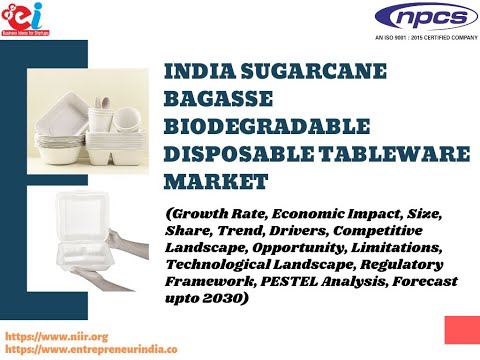
Conclusion
India’s bagasse products industry is heading for a rapidly transforming phase. With plentiful availability of raw material, growing support from the regulatory bodies, and the rising global demand for eco-friendly packaging, the sector is a very good opportunity for entrepreneurs and investors.
However, the existing market also suffers from structural issues like limited capacity of processing and supply of raw materials.
Businesses that fill these gaps by investing in bagasse pulp processing, moulded packaging production and export-oriented manufacturing can achieve good growth in the next decade.
For MSMEs and start-ups, the bagasse industry provides a rare blend of sustainability, scalability and profitability, and hence, is one of the most attractive green manufacturing opportunities within India today.(Bagasse Products Industry)
Frequently Asked Questions (FAQs)
What are bagasse products?
Bagasse products are biodegradable products developed from sugarcane residue that was lost after extracting juice. These products are commonly used for packaging, disposable tableware, and materials made from pulp.
Why there is a growing demand for bagasse based products?
Demand is on the rise as a result of plastic bans, environmental regulations and the ever-increasing need for sustainable packaging solutions in industries such as foodservice and e-commerce.
Is there supply gap in bagasse products market in India?
Yes. Around 90% of bagasse produced in sugar mills is used for captive power generation leaving very little of its raw material available to manufacture biodegradable products.
Can MSMEs launch bagasse product manufacturing business?
Yes. With the right machinery, access to raw materials and markets, MSMEs can successfully set up bagasse product manufacturing units and benefit from growing demand.
What are the most demanded products in the bagasse market?
High-demand products include: plates, bowls, trays, food containers, clamshell boxes, and eco-friendly packaging materials that are used by restaurants and catering businesses.