


Why Alcohol Industry Consultants in India Matter More Than Ever
It is no longer all about the domestic Indian market for alcohol. It has now become one of the world’s most watched alcobev markets where big capital, craft beer entrepreneurs, IMFL (Indian Made Foreign Liquor) makers, molasses-based distillers and wine manufacturers are all battling it out for capital, licences and market share simultaneously. This sector is not an easy one to navigate without the help of an experienced guide. For this reason, the most potent alcohol industry consultants in India are crucial for investors, manufacturers, and MSME promoters who wish to do this correctly from the beginning.
The installation of a brewery, distillery or blending unit is not always an easy choice to make. This includes state excise licensing, compliance with the FSSAI, sourcing of ENA (Extra Neutral Alcohol), fermentation process engineering, plant layout, design of the utilities and — crucially — a model which makes the project bankable and/or acceptable to a private investor. A highly-trained alcohol industry consultant puts it all together and transforms a good idea into validated market-research supported and process logical bankable Detailed Project Report (DPR).
The finest alcohol industry advisors in India are not just in the paper-making business. They see the world as operators, challenge you on the expenses of your feedstock, the structure of excise duties and test your forecasts against actual market conditions. For first-time business owners in a regulated sector, that level of knowledge is the key to a successful start-up or a costly failure.
What Do Alcohol Industry Consultants in India Actually Do?
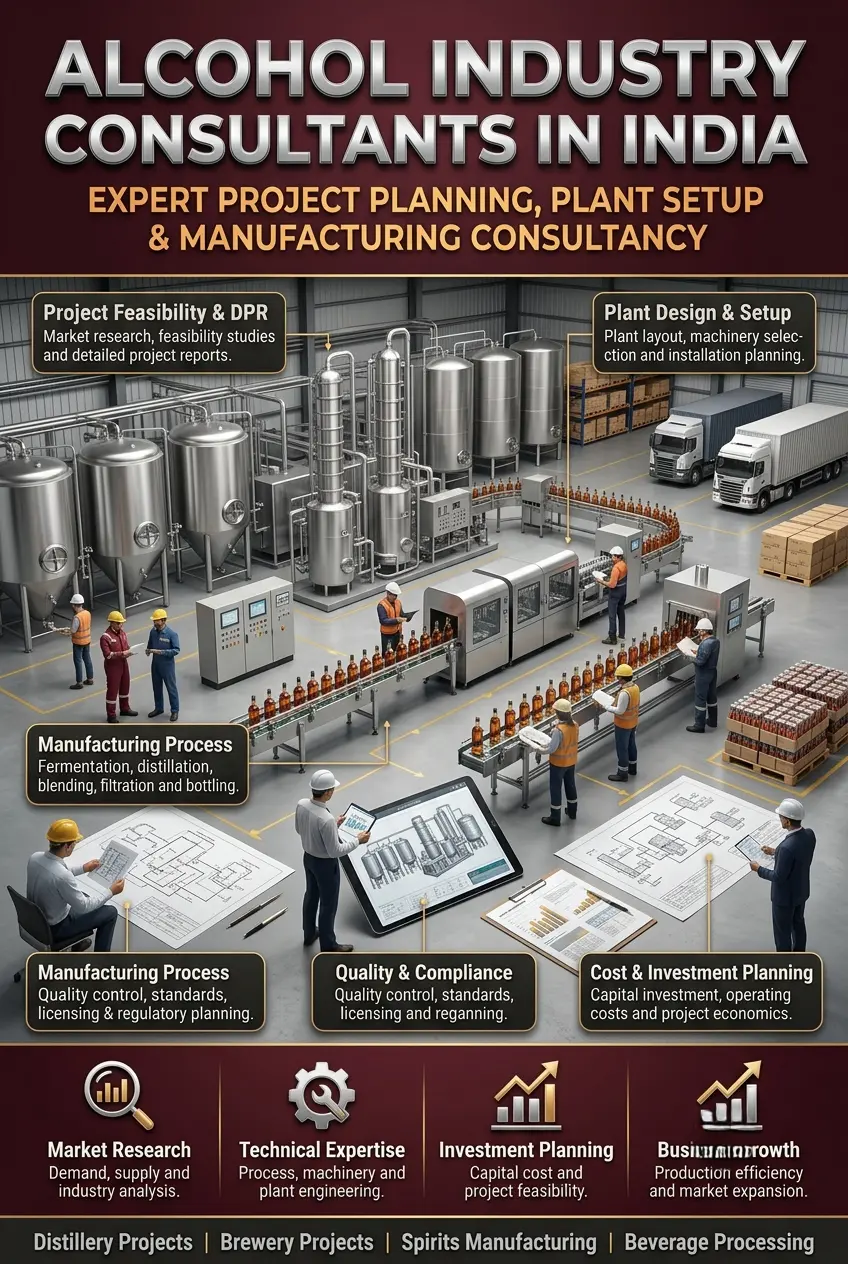
Alcohol industry consultants in India do a lot more than what one may think. The Detailed Project Report (DPR) is a comprehensive document which contains details on manufacturing process, plant capacity, raw material specification, machinery requirement, planning of utilities, cost of project, means of finance, profitability projection and payback period, that forms the core of every engagement. A DPR is just one component of service stack.
Consultants can provide significant value in process engineering areas. In the case of a grain-based distillery, this involves proper design of the mash conversion and distillation columns. In the case of a craft beer plant, it’s about a proper size of the fermentation tanks, the design of the cold room and the carbonator. It is about sourcing-grade ENA specifications and integration of flavour concentrates for an IMFL blending unit. These decisions are made in the dark without a fermentation consultant who knows fermentation science and ethanol technology.
In addition to the technical aspects, alcohol plant consultants manage the regulatory challenges. These can be intricate in India due to the varying excise laws across different states. If you are a licensee of IMFL bottling unit in Telangana, a craft brewer in Karnataka or a country liquor distiller in Uttar Pradesh, the licensing matrix differs. Consultants identify the necessary state excise regulations. They determine and identify required clearances in the Factories Act and the Pollution Control Board norms. They ensure the project is configured so as to comply with the same from day one.
Alcohol EPC (Engineering, Procurement and Construction) consultants, on the other hand, are also responsible for technology sourcing. This involves proprietary fermentation technologies, German or Italian brewing equipment, continuous distillation columns, multi-pressure distillation systems, etc.
A robust alcohol consulting company connects the entrepreneur and the equipment vendor. At the same time, it makes sure that specifications aren’t over engineered and investment is optimised.
Why India Is a Global Hotspot for Alcohol Industry Investment
By volume, India’s alcohol market is the third largest in the world and is growing fast on several fronts. About 74% of market share is held by spirits, of which whisky and rum are the most dominant. Meanwhile, beer – especially the craft beer segment – is growing at a more rapid pace than the overall market. Analysts estimate that the craft beer category will grow by more than 24% compound annual growth rate over the next few years. This mix is resulting in a unique investment landscape. Established IMFL manufacturers are focusing on premiumisation, and new players are vying for the “craft and microbrewery” angle.
Moreover, export of alcohol beverages is now a major business opportunity in India. The In addition, alcohol exports are a serious commercial venture for India. APEDA (Agricultural & Processed Food Products Export Development Authority) has targeted to increase export of alcoholic beverages to ₹8,535 crore by 2030, from present ₹3,162 crore. Indian single malt whiskies like Amrut and Indri-Trini have been receiving international awards and generating a worldwide demand for the Indian-origin premium spirits. This export success is bringing in new investment in distillery capacity and improvement in quality in several states.
The Confederation of Indian Alcoholic Beverage Companies (CIABC) has actively engaged with state governments and the central government to streamline excise policies, harmonise tax structures, and create a more investment-friendly environment. The Ministry of Food Processing Industries (MoFPI) has also highlighted the alcobev sector as a significant contributor to agri-value addition, linking grain and molasses distilleries to the broader farm-to-factory economic chain. Meanwhile, FSSAI introduced major regulatory amendments with effect from January 2026. These amendments formally recognise new categories, including Ready-To-Drink beverages, nitro craft beers, and traditional Indian liquors. This development opens entirely new manufacturing segments for entrepreneurs.
For MSME promoters, it appears that the opportunity is particularly concrete. The dual-feed ethanol distillery uses grain as its raw material. It does not only have regulatory support under National Biofuels Policy. It also has access to state-level procurement contracts. Tier 1 cities are still seeing high numbers of visitors to micro-breweries. Smaller craft breweries pursuing the bottling and distribution market are starting to hit Tier 2 markets. The demand side fundamentals of the sector include a large and young population. They also include increasing disposable income of the cities and a distinct premiumisation trend. This makes the sector one of the most promising manufacturing sectors for new investments in India.

How to Evaluate and Choose the Best Alcohol Industry Consultants in India
Hiring the right consultant for an alcohol project can make a huge difference in the life of a project. Firstly, a key criterion in selecting an SEO company is the domain knowledge related to their specific industry. What works for an engineering consulting firm in general manufacturing may not be appropriate for a distillery project or a microbrewery DPR. India’s finest alcohol plant consultants have experience in the entire range of alcohol types. These range from IMFL, craft beer, country liquor, wine to ethanol. They are aware of the nuances in each of these alcohol types.
The next important one is experience in DPR, techno-economic feasibility work. If a bank is not willing to accept an unrealistic financial projection or inconsistent capacity assumptions, then a DPR that is not accepted by a bank is worse than none. Request examples of DPRs that are approved by banks and/or developmental finance institutions. The top alcohol industry consultants in Delhi and all over India will have a track record of alcohol projects that have been moved from the planning phase to the implementation phase.
The ability to engage in EPC and process engineering is a huge advantage in the alcohol industry. Does the consultancy provide you with assistance in finding and assessing equipment vendors? Can it create process flow diagrams and utilities layouts on its own, rather than copying a generic template? Is it aware of the difference between a batch distillation column and a continuous multi-pressure distillation column, and when each would be suitable for their project size? These are the questions that will set an experienced process engineering consultant apart from a document preparation service.
The knowledge of the regulations is also crucial and, in the alcohol sector, not easy. Depending on the type of facility and its location, various excise licences, pollution control board consents, Factories Act registrations, FSSAI product licences and BIS quality certifications may be necessary. Moreover, the growing number of boutique management consultancy firms in India specializing in the alcobev industry will have established procedures. These firms can handle the compliance initiatives of many agencies and can help a promoter navigate through them without unnecessary delays.
Last but not least, check the consultant’s market research skills. Demand analysis is a necessary component of a DPR that is missing. The top alcohol industry consultants in India do independent market research before it is recommended by them to scale the project and product mix, which includes consumer preference, the prevailing capacity, state-wise consumption, and competition. This research basis is the one that makes their financial forecasts believable with lenders and investors.
Role of NPCS in Alcohol Project Consultancy Across India
Founded in 1994, and headquartered in Delhi, Niir Project Consultancy Services (NPCS) is among the most cited names in the industrial consultancy in India. NPCS add a distinct and unique flavour to the Indian alcobev consultancy world with over 30 years of practice and a portfolio of over 150,000 projects completed in more than 85 countries. The organisation has developed Detailed Project Reports and techno-economic studies for many alcohol projects. These include grain-based distilleries, country liquor units, craft beer, microbreweries, IMFL bottling, and ethanol production.
NPCS provides a comprehensive suite of tools for every engagement. These include documentation of the manufacturing process, specification of raw materials and machinery, process flow diagrams, plant layout, market research and demand analysis, product mix and capacity planning. They also cover full project financials, such as projected profitability, break-even analysis, and payback period. All the DPRs prepared by NPCS are designed in a manner that meets the typical appraisal requirements for entrepreneurs looking to bank under the MSME lending schemes or developmental finance institutions.
The alcohol project consultancy clients of NPCS are widely varied. Mr. Partha Sarathi Mishra, Bhubaneswar, Odisha, engaged NPCS for a detailed study on the viability of the establishment of a beer plant. Mr. Rajendra Dewangan, Rangareddy, Telangana, commissioned NPCS for two separate assignments. These were Liquor production from Mahua flowers and Technical feasibility study for a Beer Plant. M/s. The NPCS was requested by Odisha Standards, Bhubaneswar, to do a technical and market assessment of Indian Made Foreign Liquor production.
The company also has helped customers spread their bets throughout the ethanol-to-liquor range. Mr. Abhishek Goyal, Agra, Uttar Pradesh, hired NPCS for a comprehensive feasibility report on setting up a dual feed distillery and production economics. M/s. A techno-economic analysis was carried out by K Raheja Realty Pvt Ltd for a dual feed distillery that produces ethanol as biofuel from several feed stocks in Mumbai, Maharashtra. M/s. Versatile Engisa Private Limited, Bharuch, Gujarat had commissioned a liquor production feasibility and techno-economic analysis of Mahua flowers.
NPCS has also been a supporter of the craft beer and microbrewery segment. M/s. Ganjam, Odisha-based Suchit Biswasroy got a bankable techno-economic feasibility report on craft beer production. Mr. Ramakanth from Hyderabad, Telangana, got a market research report that is dedicated to emerging opportunities in the Indian beer market. M/s. NPCS was called in to perform a TEFR for Revoltcreations Solar Solutions LLP (Mumbai, Maharashtra) on liquor from Mahua, which utilizes traditional sources of feedstock and modern production economics.
Previously, NPCS has shown its expertise in this area. A feasibility study on establishment of a craft beer plant was commissioned by Mr. Ghanshyam Suthar from Himmatnagar, Gujarat. M/s. Zenith Metaplast (P) Limited, Nashik, Maharashtra, wanted a Pre-investment Feasibility Report for their Microbrewery. M/s. The Kranti Steel Pvt. Ltd., Bahraich, UP, had commissioned NPCS to prepare a market research report on setting up a beer plant and Mr. Kalyan Maddali, Hyderabad, Telangana, had asked NPCS to prepare a DPR focused on craft beer. M/s. NPCS engaged the company, Anthocyanin Naturals India (P) Ltd., Ernakulam, Kerala, to develop a business plan for both beer and wine production. M/s. Richmond Realtors, Mumbai commissioned this techno-economic feasibility report for a craft beer plant. Ranjeet Singh Gumtala, Amritsar, Punjab, received a feasibility study on ethanol as biofuel from broken rice.
M/s. Prime Enterprise from Bhadrak, Odisha, engaged NPCS for a study on ethanol from maize. Mr. Vaibhav Agrawal from Sant Kabir Nagar, Uttar Pradesh, received a complete business plan for a beer plant, while M/s. Kaushik Chaudhury from Kolkata, West Bengal, commissioned a technical and economic evaluation of rice beer manufacturing including can and bottle packaging. M/s. Lobotus Technology Pvt. Ltd. from Bangalore, Karnataka, received a project feasibility study for a grape wine plant. M/s. Brawn Yeast Forge Pvt. Ltd. from Meerut, Uttar Pradesh, commissioned a techno-economic evaluation on yeast from molasses — a directly linked input for the alcohol manufacturing ecosystem.
Entrepreneurs looking for NPCS’s project profiles specifically for alcohol projects can access the dedicated alcohol project catalogue at: NPCS Alcohol Project Profiles.
Best Alcohol Industry Consultants in Delhi and the India Consultancy Landscape
Delhi occupies a strategic position in India’s industrial consultancy ecosystem. Furthermore, as the national capital, Delhi hosts the headquarters of several of the country’s leading process plant consultants, MSME advisory firms, and EPC consultants. Moreover, many of the best alcohol industry consultants in Delhi serve clients across the country. In addition, they combine proximity to central government ministries, developmental finance institutions, and national-level trade bodies with the sector expertise required for complex alcohol project assignments.
Beyond Delhi, the geographic distribution of alcohol project consultancy work reflects where the sector is most active. In particular, Maharashtra, Telangana, Karnataka, Gujarat, Uttar Pradesh, and Odisha have generated the highest concentration of distillery, brewery, and blending project inquiries in recent years. Meanwhile, clients from Tier 2 industrial cities — Nashik, Nagpur, Hyderabad, Vadodara, Surat, and Lucknow — increasingly commission independent feasibility studies. Therefore, they do so before approaching banks or angel investors.
Broadly, the India consultancy firm landscape for this sector is divided into two categories. On the one hand, large EPC consultants handle multi-hundred-crore greenfield distillery projects for established industrial groups. On the other hand, boutique management consulting firms in India — and experienced independent consultancy houses like NPCS — serve the MSME and first-generation entrepreneur segment. Here, the need is for cost-effective, technically credible DPR preparation combined with hands-on mentoring through the licensing and funding process.
Comparison of Alcohol Consulting Service Types in India
| Service Type | Key Deliverable | Best Suited For | Typical Cost Range |
| DPR / Feasibility Study | Full Detailed Project Report with financials | First-gen entrepreneurs, MSME bank funding | ₹1.5L – ₹5L |
| Techno-Economic Viability (TEV) Study | Technical validation + bankable financials | Bank or DFI appraisal submissions | ₹2L – ₹8L |
| Market Research Report | Demand analysis, competitive landscape, pricing | Investors, strategic planning teams | ₹1L – ₹3L |
| Process Engineering Consultancy | PFD, P&ID, utilities design, equipment specs | Distillery/brewery plant setup teams | ₹3L – ₹15L |
| EPC Consultancy | End-to-end project management from concept to commissioning | Large-scale greenfield distillery projects | ₹20L+ |
| Regulatory Advisory | Excise licence roadmap, FSSAI, PCB, Factories Act guidance | New market entrants unfamiliar with state excise | Project-specific |
| Project Identification Services | Sector screening, opportunity identification, investment sizing | NRI investors, diversifying industrial groups | ₹50K – ₹2L |
Conclusion: Finding the Right Alcohol Industry Consultant for Your Project
India’s alcohol industry is at a genuinely exciting inflection point. Consumer behaviour is shifting toward premium products and authentic craft experiences. Moreover, export markets are opening up for Indian spirits in ways that were not imaginable a decade ago. Meanwhile, regulatory frameworks are evolving to accommodate new product categories. Additionally, the biofuels mandate has created a parallel demand engine for ethanol-linked distillery investments. Therefore, for entrepreneurs and investors looking to enter or expand in this space, the opportunity is real and the timing is right.
However, the alcohol sector is not forgiving of poorly prepared projects. Licensing missteps, incorrect process assumptions, flawed financial models, and regulatory surprises can sink a project that would otherwise have been viable. Therefore, engaging experienced alcohol industry consultants in India is not an optional step — it is a foundational one.
Whether you are planning a microbrewery in Maharashtra, a dual feed distillery in Telangana, a craft beer production facility in Gujarat, a Mahua-based liquor unit in Odisha, or an IMFL blending operation in Punjab, the first practical step is to get a credible, bank-grade DPR prepared. Furthermore, choose consultants who understand both the technical and commercial dimensions of your specific project type.
Niir Project Consultancy Services (NPCS) at www.niir.org offers a proven track record in this space, with decades of hands-on DPR and feasibility consulting experience across the full spectrum of alcohol manufacturing projects in India. Explore NPCS’s dedicated alcohol project profiles and report catalogue at NPCS Alcohol Project Profiles to understand the depth of coverage available for your specific project requirement.
Your Investment Deserves the Right Opportunity
Every serious investment begins with choosing the right sector and the right business model. With hundreds of industrial opportunities available across India’s manufacturing and clean-energy landscape, making the most informed choice is critical. Niir’s Startup Selector tool helps entrepreneurs, MSMEs, and investors identify the most suitable business opportunities based on their investment capacity, location, and interests — so your capital is directed toward a venture with the strongest fit and potential.