


The adhesive industry in India is at a fascinating juncture of chemical production, construction expansion, and consumer demand. The country’s adhesives and sealants market is projected to witness steady growth, as the pace of urbanisation, government initiatives for infrastructure development and surging end-use industries like packaging, furniture, automotive and textiles are expected to keep driving the market. In the case of any entrepreneur or any investor in the adhesive industry, selection of the right top adhesive industry consultants in India is not just a formality, but the most crucial decision that determines the viability and success of a project on the long run.
This guide explores the work of the adhesive consultants, why India is an attractive manufacturing location for adhesive, how to choose among consulting firms and why Niir Project Consultancy Services (NPCS) has become a top adhesive project consultancy firm in the country.
What Do Adhesive Industry Consultants Do?
Many people are unaware how technically complex the manufacture of Fevicol-type adhesive is, especially the entrepreneurs. The basic chemistry is polyvinyl acetate (PVA), a thermoplastic resin based on vinyl acetate monomer (VAM) that needs to be polymerised under controlled conditions to ensure a uniform viscosity with consistent strengths and shelf life. An industrial consultant is needed to connect this chemistry into a fully functional production unit.
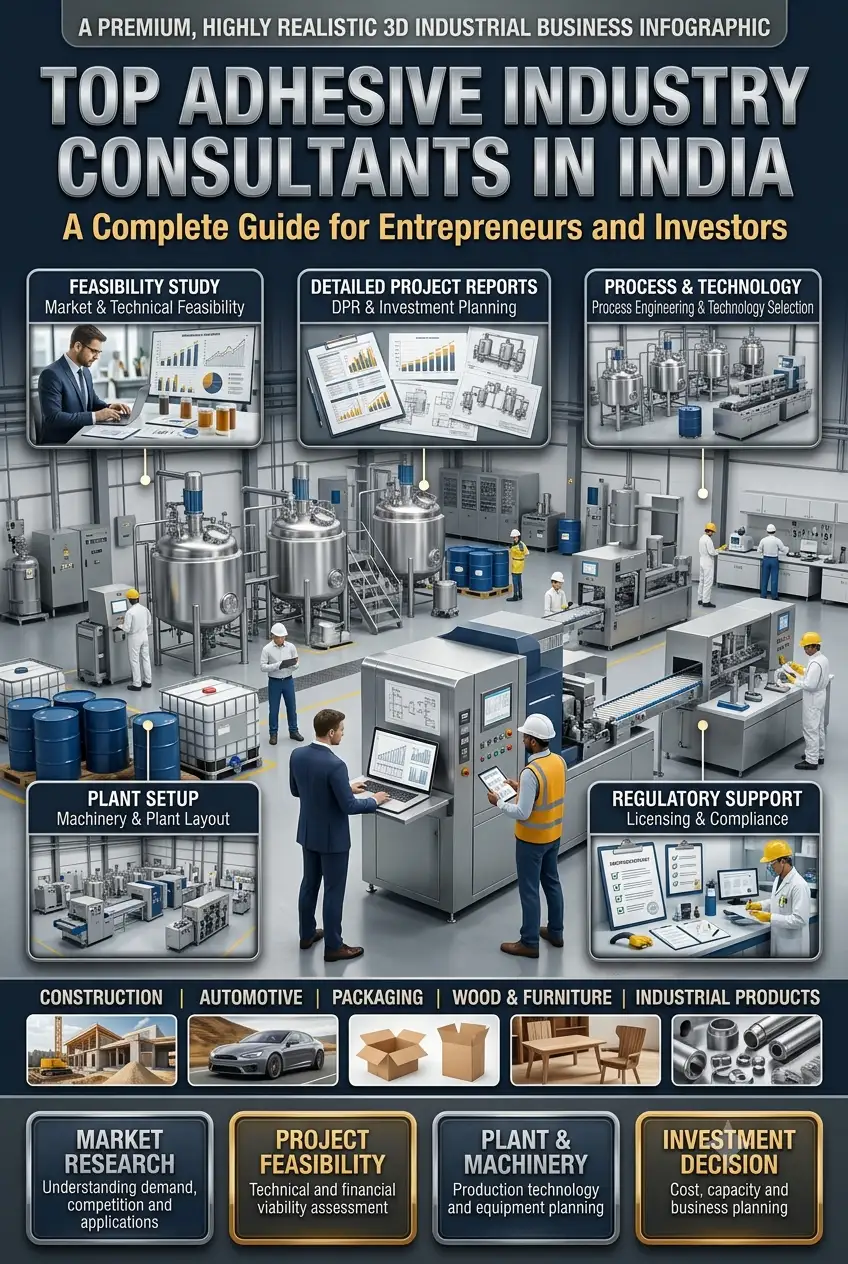
In reality, there are many services available to adhesive industry consultants. Detailed Project Report (DPR) encompasses all details related to the project execution process: from the selection of manufacturing process, plant layout, sourcing of raw materials, specification of machinery, production capacity planning, comprehensive project financials, cost of project, working capital requirement, projected balance sheet, and break-even analysis.
Other than the DPR, the experienced consultants also offer the following services – techno-economic feasibility studies, Market studies – demand-supply analysis, EPC (Engineering, Procurement and Construction) support, process engineering & plant design, and regulatory compliance advisory. This compliance layer holds significant value in the chemical industry in India. A seasoned consultant is adept in devising strategies for dealing with the quality certification from the Bureau of Indian Standards (BIS), the environmental regulations and the Factories Act (Gujarati and Marwari) consents from the State Pollution Control Board (SPCB) and the requirement for GST registration and others, which is managed systematically by the manufacturers.
In addition, many investors will need a bankable DPR to seek financial institutions like nationalised banks, NBFCs or government schemes like the MSME Ministry. An industry expert for adhesives makes sure that the project report is in accordance with the documentation standard that these lenders require.
Why India Is a High-Potential Market for Adhesive Manufacturing
The Indian adhesives and sealants industry has always showcased its strength and a gradual upward trend. IMARC Group’s industry research indicates that the Indian adhesives and sealants market will witness a compound annual growth rate (CAGR) of ~5.95% during 2023–2033, reaching USD 4.31 billion by 2033. Mordor Intelligence projects the market to expand from USD 3.46 billion to more than USD 5 billion by 2031 with a CAGR of 6.52%. These are structural demand numbers, not cyclical numbers.
India is emerging as a strong market for the investment in adhesive manufacturing, owing to several strong reasons.
Infrastructure and Construction Boom
The construction scene has significantly improved in India with the launch of various government initiatives like Housing for All, Smart Cities Mission and the National Infrastructure Pipeline. Direct beneficiaries are construction adhesives – PVA variants of Fevicol used in woodworking, flooring, tile bonding and lamination. The India Brand Equity Foundation (IBEF) states that the construction industry in India is one of the fastest-growing in the world and has continued to be a market with an ever-growing demand for bonding and sealing materials.
Make in India and PLI Incentives
Government of India’s Make in India initiative and the Production Linked Incentive (PLI) scheme pertaining to specialty chemicals are promoting the local manufacturing in chemical sub-sectors. The Department of Chemicals and Petrochemicals, under the Ministry of Chemicals and Fertilizers, regulates adhesive and chemical policy, which has a clear framework and promotes manufacturing at MSME level with delicensed production, streamlining approvals, and FDI-friendly policies. Besides, Invest India points out that 100% FDI has been allowed under automatic route for most chemical manufacturing, further establishing India’s investment appeal.
Domestic Demand and Import Substitution
Japan, Germany and the United States are the major sources for India to import vinyl acetate monomer (VAM) for adhesive formulation. But, with rising domestic manufacturing capacity and the thrust for import substitution by the government, organised Indian manufacturers are filling the commercial void with quality products. The early entrepreneur who brings a sound unit based on a solid DPR is well poised to claim a large piece of the market share.
Packaging, Furniture, and Textile End-Use Growth
PVA based adhesives are used widely in book binding, paper bag making, envelopes, gummed tapes, foil lamination, plywood bonding and fabric bonding. These are each end-use segments that are growing separately. As the packaging sector expands, the expanding furniture and interior décor industry, and the organised textile sector’s growth, all combine to provide a multi channel demand base for the adhesive industry making it a diversified and resilient business proposition.

How to Evaluate the Best Adhesive Industry Consultants in India
The Indian consulting market is crowded with generalists who claim to cover every industrial sector. When it comes to a technically specific product like Fevicol-type adhesive, the selection criteria must be disciplined and thorough. Here is how a serious entrepreneur or project investor should evaluate consulting firms.
Domain expertise must come first. A consultant who has previously delivered feasibility studies and DPRs specifically for adhesive, resin, or polymer manufacturing units will understand the nuances of polyvinyl acetate polymerisation, reactor design, VAM handling protocols, and finished product quality testing. Generic manufacturing consultants with no chemistry exposure will often miss critical plant economics variables, leading to cost overruns in actual project execution.
Track record in DPR and feasibility deliverables is equally important. The DPR is the foundational document for any project — and its quality determines whether banks fund it, whether the plant is built to the right specifications, and whether the profitability projections are achievable. Ask consultants for sample DPRs and evaluate the depth of their financial modelling, process flow documentation, and market demand analysis.
Engineering and EPC capability matters considerably for larger-scale projects. Some consultants stop at report preparation and leave the client to manage plant procurement independently. However, the best adhesive plant consultants offer end-to-end support: machinery selection, vendor identification, plant layout design, utility planning (steam, cooling water, compressed air), and supervision of plant commissioning. This integrated approach reduces errors and shortens the time from report to production.
Regulatory knowledge is non-negotiable in India’s adhesive sector. Compliance with Bureau of Indian Standards (BIS) quality norms, consent to establish and consent to operate from State Pollution Control Boards, fire safety clearances, and adherence to the Factories Act all require someone who has navigated these processes before. A consultant with no regulatory exposure leaves the client vulnerable to costly delays and compliance lapses.
Finally, the strength of a consultant’s research infrastructure — their ability to conduct real-time market studies, track raw material pricing trends (particularly VAM costs), and benchmark competitor plant economics — is a meaningful differentiator. Outdated data in a DPR leads to flawed financial projections and poor investment decisions.
In the adhesive and synthetic resin segment specifically, NPCS has developed a deep institutional capability. Their consultancy work for adhesive projects covers the complete manufacturing process — from VAM procurement and polymerisation reactor design to emulsion preparation, viscosity adjustment, packaging, and quality control. Their DPR deliverables for adhesive units include detailed plant economics, production schedule planning, machinery and raw material lists, process flow diagrams, working capital requirements, projected balance sheets, and profitability ratios with break-even analysis.
NPCS has assisted a wide range of clients in the adhesive and synthetic resin space. M/s. P.N. Trading Co. of Yamanunagar, Haryana engaged NPCS for a Project Feasibility Report on Adhesive (Fevicol Type). M/s. Axi Lam Pvt. Ltd. of Sabarkantha, Gujarat commissioned a similar Project Feasibility Report on Adhesive (Fevicol Type) for industrial applications. M/s. ARCL Organics Ltd. of Kolkata, West Bengal relied on NPCS for a Techno-Economic Feasibility Report on Adhesive (Fevicol Type), covering process engineering, financial projections, and bank funding requirements. M/s. Ankita Farm of Sri Ganganagar, Rajasthan engaged NPCS for an Industrial Project Report on Adhesives (Fevicol Type). M/s. Shree Mahabir Corporation of Cuttack, Odisha worked with NPCS on a Techno-Economic Feasibility Report on Adhesive from Maize Starch. In the hot melt adhesive sub-segment, M/s. Neha Overseas of Mumbai engaged NPCS for both a Techno-Economic Project Report on Hot Melt Glue Stick and a separate Investment and Project Report on Hot Melt Adhesives. M/s. Sayaji Industries Limited of Ahmedabad commissioned a Techno-Economic Project Report on Hot Melt Adhesive for Corrugation Board. In the resin and emulsion space, M/s. Thermax Limited Chemical Division of Bharuch, Gujarat worked with NPCS on Detailed Feasibility Studies on both Acrylate Resins and Emulsions and Epoxy Resins. M/s. K.G. Ispat Pvt. Ltd. of Kolkata engaged NPCS for an Acrylic Resin (Emulsion Type) Project Investment Report. M/s. LGW Industries Limited of Kolkata commissioned a Detailed Feasibility Study on Water Based Acrylic Adhesive for BOPP Self Adhesive Tape. M/s. OSR Gum Products of Coimbatore, Tamil Nadu worked with NPCS on a Project Investment Report covering Lamination, Bottle Labelling Adhesives, and Wood Adhesives (Starch Based). M/s. S.M. Enterprises of Agra, Uttar Pradesh engaged NPCS for an Industrial Project Report on Neoprene Based Rubber Adhesive for Footwear, Polyurethane Based Adhesive, and Epoxy Two Part systems. M/s. Global Industries of Yamuna Nagar, Haryana commissioned a Tannin Based Wood Adhesives Project Investment Report. Internationally, M/s. TECHBOND of Malaysia engaged NPCS for both an Adhesives Formulary Industrial Project Report and a Techno-Economic Feasibility Report on Industrial Adhesives, and M/s. Zant Accessories Limited of Bangladesh commissioned a Bankable Project Report on Adhesives.
Entrepreneurs looking to explore project profiles and investment opportunities in the adhesive sector can access NPCS’s adhesive and sealant project profiles catalogue on niir.org, which covers Fevicol type adhesive, hot melt adhesives, rubber-based adhesive, acrylic adhesives, sodium silicate adhesive, guar gum, and a wide range of sealant and binder products — making it a comprehensive resource for sector-wide investment planning.
NPCS is staffed by engineers, process specialists, financial analysts, and market research professionals with sector-specific experience. This multidisciplinary composition ensures that a DPR prepared by NPCS reflects both technical rigour and commercial intelligence — a combination that standalone technical consultants or standalone financial advisors typically cannot offer.
NPCS has published a comprehensive printed reference book on adhesives, glues, and resin technology, covering PVA adhesive manufacturing, formulation chemistry, plant and machinery details, and market analysis in depth — the printed book: The Complete Book on Adhesives, Glues & Resins Technology (with Process & Formulations) 2nd Revised Edition.
For a detailed techno-economic Project Report on setting up a Fevicol-type adhesive manufacturing business — including plant economics, machinery lists, raw material sourcing, financial projections, and applicable government incentives — the NPCS Project Report: Adhesive (Fevicol Type) Manufacturing Plant — Detailed Project Report, Profile, Business Plan, Industry Trends, Market Research, Survey, Manufacturing Process, Machinery, Raw Materials, Feasibility Study, Investment Opportunities, Cost and Revenue.
Best Adhesive Industry Consultants in Delhi and Across India
Delhi and the National Capital Region (NCR) constitute the most concentrated hub for industrial consulting firms in India. The city’s proximity to MSME clusters in Haryana, Uttar Pradesh, and Rajasthan — all active regions for chemical and adhesive manufacturing — makes Delhi a natural base for adhesive plant consultants serving pan-India clients.
Delhi-based consulting firms also benefit from direct access to government bodies including the DPIIT, Ministry of Chemicals and Fertilizers, and the Bureau of Indian Standards (BIS), which maintains product quality standards relevant to adhesive manufacturing. This proximity facilitates faster regulatory clearances and better access to policy intelligence.
Beyond Delhi, the broader India consultancy landscape for adhesive projects includes firms operating from Mumbai (serving Maharashtra’s chemicals belt), Ahmedabad (with access to Gujarat’s PCPIR zones), and Hyderabad (for South India’s growing furniture and construction markets). Process plant consultants and process engineering consultants in these cities increasingly serve adhesive manufacturers looking to establish capacity near raw material suppliers or end-use markets.
Industry bodies such as the Indian Paint & Coating Association (IPCA) — which represents paint, resin, and coating manufacturers including adhesive producers — provide a useful ecosystem for networking, regulatory updates, and supplier identification. Entrepreneurs setting up adhesive units are well advised to engage with such associations alongside their consulting firm for market intelligence and industry positioning.
Boutique management consulting firms in India that specialise in chemical sector DPRs and EPC consultancy often work alongside NPCS-prepared project reports as validation inputs. Bankers, chartered accountants, and EPC contractors frequently reference NPCS DPRs when evaluating adhesive project financials for term loan appraisals.
Consulting Service Types for Adhesive Projects: A Comparison
| Service Type | Key Deliverables | Best Suited For | Typical Timeline |
| Techno-Economic Feasibility Study | Process assessment, market demand analysis, cost estimation, ROI projection | Pre-investment decision-making; bank appraisal | 3–5 weeks |
| Detailed Project Report (DPR) | Full plant economics, machinery list, raw material sourcing, financial projections, break-even | Term loan applications; MSME scheme funding; investor presentations | 4–8 weeks |
| Process Engineering Consultancy | Reactor design, polymerisation process selection, utility planning, plant layout | Medium-to-large capacity adhesive plants requiring custom engineering | 6–12 weeks |
| EPC Consultancy (Engineering, Procurement, Construction) | End-to-end project delivery: design, vendor selection, procurement, commissioning supervision | Investors requiring turnkey project support with minimal in-house technical team | 3–12 months |
| Market Research Report | Demand-supply analysis, competitive landscape, pricing trends, export potential | Diversification planning; capacity expansion decisions | 2–4 weeks |
| Regulatory Compliance Advisory | BIS standards guidance, SPCB consent process, Factory Act compliance, GST setup | First-generation entrepreneurs unfamiliar with India’s chemical sector regulations | Ongoing / project-specific |

Conclusion: Taking the First Step in the Right Direction
India’s adhesive industry offers a compelling combination of stable domestic demand, multiple end-use sector growth drivers, a supportive government policy environment, and clear export potential. However, the path from investment intention to a profitable, compliant manufacturing unit requires careful planning — and that begins with choosing the right adhesive industry consultant.
Entrepreneurs and investors should prioritise consultants with demonstrated sector expertise, a proven track record in DPR and feasibility report preparation, and the technical depth to support plant design and regulatory compliance. Generic consulting firms rarely meet this bar. Firms like NPCS — with 30+ years of chemical sector experience, a vast library of published project reports, and a multidisciplinary team — represent the kind of consultancy partner that turns an investment idea into a well-executed, bankable project.
Whether you are a first-generation entrepreneur exploring the adhesive business for the first time, an NRI investor evaluating Indian manufacturing, or an existing chemical unit looking to diversify into the adhesive space, the right consultancy partnership will define the quality and speed of your success.
Your Investment Deserves the Right Opportunity
Every serious investment begins with choosing the right sector and the right business model. With hundreds of industrial opportunities available across India’s manufacturing and clean-energy landscape, making the most informed choice is critical. NIIR’s Startup Selector tool helps entrepreneurs, MSMEs, and investors identify the most suitable business opportunities based on their investment capacity, location, and interests — so your capital is directed toward a venture with the strongest fit and potential.